Miraval opened its new Life in Balance Spa with Clarins in 2012, marking the launch of a successful partnership between the two brands. Liz Terry talks to Michael Tompkins, CEO of Miraval and Clarins’ Ghislain Waeyaert about how the first year panned out
By Liz Terry | Published in Spa Business 2013 issue 4
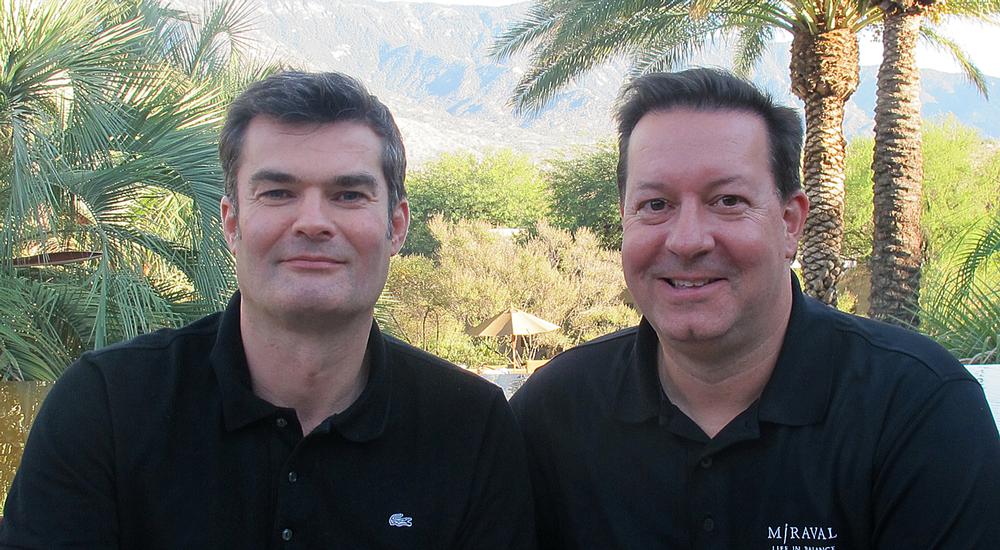
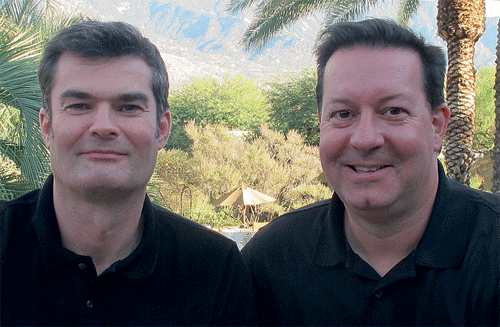
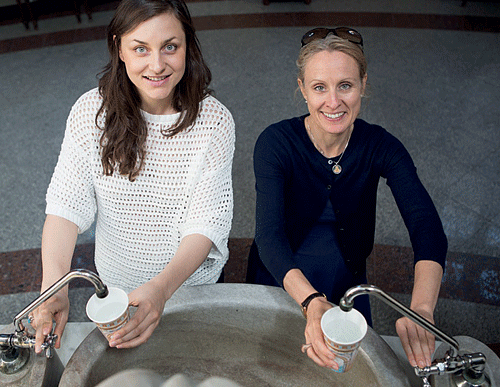
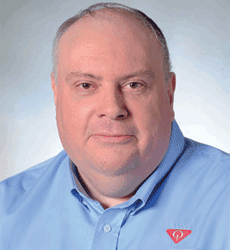
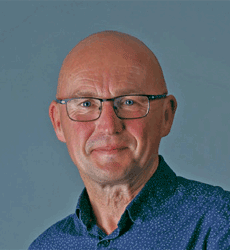
Clarins’ Ghislain Waeyaert (left) with Miraval CEO Michael Tompkins (right)
A year ago, when I sat down to talk to Michael Tompkins he and his board were promoting their new Life in Balance Spa with Clarins and announcing plans to roll Miraval out in up to six new locations, making it one of – if not the – biggest rollout of a destination spa brand ever in the US.
At the time, Philippe Bourguignon, chair of Miraval, said he believed one of the most exciting opportunities in the spa industry was to develop spas for the proximity market, commenting: “We we think we can get half our clientele from within a two hour drive.”
Now, a year later, these plans have moved on apace, with a dream deal signed for the development of a second Miraval to open at Natirar just an hour from New York City in 2015 and the likely announcement of a third US site in spring 2014. The company is also planning international expansion as a result of growing awareness of the brand.
With all this high level activity underway, Tompkins – who has just taken the chair of ISPA – is in great spirits. “I’ve been assigned by my board to find five locations for new Miravals in the US,” he says. “At the same time, we’re continuing to evaluate a number of different projects outside this country: we’d love to have a Miraval in Europe, for example and are working on this now.”
Tompkins attributes the growing international awareness of the Miraval brand to Clarins’ hard work on the PR front and the skincare brand has been leveraging its international press contacts to raise the profile of the Tucson-based resort: “Miraval wasn’t known outside the US,” says Tompkins, “but we now have a growing profile and the proportion of visitors from overseas – although still small – is increasing. We were just nominated for a World Spa Award in Spain – something which would never have happened before we joined forces with Clarins.”
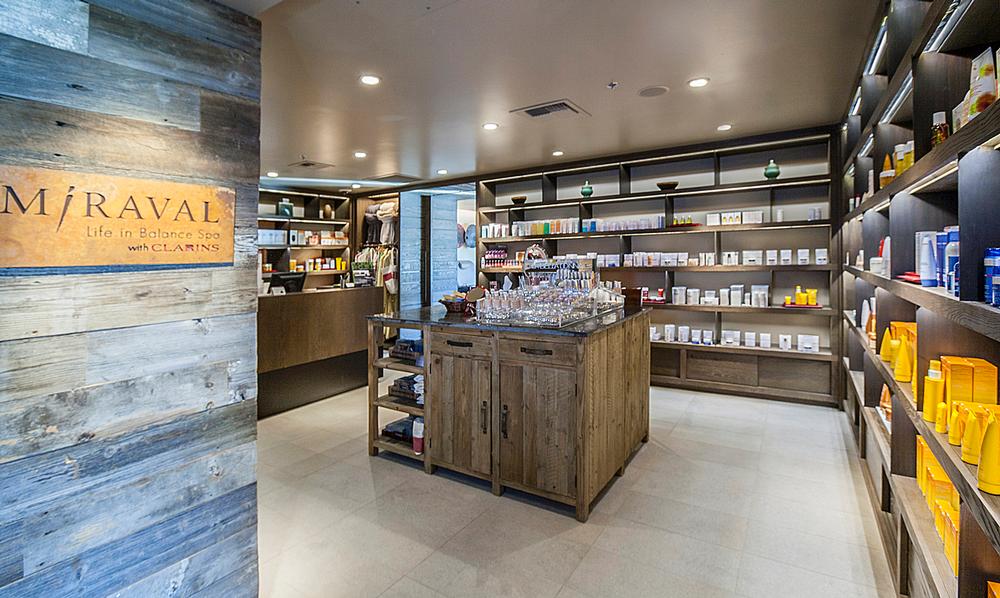
Trading & profitability The tie-up has obviously worked well for both parties and has matured into a strong working relationship. Tompkins is complementary about the role Clarins has played in the success of the spa: “When I tell you our retailing is up 54 per cent year on year, you’ll see how well it’s working,” he says. “Miraval’s trading is up 10 per cent year on year and the spa is up 30 per cent. I attribute this growth to the innovative services we’ve created and 70 per cent of those have been developed with Clarins products.”
I ask Tompkins why some spas seem reluctant to take on retail brands alongside spa brands and he gives a robust reply: “When I came into the spa market, I was told spas had to use only niche brands because they were more exclusive and because customers wouldn’t be able to find the products in stores near home, so they’d call back to buy more. That’s what I was trained to believe.
“But in fact, we’ve found the exact opposite,” he says. “Because our guests know and trust Clarins, they come out of their treatment and they purchase the product. And frankly, I don’t care where they buy it after they leave here, because the truth is that when we had exclusive brands, people never called back to buy again anyway, in spite of our efforts with telesales.”
So where does this perception come from? Tompkins says it’s a myth perpetuated by competitors: “A lot of the other skincare vendors haven’t gone down the retail route,” he says, “so exclusivity is their pitch, and the industry listens. When I first started in spa, I assumed all this information we were hearing from suppliers was the truth – the unfortunate thing is it isn’t the truth. The best decision we ever made here at Miraval was going with the Clarins line. It’s been a benefit beyond retail sales because of the comfort our guests feel in the brand.”
Strategic alliance Ghislain Waeyaert, director of Clarins’ spa activities, says the tie up is wholehearted and supported from the highest level: “From the beginning it’s been a partnership based on respect and strong relationships, which is the way Clarins treats everyone, from employees to suppliers and customers to partners,” he says. “Clarins is still a privately owned business and our CEO, Christian Courtin-Clarins, has visited Miraval on a number of occasions to talk to the team and explain his vision – you don’t get many CEOs of US$1.6bn turnover companies doing that.”
“Miraval is one of the top destination spas in the US,” says Waeyaert. “It was important to us in the rollout of Clarins as a global spa brand to be able to prove that our professional and retail product lines work within a high-end spa operation such as this.”
Staff buy-in Tompkins believes the buy-in of the Miraval staff has been an essential part of the success of the Clarins launch. The products were blind tested by therapists who were offered the choice of three professional lines. Once the decision was made, literally every member of the resort’s staff was trained by Clarins. Tompkins says he’s read guest feedback forms which say ‘I was talking with one of your landscapers and they mentioned I should try a Clarins facial’. “It cost a lot of money in labour to train the entire team,” he says, “but it was worth it because we got everyone’s buy-in.
So plans are on track at Miraval: “We routinely win 10-15 awards a year,” says Tompkins. “The year we relaunched the spa we won 21 and this year we’d won 35 by October, including Best US Spa in the SpaFinder Crystal Awards.”
Read more from this issue of Attractions Management magazine
View contents of Attractions Management 2013 issue 4
Interview: Helene Goetzelmann
L'Occitane's international spa director tells Rhianon Howells how the consumer retail company has become a spa operator with 60 facilities
Ask an expert: Profit & Loss
Hotel spas need to fight capital expenditure allocation said an investor panel at this year's Global Spa & Wellness Summit
Research: All rise
There's been an increase in the five top key performance indicators in the US spa industry shows the 2013 ISPA study
Company Profile Promotion: ESPA promotion
As ESPA's 20th
anniversary year draws
to a close, founder and
CEO Sue Harmsworth
explains how and why the
company is still evolving
Safari Spa: Animal instinct
Safari spas are the staple for Amani, one of South Africa's largest spa chains. Lisa Starr talks to MD Ronleigh Gordon
Trends: Brief encounters
We take a look at some of the most innovative spa pop-ups, a growing trend across the leisure sector
Interview: Paul Smyth
Something & Son designer shares his insights on creating pop-up spa facilities. Magali Robathan reports
Summit review: Upping the ante
Katie Barnes reveals the takeaway messages from the 2013 Global Spa & Wellness Summit in New Delhi, India, attended by 375 industry leaders
Research: Local news
Domestic travellers dominate the global wellness tourism market which has an economic impact of US$1.3 trillion. SRI's Ophelia Yeung reports
Research: Thai up
Prantik Bordoloi analyses a 2013 Thai spa industry study based on both spa consumer and spa operator opinions
Software news: Tech talk
The latest developments and news from spa software suppliers from around the world
An opportunity to reimagine one of the UK’s most recognisable towers has been formally
opened by Rivington Hark, as St Johns Beacon invites operators and partners to shape its
next phase. [more...]
Miraval opened its new Life in Balance Spa with Clarins in 2012, marking the launch of a successful partnership between the two brands. Liz Terry talks to Michael Tompkins, CEO of Miraval and Clarins’ Ghislain Waeyaert about how the first year panned out
By Liz Terry | Published in Spa Business 2013 issue 4
Clarins’ Ghislain Waeyaert (left) with Miraval CEO Michael Tompkins (right)
A year ago, when I sat down to talk to Michael Tompkins he and his board were promoting their new Life in Balance Spa with Clarins and announcing plans to roll Miraval out in up to six new locations, making it one of – if not the – biggest rollout of a destination spa brand ever in the US.
At the time, Philippe Bourguignon, chair of Miraval, said he believed one of the most exciting opportunities in the spa industry was to develop spas for the proximity market, commenting: “We we think we can get half our clientele from within a two hour drive.”
Now, a year later, these plans have moved on apace, with a dream deal signed for the development of a second Miraval to open at Natirar just an hour from New York City in 2015 and the likely announcement of a third US site in spring 2014. The company is also planning international expansion as a result of growing awareness of the brand.
With all this high level activity underway, Tompkins – who has just taken the chair of ISPA – is in great spirits. “I’ve been assigned by my board to find five locations for new Miravals in the US,” he says. “At the same time, we’re continuing to evaluate a number of different projects outside this country: we’d love to have a Miraval in Europe, for example and are working on this now.”
Tompkins attributes the growing international awareness of the Miraval brand to Clarins’ hard work on the PR front and the skincare brand has been leveraging its international press contacts to raise the profile of the Tucson-based resort: “Miraval wasn’t known outside the US,” says Tompkins, “but we now have a growing profile and the proportion of visitors from overseas – although still small – is increasing. We were just nominated for a World Spa Award in Spain – something which would never have happened before we joined forces with Clarins.”
Trading & profitability The tie-up has obviously worked well for both parties and has matured into a strong working relationship. Tompkins is complementary about the role Clarins has played in the success of the spa: “When I tell you our retailing is up 54 per cent year on year, you’ll see how well it’s working,” he says. “Miraval’s trading is up 10 per cent year on year and the spa is up 30 per cent. I attribute this growth to the innovative services we’ve created and 70 per cent of those have been developed with Clarins products.”
I ask Tompkins why some spas seem reluctant to take on retail brands alongside spa brands and he gives a robust reply: “When I came into the spa market, I was told spas had to use only niche brands because they were more exclusive and because customers wouldn’t be able to find the products in stores near home, so they’d call back to buy more. That’s what I was trained to believe.
“But in fact, we’ve found the exact opposite,” he says. “Because our guests know and trust Clarins, they come out of their treatment and they purchase the product. And frankly, I don’t care where they buy it after they leave here, because the truth is that when we had exclusive brands, people never called back to buy again anyway, in spite of our efforts with telesales.”
So where does this perception come from? Tompkins says it’s a myth perpetuated by competitors: “A lot of the other skincare vendors haven’t gone down the retail route,” he says, “so exclusivity is their pitch, and the industry listens. When I first started in spa, I assumed all this information we were hearing from suppliers was the truth – the unfortunate thing is it isn’t the truth. The best decision we ever made here at Miraval was going with the Clarins line. It’s been a benefit beyond retail sales because of the comfort our guests feel in the brand.”
Strategic alliance Ghislain Waeyaert, director of Clarins’ spa activities, says the tie up is wholehearted and supported from the highest level: “From the beginning it’s been a partnership based on respect and strong relationships, which is the way Clarins treats everyone, from employees to suppliers and customers to partners,” he says. “Clarins is still a privately owned business and our CEO, Christian Courtin-Clarins, has visited Miraval on a number of occasions to talk to the team and explain his vision – you don’t get many CEOs of US$1.6bn turnover companies doing that.”
“Miraval is one of the top destination spas in the US,” says Waeyaert. “It was important to us in the rollout of Clarins as a global spa brand to be able to prove that our professional and retail product lines work within a high-end spa operation such as this.”
Staff buy-in Tompkins believes the buy-in of the Miraval staff has been an essential part of the success of the Clarins launch. The products were blind tested by therapists who were offered the choice of three professional lines. Once the decision was made, literally every member of the resort’s staff was trained by Clarins. Tompkins says he’s read guest feedback forms which say ‘I was talking with one of your landscapers and they mentioned I should try a Clarins facial’. “It cost a lot of money in labour to train the entire team,” he says, “but it was worth it because we got everyone’s buy-in.
So plans are on track at Miraval: “We routinely win 10-15 awards a year,” says Tompkins. “The year we relaunched the spa we won 21 and this year we’d won 35 by October, including Best US Spa in the SpaFinder Crystal Awards.”
Read more from this issue of Attractions Management magazine
View contents of Attractions Management 2013 issue 4
Interview: Helene Goetzelmann
L'Occitane's international spa director tells Rhianon Howells how the consumer retail company has become a spa operator with 60 facilities
Ask an expert: Profit & Loss
Hotel spas need to fight capital expenditure allocation said an investor panel at this year's Global Spa & Wellness Summit
Research: All rise
There's been an increase in the five top key performance indicators in the US spa industry shows the 2013 ISPA study
Company Profile Promotion: ESPA promotion
As ESPA's 20th
anniversary year draws
to a close, founder and
CEO Sue Harmsworth
explains how and why the
company is still evolving
Safari Spa: Animal instinct
Safari spas are the staple for Amani, one of South Africa's largest spa chains. Lisa Starr talks to MD Ronleigh Gordon
Trends: Brief encounters
We take a look at some of the most innovative spa pop-ups, a growing trend across the leisure sector
Interview: Paul Smyth
Something & Son designer shares his insights on creating pop-up spa facilities. Magali Robathan reports
Summit review: Upping the ante
Katie Barnes reveals the takeaway messages from the 2013 Global Spa & Wellness Summit in New Delhi, India, attended by 375 industry leaders
Research: Local news
Domestic travellers dominate the global wellness tourism market which has an economic impact of US$1.3 trillion. SRI's Ophelia Yeung reports
Research: Thai up
Prantik Bordoloi analyses a 2013 Thai spa industry study based on both spa consumer and spa operator opinions
Software news: Tech talk
The latest developments and news from spa software suppliers from around the world
Hotel de France, located on the British Isle of Jersey, has created a wellness retreat package
that includes a hot yoga session that will take place in Jersey Zoo’s butterfly sanctuary.
A new immersive attraction designed to transport visitors into the final hours of ancient Pompeii
is preparing to open near the world-famous archaeological site in southern Italy.
Experience design company, BRC Imagination Arts, has completed a transition that sees founder
Bob Rogers pass ownership of the business to four long-serving senior executives, while
remaining actively involved with the company.
Movie Park Germany has opened a new Paramount Pictures-themed attraction as part of its 30th
anniversary celebrations, using immersive storytelling and adaptive reuse to reinforce the park’s
longstanding “Hollywood in Germany” positioning.
Therme Manchester’s 28-acre development, which will include interconnected glass pavilions
that measure 65,000sq m, will be the largest bathing and wellbeing attraction in the world once
complete, according to prof David Russell, CEO of Therme UK.
Efteling has opened Hooghmoed, a new family drop tower designed to broaden the appeal of its
recently launched Sirene Island themed area and introduce younger visitors to thrill attractions.
A proposed Puy du Fou development near Bicester and Universal Destinations and Experiences’
planned resort in Bedford are emerging as part of a wider transformation of the Oxford–
Cambridge Growth Corridor into a major centre for UK leisure and tourism inv
Shedd Aquarium has opened the Immersion Theater developed in partnership with SimEx-
Iwerks, as part of a wider strategy to enhance the guest experience and create additional
revenue opportunities.
The UK government has announced a temporary reduction in VAT on visitor attractions and
children’s meals as part of a summer cost-of-living support package designed to stimulate the
visitor economy and encourage family days out.
As designer Yinka Ilori prepares for his first solo gallery show in London, he speaks exclusively
to CLADmag about his mission to spread joy, the power of play, and his bold approach to using
colour (including the colours you won’t see in his work).
The government of Thailand is exploring plans for a THB300bn (£6.3bn, US$8.3bn)
entertainment complex in the country’s Eastern Economic Corridor (EEC), with officials
proposing a large-scale theme park and sports destination as part of a broader tourism and
economic development strategy.
+ More news
COMPANY PROFILES
QubicaAMF UK QubicaAMF is the largest and most
innovative bowling equipment provider with
600 employees worldwi [more...]
An opportunity to reimagine one of the UK’s most recognisable towers has been formally
opened by Rivington Hark, as St Johns Beacon invites operators and partners to shape its
next phase. [more...]