Both spa operator and consumer opinions have been canvassed for
the inaugural 2013 Spa Industry Research in Thailand. Research
co-ordinator Prantik Bordoloi reveals some interesting findings
By Prantik Bordoloi | Published in Spa Business 2013 issue 4
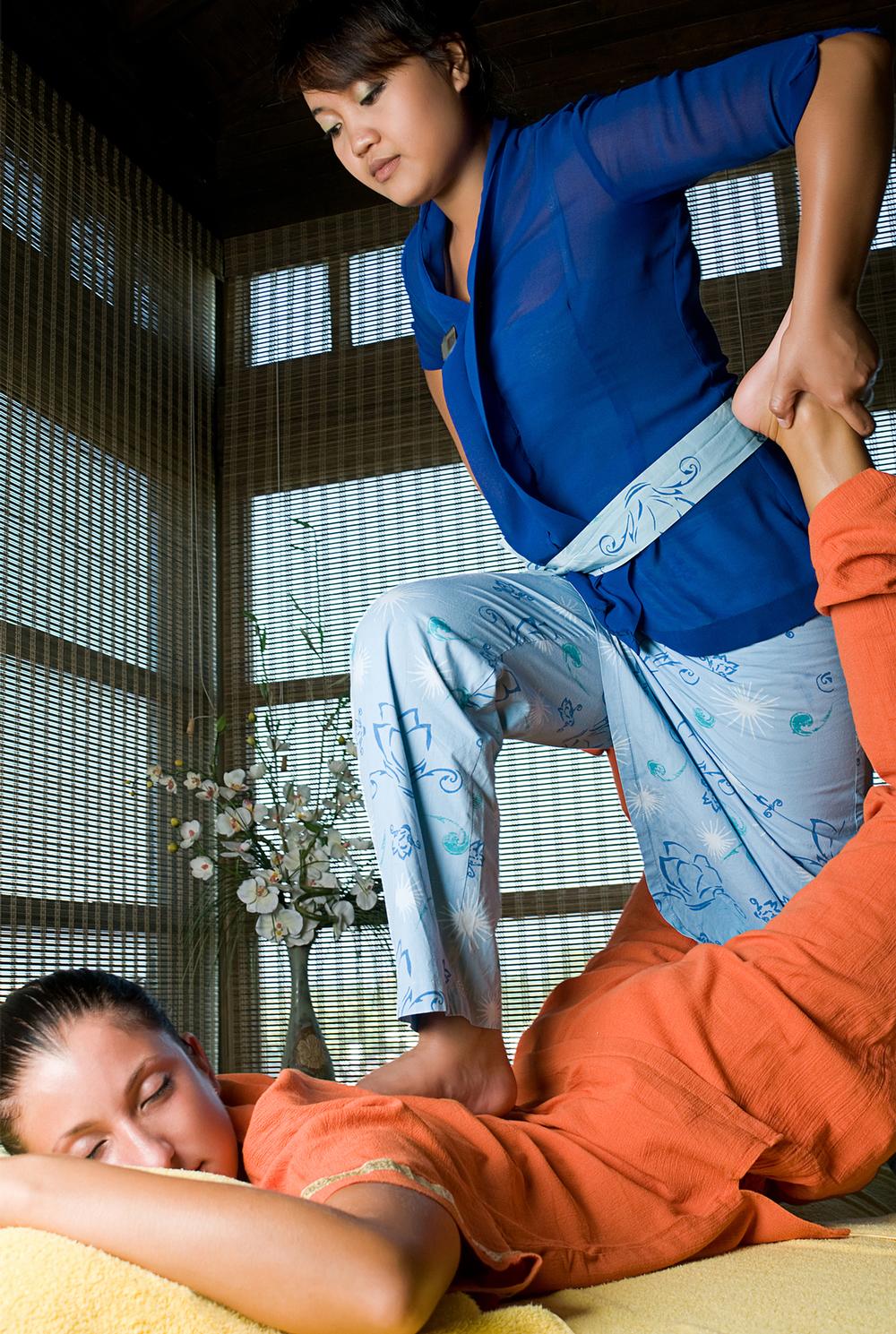
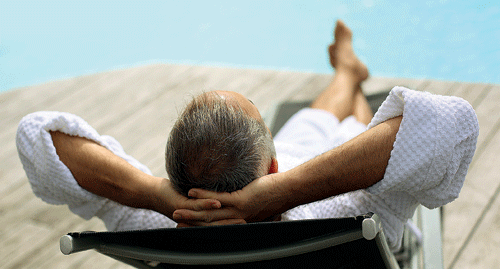
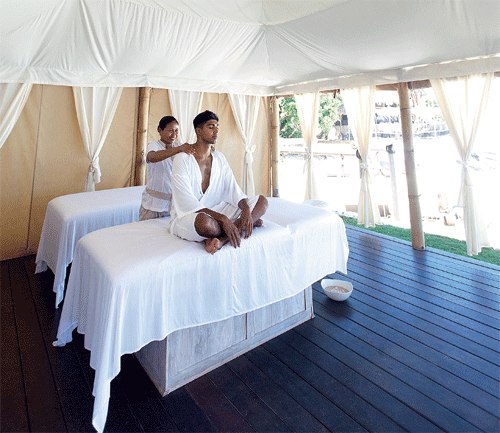
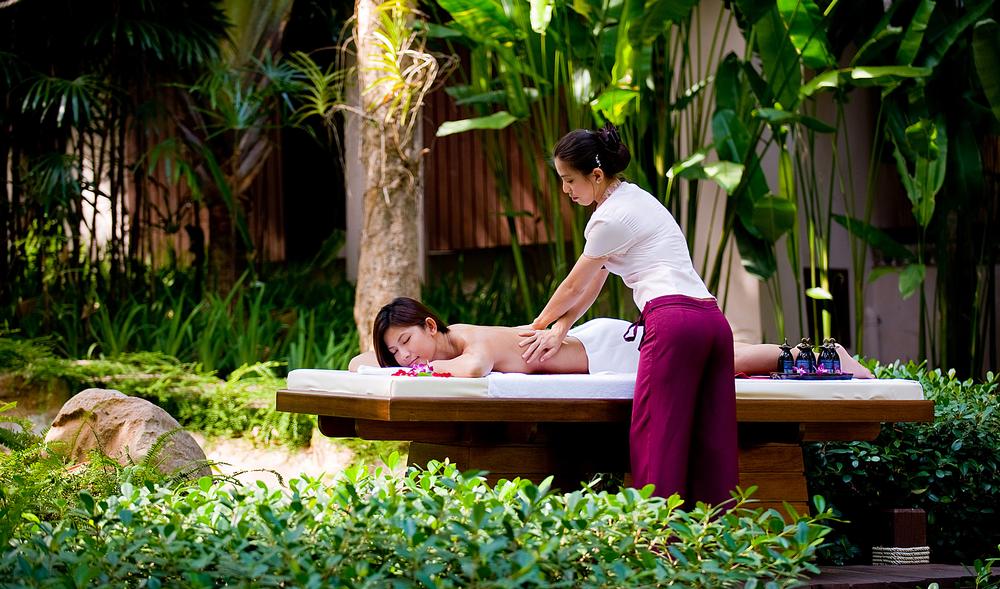
Thai massage was the top choice. Overall women prefer individualised treatments and men want more authentic therapies / shutterstock.com/Levent Konuk
Perceived developments among Thai spa customers, industry standards, trends in treatments and the impact of the pan-Asian unified market (AEC) due in 2015 were among the criteria analysed in Thailand’s 2013 Spa Industry Research which was revealed in September at the World Spa & Well-being Convention (WSWC).
Carried out by Stenden Rangsit University, in collaboration with the Thai Spa Association, the research profiled existing as well as potential spa consumers and explored the opinions of spa operators between April and September 2013 (see p90 for more details about the methodology used in the research).
Consumer trends Besides confirmations of expected behaviours, such as the fact that relaxation is stated by roughly 80 per cent as the main purpose of their spa visit, the research also revealed some unexpected results. The decision-making process of a spa consumer is, for example, much less influenced by advertisements and media. Almost every third spa-goer gets information about a spa via word-of-mouth, meaning that the recommendation by a friend is of very high importance when choosing a spa. Thus, trust plays an integral role for spa consumers. In addition, 23 per cent of respondents described the attitude of staff as the most important factor when visiting a spa, the third most important following the expected factors of hygiene, quality of treatments and atmosphere. Almost half of the potential spa consumers cited “not having enough time” as the primary reason for currently not visiting a spa.
The consensus among spa operators is that the number of male spa consumers has increased over the past few years, although there hasn’t been a significant change in the male/female ratio. Nonetheless, the spa industry expects more male customers in the near future, as male-specific products and treatments evolve. Currently, men mostly prefer massages – the top three favourites were Thai massage (56 per cent), aromatherapy massage (31 per cent) and foot massage (26 per cent) .
The research further revealed that individualised packages – programmes tailored to specific needs such as skin types, as well as authentic back-to-the-basics treatments/therapies – those which are perceived to be traditional without modern/new-age tinkering – will shape future demand in the industry. Authentic treatments/therapies are more important to men, as 50 per cent of all male respondents (compared to 23 per cent of females) stated back-to-basics as their primary future expectation in a spa.
Female spa consumers, on the other hand, prioritise individualised packages (33 per cent) and price discounts (28 per cent) when deciding on future spa visits. The discrepancy in price sensitivity between men and women is further underlined by a slightly higher average spending per treatment by male spa goers – categorical data collection shows men spend approximately THB1,372 (US$43, €33, £27); and women spend around THB1,000 (US$32, €24, £20).
In terms of spa products, female customers tend to try spa-owned products more often than male visitors who prefer well-known professional spa brands. The survey also shows that 80 per cent of female and 68 per cent of male spa consumers claim to prefer organic over non-organic products.
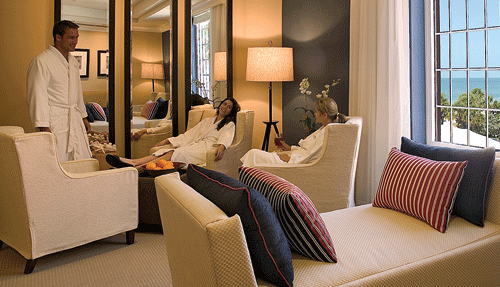
A third trend was confirmed when investigating consumers’ preference of joint visits to spas over visits alone. With 58 per cent of males and 63 per cent of females preferring to visit spas with an accompanying person, the trend to use the spa to socialise might influence future spa design and the time spent in the spa itself. One out of three female spa consumers in Thailand visit a spa, together with a friend, while, interestingly, more male consumers visit spas with their partners (22 per cent of men and 12 per cent of women).
On the menu In the opinion of spa operators, the quality and skills of therapists is getting as important as the treatment or the product itself. As such, they believe training has to focus on communication and behavioural skills, sales and especially on customer service.
Spa operators believe that spa menus are too extensive – although new treatments are added, previous offers are rarely omitted. The majority feel less is more and that menus should be fine-tuned, more streamlined, clearer to customers and changed regularly to highlight seasonal promotions.
Furthermore, operators report a continued merger between the medical and spa industries with the development of and demand for more medical spas. Treatments/therapies based on eastern and western healthcare philosophies are being offered side by side, as consumers take more responsibility for their overall wellness. Medical spas, however, present some unique challenges say operators. Unless proper training is provided, therapists will not have the right skills to perform medical treatments. In addition, medical spas also need to have a licence to be able to provide that training and offer the treatments.
Therapists and standards Research results show that the top three important characteristics of therapists for both current and potential spa consumers are pleasant behaviour, responding to individual needs and ability to explain therapies and treatments.
When comparing the two opinions, pleasant behaviour is more important to potential spa consumers, whereas responding to individual needs seems to be more important to current spa consumers. This illustrates the fact that experienced spa-goers put a lot of emphasis on individualised attention, while newcomers value a comforting atmosphere created by the therapist.
From a business standpoint, managers mostly focused on the attitude and experience of therapists. The general opinion was that skills to properly execute spa treatments and therapies can be trained, but a good attitude is something that is intrinsic and difficult to teach. Hence, the study revealed a strong emphasis on attitude-based hiring in the spa industry. Training on language/communication skills and behavioural skills were also of growing importance, the operators said.
As for the role of standards in the industry, most spa operators thought an official national standard for operating a spa would be beneficial to the industry’s image. They also believe that voluntary standards lead to higher credibility, but there wasn’t a dominant opinion on whether voluntary standards attract spa consumers.
AEC 2015 impact By 2015, countries in Southeast Asia will be transformed by an economic integration which will see the free movement of goods, services, investment, skilled labour and a freer flow of capital across the region. The development is being led by the ASEAN (the Association of Southeast Asian Nations) and is known as AEC (the ASEAN Economic Community) 2015.
Spa managers think that AEC 2015 will bring along some challenges – citing increased competition in the recruitment of skilled managers and experienced therapists, a rise in rivals, a higher need for differentiation and a greater need for language and communication skills as perceived obstacles.
That said, however, most are very positive about its impact. They feel it will bring about a range of benefits from increased investment and an improved standard of therapists to tougher spa standards and a wider diversity of treatments and differently skilled employees from other countries.
A full copy of 2013 Spa Industry Research is available from the Thai Spa Association. Details: www.thaispaasssociation.com
Read more from this issue of Attractions Management magazine
View contents of Attractions Management 2013 issue 4
Interview: Helene Goetzelmann
L'Occitane's international spa director tells Rhianon Howells how the consumer retail company has become a spa operator with 60 facilities
Ask an expert: Profit & Loss
Hotel spas need to fight capital expenditure allocation said an investor panel at this year's Global Spa & Wellness Summit
Research: All rise
There's been an increase in the five top key performance indicators in the US spa industry shows the 2013 ISPA study
Company Profile Promotion: ESPA promotion
As ESPA's 20th
anniversary year draws
to a close, founder and
CEO Sue Harmsworth
explains how and why the
company is still evolving
Safari Spa: Animal instinct
Safari spas are the staple for Amani, one of South Africa's largest spa chains. Lisa Starr talks to MD Ronleigh Gordon
Trends: Brief encounters
We take a look at some of the most innovative spa pop-ups, a growing trend across the leisure sector
Interview: Paul Smyth
Something & Son designer shares his insights on creating pop-up spa facilities. Magali Robathan reports
Summit review: Upping the ante
Katie Barnes reveals the takeaway messages from the 2013 Global Spa & Wellness Summit in New Delhi, India, attended by 375 industry leaders
Research: Local news
Domestic travellers dominate the global wellness tourism market which has an economic impact of US$1.3 trillion. SRI's Ophelia Yeung reports
Research: Thai up
Prantik Bordoloi analyses a 2013 Thai spa industry study based on both spa consumer and spa operator opinions
Software news: Tech talk
The latest developments and news from spa software suppliers from around the world
Spa consumer findings for Thailand’s 2013 Spa Industry Research report were based on a survey of 463 current and potential spa-goers of which 62 per cent were Thai nationals and 38 per cent were non-Thai nationals for international representation. Thirty-five per cent of respondents were men and 65 per cent were female. Criteria included consumer-using patterns, treatment and product trends and preferences and buying behaviour.
The second part of the research focused on operators and consisted of a focus group with 10 spa managers, 14 interviews with spa directors and experienced spa industry professionals, as well as an online survey with 86 respondents.
Stenden Rangsit University has offered a Spa & Health Management minor programme, with regular collaborations with the Thai Spa Association, for the past seven years. The research was an expansion of this collaboration. The university, which has a total of 11,000 students, has its main site in the Netherlands and other campuses in Thailand, Bali, Qatar and South Africa.
Prantik Bordoloi is a research and module co-ordinator at Stenden Rangsit University Email: [email protected] Twitter: @prantikbordoloi
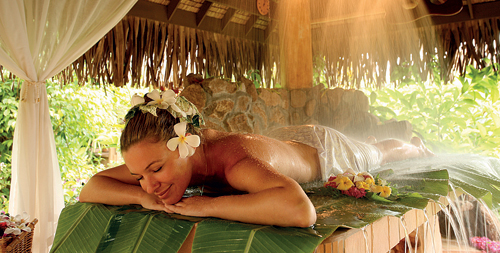
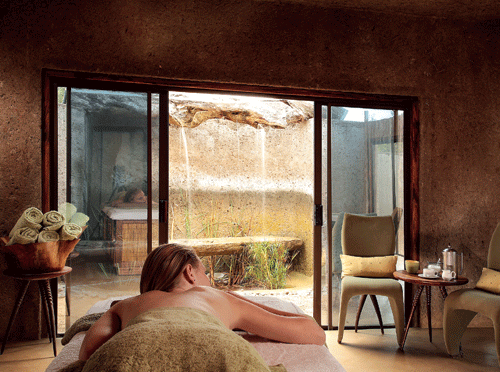
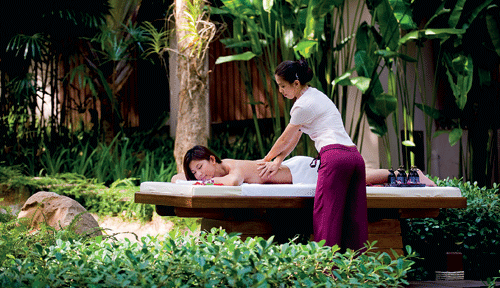
Women spend slightly less on average on spa treatments than men the research revealed / shutterstock.com/Phil Date
The research was supported by Sofitel So Bangkok along with other leading spa and hotel operators such as Chiva-Som and Hyatt
COMPANY PROFILES
IDEATTACK
IDEATTACK is a full-service planning and
design company with headquarters in
Los Angeles. [more...]
DJW
David & Lynn Willrich started the Company
over thirty years ago, from the Audio Visual
Department [more...]
QubicaAMF UK
QubicaAMF is the largest and most
innovative bowling equipment provider with
600 employees worldwi [more...]
Polin Waterparks
Polin was founded in Istanbul in 1976. Polin
has since grown into a leading company in
the waterpa [more...]
Both spa operator and consumer opinions have been canvassed for
the inaugural 2013 Spa Industry Research in Thailand. Research
co-ordinator Prantik Bordoloi reveals some interesting findings
By Prantik Bordoloi | Published in Spa Business 2013 issue 4
Thai massage was the top choice. Overall women prefer individualised treatments and men want more authentic therapies / shutterstock.com/Levent Konuk
Perceived developments among Thai spa customers, industry standards, trends in treatments and the impact of the pan-Asian unified market (AEC) due in 2015 were among the criteria analysed in Thailand’s 2013 Spa Industry Research which was revealed in September at the World Spa & Well-being Convention (WSWC).
Carried out by Stenden Rangsit University, in collaboration with the Thai Spa Association, the research profiled existing as well as potential spa consumers and explored the opinions of spa operators between April and September 2013 (see p90 for more details about the methodology used in the research).
Consumer trends Besides confirmations of expected behaviours, such as the fact that relaxation is stated by roughly 80 per cent as the main purpose of their spa visit, the research also revealed some unexpected results. The decision-making process of a spa consumer is, for example, much less influenced by advertisements and media. Almost every third spa-goer gets information about a spa via word-of-mouth, meaning that the recommendation by a friend is of very high importance when choosing a spa. Thus, trust plays an integral role for spa consumers. In addition, 23 per cent of respondents described the attitude of staff as the most important factor when visiting a spa, the third most important following the expected factors of hygiene, quality of treatments and atmosphere. Almost half of the potential spa consumers cited “not having enough time” as the primary reason for currently not visiting a spa.
The consensus among spa operators is that the number of male spa consumers has increased over the past few years, although there hasn’t been a significant change in the male/female ratio. Nonetheless, the spa industry expects more male customers in the near future, as male-specific products and treatments evolve. Currently, men mostly prefer massages – the top three favourites were Thai massage (56 per cent), aromatherapy massage (31 per cent) and foot massage (26 per cent) .
The research further revealed that individualised packages – programmes tailored to specific needs such as skin types, as well as authentic back-to-the-basics treatments/therapies – those which are perceived to be traditional without modern/new-age tinkering – will shape future demand in the industry. Authentic treatments/therapies are more important to men, as 50 per cent of all male respondents (compared to 23 per cent of females) stated back-to-basics as their primary future expectation in a spa.
Female spa consumers, on the other hand, prioritise individualised packages (33 per cent) and price discounts (28 per cent) when deciding on future spa visits. The discrepancy in price sensitivity between men and women is further underlined by a slightly higher average spending per treatment by male spa goers – categorical data collection shows men spend approximately THB1,372 (US$43, €33, £27); and women spend around THB1,000 (US$32, €24, £20).
In terms of spa products, female customers tend to try spa-owned products more often than male visitors who prefer well-known professional spa brands. The survey also shows that 80 per cent of female and 68 per cent of male spa consumers claim to prefer organic over non-organic products.
A third trend was confirmed when investigating consumers’ preference of joint visits to spas over visits alone. With 58 per cent of males and 63 per cent of females preferring to visit spas with an accompanying person, the trend to use the spa to socialise might influence future spa design and the time spent in the spa itself. One out of three female spa consumers in Thailand visit a spa, together with a friend, while, interestingly, more male consumers visit spas with their partners (22 per cent of men and 12 per cent of women).
On the menu In the opinion of spa operators, the quality and skills of therapists is getting as important as the treatment or the product itself. As such, they believe training has to focus on communication and behavioural skills, sales and especially on customer service.
Spa operators believe that spa menus are too extensive – although new treatments are added, previous offers are rarely omitted. The majority feel less is more and that menus should be fine-tuned, more streamlined, clearer to customers and changed regularly to highlight seasonal promotions.
Furthermore, operators report a continued merger between the medical and spa industries with the development of and demand for more medical spas. Treatments/therapies based on eastern and western healthcare philosophies are being offered side by side, as consumers take more responsibility for their overall wellness. Medical spas, however, present some unique challenges say operators. Unless proper training is provided, therapists will not have the right skills to perform medical treatments. In addition, medical spas also need to have a licence to be able to provide that training and offer the treatments.
Therapists and standards Research results show that the top three important characteristics of therapists for both current and potential spa consumers are pleasant behaviour, responding to individual needs and ability to explain therapies and treatments.
When comparing the two opinions, pleasant behaviour is more important to potential spa consumers, whereas responding to individual needs seems to be more important to current spa consumers. This illustrates the fact that experienced spa-goers put a lot of emphasis on individualised attention, while newcomers value a comforting atmosphere created by the therapist.
From a business standpoint, managers mostly focused on the attitude and experience of therapists. The general opinion was that skills to properly execute spa treatments and therapies can be trained, but a good attitude is something that is intrinsic and difficult to teach. Hence, the study revealed a strong emphasis on attitude-based hiring in the spa industry. Training on language/communication skills and behavioural skills were also of growing importance, the operators said.
As for the role of standards in the industry, most spa operators thought an official national standard for operating a spa would be beneficial to the industry’s image. They also believe that voluntary standards lead to higher credibility, but there wasn’t a dominant opinion on whether voluntary standards attract spa consumers.
AEC 2015 impact By 2015, countries in Southeast Asia will be transformed by an economic integration which will see the free movement of goods, services, investment, skilled labour and a freer flow of capital across the region. The development is being led by the ASEAN (the Association of Southeast Asian Nations) and is known as AEC (the ASEAN Economic Community) 2015.
Spa managers think that AEC 2015 will bring along some challenges – citing increased competition in the recruitment of skilled managers and experienced therapists, a rise in rivals, a higher need for differentiation and a greater need for language and communication skills as perceived obstacles.
That said, however, most are very positive about its impact. They feel it will bring about a range of benefits from increased investment and an improved standard of therapists to tougher spa standards and a wider diversity of treatments and differently skilled employees from other countries.
A full copy of 2013 Spa Industry Research is available from the Thai Spa Association. Details: www.thaispaasssociation.com
Read more from this issue of Attractions Management magazine
View contents of Attractions Management 2013 issue 4
Interview: Helene Goetzelmann
L'Occitane's international spa director tells Rhianon Howells how the consumer retail company has become a spa operator with 60 facilities
Ask an expert: Profit & Loss
Hotel spas need to fight capital expenditure allocation said an investor panel at this year's Global Spa & Wellness Summit
Research: All rise
There's been an increase in the five top key performance indicators in the US spa industry shows the 2013 ISPA study
Company Profile Promotion: ESPA promotion
As ESPA's 20th
anniversary year draws
to a close, founder and
CEO Sue Harmsworth
explains how and why the
company is still evolving
Safari Spa: Animal instinct
Safari spas are the staple for Amani, one of South Africa's largest spa chains. Lisa Starr talks to MD Ronleigh Gordon
Trends: Brief encounters
We take a look at some of the most innovative spa pop-ups, a growing trend across the leisure sector
Interview: Paul Smyth
Something & Son designer shares his insights on creating pop-up spa facilities. Magali Robathan reports
Summit review: Upping the ante
Katie Barnes reveals the takeaway messages from the 2013 Global Spa & Wellness Summit in New Delhi, India, attended by 375 industry leaders
Research: Local news
Domestic travellers dominate the global wellness tourism market which has an economic impact of US$1.3 trillion. SRI's Ophelia Yeung reports
Research: Thai up
Prantik Bordoloi analyses a 2013 Thai spa industry study based on both spa consumer and spa operator opinions
Software news: Tech talk
The latest developments and news from spa software suppliers from around the world
Spa consumer findings for Thailand’s 2013 Spa Industry Research report were based on a survey of 463 current and potential spa-goers of which 62 per cent were Thai nationals and 38 per cent were non-Thai nationals for international representation. Thirty-five per cent of respondents were men and 65 per cent were female. Criteria included consumer-using patterns, treatment and product trends and preferences and buying behaviour.
The second part of the research focused on operators and consisted of a focus group with 10 spa managers, 14 interviews with spa directors and experienced spa industry professionals, as well as an online survey with 86 respondents.
Stenden Rangsit University has offered a Spa & Health Management minor programme, with regular collaborations with the Thai Spa Association, for the past seven years. The research was an expansion of this collaboration. The university, which has a total of 11,000 students, has its main site in the Netherlands and other campuses in Thailand, Bali, Qatar and South Africa.
Prantik Bordoloi is a research and module co-ordinator at Stenden Rangsit University Email: [email protected] Twitter: @prantikbordoloi
Women spend slightly less on average on spa treatments than men the research revealed / shutterstock.com/Phil Date
The research was supported by Sofitel So Bangkok along with other leading spa and hotel operators such as Chiva-Som and Hyatt
Abu Dhabi-based investment firm Mubadala Capital has made a binding, fully financed
€1 billion
offer to acquire Pierre and Vacances SA, the European holiday resort operator behind the
continental European Center Parcs business.
Disney has reaffirmed its commitment to investing US$30 billion in its US parks and cruise
business by 2033, using new America250 celebrations to underline the role its attractions play
in supporting jobs, tourism and economic growth.
Expo 2030 Riyadh is being planned as a permanent visitor destination, with organisers
confirming the six-million-square-metre site will become a Global Village after the event closes.
The owner of one of Australia's best-known waterparks has acquired a major competitor,
creating a new attractions business spanning two of the country's largest visitor destinations.
The Toverland theme park in the Netherlands has announced a €98m expansion programme
that will add a resort, new attractions and staff facilities as it pursues plans to become a multi-
day destination.
Hotel de France, located on the British Isle of Jersey, has created a wellness retreat package
that includes a hot yoga session that will take place in Jersey Zoo’s butterfly sanctuary.
A new immersive attraction designed to transport visitors into the final hours of ancient Pompeii
is preparing to open near the world-famous archaeological site in southern Italy.
Experience design company, BRC Imagination Arts, has completed a transition that sees founder
Bob Rogers pass ownership of the business to four long-serving senior executives, while
remaining actively involved with the company.
Movie Park Germany has opened a new Paramount Pictures-themed attraction as part of its 30th
anniversary celebrations, using immersive storytelling and adaptive reuse to reinforce the park’s
longstanding “Hollywood in Germany” positioning.
Therme Manchester’s 28-acre development, which will include interconnected glass pavilions
that measure 65,000sq m, will be the largest bathing and wellbeing attraction in the world once
complete, according to prof David Russell, CEO of Therme UK.
+ More news
COMPANY PROFILES
IDEATTACK IDEATTACK is a full-service planning and
design company with headquarters in
Los Angeles. [more...]
DJW David & Lynn Willrich started the Company
over thirty years ago, from the Audio Visual
Department [more...]
QubicaAMF UK QubicaAMF is the largest and most
innovative bowling equipment provider with
600 employees worldwi [more...]
Polin Waterparks Polin was founded in Istanbul in 1976. Polin
has since grown into a leading company in
the waterpa [more...]