ISPA’s latest research shows that US spas have returned to pre-recession levels of growth in
all of the ‘big five’ key performance indicators. PwC’s Colin Mcllheney examines the findings
By Colin McIlheney | Published in Spa Business 2013 issue 4
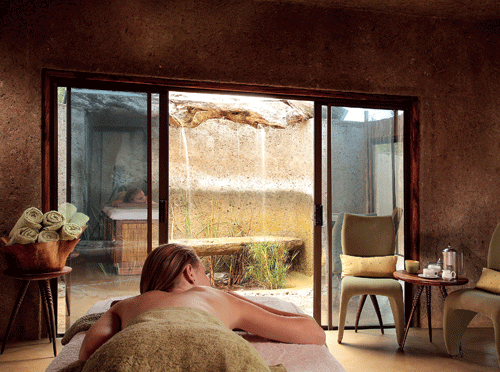
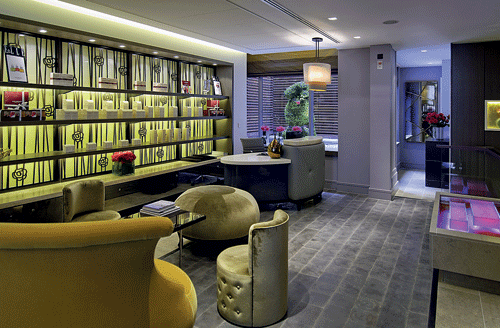
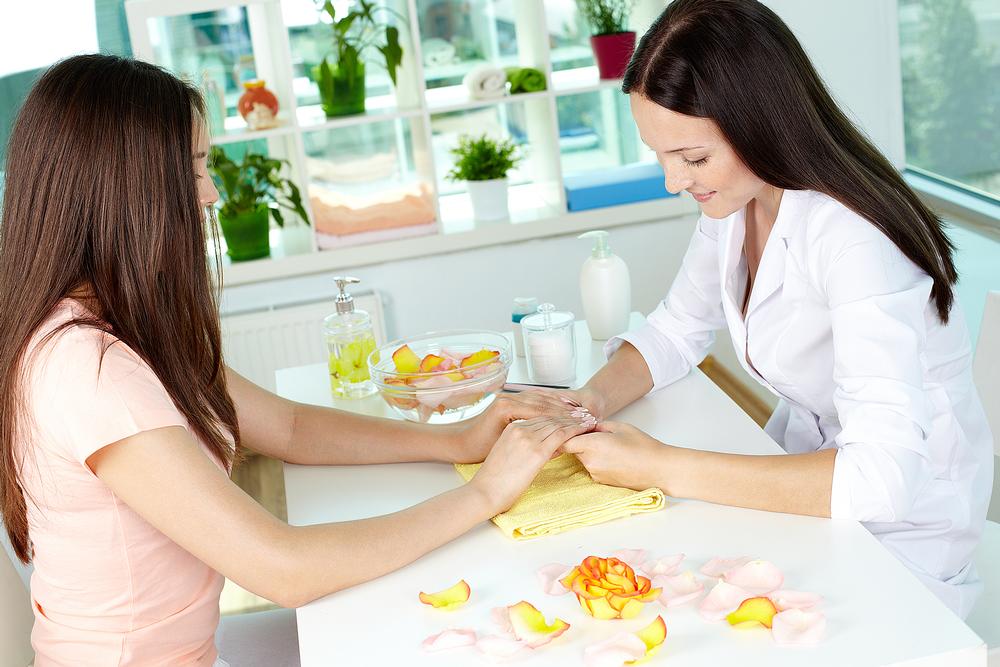
Retail lines have increased, with clothing and accessories and home goods selling well / shutterstock.com/Hasloo Group Production Studio
The US spa industry has had its strongest year since 2007, according to the International Spa Association (ISPA)’s 2013 US Spa Industry Study. The nationwide report clearly demonstrated that the five key statistics – visits, spending per visit, revenues, staffing levels and number of spas – have all grown. The findings were a continuation of the positive news from ISPA’s 2012 report (see SB12/4 p40), in parallel with the upturn of the US economy. The large-scale survey of 14,000 spa operators examined criteria such as financial performance, employment and growth in 2012, as well as ownership structures, number of visits and product and service offerings. Spas also gave an account of the six months from September 2012 to March 2013, across four key business indicators. The results corroborate the overall message of a return to growth which can be seen throughout the study.
Looking forward, spas were asked about their confidence for future prospects and about what uncertainties might lie ahead in the industry and the economy as a whole.
The big five In this year’s study, all five measures increased, which underscores the industry’s recovery. Total spa revenue is up 4.7 per cent, at US$14bn (€10.1bn, £8.7bn). Compared to the pre-recession peak of US$12.8bn (€9.3bn, £7.9bn), this 9.4 per cent increase highlights the extent of the recovery in revenue terms.
Revenue-per-visit figures show customers are spending US$87.20 (€63, £53) on average – an increase of 1.8 per cent on the year before and the first significant rise in four years.
The number of total spa locations continues to grow slowly: there are now 19,960 sites across the US – 0.5 per cent more than in 2011. This is positive news when set against the context of 2009-10 when spa closures outpaced new locations for two years. As of May 2013, total indoor floor space stood at an estimated 78 million sq ft, an increase of 1.1 per cent over May 2012.
A breakdown of spa-types show that day spas remain the industry’s mainstay, with 78.9 per cent of the total, followed by medical spas (8.8 per cent), resort/hotels (8.7 per cent) and club spas (2.9 per cent).
A promising trend in recent years has been the pace at which the total number of annual spa visits has increased each year. This continued, as total visits rose by 2.8 per cent, to 160 million.
Overall employment increased by 1.2 per cent – a percentage point more than last year – meaning that 343,500 people now work in the US spa industry. However, there was a marked shift from full-time employment (-7.2 per cent) to part-time employment (+13.2 per cent). This could be an indication of wider changes in American working practices or may reflect the spa industry’s commitment to maintaining a flexible workforce.
Adapting to create demand The ability of spas to raise prices and report increased profitability represents an increase in market demand, which is indicative of the bullish consumer sentiment witnessed across the economy. Strategically, spas continue to diversify their services in order to attract greater market share and to cater to a market that has become more price-aware over the past five years.
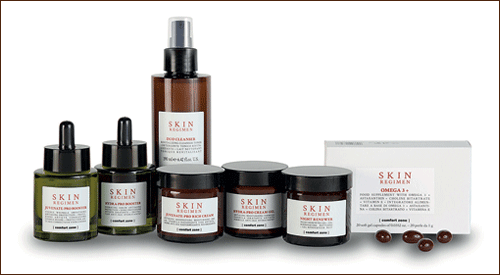
Retail products offer an example of this diversification; on average, spas offer 11 different retail lines. There was variability in this data, with resort/hotels leading the way overall (18 retail lines) and ‘other’ spas (including medical) specialising in such areas as skincare products, where they offer more than double the range presented by day spas or resort/hotel spas.
When asked to identify the most popular new product introduced in 2012, the variety on display was testament to the diversity spas have embraced in the wake of the recession. Traditional beauty products remain popular but have been bolstered with home goods, clothing and accessories and more specialised products such as homeopathy and ‘medical/therapeutic’ treatments.
Treatment offerings within spas have also continued to diversify; where 28 per cent of those surveyed in 2011 offered shorter treatment times (30 minutes or less), this number has now risen to 61 per cent. Around half of spas now also offer special discounts or promotions to their social media audience (51 per cent), as well as having loyalty programmes (47 per cent), spa party packages (47 per cent) and giving customers the option to book treatments online (45 per cent).
Reinforced confidence The positive news reported throughout the study is backed up by a survey of spas’ sentiments going forward; 78 per cent of spa operators said they anticipated an increase in revenues over the next six months. This was across the range of spa types and is the same figure as was reported in last year’s study, indicating an industry showing reinforced confidence.
Read more from this issue of Attractions Management magazine
View contents of Attractions Management 2013 issue 4
Interview: Helene Goetzelmann
L'Occitane's international spa director tells Rhianon Howells how the consumer retail company has become a spa operator with 60 facilities
Ask an expert: Profit & Loss
Hotel spas need to fight capital expenditure allocation said an investor panel at this year's Global Spa & Wellness Summit
Research: All rise
There's been an increase in the five top key performance indicators in the US spa industry shows the 2013 ISPA study
Company Profile Promotion: ESPA promotion
As ESPA's 20th
anniversary year draws
to a close, founder and
CEO Sue Harmsworth
explains how and why the
company is still evolving
Safari Spa: Animal instinct
Safari spas are the staple for Amani, one of South Africa's largest spa chains. Lisa Starr talks to MD Ronleigh Gordon
Trends: Brief encounters
We take a look at some of the most innovative spa pop-ups, a growing trend across the leisure sector
Interview: Paul Smyth
Something & Son designer shares his insights on creating pop-up spa facilities. Magali Robathan reports
Summit review: Upping the ante
Katie Barnes reveals the takeaway messages from the 2013 Global Spa & Wellness Summit in New Delhi, India, attended by 375 industry leaders
Research: Local news
Domestic travellers dominate the global wellness tourism market which has an economic impact of US$1.3 trillion. SRI's Ophelia Yeung reports
Research: Thai up
Prantik Bordoloi analyses a 2013 Thai spa industry study based on both spa consumer and spa operator opinions
Software news: Tech talk
The latest developments and news from spa software suppliers from around the world
ISPA represents spa providers in over 70 countries. Its role is to advance the industry via educational and networking opportunities, promoting spas and fostering professionalism and growth.
The organisation commissioned its first US study in 2000, followed by updates and shorter tracking studies in the following years.
This year’s full report, with technical appendix, is available at experienceispa.com. ISPA members may download a complimentary copy.
As well as his role at PwC, Colin McIlheney is ISPA’s research advisor Email: [email protected] Phone: +1 888 651 4772
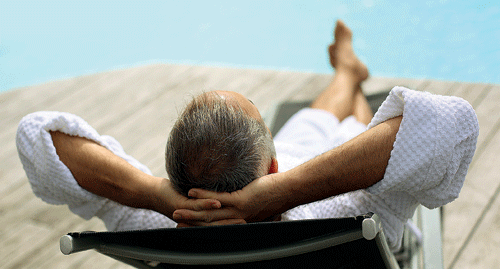
There’s been a marked shift from full-time employment (-7.2 per cent) to part-time employment (+13.2 per cent) / shutterstock.com/Pressmaster
COMPANY PROFILES
Taylor Made Designs
Founded in 1993, Taylor Made
Designs supply corporate clothing
and brand-enhancing merchandise
to [more...]
Simworx Ltd
The company was initially established
in 1997. Terry Monkton and Andrew
Roberts are the key stakeh [more...]
ISPA’s latest research shows that US spas have returned to pre-recession levels of growth in
all of the ‘big five’ key performance indicators. PwC’s Colin Mcllheney examines the findings
By Colin McIlheney | Published in Spa Business 2013 issue 4
Retail lines have increased, with clothing and accessories and home goods selling well / shutterstock.com/Hasloo Group Production Studio
The US spa industry has had its strongest year since 2007, according to the International Spa Association (ISPA)’s 2013 US Spa Industry Study. The nationwide report clearly demonstrated that the five key statistics – visits, spending per visit, revenues, staffing levels and number of spas – have all grown. The findings were a continuation of the positive news from ISPA’s 2012 report (see SB12/4 p40), in parallel with the upturn of the US economy. The large-scale survey of 14,000 spa operators examined criteria such as financial performance, employment and growth in 2012, as well as ownership structures, number of visits and product and service offerings. Spas also gave an account of the six months from September 2012 to March 2013, across four key business indicators. The results corroborate the overall message of a return to growth which can be seen throughout the study.
Looking forward, spas were asked about their confidence for future prospects and about what uncertainties might lie ahead in the industry and the economy as a whole.
The big five In this year’s study, all five measures increased, which underscores the industry’s recovery. Total spa revenue is up 4.7 per cent, at US$14bn (€10.1bn, £8.7bn). Compared to the pre-recession peak of US$12.8bn (€9.3bn, £7.9bn), this 9.4 per cent increase highlights the extent of the recovery in revenue terms.
Revenue-per-visit figures show customers are spending US$87.20 (€63, £53) on average – an increase of 1.8 per cent on the year before and the first significant rise in four years.
The number of total spa locations continues to grow slowly: there are now 19,960 sites across the US – 0.5 per cent more than in 2011. This is positive news when set against the context of 2009-10 when spa closures outpaced new locations for two years. As of May 2013, total indoor floor space stood at an estimated 78 million sq ft, an increase of 1.1 per cent over May 2012.
A breakdown of spa-types show that day spas remain the industry’s mainstay, with 78.9 per cent of the total, followed by medical spas (8.8 per cent), resort/hotels (8.7 per cent) and club spas (2.9 per cent).
A promising trend in recent years has been the pace at which the total number of annual spa visits has increased each year. This continued, as total visits rose by 2.8 per cent, to 160 million.
Overall employment increased by 1.2 per cent – a percentage point more than last year – meaning that 343,500 people now work in the US spa industry. However, there was a marked shift from full-time employment (-7.2 per cent) to part-time employment (+13.2 per cent). This could be an indication of wider changes in American working practices or may reflect the spa industry’s commitment to maintaining a flexible workforce.
Adapting to create demand The ability of spas to raise prices and report increased profitability represents an increase in market demand, which is indicative of the bullish consumer sentiment witnessed across the economy. Strategically, spas continue to diversify their services in order to attract greater market share and to cater to a market that has become more price-aware over the past five years.
Retail products offer an example of this diversification; on average, spas offer 11 different retail lines. There was variability in this data, with resort/hotels leading the way overall (18 retail lines) and ‘other’ spas (including medical) specialising in such areas as skincare products, where they offer more than double the range presented by day spas or resort/hotel spas.
When asked to identify the most popular new product introduced in 2012, the variety on display was testament to the diversity spas have embraced in the wake of the recession. Traditional beauty products remain popular but have been bolstered with home goods, clothing and accessories and more specialised products such as homeopathy and ‘medical/therapeutic’ treatments.
Treatment offerings within spas have also continued to diversify; where 28 per cent of those surveyed in 2011 offered shorter treatment times (30 minutes or less), this number has now risen to 61 per cent. Around half of spas now also offer special discounts or promotions to their social media audience (51 per cent), as well as having loyalty programmes (47 per cent), spa party packages (47 per cent) and giving customers the option to book treatments online (45 per cent).
Reinforced confidence The positive news reported throughout the study is backed up by a survey of spas’ sentiments going forward; 78 per cent of spa operators said they anticipated an increase in revenues over the next six months. This was across the range of spa types and is the same figure as was reported in last year’s study, indicating an industry showing reinforced confidence.
Read more from this issue of Attractions Management magazine
View contents of Attractions Management 2013 issue 4
Interview: Helene Goetzelmann
L'Occitane's international spa director tells Rhianon Howells how the consumer retail company has become a spa operator with 60 facilities
Ask an expert: Profit & Loss
Hotel spas need to fight capital expenditure allocation said an investor panel at this year's Global Spa & Wellness Summit
Research: All rise
There's been an increase in the five top key performance indicators in the US spa industry shows the 2013 ISPA study
Company Profile Promotion: ESPA promotion
As ESPA's 20th
anniversary year draws
to a close, founder and
CEO Sue Harmsworth
explains how and why the
company is still evolving
Safari Spa: Animal instinct
Safari spas are the staple for Amani, one of South Africa's largest spa chains. Lisa Starr talks to MD Ronleigh Gordon
Trends: Brief encounters
We take a look at some of the most innovative spa pop-ups, a growing trend across the leisure sector
Interview: Paul Smyth
Something & Son designer shares his insights on creating pop-up spa facilities. Magali Robathan reports
Summit review: Upping the ante
Katie Barnes reveals the takeaway messages from the 2013 Global Spa & Wellness Summit in New Delhi, India, attended by 375 industry leaders
Research: Local news
Domestic travellers dominate the global wellness tourism market which has an economic impact of US$1.3 trillion. SRI's Ophelia Yeung reports
Research: Thai up
Prantik Bordoloi analyses a 2013 Thai spa industry study based on both spa consumer and spa operator opinions
Software news: Tech talk
The latest developments and news from spa software suppliers from around the world
ISPA represents spa providers in over 70 countries. Its role is to advance the industry via educational and networking opportunities, promoting spas and fostering professionalism and growth.
The organisation commissioned its first US study in 2000, followed by updates and shorter tracking studies in the following years.
This year’s full report, with technical appendix, is available at experienceispa.com. ISPA members may download a complimentary copy.
As well as his role at PwC, Colin McIlheney is ISPA’s research advisor Email: [email protected] Phone: +1 888 651 4772
There’s been a marked shift from full-time employment (-7.2 per cent) to part-time employment (+13.2 per cent) / shutterstock.com/Pressmaster
Abu Dhabi-based investment firm Mubadala Capital has made a binding, fully financed
€1 billion
offer to acquire Pierre and Vacances SA, the European holiday resort operator behind the
continental European Center Parcs business.
Disney has reaffirmed its commitment to investing US$30 billion in its US parks and cruise
business by 2033, using new America250 celebrations to underline the role its attractions play
in supporting jobs, tourism and economic growth.
Expo 2030 Riyadh is being planned as a permanent visitor destination, with organisers
confirming the six-million-square-metre site will become a Global Village after the event closes.
The owner of one of Australia's best-known waterparks has acquired a major competitor,
creating a new attractions business spanning two of the country's largest visitor destinations.
The Toverland theme park in the Netherlands has announced a €98m expansion programme
that will add a resort, new attractions and staff facilities as it pursues plans to become a multi-
day destination.
Hotel de France, located on the British Isle of Jersey, has created a wellness retreat package
that includes a hot yoga session that will take place in Jersey Zoo’s butterfly sanctuary.
A new immersive attraction designed to transport visitors into the final hours of ancient Pompeii
is preparing to open near the world-famous archaeological site in southern Italy.
Experience design company, BRC Imagination Arts, has completed a transition that sees founder
Bob Rogers pass ownership of the business to four long-serving senior executives, while
remaining actively involved with the company.
Movie Park Germany has opened a new Paramount Pictures-themed attraction as part of its 30th
anniversary celebrations, using immersive storytelling and adaptive reuse to reinforce the park’s
longstanding “Hollywood in Germany” positioning.
Therme Manchester’s 28-acre development, which will include interconnected glass pavilions
that measure 65,000sq m, will be the largest bathing and wellbeing attraction in the world once
complete, according to prof David Russell, CEO of Therme UK.
+ More news
COMPANY PROFILES
Taylor Made Designs Founded in 1993, Taylor Made
Designs supply corporate clothing
and brand-enhancing merchandise
to [more...]
Simworx Ltd The company was initially established
in 1997. Terry Monkton and Andrew
Roberts are the key stakeh [more...]