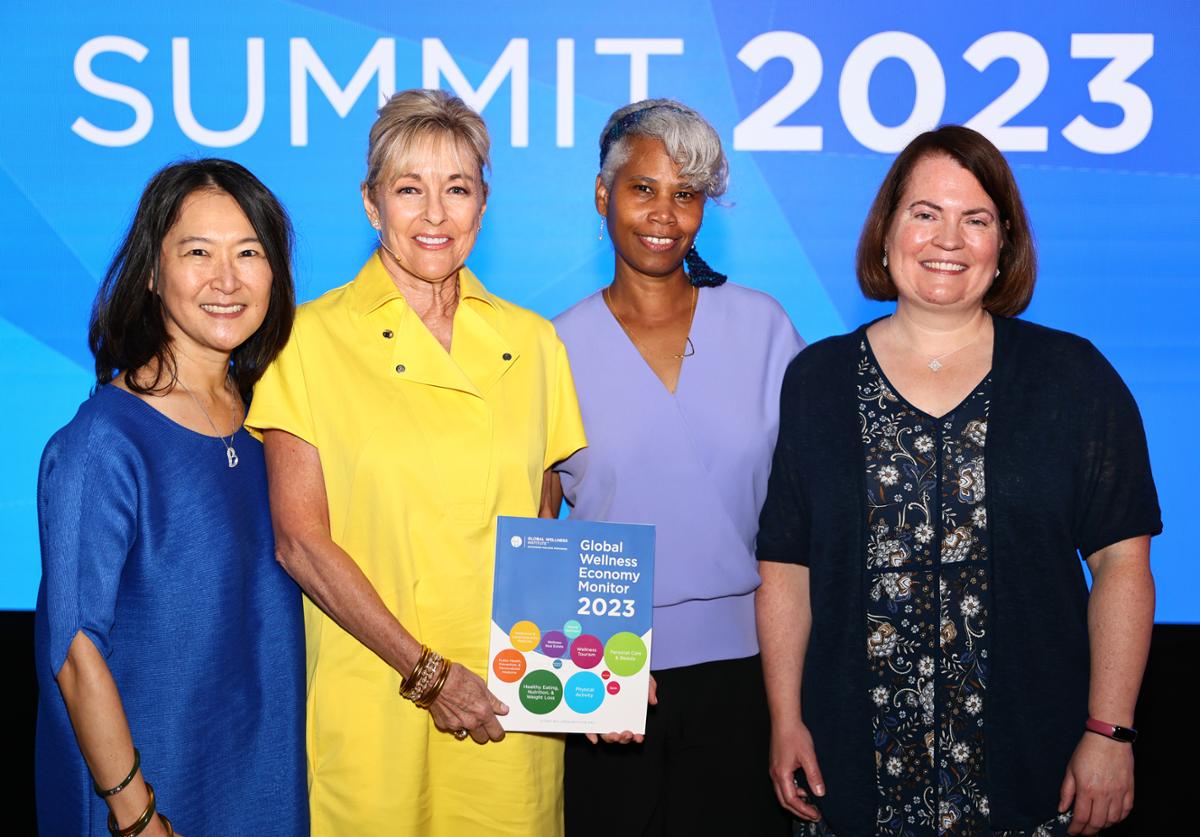
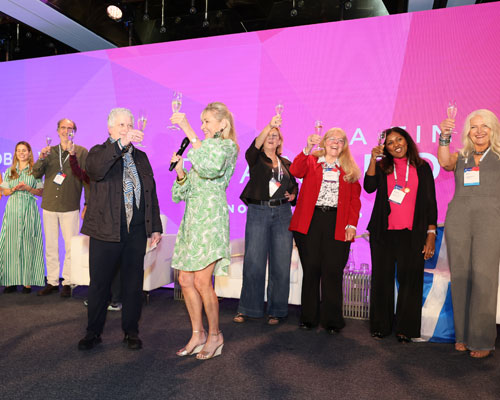
GWI chair Susie Ellis (in yellow) with report researchers Ophelia Yeung, Tonia Callender and Katherine Johnston / photo: GWS
The global wellness economy has exceeded US$5.6 trillion and will reach US$8.5 trillion by 2027, according to the 2023 Global Wellness Economy Monitor report.
The figures, just released by the Global Wellness Institute (GWI), represent a major turnaround after COVID-19 which saw the market shrink from US$4.9 trillion to US$4.4 trillion (-9.5 per cent) between 2019 and 2020.
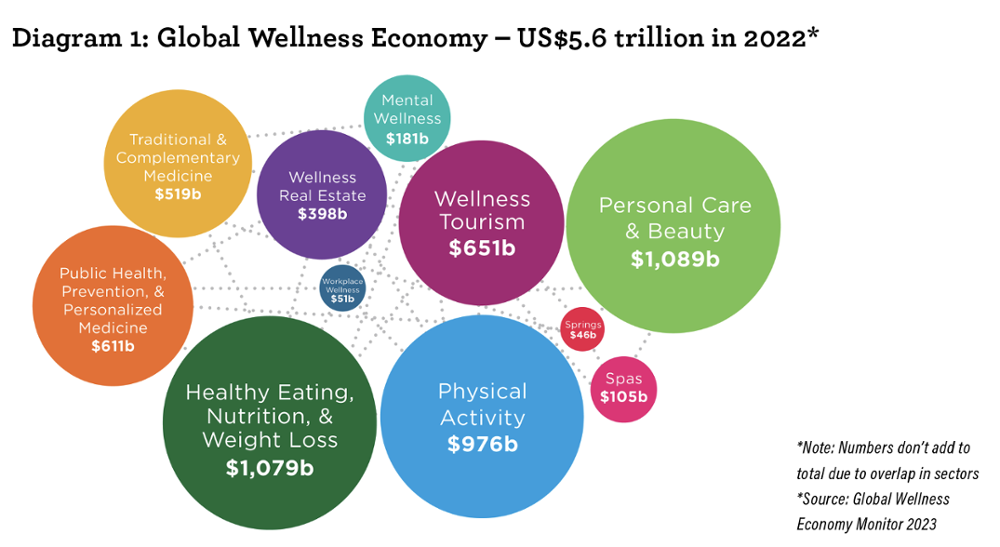
It’s since grown 26 per cent between 2020 and 2022 and seven of the 11 wellness sectors now exceed their 2019, pre-pandemic values (see Diagram 1).
Spa-related sectors The report shows that the traditional and complementary medicine sector grew by 15 per cent from 2020 to 2022 and is now worth US$518.6 billion.
The global spa market is valued at US$104.5 billion and thermal/mineral springs at US$46.3 billion. While these sectors increased by 50 per cent and 16 per cent respectively from 2020 to 2022, they’re still behind their 2019 values of US$113.8 billion and US$65.7 billion.
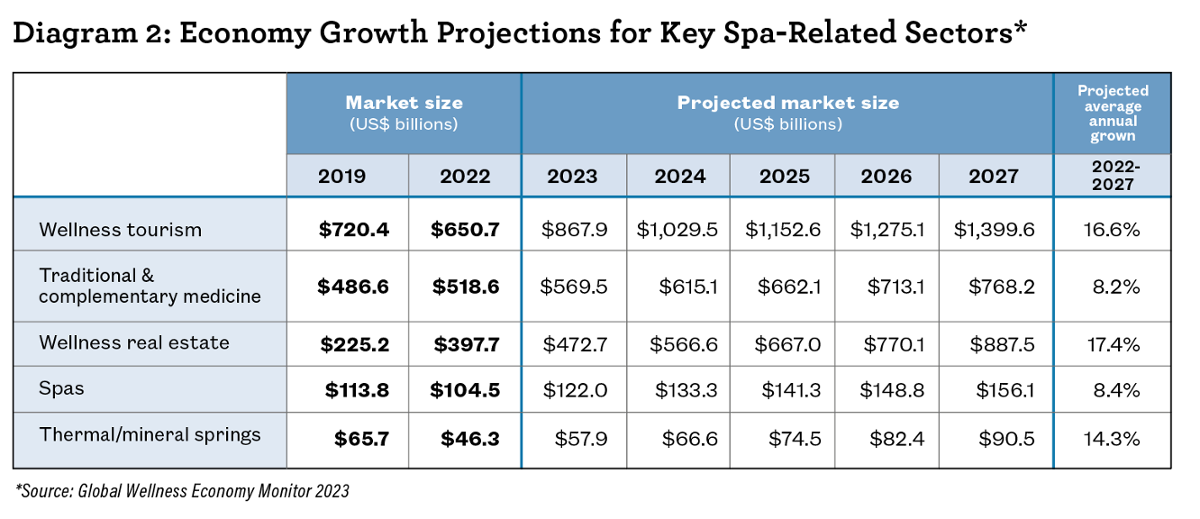
Yet, GWI predicts that a full recovery for these markets will be swift, increasing by 8.3 per cent and 14.3 per cent a year respectively, given pent-up demand. By 2027 it estimates that the spa industry will be worth US$156.1 billion and thermal/mineral springs will generate US$90.5 billion (see Diagram 2).
Regional analysis Wellness markets in all global regions have fully recovered from the pandemic, but North America (now at 123 per cent of its 2019/pre-pandemic level), Middle East-North Africa (up 119 per cent) and Europe (now at 114 per cent) have shown the most powerful growth rates since 2019.
In 2022, the North American market (US$1.9 trillion) surpassed Asia-Pacific (US$1.7 trillion) as the largest regional wellness economy. These two regions, along with Europe (US$1.5 trillion), now make up 90 per cent of the entire wellness market.
The report also states that per capita spending on wellness is highest in North America (US$5,108) and Europe (US$1,596).
Presenting the findings at the Global Wellness Summit in November (see p88), report co-author Ophelia Yeung said: “We’re very bullish about the wellness economy. Wellness has become a dominant consumer value and interest in it is only going to grow.
“But we also have a lot of unknown factors including widening wealth gaps, uncertain economic conditions and rapidly changing geopolitics that will affect the flow of people, capital, technology and ideas.
“How the wellness economy will do will depend on the interplay of all of these factors.”
Read more from this issue of Attractions Management magazine
View contents of Attractions Management 2023 issue 4
Sponsored: Highest French distinction for RKF's CEO
After receiving the highest civilian award for services to the French nation, Riadh Bouaziz, CEO of RKF Luxury Linen, reflects on his company’s many achievements and considers what lies ahead
Association focus: Thermal Heritage
Jane Kitchen finds out how two key associations – the European Historic Thermal Towns Association and the Great Spa Towns of Europe – are protecting and promoting the unique cultural relevances of Europe’s spa towns
Interview: Paul Simons
As he retires from the Great Spa Towns of Europe, the industry leader reflects on his long and esteemed career
Sponsored: New ways with water
Working globally with architects and interior designers allows Myrtha Wellness to embrace the latest trends in the international hospitality sector, as director Stefano Cattaneo explains
Sponsored: Cutting edge
Ara Patterson from Equinox Hotels talks about a partnership with
Gharieni that’s delivering ROI and innovative treatments for guests
Interview: Niamh O'Connell
What does Jumeirah’s first vice president of wellbeing have planned for the Middle East-based hospitality group?
Sponsored: Lasse Eriksen on contrast therapy
Contrast therapy is gaining attention for its healing effects. We ask aufguss and sauna expert Lasse Eriksen to share his views on the perfect experience
Nature spas: Tree of life
Lisa Starr discovers two retreats in Austria and Italy which base their wellbeing concepts on forests
Sponsored: Spirit of Excellence
Rupert Schmid and Pierre-Louis Delapalme, owners of Biologique Recherche, discuss the global rollout of its ‘Ambassade’ flagship spas
Sponsored: Outstanding performance
Bicester Hotel & Spa is working with Matrix Fitness to enable wellness guests to train like athletes with a unique offering
GWI chair Susie Ellis (in yellow) with report researchers Ophelia Yeung, Tonia Callender and Katherine Johnston / photo: GWS
The global wellness economy has exceeded US$5.6 trillion and will reach US$8.5 trillion by 2027, according to the 2023 Global Wellness Economy Monitor report.
The figures, just released by the Global Wellness Institute (GWI), represent a major turnaround after COVID-19 which saw the market shrink from US$4.9 trillion to US$4.4 trillion (-9.5 per cent) between 2019 and 2020.
It’s since grown 26 per cent between 2020 and 2022 and seven of the 11 wellness sectors now exceed their 2019, pre-pandemic values (see Diagram 1).
Spa-related sectors The report shows that the traditional and complementary medicine sector grew by 15 per cent from 2020 to 2022 and is now worth US$518.6 billion.
The global spa market is valued at US$104.5 billion and thermal/mineral springs at US$46.3 billion. While these sectors increased by 50 per cent and 16 per cent respectively from 2020 to 2022, they’re still behind their 2019 values of US$113.8 billion and US$65.7 billion.
Yet, GWI predicts that a full recovery for these markets will be swift, increasing by 8.3 per cent and 14.3 per cent a year respectively, given pent-up demand. By 2027 it estimates that the spa industry will be worth US$156.1 billion and thermal/mineral springs will generate US$90.5 billion (see Diagram 2).
Regional analysis Wellness markets in all global regions have fully recovered from the pandemic, but North America (now at 123 per cent of its 2019/pre-pandemic level), Middle East-North Africa (up 119 per cent) and Europe (now at 114 per cent) have shown the most powerful growth rates since 2019.
In 2022, the North American market (US$1.9 trillion) surpassed Asia-Pacific (US$1.7 trillion) as the largest regional wellness economy. These two regions, along with Europe (US$1.5 trillion), now make up 90 per cent of the entire wellness market.
The report also states that per capita spending on wellness is highest in North America (US$5,108) and Europe (US$1,596).
Presenting the findings at the Global Wellness Summit in November (see p88), report co-author Ophelia Yeung said: “We’re very bullish about the wellness economy. Wellness has become a dominant consumer value and interest in it is only going to grow.
“But we also have a lot of unknown factors including widening wealth gaps, uncertain economic conditions and rapidly changing geopolitics that will affect the flow of people, capital, technology and ideas.
“How the wellness economy will do will depend on the interplay of all of these factors.”
Read more from this issue of Attractions Management magazine
View contents of Attractions Management 2023 issue 4
Sponsored: Highest French distinction for RKF's CEO
After receiving the highest civilian award for services to the French nation, Riadh Bouaziz, CEO of RKF Luxury Linen, reflects on his company’s many achievements and considers what lies ahead
Association focus: Thermal Heritage
Jane Kitchen finds out how two key associations – the European Historic Thermal Towns Association and the Great Spa Towns of Europe – are protecting and promoting the unique cultural relevances of Europe’s spa towns
Interview: Paul Simons
As he retires from the Great Spa Towns of Europe, the industry leader reflects on his long and esteemed career
Sponsored: New ways with water
Working globally with architects and interior designers allows Myrtha Wellness to embrace the latest trends in the international hospitality sector, as director Stefano Cattaneo explains
Sponsored: Cutting edge
Ara Patterson from Equinox Hotels talks about a partnership with
Gharieni that’s delivering ROI and innovative treatments for guests
Interview: Niamh O'Connell
What does Jumeirah’s first vice president of wellbeing have planned for the Middle East-based hospitality group?
Sponsored: Lasse Eriksen on contrast therapy
Contrast therapy is gaining attention for its healing effects. We ask aufguss and sauna expert Lasse Eriksen to share his views on the perfect experience
Nature spas: Tree of life
Lisa Starr discovers two retreats in Austria and Italy which base their wellbeing concepts on forests
Sponsored: Spirit of Excellence
Rupert Schmid and Pierre-Louis Delapalme, owners of Biologique Recherche, discuss the global rollout of its ‘Ambassade’ flagship spas
Sponsored: Outstanding performance
Bicester Hotel & Spa is working with Matrix Fitness to enable wellness guests to train like athletes with a unique offering
A US$50 million (£44.2 million, €51.2 million) transformation of Chicago's historic McCormick
Mansion has created a new destination that combines live magic, immersive theatre, dining and
private membership under one roof.
The Montana Historical Society has officially celebrated the opening of its new Montana
Heritage
Center, a US$107 million (£79 million, €92 million) destination that combines immersive
storytelling with cutting-edge audiovisual technology to bring the sta
San Antonio Zoo has reported a US$283 million economic impact for 2025, following a decade-
long transformation programme that has seen almost US$200 million invested into the Texas
attraction.
Plans for the AU$180 million redevelopment of Reef HQ Aquarium in Townsville, Australia, are
progressing, with the project set to transform the attraction into a global centre for reef
education and conservation.
Abu Dhabi-based investment firm Mubadala Capital has made a binding, fully financed
€1 billion
offer to acquire Pierre and Vacances SA, the European holiday resort operator behind the
continental European Center Parcs business.
Disney has reaffirmed its commitment to investing US$30 billion in its US parks and cruise
business by 2033, using new America250 celebrations to underline the role its attractions play
in supporting jobs, tourism and economic growth.
Expo 2030 Riyadh is being planned as a permanent visitor destination, with organisers
confirming the six-million-square-metre site will become a Global Village after the event closes.
The owner of one of Australia's best-known waterparks has acquired a major competitor,
creating a new attractions business spanning two of the country's largest visitor destinations.
The Toverland theme park in the Netherlands has announced a €98m expansion programme
that will add a resort, new attractions and staff facilities as it pursues plans to become a multi-
day destination.
Hotel de France, located on the British Isle of Jersey, has created a wellness retreat package
that includes a hot yoga session that will take place in Jersey Zoo’s butterfly sanctuary.
+ More news
COMPANY PROFILES
Simworx Ltd The company was initially established
in 1997. Terry Monkton and Andrew
Roberts are the key stakeh [more...]
Clip 'n Climb Clip ‘n Climb currently offers facility owners and
investors more than 40 colourful and unique
Cha [more...]
Painting With Light By combining lighting, video, scenic and architectural elements, sound and special effects we tell s [more...]