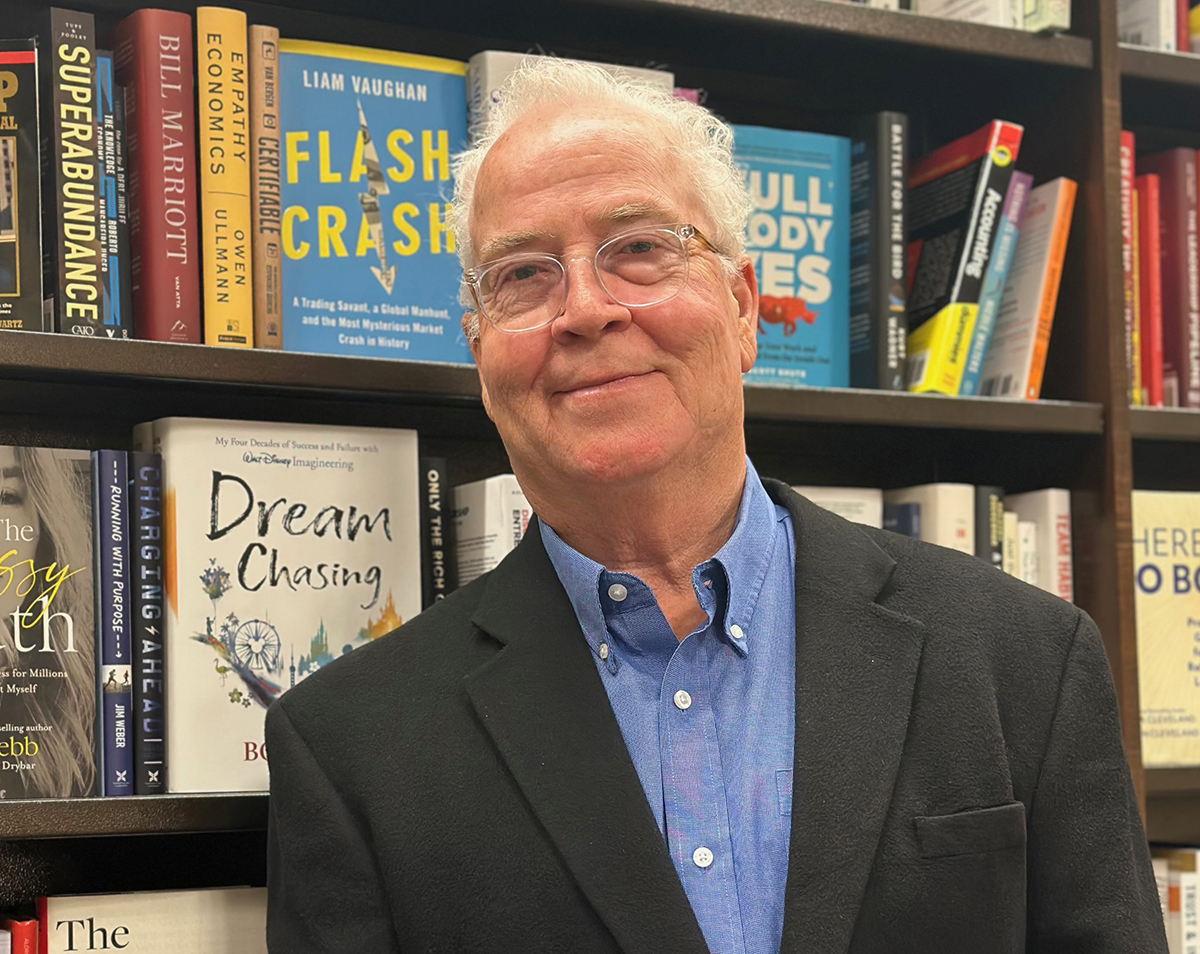
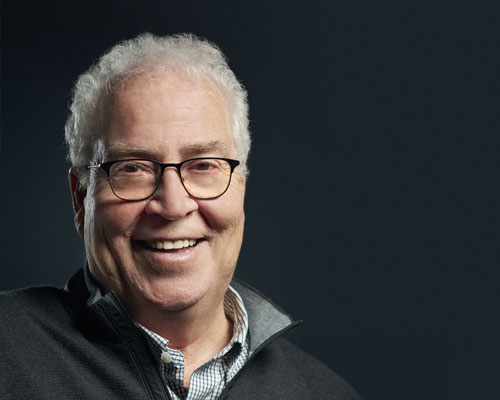
Bob Weis joined Walt Disney Imagineering in 1980. He became president in 2015 / Photo: Mike Iwerks
When Bob Weis was in junior year in college, he got a part-time summer job at Disneyland, California to help fund his studies. Hoping for a creative position, Weis was disappointed to find himself on ‘outdoor food’ – selling ice cream and popcorn from a cart.
Weis spent his days watching visitors interact with the park and its characters, seeing how they moved around and how their environment affected them.
It wasn’t until years later that Weis realised how much those days spent people-watching had informed his work designing parks and attractions for Disney. “Standing there all day, you learn how the park works, how people act, how the energy flows,” Weis tells me, speaking from his home in LA. “As an architect, those lessons were invaluable.”
Weis went on to become president of Walt Disney Imagineering (WDI), leading the design and creation of some of Disney’s most iconic projects. In his 35 plus years with Disney, Weis worked at every Disney site around the world, leaving his mark on theme parks, rides and attractions, resorts and cruise ships. After retiring from Disney in 2023, he co-founded the Global Immersive Experience Design division at Gensler, and has now begun a new career as a full-time author.
The early chapters Weis studied architecture at California State Polytechnic University, Pomona, but was equally interested in storytelling and the theatre. “I spent half my time in the theatre department, and I always loved performance, writing stories, acting and directing,” he says.
As luck would have it, in the late 1970s, Disney was looking for graduates with just this combination of skills and interests.
Weis got a job with Walt Disney Imagineering in 1980, straight out of university. Back then, Disney had just two theme parks, but it was in the process of expanding, with the creation of the Epcot theme park at Walt Disney World – Walt Disney’s last dream – and Tokyo Disneyland, its first park outside of the US.
“They needed an influx of new blood, I guess,” says Weis. “A whole bunch of us around the same age joined at that time. We were the second generation of Walt Disney Imagineering, really, with the first generation handpicked by Walt Disney himself to build Disneyland.”
Heading east Soon after joining, Weis was assigned to the Tokyo Disneyland project, led by legendary Disney executive Frank Stanek. With Disney’s main focus on the creation of Epcot in Florida – then the largest construction project in the US – Stanek had to get creative when assembling a team to design and build Tokyo Disneyland.
“He told me he was going to build Tokyo Disneyland with the fired, the retired and the recently hired,” laughs Weis, “and we were the recently hired.”
“It was an amazing experience. I was a kid who’d grown up outside Los Angeles. Suddenly I was on a plane to Japan, part of this small team trying to figure out how to build a theme park in a foreign country. Because there were so few of us on that job, we got a taste of every department. It was a great training ground and an unbelievable experience.”
The biggest lesson Weis learned from Tokyo Disneyland, he tells me, was not to have cultural arrogance, and to realise that the talent needed for a project can usually be found on the ground.
“If you look around, you’ll find the talent you need,” he says. “I learned how important it is to empower local people and let them be the decision-makers. If you’re looking over their shoulder all the time, or someone’s always flying in to make the final decision, it limits that relationship. When you give people agency, that’s when great things happen.”
Where theme parks and museums meet After a few years in Japan, Weis returned to the US, and soon became head of the creation of Disney-MGM Studios in Walt Disney World.
In 1994, Weis left Disney to launch his own consultancy company, Design Island, where he worked with museum clients including the Kennedy Space Center, the Smithsonian and Chicago’s Museum of Science and Industry, making him well placed to comment on the evolving relationship between the museum world and the themed attractions industry.
“Things are changing,” he says. “The museum world has begun to borrow techniques from theme parks to make great exhibits more immersive and draw more people in. Meanwhile the themed entertainment industry – and Disney specifically – has been influenced by the museum world in trying to tell clear and authentic stories.
“While the stories in the parks and movies may be original creations, they still need to feel real. When the Pixar team produced the Cars movies, for example, they travelled through Oklahoma, New Mexico and Arizona, and visited the saloons and car shops and mountains. When you watch the movies, they’re heavily influenced by the reality of that world.
“When we designed Cars Land [the 12 acre Cars-themed area that opened at Disney California Adventure Park in 2012], we got the same tour guides that the animators consulted to take us through the American Southwest so that we really understood what we were trying to create.
“As the museum world has become more immersive, the theme park world has tried to discover an authenticity that makes things feel real for people.”
Returning to Disney In 2008, Weis returned to Walt Disney Imagineering as an executive vice president to work on several projects including a transformation of Disney’s California Adventure, which had opened next to Disneyland in 2001, and hadn’t proved as successful as hoped.
Together with his team, Weis set about trying to understand why the park wasn’t working. The conclusion was that while people loved some of the rides, they just didn’t love the park in the way that they loved Disneyland.
“Disneyland isn’t just the total of its attractions,” says Weis. “It’s a love of strolling down Main Street, walking around the hub, watching the show and the fireworks. We felt that intangible thing was missing at California Adventure Park. It didn’t feel sincere enough and people didn’t have an emotional connection to it.”
The team set out to create a stronger sense of place, planting 1,200 mature trees, changing the “cold and commercial-looking” entrance to something that evoked the nostalgia and emotion of Disneyland’s Main Street. They added a show, World of Color, at the lake, and focused on improving all the attractions, shopping, entertainment and dining experiences at the park.
“World of Color changed the chemistry; we had people who wanted to see the show, so they stayed in the evening – they’re dining and enjoying themselves. All of a sudden you have more nice places for people to sit and listen to music,” says Weis. “You start to get that atmosphere that makes people want to linger, and to return again and again.”
The team also added attractions including Cars Land and the Avengers Campus, but Weis believes it was also these “intangible elements” that really led to the turnaround of the park.
Shanghai Disneyland Weis’ next big project was the creation of Shanghai Disneyland – Disney’s largest ever foreign investment. Mindful of concerns about cultural imperialism, Bob Iger, then CEO of Disney, said he wanted the project to be “authentically Disney, and distinctly Chinese”. It was another lesson in being respectful of a different culture. Weis and his employees made research trips across China, visiting Chinese homes and schools, studying the architecture and conducting focus groups to test their ideas. The aim was to use Chinese design elements and performance traditions to tell Disney stories.
Shanghai Disneyland includes Chinese-style architecture, including the park’s flagship restaurant the Wandering Moon Teahouse, which recreates architecture representative of China’s different regions. Chinese characters, dramas and acrobatics feature throughout the park, and the dining is influenced by Chinese tastes.
“It’s a point of pride for me to have worked with a lot of different cultures, and to have met them on an equal basis,” says Weis. “Shanghai Disney Resort is a strong fusion of Chinese culture and arts and food with Disney sensibility – that’s why it works.”
Taking charge In 2015, while working on Shanghai Disneyland, Weis got a call from Bob Chapek, who had become chairman of Walt Disney Parks and Resorts that same year, asking him to become president of Imagineering.
New to his role, Chapek had been told by the heads of various Disney theme parks that Walt Disney Imagineering needed stronger management focus.
“There is usually a healthy conflict between the operating side of Disney, which is trying to make money, and the creative development side, which is trying to push the envelope,” explains Weis. “I’ve had great relationships with all of the heads of parks I’ve worked with, but there are always disagreements. At that time Imagineering had done some projects that were running behind schedule and there was a feeling from some people that too much money was being invested in the development side of the business.”
Weis focused on getting Chapek on board, taking him behind the scenes at WDI. “I showed him how ride engineering and show development works, how you put together live entertainment – I introduced him to the dedicated teams out there at two o’clock in the morning, programming shows all night. He saw how the projects developed by the Imagineers impacted the guest experience and the uplift of the hotels and restaurants. He became a believer.
“Chapek built up a trust in the projects we were developing, and he authorised a huge amount of work around the world.”
A year of crises Everything was going pretty well – and then the COVID-19 pandemic hit. “Within two and half weeks, the entire Disney world shut down and I was faced with work I was never prepared to do,” says Weis. “I realised that leadership isn’t just about doing more of what you already know. It’s about facing challenges when you have no idea what to do, and working out what has to be done.”
A majority of Disney’s Imagineers were furloughed – together with the majority of those working for Disney’s parks division – and the projects in development were slowly shut down.
“Bit by bit, we inched our way back,” says Weis. The earlier lessons in trusting the teams on the ground came into play again. “We figured out how to empower local people on the sites to do more, and that has become a permanent way of working for Disney. We learned a lot during that time.”
Weis also led WDI’S response to the George Floyd crisis, championing progressive actions towards diversity and inclusion at the company. “We had many conversations and we committed to listening to our Imagineers,” he says. “We discovered that we were nowhere near as diverse a culture as we believed we were.”
Among Weis’ final projects were the new generation cruise ships, including the Disney Wish, and the Disney Treasure, the sixth ship in the Disney Cruise Line fleet, which launched in December 2024.
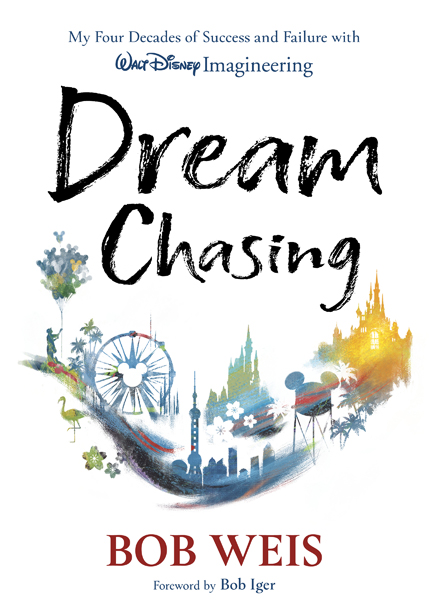
In 2023, Weis retired from Disney, and – after establishing a Global Entertainment practice at Gensler, the world’s largest architecture firm, he decided to focus on his new passion: writing. Since then, he has published two books – Dream Chasing: My Four Decades of Success and Failure with Walt Disney Imagineering – and the fictional Ghost Dog, inspired by Weis’ love of Disneyland’s Haunted Mansion ride. He is currently writing a book about Disney legend and former WDI president Marty Sklar.
“I’ve fallen in love with writing,” says Weis. “It’s been this unexpected joy for me. I feel like the luckiest guy in the world to have had the career I’ve had, and now be able to have a second one writing full time.”
Weis now finds it a joy to visit Disney’s theme parks as a guest.
“I have a freedom which I didn’t have before – of being able to go to a park without my critical hat on and just enjoy it,” he says. “I can go back to Disney parks and see the things I dreamed about, or sketched and had countless meetings about, and they’re still there. There’s nothing like a park full of people having fun.”
Walt Disney once said, “It’s kind of fun to make the impossible happen.”
Weis absolutely agrees. “I’m proud to have been an Imagineer, a collaborator, and someone who loves to do impossible things with impossibly talented people.”
BOB WEIS IN THE HOTSEAT
What’s the best advice you’ve ever been given?
Be patient.
What has been the proudest moment of your career?
Opening Shanghai Disneyland.
What’s the worst decision you’ve made in business?
Worst decision is ever thinking it’s a business, which teaches you it’s always personal.
Where is your favourite place on earth?
Home or wherever my family is.
Do you have a favourite Disney park and ride?
My favourite park is Shanghai Disneyland and my favourite ride is the Haunted Mansion.
How would you like to be remembered?
Husband, father and Imagineer who lived to be 105.
“I was lucky enough to be a part of the second generation of Imagineers. We started after Walt was gone, but we learned from many of those who worked side by side with him. When I started, there were two Disney theme parks in the world. By the time I retired from Disney in 2023, there were 12.
Dreams are exciting, frustrating, and sometimes elusive, as hard to hold on to as pixie dust, like glitter falling through your fingers. Sometimes they are meant to happen, and they do, sometimes they are meant to happen, and they don’t . . . and then there’s every combination in between. Built or unbuilt, every dream was a journey, and one many of us took together.”
Extract from Dream Chasing: My Four Decades of Success and Failure with Walt Disney Imagineering (Disney Editions Deluxe)
Photo: Merry Yu
Read more from this issue of Attractions Management magazine
View contents of Attractions Management 2025 issue 1
Editor's letter: A fresh perspective
As a new report argues that silence can help visitors better appreciate zoos, Magali Robathan explores a different way of operating
People: Marian Lee
As Netflix announces the launch of immersive attraction Netflix House, we hear about the plans from the company’s CMO
People: Frida Escobedo
The first woman to design a wing at the Metropolitan Museum of Art shares her vision for a more usable and welcoming space for modern and contemporary art
People: Delta Kay
Indigenous experiences are important for fostering respect, and must not be co-opted by non Indigenous operators, says Aboriginal tour guide Delta Kay
Theme parks: Bob Weis
The former president of Imagineering pulls back the curtain to give a behind the scenes look at how some of Disney’s biggest projects took shape
Museums: Space to learn
From the world’s first AI art museum to the latest cultural institution transforming a rural Japanese island... We check out some intriguing museums taking shape across the globe
Technology: Guiding light
Genell Zuciya, creator of attractions for Disney and Meow Wolf, explores the transformative power of lighting
Theme parks: Block party
Merlin meets Minecraft in a $85m deal set to bring the world’s biggest selling video game to life. Could this be Merlin’s most significant partnership?
Museums: A new dawn
The first phase of a ground-breaking new museum campus has opened in Benin City, Nigeria. Is this the future for post-colonial institutions?
Research: Quiet zoos
Could a quieter zoo environment restore zoos’ original purpose as restorative retreats for overstimulated minds? The authors of a new research paper certainly think so
Bob Weis joined Walt Disney Imagineering in 1980. He became president in 2015 / Photo: Mike Iwerks
When Bob Weis was in junior year in college, he got a part-time summer job at Disneyland, California to help fund his studies. Hoping for a creative position, Weis was disappointed to find himself on ‘outdoor food’ – selling ice cream and popcorn from a cart.
Weis spent his days watching visitors interact with the park and its characters, seeing how they moved around and how their environment affected them.
It wasn’t until years later that Weis realised how much those days spent people-watching had informed his work designing parks and attractions for Disney. “Standing there all day, you learn how the park works, how people act, how the energy flows,” Weis tells me, speaking from his home in LA. “As an architect, those lessons were invaluable.”
Weis went on to become president of Walt Disney Imagineering (WDI), leading the design and creation of some of Disney’s most iconic projects. In his 35 plus years with Disney, Weis worked at every Disney site around the world, leaving his mark on theme parks, rides and attractions, resorts and cruise ships. After retiring from Disney in 2023, he co-founded the Global Immersive Experience Design division at Gensler, and has now begun a new career as a full-time author.
The early chapters Weis studied architecture at California State Polytechnic University, Pomona, but was equally interested in storytelling and the theatre. “I spent half my time in the theatre department, and I always loved performance, writing stories, acting and directing,” he says.
As luck would have it, in the late 1970s, Disney was looking for graduates with just this combination of skills and interests.
Weis got a job with Walt Disney Imagineering in 1980, straight out of university. Back then, Disney had just two theme parks, but it was in the process of expanding, with the creation of the Epcot theme park at Walt Disney World – Walt Disney’s last dream – and Tokyo Disneyland, its first park outside of the US.
“They needed an influx of new blood, I guess,” says Weis. “A whole bunch of us around the same age joined at that time. We were the second generation of Walt Disney Imagineering, really, with the first generation handpicked by Walt Disney himself to build Disneyland.”
Heading east Soon after joining, Weis was assigned to the Tokyo Disneyland project, led by legendary Disney executive Frank Stanek. With Disney’s main focus on the creation of Epcot in Florida – then the largest construction project in the US – Stanek had to get creative when assembling a team to design and build Tokyo Disneyland.
“He told me he was going to build Tokyo Disneyland with the fired, the retired and the recently hired,” laughs Weis, “and we were the recently hired.”
“It was an amazing experience. I was a kid who’d grown up outside Los Angeles. Suddenly I was on a plane to Japan, part of this small team trying to figure out how to build a theme park in a foreign country. Because there were so few of us on that job, we got a taste of every department. It was a great training ground and an unbelievable experience.”
The biggest lesson Weis learned from Tokyo Disneyland, he tells me, was not to have cultural arrogance, and to realise that the talent needed for a project can usually be found on the ground.
“If you look around, you’ll find the talent you need,” he says. “I learned how important it is to empower local people and let them be the decision-makers. If you’re looking over their shoulder all the time, or someone’s always flying in to make the final decision, it limits that relationship. When you give people agency, that’s when great things happen.”
Where theme parks and museums meet After a few years in Japan, Weis returned to the US, and soon became head of the creation of Disney-MGM Studios in Walt Disney World.
In 1994, Weis left Disney to launch his own consultancy company, Design Island, where he worked with museum clients including the Kennedy Space Center, the Smithsonian and Chicago’s Museum of Science and Industry, making him well placed to comment on the evolving relationship between the museum world and the themed attractions industry.
“Things are changing,” he says. “The museum world has begun to borrow techniques from theme parks to make great exhibits more immersive and draw more people in. Meanwhile the themed entertainment industry – and Disney specifically – has been influenced by the museum world in trying to tell clear and authentic stories.
“While the stories in the parks and movies may be original creations, they still need to feel real. When the Pixar team produced the Cars movies, for example, they travelled through Oklahoma, New Mexico and Arizona, and visited the saloons and car shops and mountains. When you watch the movies, they’re heavily influenced by the reality of that world.
“When we designed Cars Land [the 12 acre Cars-themed area that opened at Disney California Adventure Park in 2012], we got the same tour guides that the animators consulted to take us through the American Southwest so that we really understood what we were trying to create.
“As the museum world has become more immersive, the theme park world has tried to discover an authenticity that makes things feel real for people.”
Returning to Disney In 2008, Weis returned to Walt Disney Imagineering as an executive vice president to work on several projects including a transformation of Disney’s California Adventure, which had opened next to Disneyland in 2001, and hadn’t proved as successful as hoped.
Together with his team, Weis set about trying to understand why the park wasn’t working. The conclusion was that while people loved some of the rides, they just didn’t love the park in the way that they loved Disneyland.
“Disneyland isn’t just the total of its attractions,” says Weis. “It’s a love of strolling down Main Street, walking around the hub, watching the show and the fireworks. We felt that intangible thing was missing at California Adventure Park. It didn’t feel sincere enough and people didn’t have an emotional connection to it.”
The team set out to create a stronger sense of place, planting 1,200 mature trees, changing the “cold and commercial-looking” entrance to something that evoked the nostalgia and emotion of Disneyland’s Main Street. They added a show, World of Color, at the lake, and focused on improving all the attractions, shopping, entertainment and dining experiences at the park.
“World of Color changed the chemistry; we had people who wanted to see the show, so they stayed in the evening – they’re dining and enjoying themselves. All of a sudden you have more nice places for people to sit and listen to music,” says Weis. “You start to get that atmosphere that makes people want to linger, and to return again and again.”
The team also added attractions including Cars Land and the Avengers Campus, but Weis believes it was also these “intangible elements” that really led to the turnaround of the park.
Shanghai Disneyland Weis’ next big project was the creation of Shanghai Disneyland – Disney’s largest ever foreign investment. Mindful of concerns about cultural imperialism, Bob Iger, then CEO of Disney, said he wanted the project to be “authentically Disney, and distinctly Chinese”. It was another lesson in being respectful of a different culture. Weis and his employees made research trips across China, visiting Chinese homes and schools, studying the architecture and conducting focus groups to test their ideas. The aim was to use Chinese design elements and performance traditions to tell Disney stories.
Shanghai Disneyland includes Chinese-style architecture, including the park’s flagship restaurant the Wandering Moon Teahouse, which recreates architecture representative of China’s different regions. Chinese characters, dramas and acrobatics feature throughout the park, and the dining is influenced by Chinese tastes.
“It’s a point of pride for me to have worked with a lot of different cultures, and to have met them on an equal basis,” says Weis. “Shanghai Disney Resort is a strong fusion of Chinese culture and arts and food with Disney sensibility – that’s why it works.”
Taking charge In 2015, while working on Shanghai Disneyland, Weis got a call from Bob Chapek, who had become chairman of Walt Disney Parks and Resorts that same year, asking him to become president of Imagineering.
New to his role, Chapek had been told by the heads of various Disney theme parks that Walt Disney Imagineering needed stronger management focus.
“There is usually a healthy conflict between the operating side of Disney, which is trying to make money, and the creative development side, which is trying to push the envelope,” explains Weis. “I’ve had great relationships with all of the heads of parks I’ve worked with, but there are always disagreements. At that time Imagineering had done some projects that were running behind schedule and there was a feeling from some people that too much money was being invested in the development side of the business.”
Weis focused on getting Chapek on board, taking him behind the scenes at WDI. “I showed him how ride engineering and show development works, how you put together live entertainment – I introduced him to the dedicated teams out there at two o’clock in the morning, programming shows all night. He saw how the projects developed by the Imagineers impacted the guest experience and the uplift of the hotels and restaurants. He became a believer.
“Chapek built up a trust in the projects we were developing, and he authorised a huge amount of work around the world.”
A year of crises Everything was going pretty well – and then the COVID-19 pandemic hit. “Within two and half weeks, the entire Disney world shut down and I was faced with work I was never prepared to do,” says Weis. “I realised that leadership isn’t just about doing more of what you already know. It’s about facing challenges when you have no idea what to do, and working out what has to be done.”
A majority of Disney’s Imagineers were furloughed – together with the majority of those working for Disney’s parks division – and the projects in development were slowly shut down.
“Bit by bit, we inched our way back,” says Weis. The earlier lessons in trusting the teams on the ground came into play again. “We figured out how to empower local people on the sites to do more, and that has become a permanent way of working for Disney. We learned a lot during that time.”
Weis also led WDI’S response to the George Floyd crisis, championing progressive actions towards diversity and inclusion at the company. “We had many conversations and we committed to listening to our Imagineers,” he says. “We discovered that we were nowhere near as diverse a culture as we believed we were.”
Among Weis’ final projects were the new generation cruise ships, including the Disney Wish, and the Disney Treasure, the sixth ship in the Disney Cruise Line fleet, which launched in December 2024.
In 2023, Weis retired from Disney, and – after establishing a Global Entertainment practice at Gensler, the world’s largest architecture firm, he decided to focus on his new passion: writing. Since then, he has published two books – Dream Chasing: My Four Decades of Success and Failure with Walt Disney Imagineering – and the fictional Ghost Dog, inspired by Weis’ love of Disneyland’s Haunted Mansion ride. He is currently writing a book about Disney legend and former WDI president Marty Sklar.
“I’ve fallen in love with writing,” says Weis. “It’s been this unexpected joy for me. I feel like the luckiest guy in the world to have had the career I’ve had, and now be able to have a second one writing full time.”
Weis now finds it a joy to visit Disney’s theme parks as a guest.
“I have a freedom which I didn’t have before – of being able to go to a park without my critical hat on and just enjoy it,” he says. “I can go back to Disney parks and see the things I dreamed about, or sketched and had countless meetings about, and they’re still there. There’s nothing like a park full of people having fun.”
Walt Disney once said, “It’s kind of fun to make the impossible happen.”
Weis absolutely agrees. “I’m proud to have been an Imagineer, a collaborator, and someone who loves to do impossible things with impossibly talented people.”
BOB WEIS IN THE HOTSEAT
What’s the best advice you’ve ever been given?
Be patient.
What has been the proudest moment of your career?
Opening Shanghai Disneyland.
What’s the worst decision you’ve made in business?
Worst decision is ever thinking it’s a business, which teaches you it’s always personal.
Where is your favourite place on earth?
Home or wherever my family is.
Do you have a favourite Disney park and ride?
My favourite park is Shanghai Disneyland and my favourite ride is the Haunted Mansion.
How would you like to be remembered?
Husband, father and Imagineer who lived to be 105.
“I was lucky enough to be a part of the second generation of Imagineers. We started after Walt was gone, but we learned from many of those who worked side by side with him. When I started, there were two Disney theme parks in the world. By the time I retired from Disney in 2023, there were 12.
Dreams are exciting, frustrating, and sometimes elusive, as hard to hold on to as pixie dust, like glitter falling through your fingers. Sometimes they are meant to happen, and they do, sometimes they are meant to happen, and they don’t . . . and then there’s every combination in between. Built or unbuilt, every dream was a journey, and one many of us took together.”
Extract from Dream Chasing: My Four Decades of Success and Failure with Walt Disney Imagineering (Disney Editions Deluxe)
Photo: Merry Yu
Read more from this issue of Attractions Management magazine
View contents of Attractions Management 2025 issue 1
Editor's letter: A fresh perspective
As a new report argues that silence can help visitors better appreciate zoos, Magali Robathan explores a different way of operating
People: Marian Lee
As Netflix announces the launch of immersive attraction Netflix House, we hear about the plans from the company’s CMO
People: Frida Escobedo
The first woman to design a wing at the Metropolitan Museum of Art shares her vision for a more usable and welcoming space for modern and contemporary art
People: Delta Kay
Indigenous experiences are important for fostering respect, and must not be co-opted by non Indigenous operators, says Aboriginal tour guide Delta Kay
Theme parks: Bob Weis
The former president of Imagineering pulls back the curtain to give a behind the scenes look at how some of Disney’s biggest projects took shape
Museums: Space to learn
From the world’s first AI art museum to the latest cultural institution transforming a rural Japanese island... We check out some intriguing museums taking shape across the globe
Technology: Guiding light
Genell Zuciya, creator of attractions for Disney and Meow Wolf, explores the transformative power of lighting
Theme parks: Block party
Merlin meets Minecraft in a $85m deal set to bring the world’s biggest selling video game to life. Could this be Merlin’s most significant partnership?
Museums: A new dawn
The first phase of a ground-breaking new museum campus has opened in Benin City, Nigeria. Is this the future for post-colonial institutions?
Research: Quiet zoos
Could a quieter zoo environment restore zoos’ original purpose as restorative retreats for overstimulated minds? The authors of a new research paper certainly think so
OMA has completed a major transformation of New York's New Museum, creating a larger
cultural campus that combines expanded exhibition spaces with learning, performance,
hospitality and public programming.
A US$50 million (£44.2 million, €51.2 million) transformation of Chicago's historic McCormick
Mansion has created a new destination that combines live magic, immersive theatre, dining and
private membership under one roof.
The Montana Historical Society has officially celebrated the opening of its new Montana
Heritage
Center, a US$107 million (£79 million, €92 million) destination that combines immersive
storytelling with cutting-edge audiovisual technology to bring the sta
San Antonio Zoo has reported a US$283 million economic impact for 2025, following a decade-
long transformation programme that has seen almost US$200 million invested into the Texas
attraction.
Plans for the AU$180 million redevelopment of Reef HQ Aquarium in Townsville, Australia, are
progressing, with the project set to transform the attraction into a global centre for reef
education and conservation.
Abu Dhabi-based investment firm Mubadala Capital has made a binding, fully financed
€1 billion
offer to acquire Pierre and Vacances SA, the European holiday resort operator behind the
continental European Center Parcs business.
Disney has reaffirmed its commitment to investing US$30 billion in its US parks and cruise
business by 2033, using new America250 celebrations to underline the role its attractions play
in supporting jobs, tourism and economic growth.
Expo 2030 Riyadh is being planned as a permanent visitor destination, with organisers
confirming the six-million-square-metre site will become a Global Village after the event closes.
The owner of one of Australia's best-known waterparks has acquired a major competitor,
creating a new attractions business spanning two of the country's largest visitor destinations.
The Toverland theme park in the Netherlands has announced a €98m expansion programme
that will add a resort, new attractions and staff facilities as it pursues plans to become a multi-
day destination.
+ More news
COMPANY PROFILES
IDEATTACK IDEATTACK is a full-service planning and
design company with headquarters in
Los Angeles. [more...]
instantprint We’re a Yorkshire-based online printer, founded
in 2009 by Adam Carnell and James Kinsella. [more...]
QubicaAMF UK QubicaAMF is the largest and most
innovative bowling equipment provider with
600 employees worldwi [more...]
Painting With Light By combining lighting, video, scenic and architectural elements, sound and special effects we tell s [more...]