A new kind of museum campus has opened its first building
in Benin City, Nigeria, aiming to reclaim African
heritage and redefine museum practices across the
continent. Magali Robathan finds out more
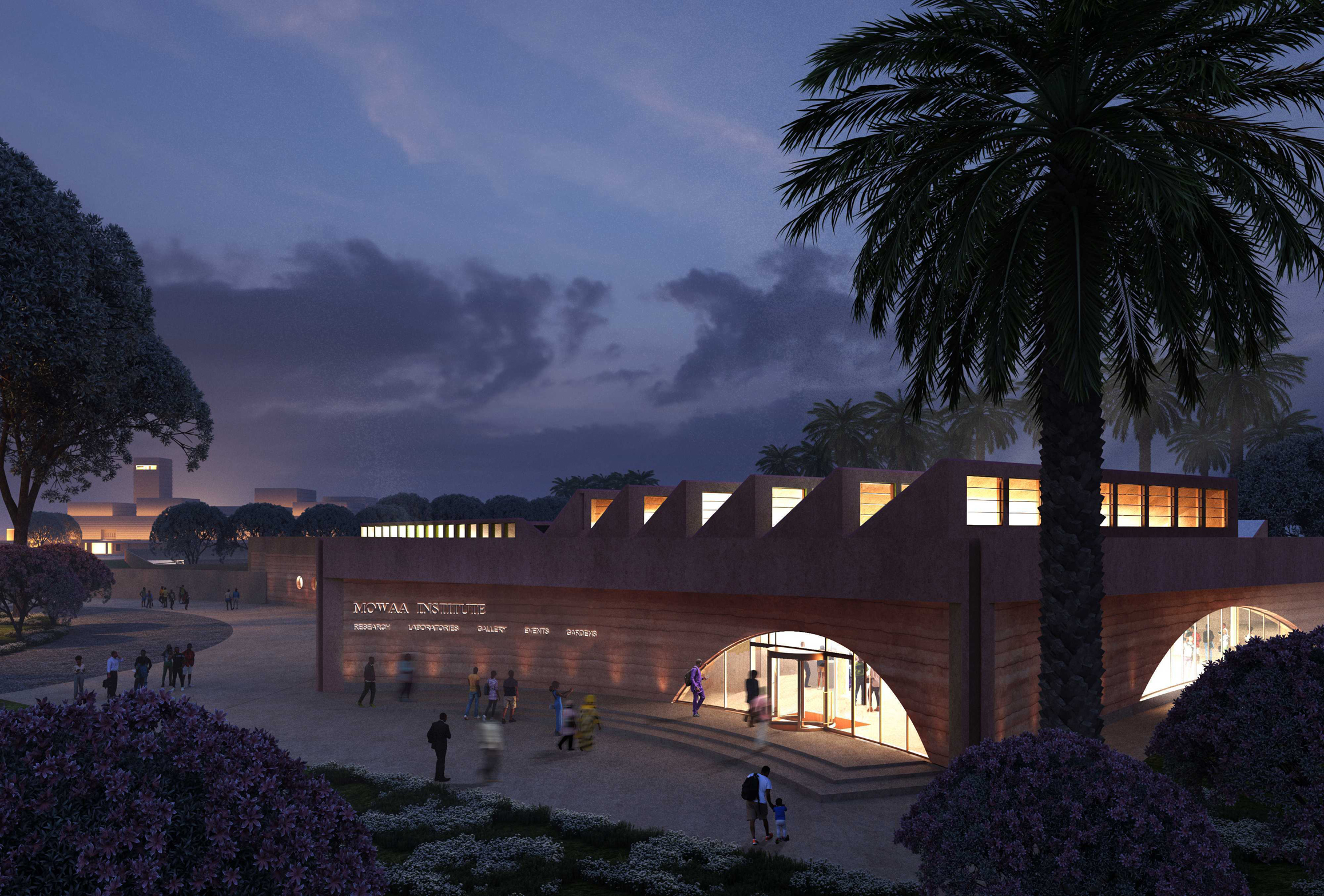
The MOWAA Institute is being constructed using locally sourced rammed earth / Image courtesy of MOWAA
Set within the boundaries of the ancient city of Benin, the Museum of West African Art (MOWAA) is made up of a collection of buildings and performance spaces set across a 15 acre campus.
MOWAA’s first building is a major archaeological facility – the MOWAA Institute – which had a ‘hard hat opening’ in November 2024. When complete, the MOWAA campus will also include the Rainforest Gallery – a purpose-built exhibition space for contemporary art; an Artisans Hall showcasing traditional cultures and products by local craftspeople; an accommodation facility for visiting academics, artists and visitors; and a material science lab, as well as artists’ studios and research and educational facilities. Outdoor spaces will include sculpture parks, memorials and gardens.
Big ambitions The idea for MOWAA was born from a need to address a lack of infrastructure that was hampering efforts to repatriate looted and stolen artefacts, including the famed Benin Bronzes. The facility will feature state-of-the-art storage facilities designed with the tropical Nigerian climate in mind, putting paid to arguments that Africa has no space and capacity to look after its heritage.
For now, MOWAA has removed itself from the ongoing debate about the ownership of any returned Benin Bronzes, with MOWAA’s director Phillip Ihenacho saying that: “[we] don’t want to get further entangled in any sort of dispute around to whom these objects should be returned… [but MOWAA is] available as and when we are needed.”
In any case, the remit of the museum has moved beyond just showcasing historic artefacts – the ambition is that it will help redefine museum practices across Africa and become a leader and collaborator in the fields of archaeology, collections management and conservation. The facility will offer training programmes using cutting edge techniques to help develop a new generation of African scholars, artists and researchers.
“We are not just a traditional museum, at all… We have shifted away from that experience that was a legacy of colonialism to something that is more relevant to Nigerians and Africans,” said Ihenacho at a press conference in November.
The independent not for profit museum has so far raised around $20m in funding from a range of sources including the state of Edo, the German and Nigerian governments, the Mellon Foundation and the British Museum.
The plan is to raise money as they go along – the whole campus is expected to cost around $100m, including construction and an endowment fund to cover operational costs.
Visitors as allies The one storey, 4,000sq m MOWAA Institute is still under construction, but launched a hard hat preview of the building in November 2024. The aim of the two-day event – which was called Museum in the Making: Rediscovering a West African identity, philosophy and practice – was not just to introduce the public to the rammed-earth building, but also to invite them to become part of the conversation about what MOWAA could become.
“This inauguration presents an opportune moment to engage others in candid, reflective discussions on what it means to be a ‘West African’ museum and how museum practices on the continent must evolve to address the realities and diverse audiences of the 21st century, moving beyond simply replicating global north models,” said MOWAA Institute’s director Ore Disu at the launch.
“It’s a conscious push for us to not have a finished product, but to leave room for other ideas to take root, to substantively inform our programmes and way of working,” added Disu. “We hope our visitors become allies in this transformative agenda and leave with a sense of the deep symbolic and historic importance of Benin City for Black and African civilizations.”
The decision to begin the MOWAA Museum project with the opening of the MOWAA Institute was a very conscious one,” says Phillip Ihenacho, executive director and chairman of MOWAA.
“It was a deliberate, strategic decision to begin with a strong foundation for artists and heritage managers and to instil a sense of collective responsibility to work together to preserve and celebrate heritage,” he adds. “The Institute is the intellectual powerhouse of all of our campus programmes.”
The MOWAA Archaeology Project As well as workshops, talks and tours of the building, the launch also involved a live archaeological dig, partly to showcase the work that’s been carried out over the past few years on the site.
The MOWAA Archaeology Project launched in December 2021 in collaboration with the British Museum, the German Archaeological Institute and the Nigerian National Commission for Museums and Monuments to carry out extensive archaeological research on the museum site.
It represents the most extensive archaeological research undertaken in Benin City since the 1960s, and is set to improve understanding of the Kingdom of Benin’s history and culture, as well as supporting the development of a new team of young Nigerian architects. The finds from this excavation will be exhibited as part of the Institute’s inaugural exhibition, which launches in May 2025.
A big focus of the new Institute is on conservation, with the directors already in talks with other museums in Nigeria and elsewhere in West Africa about their conservation needs. The aim is for MOWAA to examine existing conservation methodologies – many of which have been defined by what is needed in more temperate climates – and develop new ones.
For now, the museum is evolving, and it will be very interesting to see where the project goes.
“It was a deliberate, strategic decision to begin with a strong foundation for artists and heritage managers and to instil a sense of collective responsibility to work together to preserve and celebrate heritage” - MOWAA’s director Phillip Ihenacho
"We hope our visitors become allies in this transformative agenda and leave with a sense of the deep symbolic and historic importance of Benin City for Black and African civilizations” – MOWAA Institute’s director Ore Disu
MOWAA’s spaces
The MOWAA Institute
The 4,000sq m Institute has been designed by Adjaye Associates and features an exhibition gallery with views into the collection study area, a 180-seater auditorium, conference rooms, conservation laboratories, and a library.
The Rainforest Gallery
MOWAA’s Rainforest Gallery will feature 1,400sqm of exhibition space.
Artisans Hall
Serving as a curated retail space for local artisans to thrive economically, the Artisans Hall will showcase living and traditional cultures.
Material Science Lab
MOWAA programmes will connect with a global audience of Nigerians and other Diaspora and African communities through dialogue and education.
Art Guesthouse
The Art Guesthouse will offer short-term accommodation, serving as a creative base for visiting academics, artists, and outside visitors.
Green and outdoor spaces
In the form of sculpture parks, memorials, and gardens, MOWAA will ‘reclaim nature’ to expand shared spaces for visitors and local communities.
The MOWAA Institute will focus on archaelogical research and conservation / Image courtesy of MOWAA
Read more from this issue of Attractions Management magazine
View contents of Attractions Management 2025 issue 1
Editor's letter: A fresh perspective
As a new report argues that silence can help visitors better appreciate zoos, Magali Robathan explores a different way of operating
People: Marian Lee
As Netflix announces the launch of immersive attraction Netflix House, we hear about the plans from the company’s CMO
People: Frida Escobedo
The first woman to design a wing at the Metropolitan Museum of Art shares her vision for a more usable and welcoming space for modern and contemporary art
People: Delta Kay
Indigenous experiences are important for fostering respect, and must not be co-opted by non Indigenous operators, says Aboriginal tour guide Delta Kay
Theme parks: Bob Weis
The former president of Imagineering pulls back the curtain to give a behind the scenes look at how some of Disney’s biggest projects took shape
Museums: Space to learn
From the world’s first AI art museum to the latest cultural institution transforming a rural Japanese island... We check out some intriguing museums taking shape across the globe
Technology: Guiding light
Genell Zuciya, creator of attractions for Disney and Meow Wolf, explores the transformative power of lighting
Theme parks: Block party
Merlin meets Minecraft in a $85m deal set to bring the world’s biggest selling video game to life. Could this be Merlin’s most significant partnership?
Museums: A new dawn
The first phase of a ground-breaking new museum campus has opened in Benin City, Nigeria. Is this the future for post-colonial institutions?
Research: Quiet zoos
Could a quieter zoo environment restore zoos’ original purpose as restorative retreats for overstimulated minds? The authors of a new research paper certainly think so
A new kind of museum campus has opened its first building
in Benin City, Nigeria, aiming to reclaim African
heritage and redefine museum practices across the
continent. Magali Robathan finds out more
The MOWAA Institute is being constructed using locally sourced rammed earth / Image courtesy of MOWAA
Set within the boundaries of the ancient city of Benin, the Museum of West African Art (MOWAA) is made up of a collection of buildings and performance spaces set across a 15 acre campus.
MOWAA’s first building is a major archaeological facility – the MOWAA Institute – which had a ‘hard hat opening’ in November 2024. When complete, the MOWAA campus will also include the Rainforest Gallery – a purpose-built exhibition space for contemporary art; an Artisans Hall showcasing traditional cultures and products by local craftspeople; an accommodation facility for visiting academics, artists and visitors; and a material science lab, as well as artists’ studios and research and educational facilities. Outdoor spaces will include sculpture parks, memorials and gardens.
Big ambitions The idea for MOWAA was born from a need to address a lack of infrastructure that was hampering efforts to repatriate looted and stolen artefacts, including the famed Benin Bronzes. The facility will feature state-of-the-art storage facilities designed with the tropical Nigerian climate in mind, putting paid to arguments that Africa has no space and capacity to look after its heritage.
For now, MOWAA has removed itself from the ongoing debate about the ownership of any returned Benin Bronzes, with MOWAA’s director Phillip Ihenacho saying that: “[we] don’t want to get further entangled in any sort of dispute around to whom these objects should be returned… [but MOWAA is] available as and when we are needed.”
In any case, the remit of the museum has moved beyond just showcasing historic artefacts – the ambition is that it will help redefine museum practices across Africa and become a leader and collaborator in the fields of archaeology, collections management and conservation. The facility will offer training programmes using cutting edge techniques to help develop a new generation of African scholars, artists and researchers.
“We are not just a traditional museum, at all… We have shifted away from that experience that was a legacy of colonialism to something that is more relevant to Nigerians and Africans,” said Ihenacho at a press conference in November.
The independent not for profit museum has so far raised around $20m in funding from a range of sources including the state of Edo, the German and Nigerian governments, the Mellon Foundation and the British Museum.
The plan is to raise money as they go along – the whole campus is expected to cost around $100m, including construction and an endowment fund to cover operational costs.
Visitors as allies The one storey, 4,000sq m MOWAA Institute is still under construction, but launched a hard hat preview of the building in November 2024. The aim of the two-day event – which was called Museum in the Making: Rediscovering a West African identity, philosophy and practice – was not just to introduce the public to the rammed-earth building, but also to invite them to become part of the conversation about what MOWAA could become.
“This inauguration presents an opportune moment to engage others in candid, reflective discussions on what it means to be a ‘West African’ museum and how museum practices on the continent must evolve to address the realities and diverse audiences of the 21st century, moving beyond simply replicating global north models,” said MOWAA Institute’s director Ore Disu at the launch.
“It’s a conscious push for us to not have a finished product, but to leave room for other ideas to take root, to substantively inform our programmes and way of working,” added Disu. “We hope our visitors become allies in this transformative agenda and leave with a sense of the deep symbolic and historic importance of Benin City for Black and African civilizations.”
The decision to begin the MOWAA Museum project with the opening of the MOWAA Institute was a very conscious one,” says Phillip Ihenacho, executive director and chairman of MOWAA.
“It was a deliberate, strategic decision to begin with a strong foundation for artists and heritage managers and to instil a sense of collective responsibility to work together to preserve and celebrate heritage,” he adds. “The Institute is the intellectual powerhouse of all of our campus programmes.”
The MOWAA Archaeology Project As well as workshops, talks and tours of the building, the launch also involved a live archaeological dig, partly to showcase the work that’s been carried out over the past few years on the site.
The MOWAA Archaeology Project launched in December 2021 in collaboration with the British Museum, the German Archaeological Institute and the Nigerian National Commission for Museums and Monuments to carry out extensive archaeological research on the museum site.
It represents the most extensive archaeological research undertaken in Benin City since the 1960s, and is set to improve understanding of the Kingdom of Benin’s history and culture, as well as supporting the development of a new team of young Nigerian architects. The finds from this excavation will be exhibited as part of the Institute’s inaugural exhibition, which launches in May 2025.
A big focus of the new Institute is on conservation, with the directors already in talks with other museums in Nigeria and elsewhere in West Africa about their conservation needs. The aim is for MOWAA to examine existing conservation methodologies – many of which have been defined by what is needed in more temperate climates – and develop new ones.
For now, the museum is evolving, and it will be very interesting to see where the project goes.
“It was a deliberate, strategic decision to begin with a strong foundation for artists and heritage managers and to instil a sense of collective responsibility to work together to preserve and celebrate heritage” - MOWAA’s director Phillip Ihenacho
"We hope our visitors become allies in this transformative agenda and leave with a sense of the deep symbolic and historic importance of Benin City for Black and African civilizations” – MOWAA Institute’s director Ore Disu
MOWAA’s spaces
The MOWAA Institute
The 4,000sq m Institute has been designed by Adjaye Associates and features an exhibition gallery with views into the collection study area, a 180-seater auditorium, conference rooms, conservation laboratories, and a library.
The Rainforest Gallery
MOWAA’s Rainforest Gallery will feature 1,400sqm of exhibition space.
Artisans Hall
Serving as a curated retail space for local artisans to thrive economically, the Artisans Hall will showcase living and traditional cultures.
Material Science Lab
MOWAA programmes will connect with a global audience of Nigerians and other Diaspora and African communities through dialogue and education.
Art Guesthouse
The Art Guesthouse will offer short-term accommodation, serving as a creative base for visiting academics, artists, and outside visitors.
Green and outdoor spaces
In the form of sculpture parks, memorials, and gardens, MOWAA will ‘reclaim nature’ to expand shared spaces for visitors and local communities.
The MOWAA Institute will focus on archaelogical research and conservation / Image courtesy of MOWAA
Read more from this issue of Attractions Management magazine
View contents of Attractions Management 2025 issue 1
Editor's letter: A fresh perspective
As a new report argues that silence can help visitors better appreciate zoos, Magali Robathan explores a different way of operating
People: Marian Lee
As Netflix announces the launch of immersive attraction Netflix House, we hear about the plans from the company’s CMO
People: Frida Escobedo
The first woman to design a wing at the Metropolitan Museum of Art shares her vision for a more usable and welcoming space for modern and contemporary art
People: Delta Kay
Indigenous experiences are important for fostering respect, and must not be co-opted by non Indigenous operators, says Aboriginal tour guide Delta Kay
Theme parks: Bob Weis
The former president of Imagineering pulls back the curtain to give a behind the scenes look at how some of Disney’s biggest projects took shape
Museums: Space to learn
From the world’s first AI art museum to the latest cultural institution transforming a rural Japanese island... We check out some intriguing museums taking shape across the globe
Technology: Guiding light
Genell Zuciya, creator of attractions for Disney and Meow Wolf, explores the transformative power of lighting
Theme parks: Block party
Merlin meets Minecraft in a $85m deal set to bring the world’s biggest selling video game to life. Could this be Merlin’s most significant partnership?
Museums: A new dawn
The first phase of a ground-breaking new museum campus has opened in Benin City, Nigeria. Is this the future for post-colonial institutions?
Research: Quiet zoos
Could a quieter zoo environment restore zoos’ original purpose as restorative retreats for overstimulated minds? The authors of a new research paper certainly think so
OMA has completed a major transformation of New York's New Museum, creating a larger
cultural campus that combines expanded exhibition spaces with learning, performance,
hospitality and public programming.
A US$50 million (£44.2 million, €51.2 million) transformation of Chicago's historic McCormick
Mansion has created a new destination that combines live magic, immersive theatre, dining and
private membership under one roof.
The Montana Historical Society has officially celebrated the opening of its new Montana
Heritage
Center, a US$107 million (£79 million, €92 million) destination that combines immersive
storytelling with cutting-edge audiovisual technology to bring the sta
San Antonio Zoo has reported a US$283 million economic impact for 2025, following a decade-
long transformation programme that has seen almost US$200 million invested into the Texas
attraction.
Plans for the AU$180 million redevelopment of Reef HQ Aquarium in Townsville, Australia, are
progressing, with the project set to transform the attraction into a global centre for reef
education and conservation.
Abu Dhabi-based investment firm Mubadala Capital has made a binding, fully financed
€1 billion
offer to acquire Pierre and Vacances SA, the European holiday resort operator behind the
continental European Center Parcs business.
Disney has reaffirmed its commitment to investing US$30 billion in its US parks and cruise
business by 2033, using new America250 celebrations to underline the role its attractions play
in supporting jobs, tourism and economic growth.
Expo 2030 Riyadh is being planned as a permanent visitor destination, with organisers
confirming the six-million-square-metre site will become a Global Village after the event closes.
The owner of one of Australia's best-known waterparks has acquired a major competitor,
creating a new attractions business spanning two of the country's largest visitor destinations.
The Toverland theme park in the Netherlands has announced a €98m expansion programme
that will add a resort, new attractions and staff facilities as it pursues plans to become a multi-
day destination.
+ More news
COMPANY PROFILES
Simworx Ltd The company was initially established
in 1997. Terry Monkton and Andrew
Roberts are the key stakeh [more...]
Painting With Light By combining lighting, video, scenic and architectural elements, sound and special effects we tell s [more...]
RMA Ltd RMA Ltd is a one-stop global company
that can design, build and produce from a
greenfield site upw [more...]
Holovis Holovis is a privately owned company
established in 2004 by CEO Stuart
Hetherington. [more...]