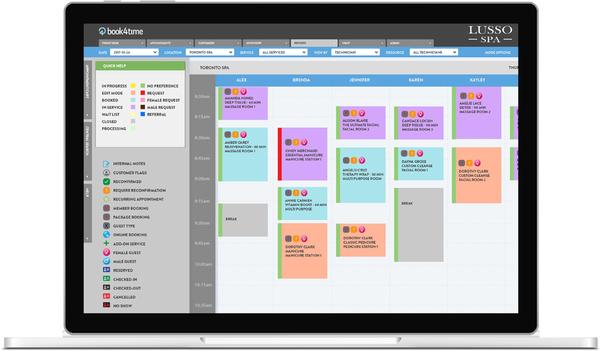
How much revenue are you losing by turning away customers? Probably more than you think You know the pain: you can’t accommodate people for any number of reasons – the client requested a specific therapist or gender that you don’t have available, or all the hot stones are booked – so you have to turn them away.
Then what happens? Roger Sholanki, CEO of Book4Time says, “An average spa loses about 15 per cent of a day’s business from turning away clients. Out of 100 appointments a day, that’s 15 appointments at $150 (£123, €140) on average.”
If you’re open year-round and closed only for Christmas and New Year’s, that’s a total revenue loss of $816,750 (£670,000, €770,000).
“A regular will probably call back,” says Sholanki, “but several studies have shown that first-time potential customers who are turned away will never call back, and that’s where you will lose the most – possibly to a local competitor.”
Current methods for dealing with this problem are ineffective: busy staff try to take notes and/or manually log the reasons for turning away customers, then management uses these logs to try to make changes to staff scheduling or facilities. This process is cumbersome and relies heavily on trial and error, leaving high potential for failure.
Imagine simplifying this process and recapturing that lost revenue.
Book4Time makes it easy to optimise your scheduling and facilities to accommodate as much business as possible in two easy steps.
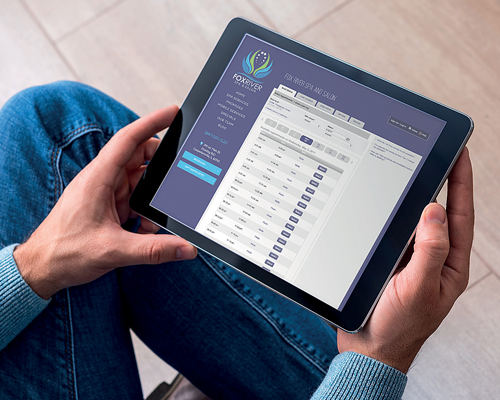
1. Collect the data Book4Time’s turn-away tracking removes the guesswork by automatically logging the reasons for every turn away. The system then creates an analytics report where managers can see exactly what’s happening.
2. Optimise Knowledge is power. Once you know why you’re turning people away, you can optimise your scheduling and facilities to accommodate the clients you’re currently losing.
Sholanki says, “With Turn-Away tracking, spas know exactly how much facial or massage business they lost last month, for example, and the system will quantify that in dollars based on services requested. So when creating your schedules, you can staff more facialists or male massage therapists, and fill that demand.”
It really is that simple.
Book4Time makes maximising your revenue a simple and painless process. You’ll never have to guess again.
For more information visit www.book4time.com
Read more from this issue of Attractions Management magazine
View contents of Attractions Management 2017 issue 2
Wellness communities: Europe
Part 2 of our series explores some of
the most exciting European wellness
communities in development
Promotional feature: Babor
CEO Michael Schummert explains how the
company’s expertise in results-driven treatments makes its precision
‘Made in Germany’ products more relevant than ever before
How much revenue are you losing by turning away customers? Probably more than you think You know the pain: you can’t accommodate people for any number of reasons – the client requested a specific therapist or gender that you don’t have available, or all the hot stones are booked – so you have to turn them away.
Then what happens? Roger Sholanki, CEO of Book4Time says, “An average spa loses about 15 per cent of a day’s business from turning away clients. Out of 100 appointments a day, that’s 15 appointments at $150 (£123, €140) on average.”
If you’re open year-round and closed only for Christmas and New Year’s, that’s a total revenue loss of $816,750 (£670,000, €770,000).
“A regular will probably call back,” says Sholanki, “but several studies have shown that first-time potential customers who are turned away will never call back, and that’s where you will lose the most – possibly to a local competitor.”
Current methods for dealing with this problem are ineffective: busy staff try to take notes and/or manually log the reasons for turning away customers, then management uses these logs to try to make changes to staff scheduling or facilities. This process is cumbersome and relies heavily on trial and error, leaving high potential for failure.
Imagine simplifying this process and recapturing that lost revenue.
Book4Time makes it easy to optimise your scheduling and facilities to accommodate as much business as possible in two easy steps.
1. Collect the data Book4Time’s turn-away tracking removes the guesswork by automatically logging the reasons for every turn away. The system then creates an analytics report where managers can see exactly what’s happening.
2. Optimise Knowledge is power. Once you know why you’re turning people away, you can optimise your scheduling and facilities to accommodate the clients you’re currently losing.
Sholanki says, “With Turn-Away tracking, spas know exactly how much facial or massage business they lost last month, for example, and the system will quantify that in dollars based on services requested. So when creating your schedules, you can staff more facialists or male massage therapists, and fill that demand.”
It really is that simple.
Book4Time makes maximising your revenue a simple and painless process. You’ll never have to guess again.
For more information visit www.book4time.com
Read more from this issue of Attractions Management magazine
View contents of Attractions Management 2017 issue 2
Wellness communities: Europe
Part 2 of our series explores some of
the most exciting European wellness
communities in development
Promotional feature: Babor
CEO Michael Schummert explains how the
company’s expertise in results-driven treatments makes its precision
‘Made in Germany’ products more relevant than ever before
London Museum will open four new food and drink destinations when it launches its new home
at Smithfield on 28 November, making hospitality a central part of the visitor experience at one
of the capital's biggest cultural openings of the year.
OMA has completed a major transformation of New York's New Museum, creating a larger
cultural campus that combines expanded exhibition spaces with learning, performance,
hospitality and public programming.
A US$50 million (£44.2 million, €51.2 million) transformation of Chicago's historic McCormick
Mansion has created a new destination that combines live magic, immersive theatre, dining and
private membership under one roof.
The Montana Historical Society has officially celebrated the opening of its new Montana
Heritage
Center, a US$107 million (£79 million, €92 million) destination that combines immersive
storytelling with cutting-edge audiovisual technology to bring the sta
San Antonio Zoo has reported a US$283 million economic impact for 2025, following a decade-
long transformation programme that has seen almost US$200 million invested into the Texas
attraction.
Plans for the AU$180 million redevelopment of Reef HQ Aquarium in Townsville, Australia, are
progressing, with the project set to transform the attraction into a global centre for reef
education and conservation.
Abu Dhabi-based investment firm Mubadala Capital has made a binding, fully financed
€1 billion
offer to acquire Pierre and Vacances SA, the European holiday resort operator behind the
continental European Center Parcs business.
Disney has reaffirmed its commitment to investing US$30 billion in its US parks and cruise
business by 2033, using new America250 celebrations to underline the role its attractions play
in supporting jobs, tourism and economic growth.
Expo 2030 Riyadh is being planned as a permanent visitor destination, with organisers
confirming the six-million-square-metre site will become a Global Village after the event closes.
The owner of one of Australia's best-known waterparks has acquired a major competitor,
creating a new attractions business spanning two of the country's largest visitor destinations.