Opened in June 2024, the Story of Emily celebrates the life of Emily Hobhouse, a Victorian welfare campaigner who exposed the truth about Britain’s brutal treatment of civilians in concentration camps during the South African Anglo-Boer War at the turn of the 20th century. While Hobhouse is widely celebrated in South Africa – she was made an honorary citizen and several museums commemorate her life – she was labelled a traitor in the UK, and has been largely written out of history.
Now this museum is shining a spotlight on the courage and humanity of Hobhouse.
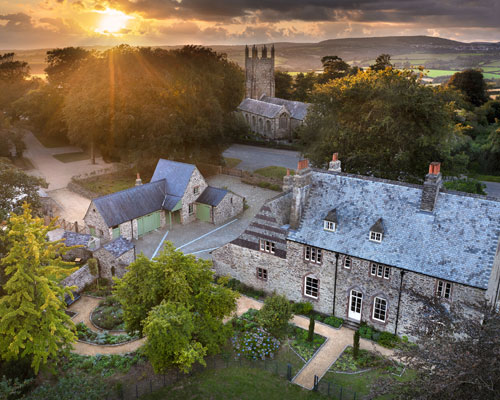
The attraction has been created by author, journalist and historian Elsabé Brits, together with South African investors Karen Roos and Koos Bekker, who bought the Grade II listed rectory and 40-acre estate that Hobhouse grew up in back in 2018. Roos and Bekker are known for five star winery, hotel and spa Babylonstoren in their native South Africa, and five star hotel the Newt in Somerset, UK.
In 2025, Story of Emily attracted 20,000 visitors, and has won a slew of awards, including a Thea Outstanding Achievement award – the only UK recipient of the award at the 32nd annual event – and RIBA South West and Wessex Building of the Year Award 2025.
The attraction is divided into two main parts. The story of the first 34 years of Hobhouse’s life is told in the home that she grew up in, which has been meticulously restored back to the way it would have been in 1875, when she was 15. The War Rooms are housed in a separate building, designed by architects Stonewood Design, and tell the story of the Anglo-Boer War and the concentration camps using AV, VR, film, artefacts and more.
Here Elsabe Brits shares the story of how this attraction came about
How did you get involved with the Story of Emily?
I became involved right at the start in 2017 with the concept. I provided the research for the attraction, wrote the storyline for the War Rooms and Rectory, and sourced the décor and artefacts. I have been fascinated by Emily Hobhouse since I began researching her in 2013. It’s been a wonderful journey.
This is a personal story for me – most of my ancestors were involved in the Boer war. They lost their possessions as a result of Kitchener’s scorched-earth policy, and the women and children were sent to concentration camps. I have a diary of my great-grandfather, which he wrote while a prisoner of war in Ceylon, as well as artwork he created there. One of my great-grandmothers experienced the Krugersdorp concentration camp [which Emily Hobhouse visited and documented the appalling conditions of] with her mother and siblings.
history blends with cutting-edge technology to create a fascinating immersive experience
One of the biggest impacts of the war is not only the loss of life and possessions, but also the psychological trauma that lasted for decades.
Why is Emily Hobhouse a good subject for a museum?
She is perfect for a museum, because her story is so unique. Emily Hobhouse was a woman who grew up in the Victorian era and was seen as a failure because she was unmarried and childless, but who had the moral courage to challenge the mighty British Empire about its conduct during the Boer War.
As a pacifist, she felt an ethical and moral obligation to help the women and children during the war. And she did it practically alone, in an era when it was extraordinary - even frowned upon - for a woman to do so, and during a war when jingoism was very popular. Most of her own people called her a traitor, yet she never backed down, even though it had a heavy personal impact on her.
She changed the course of history.
How would you describe the Story of Emily and what it offers?
One has to experience its uniqueness in person. We have the fully restored mid-Victorian home where Emily Hobhouse was born and lived. A restaurant offering South African heritage cuisine. And then the War Rooms, which are fully immersive and tell the story of Hobhouse, her journey to South Africa, and the way she saved thousands of women and children during the Anglo-Boer War. It blends the historical with the modern.
What sets it apart from other attractions?
In the War Rooms, history blends with cutting-edge technology to create a fascinating immersive experience. Visitors can discover installations, animation, film, and virtual reality, and see décor, historical pictures, and artefacts. This unique, sensory journey shares the resolve and courage of Hobhouse and the women and children before, during and after the Anglo-Boer War.
What was your starting point when designing and curating the content for the museum?
I worked with architects from Stonewood Design and a design team from Kossmanndejong. The starting point was to create a storyline with the messages we wanted to convey. This changed several times. Once this was determined, we decided where to use animations, light boxes, photographs, and films. In the meantime, I began collecting the décor and artefacts. It became difficult when we had several balls in the air, and the story had to be rewritten several times.
One challenge that we successfully overcame was installing a 20m glass wall in our restaurant
What were the biggest challenges of the project?
One challenge that we successfully overcame was installing a 20m glass wall in our restaurant. This is actually the longest single pane of glass that can be produced in Europe – it was transported to The Story of Emily site on an articulated lorry in September 2022. The 20m glass wall weighs 8434kg and required a 500-ton crane to lift it into place. Because of the necessary position of the crane, the lift was blind and instructions were given by radio. It was a nerve-racking day and involved a big team but the results of our beautiful light-filled restaurant speak for themselves.
Do you have a favourite part of the museum?
I am most proud of the concentration camp we recreated inside the War Rooms. I hand sourced every single article and artefact in that room – I did so for the other rooms as well, but that one was particularly important because I want visitors to really feel they’re in a concentration camp. It was the most challenging space to create, but I’m proud of the result.
How has the attraction been received? Have you had any interesting reactions from visitors?
We have had wonderful feedback. An overwhelming majority of people comment that they have never heard of Emily Hobhouse, but are happy to learn that herstory is now told. Many knew about the Anglo-Boer War, but were unaware of aspects such as the scorched earth policy and the concentration camps, and of Hobhouse’s role in alleviating the suffering of women and children.
All of our recent award wins recognise the traction that we are proud to have achieved in a short space of time. We have been extremely pleased with the visitor numbers – 20,000 in the last year – who deeply connect and engage with the experience on every visit.
What are the plans going forward?
Our main focus now is on building our brand and awareness nationally.