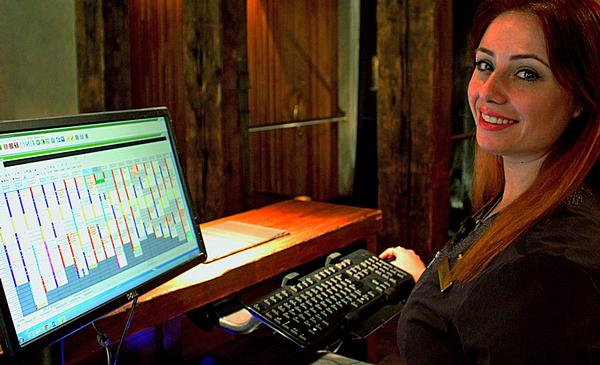
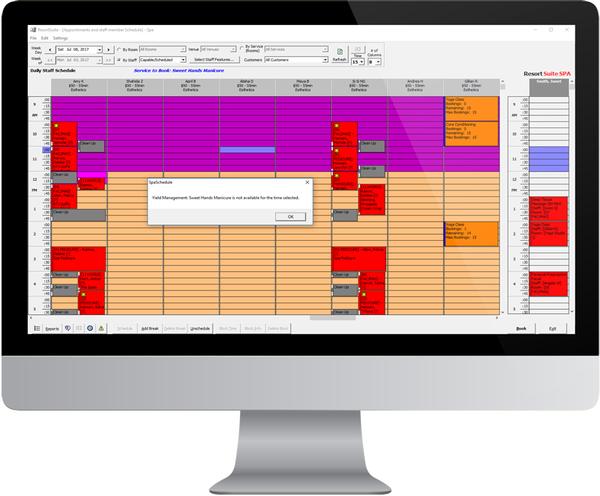
Nemacolin Woodlands Spa uses SpaSoft to create reporting on both demand and production
If you’ve ever booked a flight, you’ll be familiar with revenue management – a technique employed by the airline industry since the 1980s to maximise revenue during periods of high demand, ensure the greatest amount of inventory is fulfilled during off-peak times, and increase profits in the process. Essentially, it’s about selling the right product to the right customer at the right time and at the right price. The spa industry, with its periods of variable demand, has long been a contender to reap the benefits of this strategy. Spa software companies are helping spas take the leap.
Dynamic techniques According to Frank Pitsikalis, founder and CEO of software company ResortSuite, the spa industry shares many of the attributes that make revenue management such a success in the travel and leisure industries, including sales via reservation, a segmented customer base, a perishable inventory – and the ability to use price as a driver of purchasing behaviour.
Spas have the potential to leverage the rewards of revenue management by employing key techniques like dynamic pricing and dynamic availability. However, many spa managers or owners are put off by the perceived complexity of their operations, which can include a huge variety of treatment types, mixed use of facilities, diverse consumer demographics and issues around competition. So it’s no surprise that most spas are still offering the same services for the same amount of time and at the same prices – even during their most high-demand periods.
Dynamic pricing, that favourite of the airline industry, involves altering the price based on capacity, time, or both, and can be applied in a spa by offering services at a reduced price during low-peak times in order to encourage an increase in volume. It might mean offering discounted rates during weekday afternoons, for example – but there can be a tricky balance between price reductions and what the subsequent increase in volume needs to be to positively impact the overall margins.
This is where spa software comes into its own. As Amanda Wisell, marketing manager at spa technology company SpaSoft, part of Springer-Miller Systems, says: “Spas are looking for dynamic pricing that is both easy to set up and automated, so they don’t have to think about it once the pricing is deployed. SpaSoft offers reporting on both demand and production to help spas analyse their business so that they know how to dynamically price their offerings. Spas will see increased revenue during periods of high demand and increased bookings during times of low demand.”
This has proved successful for SpaSoft client Nemacolin Woodlands Resort in Pennsylvania, US. “SpaSoft’s Revenue Projection Report is our most commonly used tool,” says assistant spa director Miranda Henning. “It allows us to compare what is currently on our books with our budget. If we see we’re falling short throughout the month, we choose our lower volume days to promote the spa and offer lower rates to generate revenue.”
Dynamic availability, on the other hand, aims to increase profits by managing the mix of services on offer. A spa might achieve this by shortening its menu to higher margin services, or not offering longer services during peak times.
“There are good reasons why you would change your menu mix based on periods of demand,” explains ResortSuite’s Pitsikalis. “By cutting off longer services or lower-margin services during your peak times, you’ll actually service more guests. This results in more retail opportunities and higher guest satisfaction – and selling more services that have a higher drag on your retail sales can also generate substantially higher revenues overall.”
Spa revenue management has been part of the Miraval business model for five years, as ResortSuite customer Cecil Hopper, director of revenue management at the iconic destination spa in Arizona, explains: “Like most spas, during our peak hours, unconstrained demand far exceeds capacity. As operators, we’re tasked with designing a menu that supports the optimisation of profit during these high-demand hours, and occupancy in off-peak periods. ResortSuite’s yield function, in combination with a granular menu analysis, allows us to deliver the right treatment to the right guest at the right time in an automated fashion.”
Know your business metrics With no mathematical formula or one-size-fits-all approach, Pitsikalis maintains that the key to the successful implementation of any revenue management strategy is in the careful analysis and thorough understanding of a spa’s current business metrics, a principle shared by spa software companies across the board.
The Assistant Company’s (TAC) managing director Guenther Poellabauer agrees. “Our spa management software helps with effective resource management of rooms, staff and equipment, economical slot optimisation, and the savvy optimisation of pre- and wrap-up times or smart low-high demand planning. By analysing booking history and reports and forecasting customer behaviour, it’s possible to allocate the right resources.”
So how can a spa operator navigate through the complexities and apply the right techniques for their own business? Before the word ‘profitability’ can be uttered, a spa needs to get to grips with an assessment of its current operations, so that a baseline for measuring the success of any new strategies can be established. This should include peak periods, staff usage and availability, margins on services, and usage of multi-purpose treatment rooms, together with the current overall profit performance. Spa software solutions can help improve a spa’s revenue management by providing an overview of the business metrics so that the best techniques can be automated and applied.
Josh McCarter, CEO of spa management software company Booker, says: “Booker gives spa owners reporting tools so that they can get a very clear picture of their financial performance, including which services, providers, products, and times of day are most profitable. Owners and managers who study their data can make better decisions about their business, including when to add or remove low profitability products or services, and when to change pricing.”
Likewise, as Stephanie Moran, senior vice president of sales at software provider Mindbody, explains: “Most often spa operator customers are asking for a streamlined way to look at reports and data. We’re currently working with a partner, iKizmet, which integrates with our software to take a business’s data and visualise its business potential for that particular spa operator. This gives the operator the best understanding of what’s happening behind the business.”
Every spa is different, but by having an in-depth understanding of the business, together with the right software platform in place to manage specific techniques, the right programme can be created for any given operation. So what are spa operators asking for when it comes to revenue management software?
Choose the right tools “Predictive reporting always tops the list,” says Premier Software’s chief operating officer Leonie Wileman. “Real-time reporting, in particular, is essential for revenue managers, and once a spa has used the software over several months, they can use a variety of reports to predict future trends. Reports that use data in different ways to help improve yield and determine pricing structures that are attractive, but competitive, are also key.”
Premier Software client Nick McIvor, group revenue manager at UK-based Ramside Estates, has adopted a revenue mindset since their spa opened in 2015: “We’ve always had pricing and availability controls in place, in one way or another,” he explains. “However, once our spa had reached maturity, we were able to more accurately identify our market segments and demand trends, which allowed us to constantly evolve our spa revenue management strategy. Now our range of control systems are quite complex.”
To the uninitiated, dynamic pricing might seem like a dark art, but if you have the right software in place to set the right rules for your business operations, then the management systems should all fall into place. “You have to strike a balance between discounting at the right time and for the right yields,” says Stefan Drummond, founder and managing director of software solution provider EZ Runner. “Our flexible pricing table allows different price levels to be configured on different days of the week. In addition, the software holds all history and spend patterns, so by running certain reports you can assess the best course of action, and apply more of an analytical action.”
Helen Wynne, health club and spa project manager at UK-based Hand Picked Hotels, an EZ Runner customer, has been using dynamic pricing and availability for over 10 years. “It’s been extremely positive,” she says. “It provides us with the ability to run various business reports to look at our average rates and yields.”
Many spas have revenue management programmes working alongside their marketing strategy, and increasing numbers of operators are looking to implement smart automated marketing tools that comb through a spa’s customer and financial data to determine when to offer discounts – and how aggressive that discount should be, based on the situation. Booker’s McCarter adds: “Tools like Booker’s Frederick automate the process via artificial intelligence, allowing spa operators to manage their appointment yield and fill slow times by sending automated offers and appointment reminders to customers who are most likely to take action and come back in.”
Brigham Dallas, founder of Arizona, US-based Sugar Me Wax salon, has been making full use of Booker’s Frederick for almost a year now to offer dynamic pricing during slower time periods: “We use the boosts, which last a day or two, and we almost always get responses,” says Dallas. “Before we had Frederick from Booker, we didn’t do any dynamic pricing, just email promotions and text messages, but with a boost once or twice a month, we’re seeing an increase in appointments made and profitability across all of our Sugar Me Wax salons. It’s exactly what we needed. We’re seeing about $1,000 to $2,000 in additional revenue each month per salon – just from Frederick boosts alone.”
There might not be a magic equation or set method available to spa operators when it comes to implementing revenue management techniques, but those that have made the leap have seen a positive impact on their businesses. As Ramside Estates’ McIvor explains: “We implemented a new revenue management strategy in November 2016, and since then, we’ve achieved an increase in turnover by 40 per cent. We’re constantly trying to achieve the best yield by forecasting, controlling and manipulating prices for spa day guests, treatment guests, hotel residents and spa members in the facility at each time slot to make sure we are striking the balance that delivers us the highest return.”
Customer comes first In an industry where guest experience is key, the customer’s perception of any business strategy needs to be thought through carefully. One of the key concerns for spa operators in using dynamic pricing or availability is that the very techniques that are used to boost profitability might alter customer behaviour enough to lead them to undervalue the service.
“There are always concerns that customers will get used to paying discounted prices and undervalue a service if they see too many offers and promotions,” explains Booker’s McCarter. “Tools that allow easy customisation of offers reduce that risk by directing communications about promotional pricing to specific customer groups.”
Miraval’s Hopper agrees: “The primary challenge with spa revenue management is adapting the sales culture of spa and reservations to see this as a benefit to the consumer, rather than a tactic to optimise profit,” he explains. “Once colleagues are on board and can represent availability with confidence, negative consumer perception becomes minimal.”
Future proof And what of the future? As spa software continues to evolve, how will revenue management techniques get easier for operators? Premier Software’s Wileman envisages that most bookings and communications will be carried out online in the not-too-distant future, which means the actual spa experience will need to deliver more. “As all bookings move online, the experience changes from personal to virtual, and spas will be under pressure to provide the ultimate experience, as reviews will play a large part in repeat business,” she explains. “As clients demand more, a spa’s software system must be able to pre-empt a client’s next move, and also integrate with the latest social media platforms.”
TAC’s Poellabauer believes that flexibility is key. “Millennials are striving for self-optimisation and self-determination, especially when it comes to planning their leisure activities,” he explains. “They’re more flexible and spontaneous, and they appreciate their work-life balance. Treatments such as early-bird sessions before work or quick lunch massages, as well as dynamic packages, will be of more value than appointments that have to be booked months in advance. This flexibility will be rewarded with attractive prices.”
As customer behaviour evolves, spa software needs to be adaptable to changing business requirements, helping operators meet upcoming trends and client-spending habits head-on.
Read more from this issue of Attractions Management magazine
View contents of Attractions Management 2017 issue 3
Promotional feature: Elemis - Deep Benefits
With its market-leading Pro-Collagen skincare products already
a worldwide success, Elemis has further expanded its premium
anti-ageing range with a potent new seaweed-based Marine Oil
Promotional feature: RKF - a touch of luxury
As a global leader in the field of luxury
fabrics for spas and hospitality, RKF
is known for pushing the boundaries
of design and function. We find out
about the company's latest work
An opportunity to reimagine one of the UK’s most recognisable towers has been formally
opened by Rivington Hark, as St Johns Beacon invites operators and partners to shape its
next phase. [more...]
Nemacolin Woodlands Spa uses SpaSoft to create reporting on both demand and production
If you’ve ever booked a flight, you’ll be familiar with revenue management – a technique employed by the airline industry since the 1980s to maximise revenue during periods of high demand, ensure the greatest amount of inventory is fulfilled during off-peak times, and increase profits in the process. Essentially, it’s about selling the right product to the right customer at the right time and at the right price. The spa industry, with its periods of variable demand, has long been a contender to reap the benefits of this strategy. Spa software companies are helping spas take the leap.
Dynamic techniques According to Frank Pitsikalis, founder and CEO of software company ResortSuite, the spa industry shares many of the attributes that make revenue management such a success in the travel and leisure industries, including sales via reservation, a segmented customer base, a perishable inventory – and the ability to use price as a driver of purchasing behaviour.
Spas have the potential to leverage the rewards of revenue management by employing key techniques like dynamic pricing and dynamic availability. However, many spa managers or owners are put off by the perceived complexity of their operations, which can include a huge variety of treatment types, mixed use of facilities, diverse consumer demographics and issues around competition. So it’s no surprise that most spas are still offering the same services for the same amount of time and at the same prices – even during their most high-demand periods.
Dynamic pricing, that favourite of the airline industry, involves altering the price based on capacity, time, or both, and can be applied in a spa by offering services at a reduced price during low-peak times in order to encourage an increase in volume. It might mean offering discounted rates during weekday afternoons, for example – but there can be a tricky balance between price reductions and what the subsequent increase in volume needs to be to positively impact the overall margins.
This is where spa software comes into its own. As Amanda Wisell, marketing manager at spa technology company SpaSoft, part of Springer-Miller Systems, says: “Spas are looking for dynamic pricing that is both easy to set up and automated, so they don’t have to think about it once the pricing is deployed. SpaSoft offers reporting on both demand and production to help spas analyse their business so that they know how to dynamically price their offerings. Spas will see increased revenue during periods of high demand and increased bookings during times of low demand.”
This has proved successful for SpaSoft client Nemacolin Woodlands Resort in Pennsylvania, US. “SpaSoft’s Revenue Projection Report is our most commonly used tool,” says assistant spa director Miranda Henning. “It allows us to compare what is currently on our books with our budget. If we see we’re falling short throughout the month, we choose our lower volume days to promote the spa and offer lower rates to generate revenue.”
Dynamic availability, on the other hand, aims to increase profits by managing the mix of services on offer. A spa might achieve this by shortening its menu to higher margin services, or not offering longer services during peak times.
“There are good reasons why you would change your menu mix based on periods of demand,” explains ResortSuite’s Pitsikalis. “By cutting off longer services or lower-margin services during your peak times, you’ll actually service more guests. This results in more retail opportunities and higher guest satisfaction – and selling more services that have a higher drag on your retail sales can also generate substantially higher revenues overall.”
Spa revenue management has been part of the Miraval business model for five years, as ResortSuite customer Cecil Hopper, director of revenue management at the iconic destination spa in Arizona, explains: “Like most spas, during our peak hours, unconstrained demand far exceeds capacity. As operators, we’re tasked with designing a menu that supports the optimisation of profit during these high-demand hours, and occupancy in off-peak periods. ResortSuite’s yield function, in combination with a granular menu analysis, allows us to deliver the right treatment to the right guest at the right time in an automated fashion.”
Know your business metrics With no mathematical formula or one-size-fits-all approach, Pitsikalis maintains that the key to the successful implementation of any revenue management strategy is in the careful analysis and thorough understanding of a spa’s current business metrics, a principle shared by spa software companies across the board.
The Assistant Company’s (TAC) managing director Guenther Poellabauer agrees. “Our spa management software helps with effective resource management of rooms, staff and equipment, economical slot optimisation, and the savvy optimisation of pre- and wrap-up times or smart low-high demand planning. By analysing booking history and reports and forecasting customer behaviour, it’s possible to allocate the right resources.”
So how can a spa operator navigate through the complexities and apply the right techniques for their own business? Before the word ‘profitability’ can be uttered, a spa needs to get to grips with an assessment of its current operations, so that a baseline for measuring the success of any new strategies can be established. This should include peak periods, staff usage and availability, margins on services, and usage of multi-purpose treatment rooms, together with the current overall profit performance. Spa software solutions can help improve a spa’s revenue management by providing an overview of the business metrics so that the best techniques can be automated and applied.
Josh McCarter, CEO of spa management software company Booker, says: “Booker gives spa owners reporting tools so that they can get a very clear picture of their financial performance, including which services, providers, products, and times of day are most profitable. Owners and managers who study their data can make better decisions about their business, including when to add or remove low profitability products or services, and when to change pricing.”
Likewise, as Stephanie Moran, senior vice president of sales at software provider Mindbody, explains: “Most often spa operator customers are asking for a streamlined way to look at reports and data. We’re currently working with a partner, iKizmet, which integrates with our software to take a business’s data and visualise its business potential for that particular spa operator. This gives the operator the best understanding of what’s happening behind the business.”
Every spa is different, but by having an in-depth understanding of the business, together with the right software platform in place to manage specific techniques, the right programme can be created for any given operation. So what are spa operators asking for when it comes to revenue management software?
Choose the right tools “Predictive reporting always tops the list,” says Premier Software’s chief operating officer Leonie Wileman. “Real-time reporting, in particular, is essential for revenue managers, and once a spa has used the software over several months, they can use a variety of reports to predict future trends. Reports that use data in different ways to help improve yield and determine pricing structures that are attractive, but competitive, are also key.”
Premier Software client Nick McIvor, group revenue manager at UK-based Ramside Estates, has adopted a revenue mindset since their spa opened in 2015: “We’ve always had pricing and availability controls in place, in one way or another,” he explains. “However, once our spa had reached maturity, we were able to more accurately identify our market segments and demand trends, which allowed us to constantly evolve our spa revenue management strategy. Now our range of control systems are quite complex.”
To the uninitiated, dynamic pricing might seem like a dark art, but if you have the right software in place to set the right rules for your business operations, then the management systems should all fall into place. “You have to strike a balance between discounting at the right time and for the right yields,” says Stefan Drummond, founder and managing director of software solution provider EZ Runner. “Our flexible pricing table allows different price levels to be configured on different days of the week. In addition, the software holds all history and spend patterns, so by running certain reports you can assess the best course of action, and apply more of an analytical action.”
Helen Wynne, health club and spa project manager at UK-based Hand Picked Hotels, an EZ Runner customer, has been using dynamic pricing and availability for over 10 years. “It’s been extremely positive,” she says. “It provides us with the ability to run various business reports to look at our average rates and yields.”
Many spas have revenue management programmes working alongside their marketing strategy, and increasing numbers of operators are looking to implement smart automated marketing tools that comb through a spa’s customer and financial data to determine when to offer discounts – and how aggressive that discount should be, based on the situation. Booker’s McCarter adds: “Tools like Booker’s Frederick automate the process via artificial intelligence, allowing spa operators to manage their appointment yield and fill slow times by sending automated offers and appointment reminders to customers who are most likely to take action and come back in.”
Brigham Dallas, founder of Arizona, US-based Sugar Me Wax salon, has been making full use of Booker’s Frederick for almost a year now to offer dynamic pricing during slower time periods: “We use the boosts, which last a day or two, and we almost always get responses,” says Dallas. “Before we had Frederick from Booker, we didn’t do any dynamic pricing, just email promotions and text messages, but with a boost once or twice a month, we’re seeing an increase in appointments made and profitability across all of our Sugar Me Wax salons. It’s exactly what we needed. We’re seeing about $1,000 to $2,000 in additional revenue each month per salon – just from Frederick boosts alone.”
There might not be a magic equation or set method available to spa operators when it comes to implementing revenue management techniques, but those that have made the leap have seen a positive impact on their businesses. As Ramside Estates’ McIvor explains: “We implemented a new revenue management strategy in November 2016, and since then, we’ve achieved an increase in turnover by 40 per cent. We’re constantly trying to achieve the best yield by forecasting, controlling and manipulating prices for spa day guests, treatment guests, hotel residents and spa members in the facility at each time slot to make sure we are striking the balance that delivers us the highest return.”
Customer comes first In an industry where guest experience is key, the customer’s perception of any business strategy needs to be thought through carefully. One of the key concerns for spa operators in using dynamic pricing or availability is that the very techniques that are used to boost profitability might alter customer behaviour enough to lead them to undervalue the service.
“There are always concerns that customers will get used to paying discounted prices and undervalue a service if they see too many offers and promotions,” explains Booker’s McCarter. “Tools that allow easy customisation of offers reduce that risk by directing communications about promotional pricing to specific customer groups.”
Miraval’s Hopper agrees: “The primary challenge with spa revenue management is adapting the sales culture of spa and reservations to see this as a benefit to the consumer, rather than a tactic to optimise profit,” he explains. “Once colleagues are on board and can represent availability with confidence, negative consumer perception becomes minimal.”
Future proof And what of the future? As spa software continues to evolve, how will revenue management techniques get easier for operators? Premier Software’s Wileman envisages that most bookings and communications will be carried out online in the not-too-distant future, which means the actual spa experience will need to deliver more. “As all bookings move online, the experience changes from personal to virtual, and spas will be under pressure to provide the ultimate experience, as reviews will play a large part in repeat business,” she explains. “As clients demand more, a spa’s software system must be able to pre-empt a client’s next move, and also integrate with the latest social media platforms.”
TAC’s Poellabauer believes that flexibility is key. “Millennials are striving for self-optimisation and self-determination, especially when it comes to planning their leisure activities,” he explains. “They’re more flexible and spontaneous, and they appreciate their work-life balance. Treatments such as early-bird sessions before work or quick lunch massages, as well as dynamic packages, will be of more value than appointments that have to be booked months in advance. This flexibility will be rewarded with attractive prices.”
As customer behaviour evolves, spa software needs to be adaptable to changing business requirements, helping operators meet upcoming trends and client-spending habits head-on.
Read more from this issue of Attractions Management magazine
View contents of Attractions Management 2017 issue 3
Promotional feature: Elemis - Deep Benefits
With its market-leading Pro-Collagen skincare products already
a worldwide success, Elemis has further expanded its premium
anti-ageing range with a potent new seaweed-based Marine Oil
Promotional feature: RKF - a touch of luxury
As a global leader in the field of luxury
fabrics for spas and hospitality, RKF
is known for pushing the boundaries
of design and function. We find out
about the company's latest work
A new immersive attraction designed to transport visitors into the final hours of ancient Pompeii
is preparing to open near the world-famous archaeological site in southern Italy.
Experience design company, BRC Imagination Arts, has completed a transition that sees founder
Bob Rogers pass ownership of the business to four long-serving senior executives, while
remaining actively involved with the company.
Movie Park Germany has opened a new Paramount Pictures-themed attraction as part of its 30th
anniversary celebrations, using immersive storytelling and adaptive reuse to reinforce the park’s
longstanding “Hollywood in Germany” positioning.
Therme Manchester’s 28-acre development, which will include interconnected glass pavilions
that measure 65,000sq m, will be the largest bathing and wellbeing attraction in the world once
complete, according to prof David Russell, CEO of Therme UK.
Efteling has opened Hooghmoed, a new family drop tower designed to broaden the appeal of its
recently launched Sirene Island themed area and introduce younger visitors to thrill attractions.
A proposed Puy du Fou development near Bicester and Universal Destinations and Experiences’
planned resort in Bedford are emerging as part of a wider transformation of the Oxford–
Cambridge Growth Corridor into a major centre for UK leisure and tourism inv
Shedd Aquarium has opened the Immersion Theater developed in partnership with SimEx-
Iwerks, as part of a wider strategy to enhance the guest experience and create additional
revenue opportunities.
The UK government has announced a temporary reduction in VAT on visitor attractions and
children’s meals as part of a summer cost-of-living support package designed to stimulate the
visitor economy and encourage family days out.
As designer Yinka Ilori prepares for his first solo gallery show in London, he speaks exclusively
to CLADmag about his mission to spread joy, the power of play, and his bold approach to using
colour (including the colours you won’t see in his work).
The government of Thailand is exploring plans for a THB300bn (£6.3bn, US$8.3bn)
entertainment complex in the country’s Eastern Economic Corridor (EEC), with officials
proposing a large-scale theme park and sports destination as part of a broader tourism and
economic development strategy.
An opportunity to reimagine one of the UK’s most recognisable towers has been formally
opened by Rivington Hark, as St Johns Beacon invites operators and partners to shape its
next phase. [more...]