Construction marvel: 16 floors are below ground level and two are under water
In China’s cities, everything is noisy. Horns beep constantly, people play games on their phones at loud volumes and without earphones, the sound of construction work is ubiquitous, and shop speakers blare out promotions on repeat. Noise pollution is everywhere, all day and all night. So arriving at the InterContinental Shanghai Wonderland Hotel, you quickly notice – it’s peaceful.
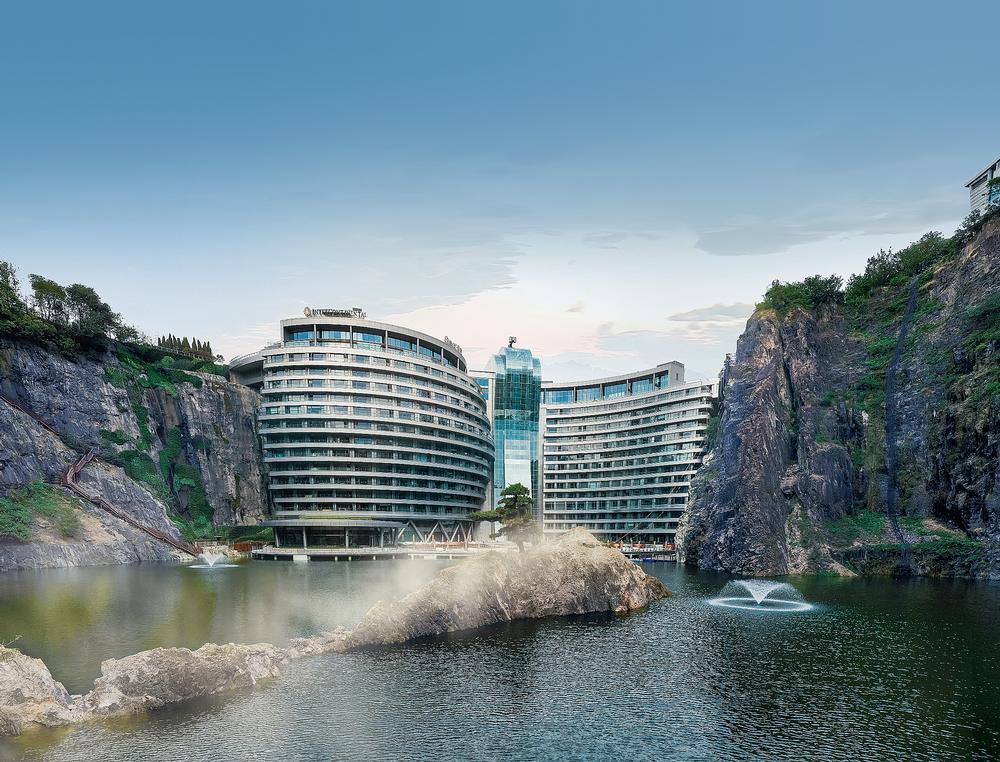
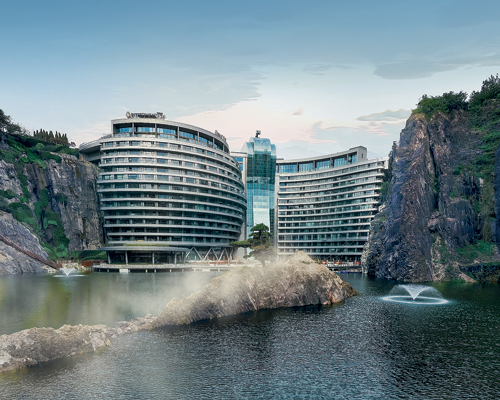
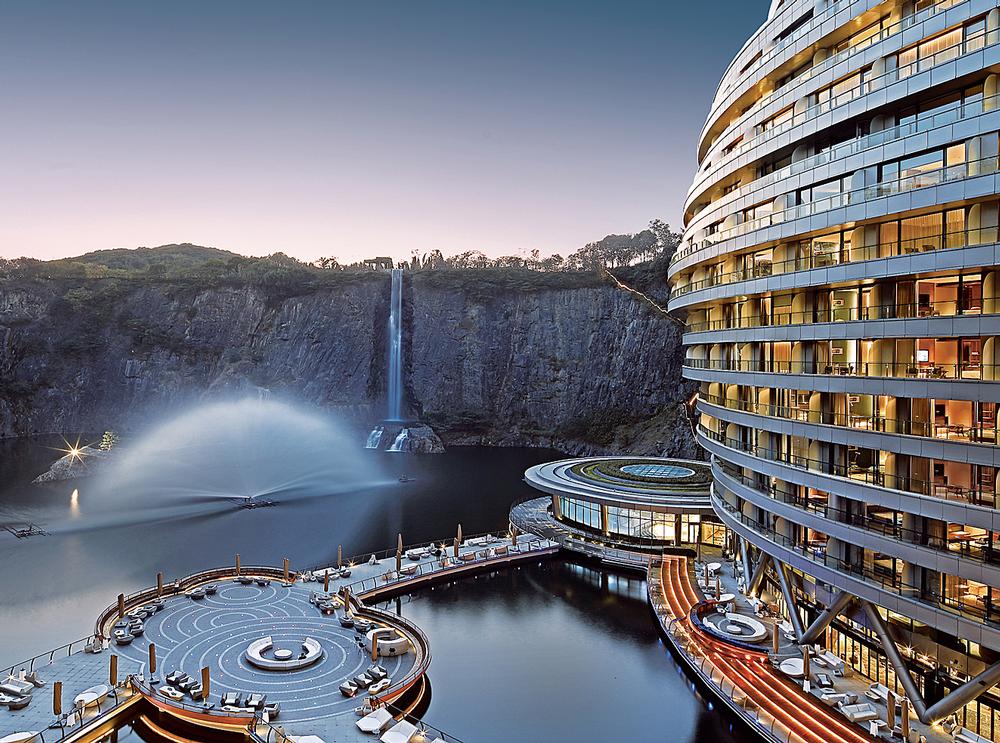
The long-awaited development, also known as the Quarry Hotel, sits in an abandoned mine in the Sheshan Mountain Range about an hour from Shanghai. Conceived by Atkins for Chinese developer Shimao Group back in 2006 and completed by JADE+QA Architects, the US$300m (€265.5m, £229.m) resort finally opened in November 2018. The huge 337-room hotel pushes construction to its limits as it hugs the cliff and delves into the rocky basin – 16 of the 18 floors are below ground level and two are submerged in water.
The approach to the lobby is deceptive. The tip of the silver building arches just above the ground behind a white sculpture, giving nothing away. It’s not until you enter the glass elevator that it becomes clear you’re on the top floor, and though you push the button for the 11th floor, the elevator is going down.
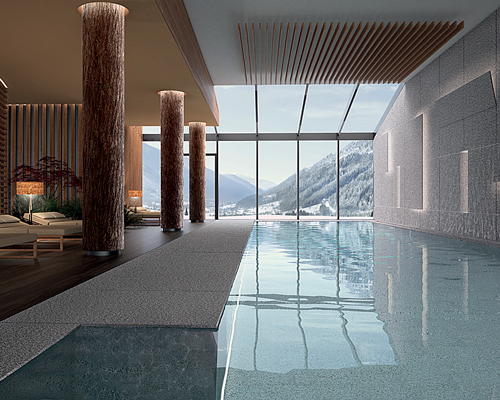
Far from the sounds of traffic, it’s peaceful and tranquil, but there’s plenty to do. Even though I stayed on a Sunday, guests included lots of families and couples. Billed as a leisure complex, guests can take a dip in the futuristic-designed pool, try kayaking and paddleboarding on the lake at the bottom of the quarry or, for the more adventurous, scale the cliff face in a rock climbing session.
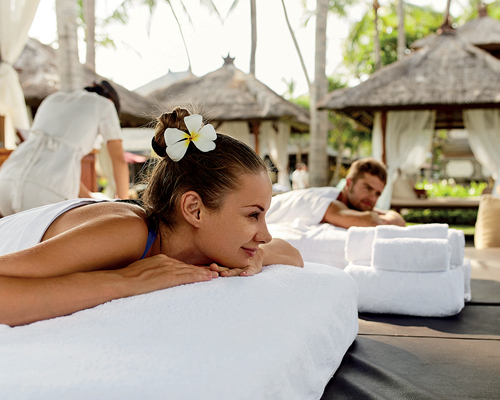
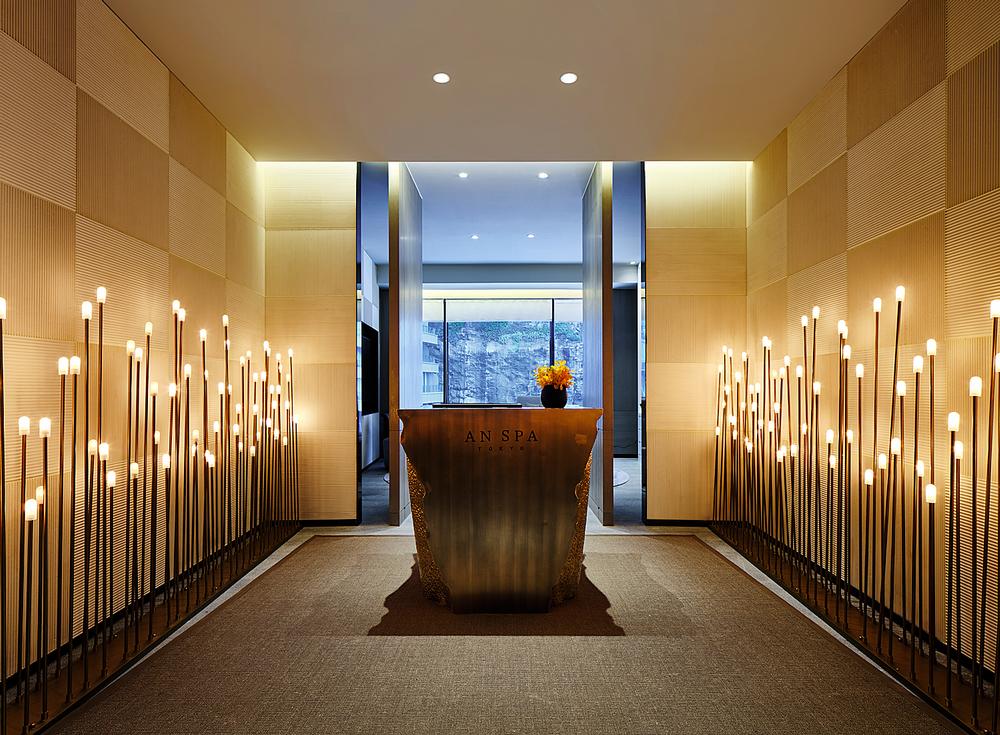
What’s on offer? Early afternoon, I eschewed bungee jumping for a treatment at the hotel’s An Spa. The intimate spa, located on the 13th floor, has two double and two single treatment rooms with a changing area, sauna and steamroom towards the back. Chatting with spa manager Zhu Ruizhi, I wondered if the size of the spa was adequate, considering the size of the hotel. She says it hasn’t posed a problem with guest bookings. “So far our clients have been very happy. It’s not really about the volume of spa visitors as the average spend per client is around CNY2,000 (US$291, €259, £233), so we may have fewer clients but they spend more money on luxury treatments.”
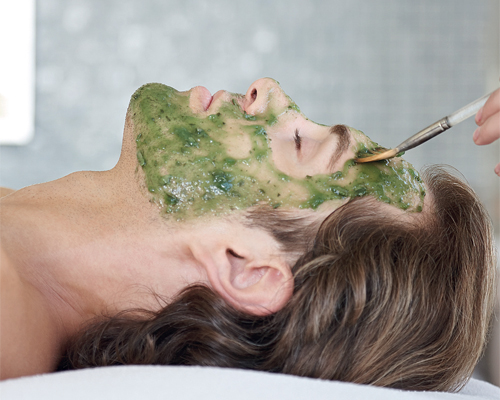
Arriving for my appointment, I was warmly greeted by the receptionist who sat me in a lounge-style waiting room and swiftly served a Japanese green tea while I took in the great views of the quarry and enjoyed watching the paddleboarders in the distance. Zhu says the scope of the spa’s 20-plus treatments – which range from a sleep inducing, deep breathing massage to Chinese and Japanese modalities – is a particular selling point. The 60-minute, CNY880 (US$128, €114, £102) Meridians Massage and CNY780 (US$113, €101, £91) Tui-Na focus on unblocking the flow of qi to increase joint lubrication, increase circulation, and boost immunity. While Thémaé, a tea-based product line, reflects the Asian-inspired offer, she says. Japanese green tea, Chinese white tea, Taiwanese oolong tea, and Indian black tea used in Thémaé treatments have antioxidants that regenerate skin cells and stimulate the circulation. Essentials oils from Hinkoi, Japan – sandalwood, sakura and yuzu – are also used in other services.
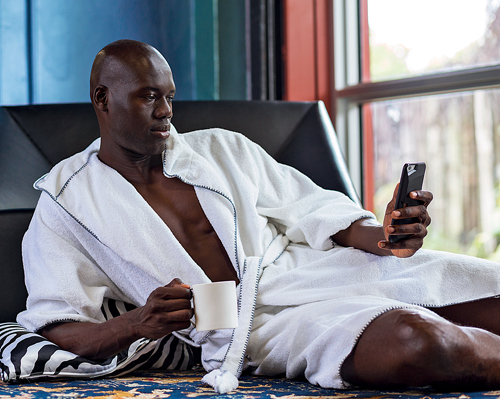
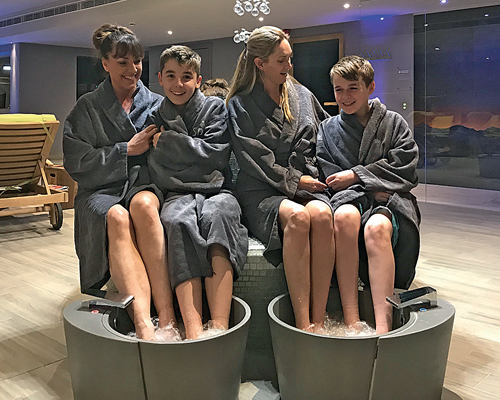
Impressive service The steamroom and sauna were a nice way to relax pre-treatment and extra comfort came from the fresh, fluffy towels and yukata robe. I was struck by how neat and tidy everything was.
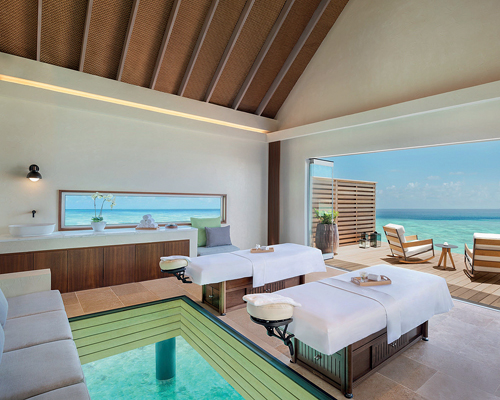
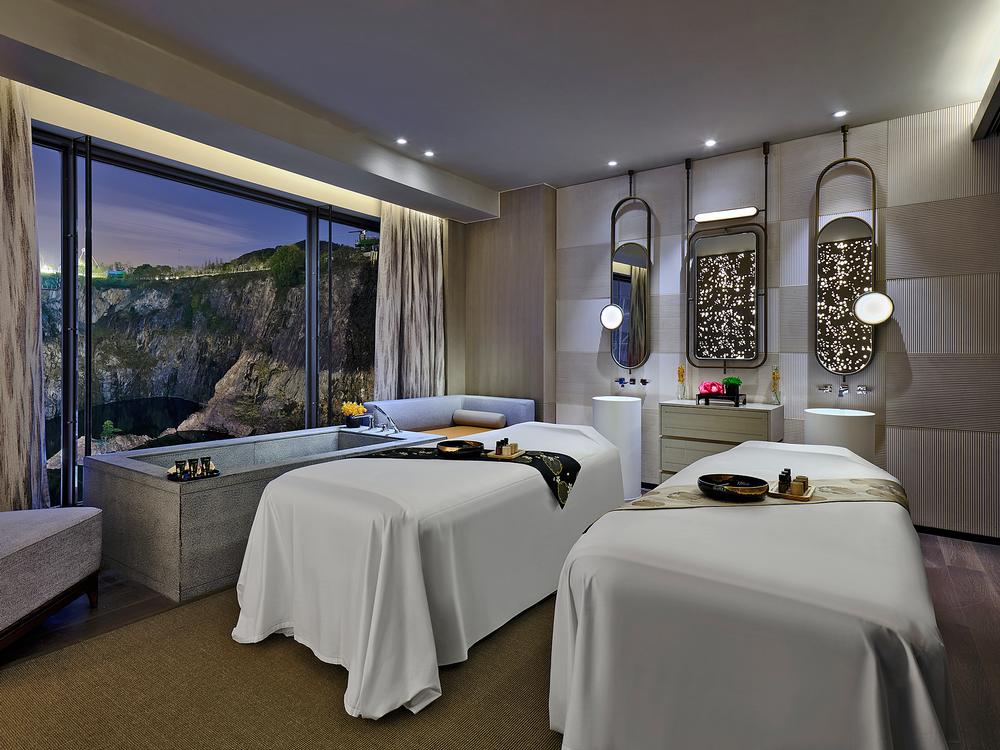
After about 30 minutes my therapist, Stella, led me to a serenely-decorated treatment room with large windows giving way to the view of copper-coloured rock and blue-green water below. She had prepared a foot ritual and washed my feet gently in warm milky-pink water. We chatted for a while. Stella made polite conversation about what I’d done that day and was happy to answer questions about her own background. A Chinese masseuse, she had moved to Shanghai from Sichuan Province. She was a very personable and easy to talk to, which made me feel comfortable immediately. Her English was great – and she’d pretty much taught herself.
Stella is one of four therapists who have been handpicked to match the clientele, which includes mostly hotel guests but also day visitors from Songjiang, one of Shanghai’s rich satellite towns. Zhu says: “All our therapists must have at least one year’s experience working in a five-star hotel spa, be familiar with the treatments, be attentive to detail, love what they do, and have a warm heart.”
I’d chosen a 60-minute aromatherapy massage, priced at CNY1,100 (US$160, €142, £128), which was customised with sakura – an oil I was drawn to because its cherry blossom scent smelled the nicest. I’d requested a firm massage and pointed out my shoulders and upper back as problem areas, though I must admit, I did not expect much personalisation. However, I was impressed again. Stella worked expertly and methodically using a combination of Japanese, Chinese, Vietnamese and Thai techniques. Firm pressure was sustained throughout and she paid special attention to knots in my shoulders and back. Her 16 years’ experience was evident. She intermittently checked whether the pressure was too strong or the room was the right temperature. I especially enjoyed the attention she paid to my calves and my head and scalp. Afterwards, my body was left feeling completely niggle-free and my state of mind completely peaceful.
If I’m honest, the spa doesn’t have the wow factor of the main hotel. But in many ways the elegant and serene offer, quietly cocooned inside the building, and the focus on expert treatments and brilliant service, is all you really need to really get away from it all, soaking up every second of peace and quiet possible before returning to reality.
Read more from this issue of Attractions Management magazine
View contents of Attractions Management 2019 issue 3
Spa Programmes: On the menu
Energy medicine at Six Senses; aroma retreat on Croatia’s Island of Vitality and menopause programming all feature in our spa menu round-up
Top team: Rosewood
Jane Kitchen talks to the wellness team behind Rosewood, and its forward-thinking spa concepts, as CEO Sonia Cheng leads a vigorous global rollout
Everyone’s talking about: CBD
Are CBD treatments and products an unregulated fad, or a serious business proposition? Spa Business investigates
Promotional feature: The Madison Collection
Innovation of form and function in robes and towels is a vital part of attracting the next generation of wellness consumers. Charmaine T Lang from The Madison Collection explains how her company consistently maintains its successful point of difference
Interview: Markus Engel
The CEO of Asia’s Urban Resort Concepts talks to Spa Business about positive disruption in the hospitality and spa sector
Promotional feature: The Wellness
A beautiful pool can be the standout feature that draws new customers. It can also cut your running costs if it’s designed to be sustainable. Mohammed Ibrahim, CEO of The Wellness, explains
Interview: Davide Bollati
Liz Terry speaks to the founder of Comfort Zone about the group’s new botanical garden and ongoing commitment to environmentalism
Research: Generation gap
A new consumer study by ISPA uncovers spa-goer preferences and habits across different age groups
Promotional feature: Phytomer
Formulating the ultimate universal product to heal and defend the skin has taken three years of R&D for Phytomer, the French luxury marine skincare brand. The company’s scientific director tells Spa Business about the launch of the groundbreaking Prebioforce serum
Event Report: APSWC Round Table
Industry leaders contribute to APSWC’s third white paper at annual gathering. Catharine Nicol reports from Malaysia
Family spa: Play time
Spa Business takes a look at innovative spa programmes for children and families
Eco spa: Going green
Joanna Roche and Bonnie Baker share their ambitions for the Green Spa Network
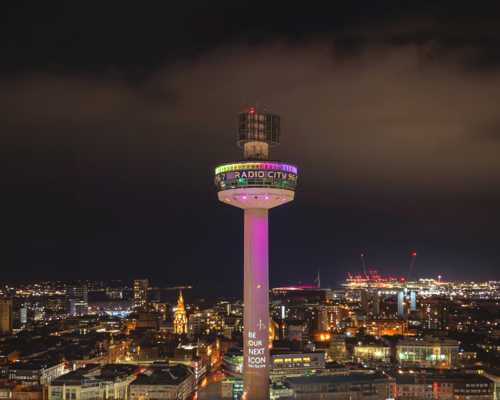
An opportunity to reimagine one of the UK’s most recognisable towers has been formally
opened by Rivington Hark, as St Johns Beacon invites operators and partners to shape its
next phase. [more...]
Construction marvel: 16 floors are below ground level and two are under water
In China’s cities, everything is noisy. Horns beep constantly, people play games on their phones at loud volumes and without earphones, the sound of construction work is ubiquitous, and shop speakers blare out promotions on repeat. Noise pollution is everywhere, all day and all night. So arriving at the InterContinental Shanghai Wonderland Hotel, you quickly notice – it’s peaceful.
The long-awaited development, also known as the Quarry Hotel, sits in an abandoned mine in the Sheshan Mountain Range about an hour from Shanghai. Conceived by Atkins for Chinese developer Shimao Group back in 2006 and completed by JADE+QA Architects, the US$300m (€265.5m, £229.m) resort finally opened in November 2018. The huge 337-room hotel pushes construction to its limits as it hugs the cliff and delves into the rocky basin – 16 of the 18 floors are below ground level and two are submerged in water.
The approach to the lobby is deceptive. The tip of the silver building arches just above the ground behind a white sculpture, giving nothing away. It’s not until you enter the glass elevator that it becomes clear you’re on the top floor, and though you push the button for the 11th floor, the elevator is going down.
Far from the sounds of traffic, it’s peaceful and tranquil, but there’s plenty to do. Even though I stayed on a Sunday, guests included lots of families and couples. Billed as a leisure complex, guests can take a dip in the futuristic-designed pool, try kayaking and paddleboarding on the lake at the bottom of the quarry or, for the more adventurous, scale the cliff face in a rock climbing session.
What’s on offer? Early afternoon, I eschewed bungee jumping for a treatment at the hotel’s An Spa. The intimate spa, located on the 13th floor, has two double and two single treatment rooms with a changing area, sauna and steamroom towards the back. Chatting with spa manager Zhu Ruizhi, I wondered if the size of the spa was adequate, considering the size of the hotel. She says it hasn’t posed a problem with guest bookings. “So far our clients have been very happy. It’s not really about the volume of spa visitors as the average spend per client is around CNY2,000 (US$291, €259, £233), so we may have fewer clients but they spend more money on luxury treatments.”
Arriving for my appointment, I was warmly greeted by the receptionist who sat me in a lounge-style waiting room and swiftly served a Japanese green tea while I took in the great views of the quarry and enjoyed watching the paddleboarders in the distance. Zhu says the scope of the spa’s 20-plus treatments – which range from a sleep inducing, deep breathing massage to Chinese and Japanese modalities – is a particular selling point. The 60-minute, CNY880 (US$128, €114, £102) Meridians Massage and CNY780 (US$113, €101, £91) Tui-Na focus on unblocking the flow of qi to increase joint lubrication, increase circulation, and boost immunity. While Thémaé, a tea-based product line, reflects the Asian-inspired offer, she says. Japanese green tea, Chinese white tea, Taiwanese oolong tea, and Indian black tea used in Thémaé treatments have antioxidants that regenerate skin cells and stimulate the circulation. Essentials oils from Hinkoi, Japan – sandalwood, sakura and yuzu – are also used in other services.
Impressive service The steamroom and sauna were a nice way to relax pre-treatment and extra comfort came from the fresh, fluffy towels and yukata robe. I was struck by how neat and tidy everything was.
After about 30 minutes my therapist, Stella, led me to a serenely-decorated treatment room with large windows giving way to the view of copper-coloured rock and blue-green water below. She had prepared a foot ritual and washed my feet gently in warm milky-pink water. We chatted for a while. Stella made polite conversation about what I’d done that day and was happy to answer questions about her own background. A Chinese masseuse, she had moved to Shanghai from Sichuan Province. She was a very personable and easy to talk to, which made me feel comfortable immediately. Her English was great – and she’d pretty much taught herself.
Stella is one of four therapists who have been handpicked to match the clientele, which includes mostly hotel guests but also day visitors from Songjiang, one of Shanghai’s rich satellite towns. Zhu says: “All our therapists must have at least one year’s experience working in a five-star hotel spa, be familiar with the treatments, be attentive to detail, love what they do, and have a warm heart.”
I’d chosen a 60-minute aromatherapy massage, priced at CNY1,100 (US$160, €142, £128), which was customised with sakura – an oil I was drawn to because its cherry blossom scent smelled the nicest. I’d requested a firm massage and pointed out my shoulders and upper back as problem areas, though I must admit, I did not expect much personalisation. However, I was impressed again. Stella worked expertly and methodically using a combination of Japanese, Chinese, Vietnamese and Thai techniques. Firm pressure was sustained throughout and she paid special attention to knots in my shoulders and back. Her 16 years’ experience was evident. She intermittently checked whether the pressure was too strong or the room was the right temperature. I especially enjoyed the attention she paid to my calves and my head and scalp. Afterwards, my body was left feeling completely niggle-free and my state of mind completely peaceful.
If I’m honest, the spa doesn’t have the wow factor of the main hotel. But in many ways the elegant and serene offer, quietly cocooned inside the building, and the focus on expert treatments and brilliant service, is all you really need to really get away from it all, soaking up every second of peace and quiet possible before returning to reality.
Read more from this issue of Attractions Management magazine
View contents of Attractions Management 2019 issue 3
Spa Programmes: On the menu
Energy medicine at Six Senses; aroma retreat on Croatia’s Island of Vitality and menopause programming all feature in our spa menu round-up
Top team: Rosewood
Jane Kitchen talks to the wellness team behind Rosewood, and its forward-thinking spa concepts, as CEO Sonia Cheng leads a vigorous global rollout
Everyone’s talking about: CBD
Are CBD treatments and products an unregulated fad, or a serious business proposition? Spa Business investigates
Promotional feature: The Madison Collection
Innovation of form and function in robes and towels is a vital part of attracting the next generation of wellness consumers. Charmaine T Lang from The Madison Collection explains how her company consistently maintains its successful point of difference
Interview: Markus Engel
The CEO of Asia’s Urban Resort Concepts talks to Spa Business about positive disruption in the hospitality and spa sector
Promotional feature: The Wellness
A beautiful pool can be the standout feature that draws new customers. It can also cut your running costs if it’s designed to be sustainable. Mohammed Ibrahim, CEO of The Wellness, explains
Interview: Davide Bollati
Liz Terry speaks to the founder of Comfort Zone about the group’s new botanical garden and ongoing commitment to environmentalism
Research: Generation gap
A new consumer study by ISPA uncovers spa-goer preferences and habits across different age groups
Promotional feature: Phytomer
Formulating the ultimate universal product to heal and defend the skin has taken three years of R&D for Phytomer, the French luxury marine skincare brand. The company’s scientific director tells Spa Business about the launch of the groundbreaking Prebioforce serum
Event Report: APSWC Round Table
Industry leaders contribute to APSWC’s third white paper at annual gathering. Catharine Nicol reports from Malaysia
Family spa: Play time
Spa Business takes a look at innovative spa programmes for children and families
Eco spa: Going green
Joanna Roche and Bonnie Baker share their ambitions for the Green Spa Network
Hotel de France, located on the British Isle of Jersey, has created a wellness retreat package
that includes a hot yoga session that will take place in Jersey Zoo’s butterfly sanctuary.
A new immersive attraction designed to transport visitors into the final hours of ancient Pompeii
is preparing to open near the world-famous archaeological site in southern Italy.
Experience design company, BRC Imagination Arts, has completed a transition that sees founder
Bob Rogers pass ownership of the business to four long-serving senior executives, while
remaining actively involved with the company.
Movie Park Germany has opened a new Paramount Pictures-themed attraction as part of its 30th
anniversary celebrations, using immersive storytelling and adaptive reuse to reinforce the park’s
longstanding “Hollywood in Germany” positioning.
Therme Manchester’s 28-acre development, which will include interconnected glass pavilions
that measure 65,000sq m, will be the largest bathing and wellbeing attraction in the world once
complete, according to prof David Russell, CEO of Therme UK.
Efteling has opened Hooghmoed, a new family drop tower designed to broaden the appeal of its
recently launched Sirene Island themed area and introduce younger visitors to thrill attractions.
A proposed Puy du Fou development near Bicester and Universal Destinations and Experiences’
planned resort in Bedford are emerging as part of a wider transformation of the Oxford–
Cambridge Growth Corridor into a major centre for UK leisure and tourism inv
Shedd Aquarium has opened the Immersion Theater developed in partnership with SimEx-
Iwerks, as part of a wider strategy to enhance the guest experience and create additional
revenue opportunities.
The UK government has announced a temporary reduction in VAT on visitor attractions and
children’s meals as part of a summer cost-of-living support package designed to stimulate the
visitor economy and encourage family days out.
As designer Yinka Ilori prepares for his first solo gallery show in London, he speaks exclusively
to CLADmag about his mission to spread joy, the power of play, and his bold approach to using
colour (including the colours you won’t see in his work).
The government of Thailand is exploring plans for a THB300bn (£6.3bn, US$8.3bn)
entertainment complex in the country’s Eastern Economic Corridor (EEC), with officials
proposing a large-scale theme park and sports destination as part of a broader tourism and
economic development strategy.
An opportunity to reimagine one of the UK’s most recognisable towers has been formally
opened by Rivington Hark, as St Johns Beacon invites operators and partners to shape its
next phase. [more...]