ISPA’s latest consumer study shows how spa-goer
habits vary across different generations. Research authors
Russell Donaldson and Mia Carter share their highlights
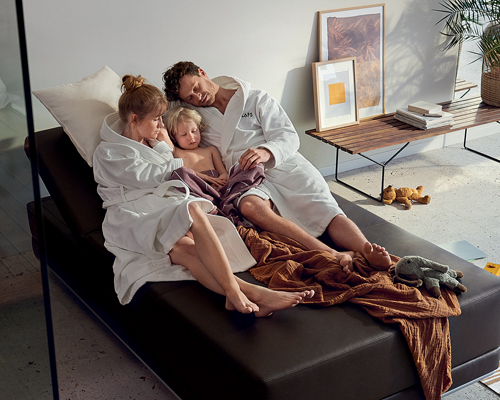
Gen Z spa-goers seek out comfort and are the group most likely to
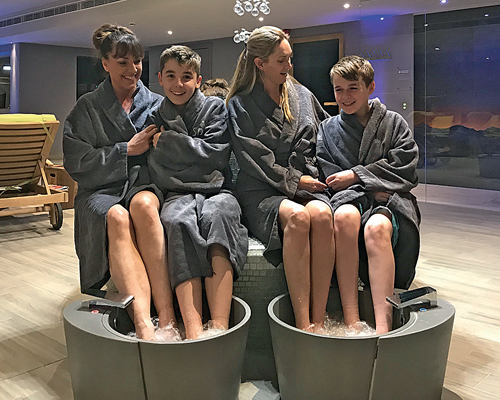
visit a facility with parents or family / 4 PM production/Shutterstock
Millennials and gen X have the strongest spending power and are more likely to look for a ‘digital detox’, while gen Z are an upcoming market who seek out comfort and visit with friends. These are just a couple of observations from a new consumer study by the International Spa Association (ISPA). Released in June, the study was based on interviews with 1,000 spa-goers across the US (see p76) and highlights behavioural patterns between different age groups – what ISPA refers to as “unmasking the generational shift”. The study is intended as a vital source of information for spas to learn about the habits of their current customers, as well as to get a step ahead of the industry’s next big trend.
So, what does the research have to say about different generations of spa-goers and how is it relevant to the day-to-day offering of spas?
Spending power Encouragingly for the industry as a whole, consumer spending on treatments and retail in spas is strong. Looking at the data through a generational lens shows that it’s millennials and gen X who are currently the industry’s biggest spenders, with the highest spend on treatments, retail and gift cards compared with other generations. More than half of millennial and gen X spa-goers reported spending US$80+ (€70, £63) on treatments on their most recent visit (56 per cent and 53 per cent respectively), while 72 per cent and 68 per cent said they also purchased a retail product at the spa. Overall, baby boomers and the greatest generation (born before 1946) appear to be the group’s least likely to spend: 43 per cent and 69 per cent respectively made no retail purchase on their most recent visit, by comparison.
The study also explored consumer attitudes to using personal technology such as smartphones in the spa environment – an ever prickly subject. The majority of consumers (89 per cent) feel the balance is right when it comes to how strict or lenient technology policies currently are. However, looking at the nuances between generations reveals that millennials (14 per cent) and gen X (12 per cent) are slightly more likely than the other groups to feel that technology policies are too liberal and do not allow enough privacy.
Moreover, over a third of both millennials (36 per cent) and gen X (34 per cent) feel that a technology ban would make a spa more attractive – considerably higher than gen Z consumers (22 per cent). This could be a sign that these sometimes stressed and overworked millennials and gen X consumers appreciate the opportunity to switch off at a spa in pursuit of a ‘digital detox’ more than younger generations.
Gen Z – a coming force Just as millennials have become a powerful force in the economy, another younger generation will inevitably follow, and soon purchasing power will shift downwards to the so-called ‘gen Z’ – people born between 1996 and the present day. It will be useful for spas to be aware of what appeals to this coming generation, because in the same way that spas were able to capitalise on the needs of millennials, there will undoubtedly be a sizable opportunity for spas with a strong offering catering to the needs of gen Z.
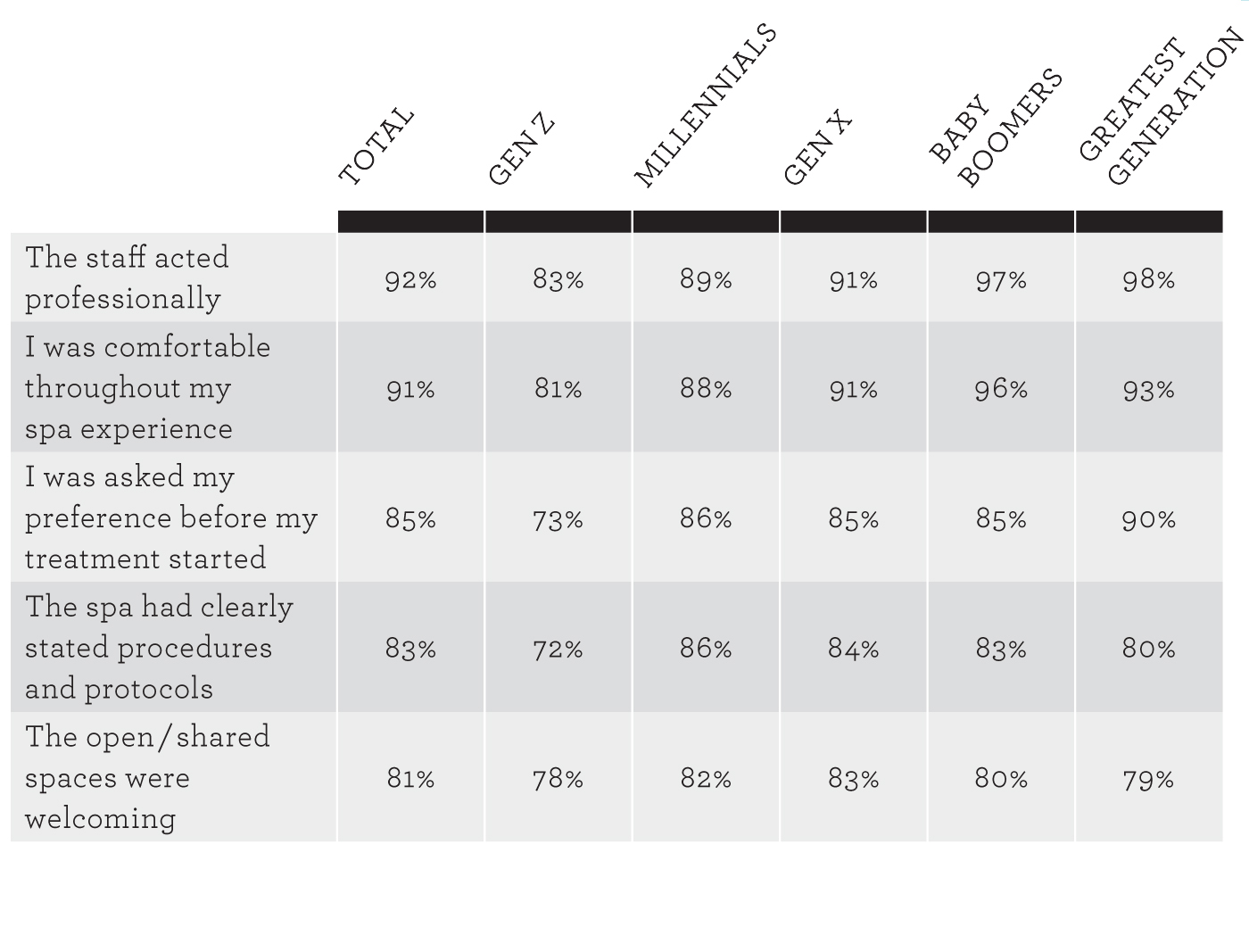
As a place of relaxation, it goes without saying that spa-goers should feel comfortable and welcome when visiting a spa. Table 1 shows that the vast majority of spa-goers interviewed agreed that they felt comfortable during their spa experience (91 per cent) and that staff acted professionally (92 per cent). Most spa-goers noted that they were asked their preferences before their treatment (85 per cent) and were aware that the spa had stated procedures and protocols (83 per cent).
While at an overall level, the numbers show spa-goers to feel very comfortable with their experiences, looking at the figures from a generational perspective demonstrates some interesting differences with gen Z recording consistently lower scores than the other generations. Where the industry has seen millennials progress to join gen X as the bigger-spending consumers in spas, an important question lies in what can be done to continue to make gen Z feel more comfortable and support that young group as the ‘up and coming’ spa-going generation. The role of the service provider can be crucial here, in both being attentive to their needs and ensuring that the end-to-end experience is as comfortable as possible.
How do people visit a spa? The study shows that more than half of the spa-goers interviewed reported visiting the spa alone (55 per cent) on their most recent visit. Gen Z, however, are the most likely to visit with a group of friends (30 per cent) – this figure then drops moving up different generations through millennials (24 per cent), gen X (17 per cent), baby boomers (12 per cent) and the greatest generation (11 per cent).
These findings suggests that gen Z may find value in the spa to be a shared experience, as a way of connecting with friends. More obviously, they are the generational group most likely to visit the spa with parents or family, providing a good opportunity for spas to make an impression on these young consumers and capture their interest early on.
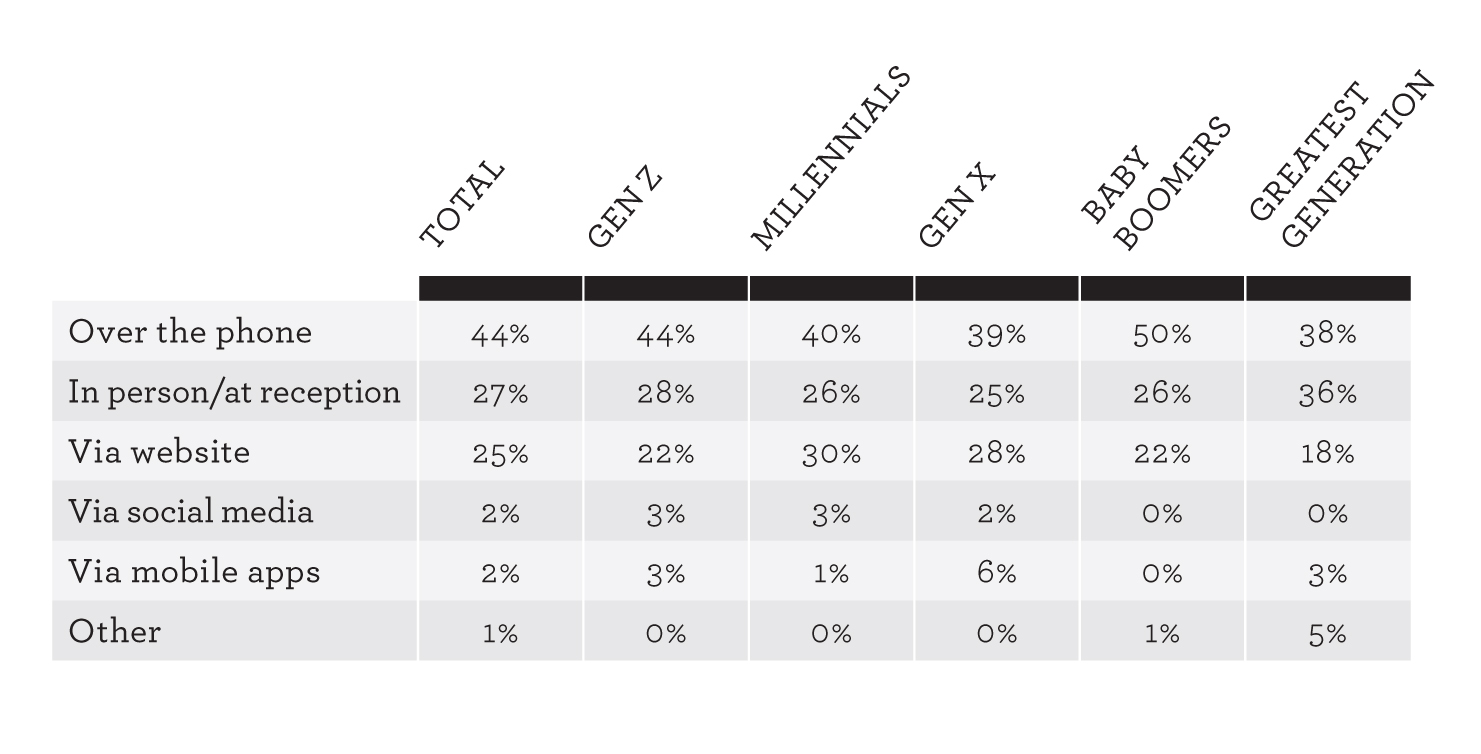
Booking preferences When looking at how spa-goers prefer to book appointments, it appears that the traditional methods are still more popular than more modern digital appointment-making methods (see Table 2). A striking finding is that the data does not demonstrate many differences between the generations when it comes to booking preferences. While gen Z are true digital natives who, from earliest youth have been exposed to the internet, social networks, and mobile systems, they seem no more likely to use digital methods for booking an appointment than any other generation. Forty-four per cent prefer booking over the phone and 28 per cent prefer booking in person versus 44 per cent and 27 per cent respectively at an overall level.
More surprisingly, on average only 2 per cent of spa-goers are using apps to book spa treatments, which is mostly consistent across generations. With the ever-increasing advancements in mobile technology, and an increase in innovative mobile spa businesses, it’s now more important than ever for spas to consider how they can update their infrastructure to take the pressure of manual traditional services.
Balance of power The generational analysis and the corresponding nuances in behaviour are an important focus of ISPA’s latest Consumer Snapshot Initiative. The results highlight how the generational shift continues to transform the consumer landscape and showcases many opportunities for spas to better cater for their clientele. Millennial and gen X consumers hold the balance of power currently, but the industry shouldn’t lose sight of gen Z as the coming force in the years ahead. With that in mind, spa professionals must continue to think about how they can deliver value for this emerging consumer group and capitalise from new ways of increasing revenue.
How consumers feel about the spa experience across generations
Table 1
Source: The Spa-Going Experience, ISPA Consumer Snapshot Initiative, Volume IX. June 2019
Preferred booking methods by generation
Table 2
Source: The Spa-Going Experience, ISPA Consumer Snapshot Initiative, Volume IX. June 2019
About the research
ISPA has been producing its Consumer Snapshot Initiative studies for nearly a decade, providing new insights on emerging opportunities that could strengthen the spa economy.
Its ninth edition The Spa-Going Experience was released in June. It was based on interviews with 1,000 spa-goers from across the US. Respondents included the following groups: gen Z, born 1996-present (9 per cent); millennials, born 1982-1995 (24 per cent); gen X, born 1965-1981 (25 per cent); baby boomers, born 1946-1964 (36 per cent) and greatest generation, born before 1946 (6 per cent).
Mia Carter & Russell Donaldson
Russell Donaldson and Mia Carter are
PwC research specialists based in the UK
Spa Programmes: On the menu
Energy medicine at Six Senses; aroma retreat on Croatia’s Island of Vitality and menopause programming all feature in our spa menu round-up
Top team: Rosewood
Jane Kitchen talks to the wellness team behind Rosewood, and its forward-thinking spa concepts, as CEO Sonia Cheng leads a vigorous global rollout
Everyone’s talking about: CBD
Are CBD treatments and products an unregulated fad, or a serious business proposition? Spa Business investigates
Promotional feature: The Madison Collection
Innovation of form and function in robes and towels is a vital part of attracting the next generation of wellness consumers. Charmaine T Lang from The Madison Collection explains how her company consistently maintains its successful point of difference
Interview: Markus Engel
The CEO of Asia’s Urban Resort Concepts talks to Spa Business about positive disruption in the hospitality and spa sector
Promotional feature: The Wellness
A beautiful pool can be the standout feature that draws new customers. It can also cut your running costs if it’s designed to be sustainable. Mohammed Ibrahim, CEO of The Wellness, explains
Interview: Davide Bollati
Liz Terry speaks to the founder of Comfort Zone about the group’s new botanical garden and ongoing commitment to environmentalism
Research: Generation gap
A new consumer study by ISPA uncovers spa-goer preferences and habits across different age groups
Promotional feature: Phytomer
Formulating the ultimate universal product to heal and defend the skin has taken three years of R&D for Phytomer, the French luxury marine skincare brand. The company’s scientific director tells Spa Business about the launch of the groundbreaking Prebioforce serum
Event Report: APSWC Round Table
Industry leaders contribute to APSWC’s third white paper at annual gathering. Catharine Nicol reports from Malaysia
Family spa: Play time
Spa Business takes a look at innovative spa programmes for children and families
Eco spa: Going green
Joanna Roche and Bonnie Baker share their ambitions for the Green Spa Network
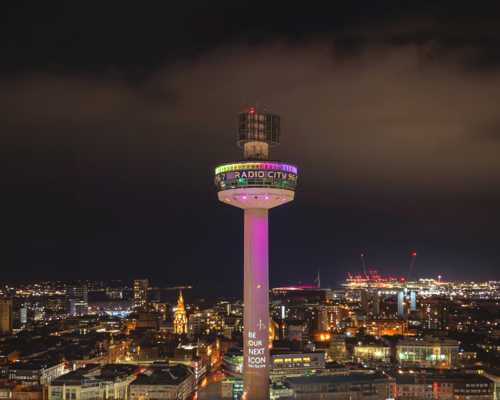
An opportunity to reimagine one of the UK’s most recognisable towers has been formally
opened by Rivington Hark, as St Johns Beacon invites operators and partners to shape its
next phase. [more...]
ISPA’s latest consumer study shows how spa-goer
habits vary across different generations. Research authors
Russell Donaldson and Mia Carter share their highlights
Gen Z spa-goers seek out comfort and are the group most likely to
visit a facility with parents or family / 4 PM production/Shutterstock
Millennials and gen X have the strongest spending power and are more likely to look for a ‘digital detox’, while gen Z are an upcoming market who seek out comfort and visit with friends. These are just a couple of observations from a new consumer study by the International Spa Association (ISPA). Released in June, the study was based on interviews with 1,000 spa-goers across the US (see p76) and highlights behavioural patterns between different age groups – what ISPA refers to as “unmasking the generational shift”. The study is intended as a vital source of information for spas to learn about the habits of their current customers, as well as to get a step ahead of the industry’s next big trend.
So, what does the research have to say about different generations of spa-goers and how is it relevant to the day-to-day offering of spas?
Spending power Encouragingly for the industry as a whole, consumer spending on treatments and retail in spas is strong. Looking at the data through a generational lens shows that it’s millennials and gen X who are currently the industry’s biggest spenders, with the highest spend on treatments, retail and gift cards compared with other generations. More than half of millennial and gen X spa-goers reported spending US$80+ (€70, £63) on treatments on their most recent visit (56 per cent and 53 per cent respectively), while 72 per cent and 68 per cent said they also purchased a retail product at the spa. Overall, baby boomers and the greatest generation (born before 1946) appear to be the group’s least likely to spend: 43 per cent and 69 per cent respectively made no retail purchase on their most recent visit, by comparison.
The study also explored consumer attitudes to using personal technology such as smartphones in the spa environment – an ever prickly subject. The majority of consumers (89 per cent) feel the balance is right when it comes to how strict or lenient technology policies currently are. However, looking at the nuances between generations reveals that millennials (14 per cent) and gen X (12 per cent) are slightly more likely than the other groups to feel that technology policies are too liberal and do not allow enough privacy.
Moreover, over a third of both millennials (36 per cent) and gen X (34 per cent) feel that a technology ban would make a spa more attractive – considerably higher than gen Z consumers (22 per cent). This could be a sign that these sometimes stressed and overworked millennials and gen X consumers appreciate the opportunity to switch off at a spa in pursuit of a ‘digital detox’ more than younger generations.
Gen Z – a coming force Just as millennials have become a powerful force in the economy, another younger generation will inevitably follow, and soon purchasing power will shift downwards to the so-called ‘gen Z’ – people born between 1996 and the present day. It will be useful for spas to be aware of what appeals to this coming generation, because in the same way that spas were able to capitalise on the needs of millennials, there will undoubtedly be a sizable opportunity for spas with a strong offering catering to the needs of gen Z.
As a place of relaxation, it goes without saying that spa-goers should feel comfortable and welcome when visiting a spa. Table 1 shows that the vast majority of spa-goers interviewed agreed that they felt comfortable during their spa experience (91 per cent) and that staff acted professionally (92 per cent). Most spa-goers noted that they were asked their preferences before their treatment (85 per cent) and were aware that the spa had stated procedures and protocols (83 per cent).
While at an overall level, the numbers show spa-goers to feel very comfortable with their experiences, looking at the figures from a generational perspective demonstrates some interesting differences with gen Z recording consistently lower scores than the other generations. Where the industry has seen millennials progress to join gen X as the bigger-spending consumers in spas, an important question lies in what can be done to continue to make gen Z feel more comfortable and support that young group as the ‘up and coming’ spa-going generation. The role of the service provider can be crucial here, in both being attentive to their needs and ensuring that the end-to-end experience is as comfortable as possible.
How do people visit a spa? The study shows that more than half of the spa-goers interviewed reported visiting the spa alone (55 per cent) on their most recent visit. Gen Z, however, are the most likely to visit with a group of friends (30 per cent) – this figure then drops moving up different generations through millennials (24 per cent), gen X (17 per cent), baby boomers (12 per cent) and the greatest generation (11 per cent).
These findings suggests that gen Z may find value in the spa to be a shared experience, as a way of connecting with friends. More obviously, they are the generational group most likely to visit the spa with parents or family, providing a good opportunity for spas to make an impression on these young consumers and capture their interest early on.
Booking preferences When looking at how spa-goers prefer to book appointments, it appears that the traditional methods are still more popular than more modern digital appointment-making methods (see Table 2). A striking finding is that the data does not demonstrate many differences between the generations when it comes to booking preferences. While gen Z are true digital natives who, from earliest youth have been exposed to the internet, social networks, and mobile systems, they seem no more likely to use digital methods for booking an appointment than any other generation. Forty-four per cent prefer booking over the phone and 28 per cent prefer booking in person versus 44 per cent and 27 per cent respectively at an overall level.
More surprisingly, on average only 2 per cent of spa-goers are using apps to book spa treatments, which is mostly consistent across generations. With the ever-increasing advancements in mobile technology, and an increase in innovative mobile spa businesses, it’s now more important than ever for spas to consider how they can update their infrastructure to take the pressure of manual traditional services.
Balance of power The generational analysis and the corresponding nuances in behaviour are an important focus of ISPA’s latest Consumer Snapshot Initiative. The results highlight how the generational shift continues to transform the consumer landscape and showcases many opportunities for spas to better cater for their clientele. Millennial and gen X consumers hold the balance of power currently, but the industry shouldn’t lose sight of gen Z as the coming force in the years ahead. With that in mind, spa professionals must continue to think about how they can deliver value for this emerging consumer group and capitalise from new ways of increasing revenue.
How consumers feel about the spa experience across generations
Table 1
Source: The Spa-Going Experience, ISPA Consumer Snapshot Initiative, Volume IX. June 2019
Preferred booking methods by generation
Table 2
Source: The Spa-Going Experience, ISPA Consumer Snapshot Initiative, Volume IX. June 2019
About the research
ISPA has been producing its Consumer Snapshot Initiative studies for nearly a decade, providing new insights on emerging opportunities that could strengthen the spa economy.
Its ninth edition The Spa-Going Experience was released in June. It was based on interviews with 1,000 spa-goers from across the US. Respondents included the following groups: gen Z, born 1996-present (9 per cent); millennials, born 1982-1995 (24 per cent); gen X, born 1965-1981 (25 per cent); baby boomers, born 1946-1964 (36 per cent) and greatest generation, born before 1946 (6 per cent).
Mia Carter & Russell Donaldson
Russell Donaldson and Mia Carter are
PwC research specialists based in the UK
Spa Programmes: On the menu
Energy medicine at Six Senses; aroma retreat on Croatia’s Island of Vitality and menopause programming all feature in our spa menu round-up
Top team: Rosewood
Jane Kitchen talks to the wellness team behind Rosewood, and its forward-thinking spa concepts, as CEO Sonia Cheng leads a vigorous global rollout
Everyone’s talking about: CBD
Are CBD treatments and products an unregulated fad, or a serious business proposition? Spa Business investigates
Promotional feature: The Madison Collection
Innovation of form and function in robes and towels is a vital part of attracting the next generation of wellness consumers. Charmaine T Lang from The Madison Collection explains how her company consistently maintains its successful point of difference
Interview: Markus Engel
The CEO of Asia’s Urban Resort Concepts talks to Spa Business about positive disruption in the hospitality and spa sector
Promotional feature: The Wellness
A beautiful pool can be the standout feature that draws new customers. It can also cut your running costs if it’s designed to be sustainable. Mohammed Ibrahim, CEO of The Wellness, explains
Interview: Davide Bollati
Liz Terry speaks to the founder of Comfort Zone about the group’s new botanical garden and ongoing commitment to environmentalism
Research: Generation gap
A new consumer study by ISPA uncovers spa-goer preferences and habits across different age groups
Promotional feature: Phytomer
Formulating the ultimate universal product to heal and defend the skin has taken three years of R&D for Phytomer, the French luxury marine skincare brand. The company’s scientific director tells Spa Business about the launch of the groundbreaking Prebioforce serum
Event Report: APSWC Round Table
Industry leaders contribute to APSWC’s third white paper at annual gathering. Catharine Nicol reports from Malaysia
Family spa: Play time
Spa Business takes a look at innovative spa programmes for children and families
Eco spa: Going green
Joanna Roche and Bonnie Baker share their ambitions for the Green Spa Network
A new immersive attraction designed to transport visitors into the final hours of ancient Pompeii
is preparing to open near the world-famous archaeological site in southern Italy.
Experience design company, BRC Imagination Arts, has completed a transition that sees founder
Bob Rogers pass ownership of the business to four long-serving senior executives, while
remaining actively involved with the company.
Movie Park Germany has opened a new Paramount Pictures-themed attraction as part of its 30th
anniversary celebrations, using immersive storytelling and adaptive reuse to reinforce the park’s
longstanding “Hollywood in Germany” positioning.
Therme Manchester’s 28-acre development, which will include interconnected glass pavilions
that measure 65,000sq m, will be the largest bathing and wellbeing attraction in the world once
complete, according to prof David Russell, CEO of Therme UK.
Efteling has opened Hooghmoed, a new family drop tower designed to broaden the appeal of its
recently launched Sirene Island themed area and introduce younger visitors to thrill attractions.
A proposed Puy du Fou development near Bicester and Universal Destinations and Experiences’
planned resort in Bedford are emerging as part of a wider transformation of the Oxford–
Cambridge Growth Corridor into a major centre for UK leisure and tourism inv
Shedd Aquarium has opened the Immersion Theater developed in partnership with SimEx-
Iwerks, as part of a wider strategy to enhance the guest experience and create additional
revenue opportunities.
The UK government has announced a temporary reduction in VAT on visitor attractions and
children’s meals as part of a summer cost-of-living support package designed to stimulate the
visitor economy and encourage family days out.
As designer Yinka Ilori prepares for his first solo gallery show in London, he speaks exclusively
to CLADmag about his mission to spread joy, the power of play, and his bold approach to using
colour (including the colours you won’t see in his work).
The government of Thailand is exploring plans for a THB300bn (£6.3bn, US$8.3bn)
entertainment complex in the country’s Eastern Economic Corridor (EEC), with officials
proposing a large-scale theme park and sports destination as part of a broader tourism and
economic development strategy.
An opportunity to reimagine one of the UK’s most recognisable towers has been formally
opened by Rivington Hark, as St Johns Beacon invites operators and partners to shape its
next phase. [more...]