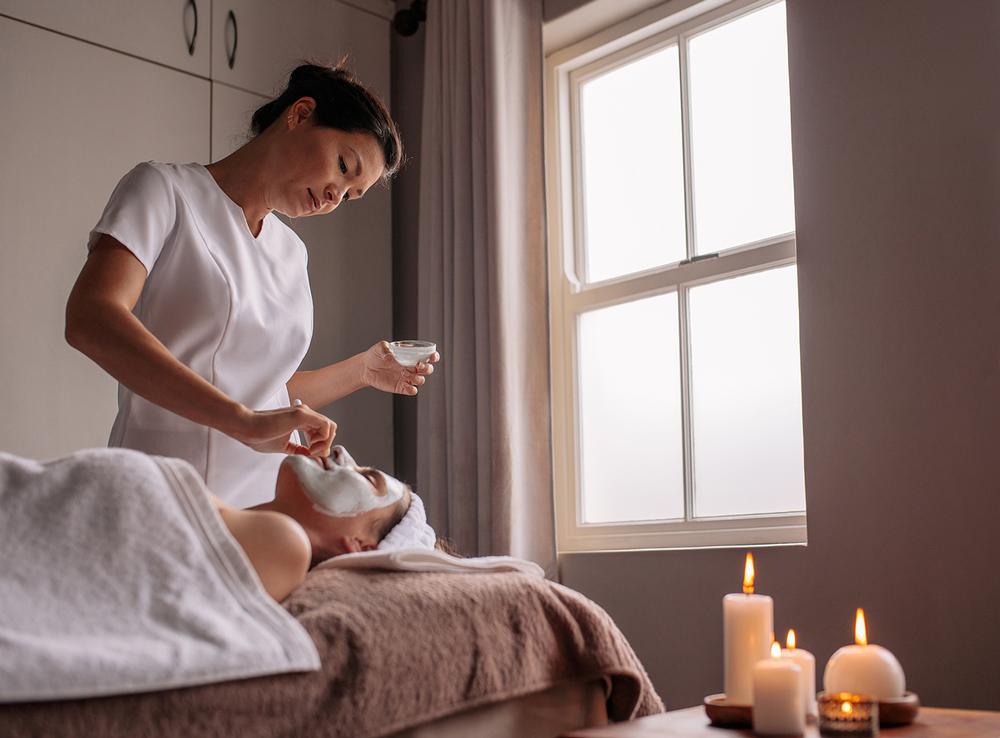
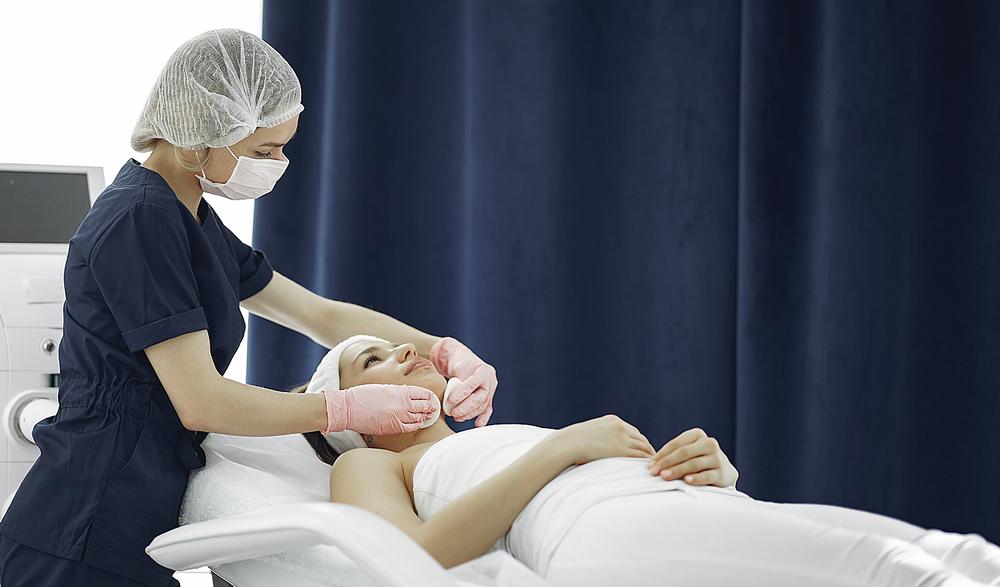
Global spa capture rates sat at 16.2 per cent before coronavirus / Jacob Lund/shutterstock
The spa world is experiencing unprecedented pressures and changes which will continue to greatly impact the industry’s performance. Intelligent Spas’ 2019 Global Research captured updated spa benchmarks from over 200 properties across 43 countries just before the COVID-19 outbreak and provides all industry stakeholders with a clear state of the sector over the last three years, plus an opportunity to measure the rate of disruption and recovery as the situation evolves.
Julie Garrow, founder and managing director of Intelligent Spas says: “We’ve been tracking global spa performance over the last 10 years and our latest survey shows that average revenue per spa halved during that time due to a supply and demand imbalance, in essence, too many spas opened compared to the level of demand for spa services. A 47 per cent decrease in average spa occupancy rates between 2008 and 2018 prove this. On the positive side, revenue per visit increased 29 per cent to US$129 (€118, £104). Overall, the findings confirm many revenue and visit indicators have decreased significantly and even before the coronavirus, the business environment for spa owners and managers was challenging.”
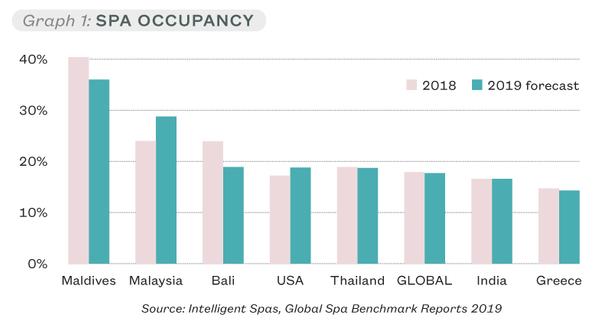
Spa occupancy and capture rates The number of people visiting spas in comparison to the number of available spas and treatments is alarming. Although some spas have performed really well over the last three years, the average occupancy rates indicate that many spas have not. The global spa occupancy rate in 2018 was 17.9 per cent and it was forecast to slightly decrease to 17.7 per cent in 2019 (see Graph 1).
The massive declines in visits due to lockdowns associated with the current pandemic will inevitably greatly impact 2020 occupancy rates. Intelligent Spas’ survey breaks down occupancy by some spa marketplaces, which highlights key differences in results. Maldives performed well predicting a 36 per cent occupancy rate in 2019, down from 40.4 per cent the previous year. In comparison, spas in Greece reported 14.7 per cent occupancy and were forecasting a slight decline for 2019.
The research also recorded two spa capture rate statistics for hotels and resorts in 2019. Spas in the Americas reported the highest in both benchmarks, with 23 per cent of all hotel/resort guests visiting the spa and 52 per cent of total spa visits being from hotel/resort guests. Spas in the Middle East and Africa reported the lowest rates, with 14 per cent of all hotel/resort guests visiting the spa and 36 per cent of total spa visits being from hotel/resort guests. On average, spa capture rates around the world were 16.2 per cent of all hotel/resort guests visiting the spa and 45.8 per cent of total spa visits were from hotel/resort guests.
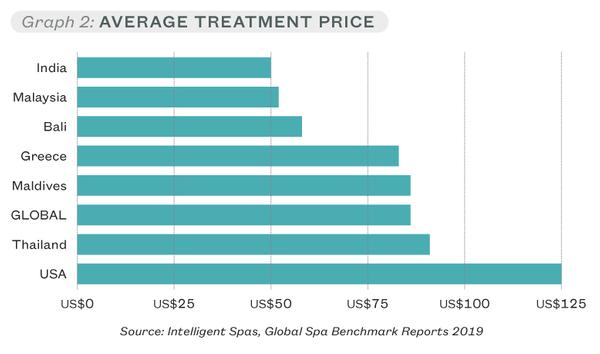
Revenue analysis The average treatment price benchmark in spas is the ratio for annual treatment revenue received and the number of treatments sold. It assesses the performance of treatments alone, without including other revenue sources such as retail revenue, which are included in the average revenue per visit benchmark ratio calculation. If a spa menu offers a variety of lower priced services, such as express services, the average treatment price will be lower, versus if a spa is more focused on higher ticket treatments, the result will be higher assuming the same number of treatments are sold. Spas in the USA predicted an average treatment price of US$125 (€115, £100) in 2019, compared to spas in India which predicted less than half that at US$50 (€46, £40) (see Graph 2).
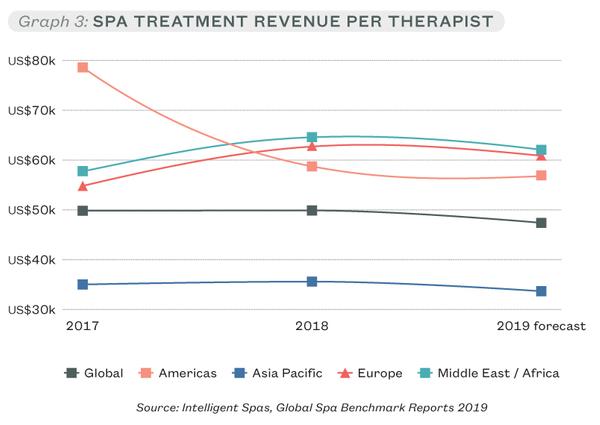
It’s interesting to breakdown spa treatment revenue per therapist as this clearly identifies if the cost of the therapist is more or less than what they’re generating for the business. Spas in the Americas experienced a sharp decline in treatment revenue per therapist between 2017 and 2018, however that was forecast to stabilise in 2019 at around US$57,000 (€52,251, £45,800)(see Graph 3). In comparison, spas in the Asia Pacific region reported the lowest levels in the three years collated, achieving between US$33,000 (€30,251, £26,515) and US$35,000 (€32,084, £28,122) treatment revenue per therapist.
In Asia, treatment prices and average revenue per visit are generally lower than the USA so these limit an Asian spa’s ability to generate the same levels of revenue. Labour rates are also lower in comparison, so this balances the costs associated with the revenue generated.
The research was also broken down by spa type to identify a range of variations between day spas, hotel spas and resort spas and some of the biggest differences were found in daily retail revenues. Hotel spas recorded the lowest daily retail revenue between 2017 and 2018, however that was forecast to improve in 2019 to be US$91 (€83, £73), passing that of day spas, which predicted daily retail revenue to be US$84 (€77, £67) last year. Resort spas have consistently performed the best over the three years and generated a predicted US$162 (€149, £130) in daily retail revenue in 2019. Resort guests have more time to shop because they’re typically on vacation and resort spas generally contain larger retail spaces with a greater range of products.
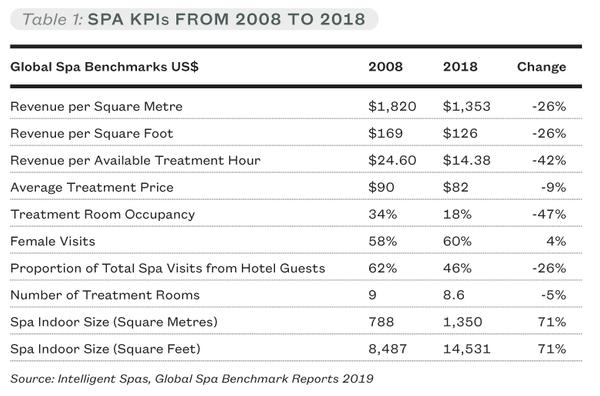
Changes since 2008 The global spa industry has experienced some interesting changes over the last decade as shown in the difference in key performance indicators in Table 1. Intelligent Spas’ findings confirm many revenue and visit indicators have decreased significantly and spas continued to be challenged by financial and operational issues, ranging from maintaining existing clients, attracting new guests and managing revenue targets, while new spas entered their marketplace.
Post COVID-19 The aim of Intelligent Spas’ research is to help spa owners, managers, investors and other stakeholders tackle the ever-changing conditions of their business environment and to measure and enhance their performance.
The recent events caused by COVID-19 highlight the very important need for spas to closely monitor their businesses and plan for downturns in the market. Unfortunately, based on significant changes experienced in the last 10 years, the unprecedented impact of COVID-19 will push some spas into permanent closure. The businesses which continue to operate are encouraged to track their performance regularly, put financial buffers in place to protect them during slow periods and ensure they have a loyal client base to support them when normality resumes. These policies and procedures empower owners and managers to understand how their business is performing at any point in time, identify new risks in a timely manner and make informed decisions to maximise their success.
Julie Garrow is the founder and managing director of Intelligent Spas | [email protected]
About the research
The information in this article is based on Intelligent Spas’ second Global Spa Benchmark Survey which coincides with the 10th anniversary of its first global spa survey results. The latest benchmark survey was released in December 2019 and is based on over 200 spas, in 43 countries. The full survey results are available in three types of reports starting from US$40 (€37, £32) and each can be downloaded at IntelligentSpas.com
Survey sponsors include The Assistant Company (TAC); the Asia Pacific Spa & Wellness Coalition (APSWC); Spa & Wellness Association of Singapore (SWAS); Association of Malaysian Spas (AMSPA) and the Malaysian Association of Wellness and Spa (MAWSPA)
Founded in 2001, Intelligent Spas also provides detailed operations and training manuals starting at US$30 (€28, £24).
Read more from this issue of Attractions Management magazine
View contents of Attractions Management 2020 issue 2
Editor’s letter: Our greatest challenge
Spa and wellness businesses will reopen while COVID-19 is still circulating in the community, meaning we have to find models which work in this new reality, says Katie Barnes. So how will this change the industry?
On the menu: Pivot to digital
Which forward-thinking spas are taking their offerings online during the coronavirus pandemic?
Interview: Mary Celeste Beall
The celebrated Blackberry Farm has opened a sister property in the mountains of Tennessee. The owner tells Spa Business why wellness through nature underpins the new destination
Everyone’s talking about: COVID-19
Spa operators, wellness companies and organisations from around the world talk to Spa Business about the impact of coronavirus and what to expect down the line
Promotion: Simone Gibertoni: Clinique La Prairie
World-renowned medical spa, Clinique La Prairie, is creating a global network of
locations to support clients with their wellbeing, every day of the year, says its CEO
Research: First responders
ISPA’s COVID-19 survey offers insights into how the industry has responded to the global pandemic. Spa Business magazine examines the findings
Hotel spa: Country life: The Newt
Karen Roos, owner of the world-renowned hotel The Newt, on design, gardens and a spa housed in an old cow barn
Insights: Calls to action
Industry leaders around the world come together in a crisis to share ideas and innovations in a series of GWS Collaboration calls. Spa Business magazine reports on the highlights
Insights: Webinar wisdom
Spa Business shares its industry-relevant takeaways from the masses of webinars that are being streamed worldwide
Research: Measure for measure
Intelligent Spas reveals its latest global spa benchmarks and explores what they mean in today’s ever-changing climate
Focus on: Extreme wellness
Spa Business tries out two boundary-pushing, cold immersion retreats led by ‘The Iceman’ Wim Hof and Dr Marc Cohen
Promotion: Barr and Wray: Creating
a seamless journey
With 60 years of experience, Barr and Wray has long been known for excellence in technical design for wellness. Design director Graeme Banks explains the company also offers interior design services
Interview: Juliu Horvath
The founder of Gyrotonic and Gyrokinesis tells Spa Business why he’ll never stop adapting his famous movement modality
Promotion: ISPA publishes Reopening Toolkit
A much-needed guide by ISPA gives essential advice on business planning, standard operating procedures, marketing and communications to support spas through the coronavirus crisis
An opportunity to reimagine one of the UK’s most recognisable towers has been formally
opened by Rivington Hark, as St Johns Beacon invites operators and partners to shape its
next phase. [more...]
Global spa capture rates sat at 16.2 per cent before coronavirus / Jacob Lund/shutterstock
The spa world is experiencing unprecedented pressures and changes which will continue to greatly impact the industry’s performance. Intelligent Spas’ 2019 Global Research captured updated spa benchmarks from over 200 properties across 43 countries just before the COVID-19 outbreak and provides all industry stakeholders with a clear state of the sector over the last three years, plus an opportunity to measure the rate of disruption and recovery as the situation evolves.
Julie Garrow, founder and managing director of Intelligent Spas says: “We’ve been tracking global spa performance over the last 10 years and our latest survey shows that average revenue per spa halved during that time due to a supply and demand imbalance, in essence, too many spas opened compared to the level of demand for spa services. A 47 per cent decrease in average spa occupancy rates between 2008 and 2018 prove this. On the positive side, revenue per visit increased 29 per cent to US$129 (€118, £104). Overall, the findings confirm many revenue and visit indicators have decreased significantly and even before the coronavirus, the business environment for spa owners and managers was challenging.”
Spa occupancy and capture rates The number of people visiting spas in comparison to the number of available spas and treatments is alarming. Although some spas have performed really well over the last three years, the average occupancy rates indicate that many spas have not. The global spa occupancy rate in 2018 was 17.9 per cent and it was forecast to slightly decrease to 17.7 per cent in 2019 (see Graph 1).
The massive declines in visits due to lockdowns associated with the current pandemic will inevitably greatly impact 2020 occupancy rates. Intelligent Spas’ survey breaks down occupancy by some spa marketplaces, which highlights key differences in results. Maldives performed well predicting a 36 per cent occupancy rate in 2019, down from 40.4 per cent the previous year. In comparison, spas in Greece reported 14.7 per cent occupancy and were forecasting a slight decline for 2019.
The research also recorded two spa capture rate statistics for hotels and resorts in 2019. Spas in the Americas reported the highest in both benchmarks, with 23 per cent of all hotel/resort guests visiting the spa and 52 per cent of total spa visits being from hotel/resort guests. Spas in the Middle East and Africa reported the lowest rates, with 14 per cent of all hotel/resort guests visiting the spa and 36 per cent of total spa visits being from hotel/resort guests. On average, spa capture rates around the world were 16.2 per cent of all hotel/resort guests visiting the spa and 45.8 per cent of total spa visits were from hotel/resort guests.
Revenue analysis The average treatment price benchmark in spas is the ratio for annual treatment revenue received and the number of treatments sold. It assesses the performance of treatments alone, without including other revenue sources such as retail revenue, which are included in the average revenue per visit benchmark ratio calculation. If a spa menu offers a variety of lower priced services, such as express services, the average treatment price will be lower, versus if a spa is more focused on higher ticket treatments, the result will be higher assuming the same number of treatments are sold. Spas in the USA predicted an average treatment price of US$125 (€115, £100) in 2019, compared to spas in India which predicted less than half that at US$50 (€46, £40) (see Graph 2).
It’s interesting to breakdown spa treatment revenue per therapist as this clearly identifies if the cost of the therapist is more or less than what they’re generating for the business. Spas in the Americas experienced a sharp decline in treatment revenue per therapist between 2017 and 2018, however that was forecast to stabilise in 2019 at around US$57,000 (€52,251, £45,800)(see Graph 3). In comparison, spas in the Asia Pacific region reported the lowest levels in the three years collated, achieving between US$33,000 (€30,251, £26,515) and US$35,000 (€32,084, £28,122) treatment revenue per therapist.
In Asia, treatment prices and average revenue per visit are generally lower than the USA so these limit an Asian spa’s ability to generate the same levels of revenue. Labour rates are also lower in comparison, so this balances the costs associated with the revenue generated.
The research was also broken down by spa type to identify a range of variations between day spas, hotel spas and resort spas and some of the biggest differences were found in daily retail revenues. Hotel spas recorded the lowest daily retail revenue between 2017 and 2018, however that was forecast to improve in 2019 to be US$91 (€83, £73), passing that of day spas, which predicted daily retail revenue to be US$84 (€77, £67) last year. Resort spas have consistently performed the best over the three years and generated a predicted US$162 (€149, £130) in daily retail revenue in 2019. Resort guests have more time to shop because they’re typically on vacation and resort spas generally contain larger retail spaces with a greater range of products.
Changes since 2008 The global spa industry has experienced some interesting changes over the last decade as shown in the difference in key performance indicators in Table 1. Intelligent Spas’ findings confirm many revenue and visit indicators have decreased significantly and spas continued to be challenged by financial and operational issues, ranging from maintaining existing clients, attracting new guests and managing revenue targets, while new spas entered their marketplace.
Post COVID-19 The aim of Intelligent Spas’ research is to help spa owners, managers, investors and other stakeholders tackle the ever-changing conditions of their business environment and to measure and enhance their performance.
The recent events caused by COVID-19 highlight the very important need for spas to closely monitor their businesses and plan for downturns in the market. Unfortunately, based on significant changes experienced in the last 10 years, the unprecedented impact of COVID-19 will push some spas into permanent closure. The businesses which continue to operate are encouraged to track their performance regularly, put financial buffers in place to protect them during slow periods and ensure they have a loyal client base to support them when normality resumes. These policies and procedures empower owners and managers to understand how their business is performing at any point in time, identify new risks in a timely manner and make informed decisions to maximise their success.
Julie Garrow is the founder and managing director of Intelligent Spas | [email protected]
About the research
The information in this article is based on Intelligent Spas’ second Global Spa Benchmark Survey which coincides with the 10th anniversary of its first global spa survey results. The latest benchmark survey was released in December 2019 and is based on over 200 spas, in 43 countries. The full survey results are available in three types of reports starting from US$40 (€37, £32) and each can be downloaded at IntelligentSpas.com
Survey sponsors include The Assistant Company (TAC); the Asia Pacific Spa & Wellness Coalition (APSWC); Spa & Wellness Association of Singapore (SWAS); Association of Malaysian Spas (AMSPA) and the Malaysian Association of Wellness and Spa (MAWSPA)
Founded in 2001, Intelligent Spas also provides detailed operations and training manuals starting at US$30 (€28, £24).
Read more from this issue of Attractions Management magazine
View contents of Attractions Management 2020 issue 2
Editor’s letter: Our greatest challenge
Spa and wellness businesses will reopen while COVID-19 is still circulating in the community, meaning we have to find models which work in this new reality, says Katie Barnes. So how will this change the industry?
On the menu: Pivot to digital
Which forward-thinking spas are taking their offerings online during the coronavirus pandemic?
Interview: Mary Celeste Beall
The celebrated Blackberry Farm has opened a sister property in the mountains of Tennessee. The owner tells Spa Business why wellness through nature underpins the new destination
Everyone’s talking about: COVID-19
Spa operators, wellness companies and organisations from around the world talk to Spa Business about the impact of coronavirus and what to expect down the line
Promotion: Simone Gibertoni: Clinique La Prairie
World-renowned medical spa, Clinique La Prairie, is creating a global network of
locations to support clients with their wellbeing, every day of the year, says its CEO
Research: First responders
ISPA’s COVID-19 survey offers insights into how the industry has responded to the global pandemic. Spa Business magazine examines the findings
Hotel spa: Country life: The Newt
Karen Roos, owner of the world-renowned hotel The Newt, on design, gardens and a spa housed in an old cow barn
Insights: Calls to action
Industry leaders around the world come together in a crisis to share ideas and innovations in a series of GWS Collaboration calls. Spa Business magazine reports on the highlights
Insights: Webinar wisdom
Spa Business shares its industry-relevant takeaways from the masses of webinars that are being streamed worldwide
Research: Measure for measure
Intelligent Spas reveals its latest global spa benchmarks and explores what they mean in today’s ever-changing climate
Focus on: Extreme wellness
Spa Business tries out two boundary-pushing, cold immersion retreats led by ‘The Iceman’ Wim Hof and Dr Marc Cohen
Promotion: Barr and Wray: Creating
a seamless journey
With 60 years of experience, Barr and Wray has long been known for excellence in technical design for wellness. Design director Graeme Banks explains the company also offers interior design services
Interview: Juliu Horvath
The founder of Gyrotonic and Gyrokinesis tells Spa Business why he’ll never stop adapting his famous movement modality
Promotion: ISPA publishes Reopening Toolkit
A much-needed guide by ISPA gives essential advice on business planning, standard operating procedures, marketing and communications to support spas through the coronavirus crisis
The Toverland theme park in the Netherlands has announced a €98m expansion programme
that will add a resort, new attractions and staff facilities as it pursues plans to become a multi-
day destination.
Hotel de France, located on the British Isle of Jersey, has created a wellness retreat package
that includes a hot yoga session that will take place in Jersey Zoo’s butterfly sanctuary.
A new immersive attraction designed to transport visitors into the final hours of ancient Pompeii
is preparing to open near the world-famous archaeological site in southern Italy.
Experience design company, BRC Imagination Arts, has completed a transition that sees founder
Bob Rogers pass ownership of the business to four long-serving senior executives, while
remaining actively involved with the company.
Movie Park Germany has opened a new Paramount Pictures-themed attraction as part of its 30th
anniversary celebrations, using immersive storytelling and adaptive reuse to reinforce the park’s
longstanding “Hollywood in Germany” positioning.
Therme Manchester’s 28-acre development, which will include interconnected glass pavilions
that measure 65,000sq m, will be the largest bathing and wellbeing attraction in the world once
complete, according to prof David Russell, CEO of Therme UK.
Efteling has opened Hooghmoed, a new family drop tower designed to broaden the appeal of its
recently launched Sirene Island themed area and introduce younger visitors to thrill attractions.
A proposed Puy du Fou development near Bicester and Universal Destinations and Experiences’
planned resort in Bedford are emerging as part of a wider transformation of the Oxford–
Cambridge Growth Corridor into a major centre for UK leisure and tourism inv
Shedd Aquarium has opened the Immersion Theater developed in partnership with SimEx-
Iwerks, as part of a wider strategy to enhance the guest experience and create additional
revenue opportunities.
The UK government has announced a temporary reduction in VAT on visitor attractions and
children’s meals as part of a summer cost-of-living support package designed to stimulate the
visitor economy and encourage family days out.
+ More news
COMPANY PROFILES
Clip 'n Climb Clip ‘n Climb currently offers facility owners and
investors more than 40 colourful and unique
Cha [more...]
DJW David & Lynn Willrich started the Company
over thirty years ago, from the Audio Visual
Department [more...]
IDEATTACK IDEATTACK is a full-service planning and
design company with headquarters in
Los Angeles. [more...]
An opportunity to reimagine one of the UK’s most recognisable towers has been formally
opened by Rivington Hark, as St Johns Beacon invites operators and partners to shape its
next phase. [more...]