The US spa industry continues to grow across
key metrics and trends to watch include CBD, gen Z and the role of technology. Russell Donaldson
takes a closer look at ISPA’s latest research
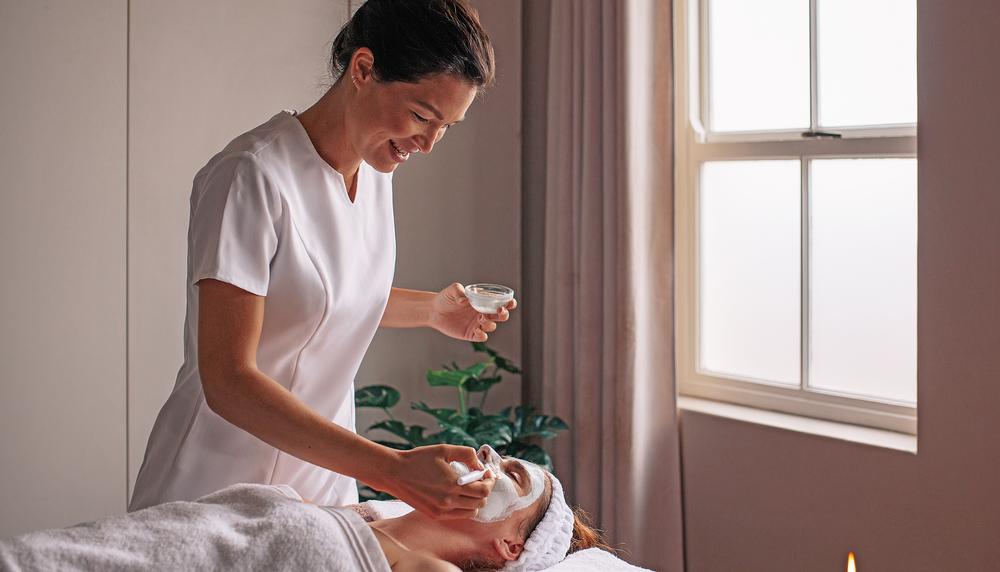
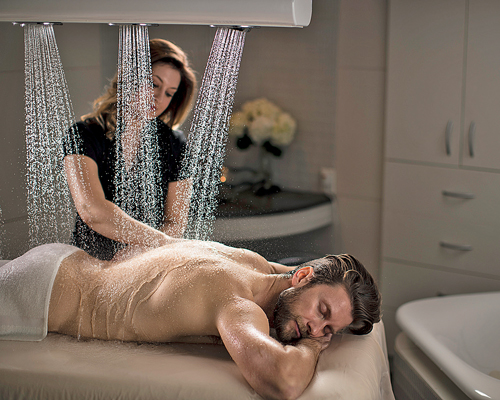
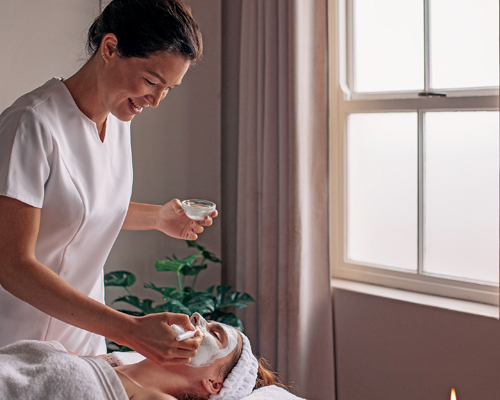
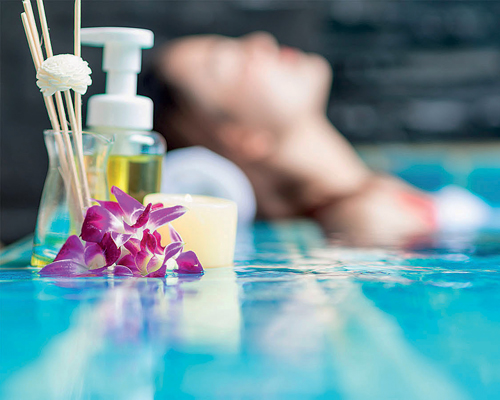
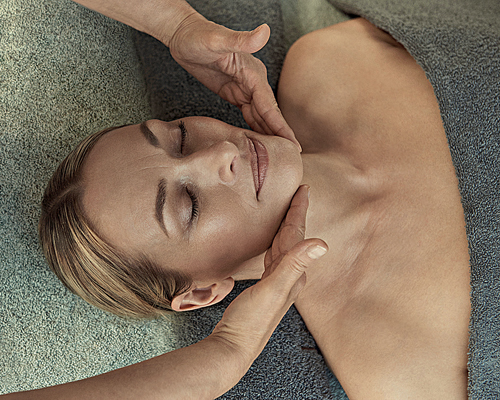
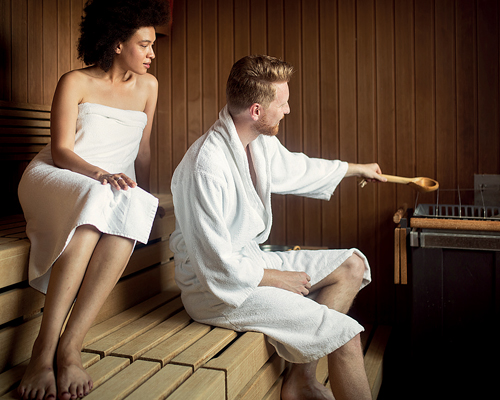
There are now 22,160 spas in the US, generating US$18.3bn a year in revenues and employing 377,900 people / Jacob Lund/shutterstock
It’s been 20 years since the International Spa Association (ISPA) launched one of the first studies to provide an outline of the US spa industry, particularly its size and growth. Back then, in 1999, there were around 4,140 spas located in North America which were generating US$4.2bn (€3.8bn, £3.3bn) in revenues.
This year the 2019 ISPA US Spa Industry Study, carried out in collaboration with PricewaterhouseCoopers (PwC) and released at the annual ISPA conference in September, paints a positive picture of an industry going from strength to strength across all key metrics. This includes annual revenue which has more than quadrupled since the first study to exceed US$18bn, making the spa sector the fourth biggest leisure industry in the US behind health clubs, golf clubs and cruise ships respectively.
The study also aims each year to unearth some of the industry’s emerging trends to help spa leaders get ahead on the ‘next big thing’. With record participation from 700 spa directors and managers in the study this year, it allows for a comprehensive view into where the industry’s leaders see growth.
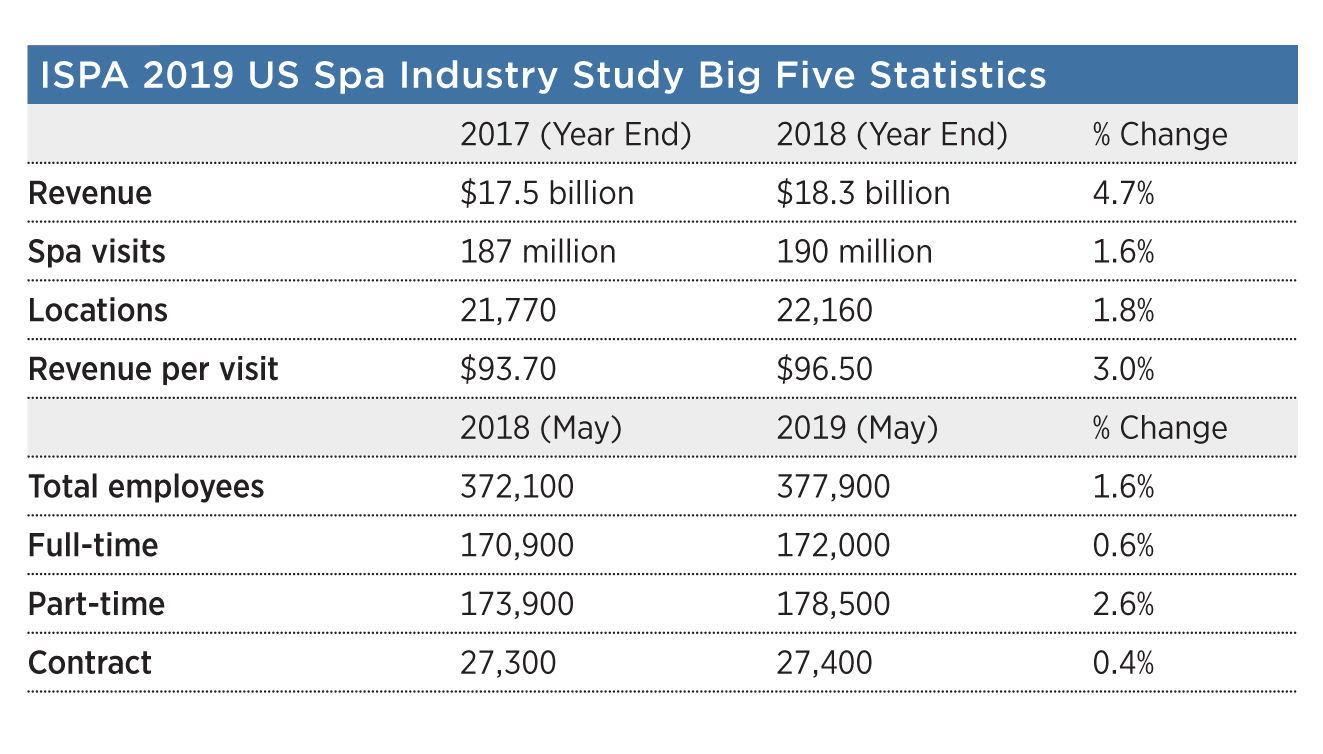
The big five With a backdrop of strong economic growth in the US in 2018, all of the study’s famous ‘Big 5’ statistics – revenue, employment, locations, spa visits and revenue per visit – increased to record high figures (see Table 1). The 22,160 spas across the nation generated US$18.3bn (€16.3bn, £15bn) in revenues, a rise of 4.7 per cent since 2017, and this has been attributed to a growth in revenue per visit which has gone up by 3 per cent and now sits at US$96.5 (€86, £79.4).
The number of jobs in the industry has continued on an upward path. Total employment is estimated to have risen to 377,900 as of May 2019, indicating a 1.6 per cent increase. In recent years, the part-time workforce has tended to grow more quickly than the full-time complement and the latest figures continue on this trajectory with spas employing part-time staff at a faster pace (+2.6 per cent) than full-time positions (+0.6 per cent). In contrast to previous years, however, the number of people employed on a contract basis went up slightly (0.4 per cent) in 2018.
CBD – the next big thing Each year, study participants share insights on what they believe will be the next big new trend to shape the US spa industry. While the traditional notion of spas being sanctuaries for beauty and pampering are still at play and these remain a prominent feature, the overarching theme from this year’s data shows the role of spas in encouraging wellbeing. The industry believes its key mission is to provide services focusing on care of body and mind – from diet counselling, fitness and meditation to sleep therapy and energy work.
An overwhelming number of insiders predict a rise of cannabidiol products and treatments (CBD). While still in its infancy, CBD oil has burst onto the spa scene and 43 per cent of survey respondents said they felt it could become the industry’s next big trend.
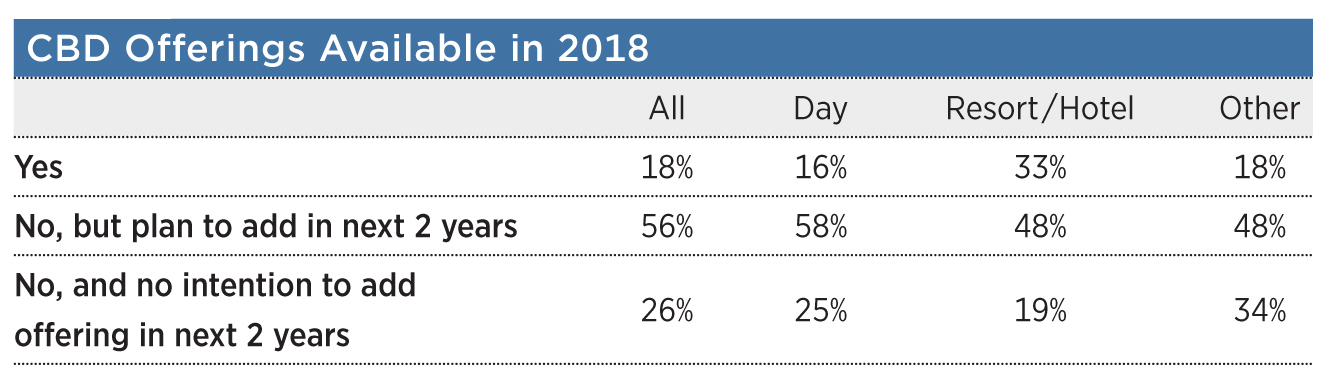
Almost one in five spas (18 per cent) had a CBD offering in place in 2018 (see Table 2), although the prevalence varies considerably according to each region’s legislative provisions, with spas in the north-west and south-west regions more likely to have a CBD offering than elsewhere in the country.
A clear majority of facilities which already have a CBD offering are incorporating it into massage treatments (86 per cent) or offering CBD products for sale as retail items (75 per cent).
Interestingly, at an overall level, more than half of spas (56 per cent) said they plan to add a CBD offering in the next two years. Of course, it’s impossible to predict just how much CBD will grow as a trend, but if that statistic does develop into reality, it would see the number of spas with a CBD offering rise from 18 per cent now to 74 per cent by 2022. Were that to happen, the early adopters could be in a lucrative position to capitalise on a new trend.
For a greater insight into how operators are embracing CBD treatments and products see the last issue of Spa Business magazine (SB19/3 p52).
Gen Z – up and coming Another emerging trend that came through in this year’s study was market expansion for spas through targeting new groups of clients, such as the male spa-goer, athletes or gen Z consumers. Among those groups, gen Z have been proving to be of particular interest to industry leaders. They’re the consumers younger than millennials. Born after 1996, a sizeable number have already reached the age of majority, and as more start work and earn money, they’ll undoubtedly become a crucial part of spas’ customer base in the future. The ninth edition of ISPA’s Consumer Snapshot Initiative, published in June, highlights spa-goer habits across different age groups (see SB19/3 p74) and found that gen Z feel the least comfortable when visiting spas. The spa industry very successfully engaged with millennials as they transitioned to adulthood, so these findings serve as a timely reminder of the need to be relevant to gen Z as the ‘up and coming’ generation. The consumer snapshot suggests this is a group which prefers a shared experience – whether that’s visiting with friends or, more obviously, with parents or family. A vital first step will be making a good early impression ensuring they feel comfortable during their experience, have their preferences heard, and ultimately feel welcome in the spa environment.
Role of technology Finally, the role technology plays in spas also came across as something increasingly shaping the industry. More specifically, it’s worth looking at how it can be used to a greater extent to improve operational and customer service functions. Online booking is a good example.
All industries are constantly looking for ways to take pressure off more manual services through the use of technology. This year’s study found that the vast majority (88 per cent) of spas had at least one online booking feature available in 2018. Having those features in place, however, does not necessarily mean they’re used to their full potential. The generational Consumer Snapshot survey found that 70 per cent of spa-goers prefer to make an appointment over the phone or in-person at reception, compared to just 29 per cent online or using an app.
Considering just how much online booking has grown in other leisure industries such as travel and recreation, it’s worth thinking how spas can make people more comfortable with online booking to maximise the use of digital methods and ease the pressure on manual services.
Positive footing Other potential emerging trends highlighted in the study include the role of mobile and in-home services, express options for time-constrained consumers and greater implementation of alternative and complementary treatments. Time will tell whether these come through more emphatically in future.
Many trends come and go, and some make more of a lasting impact than others, but the emergence of CBD, gen Z and the greater use of technology to improve the business are all proving to be significant talking points. Their lasting impact will only become known over time, but with the 2019 ISPA US Spa Industry Study highlighting an industry in a strong position, the spa industry is heading into the future on a positive footing.
Table 1
Table 2
A full copy the 2019 ISPA US Spa Industry Study is available at experienceispa.com. It’s free to ISPA members or can be purchased by non-members for US$800 (€724, £632).
Russell Donaldson is a manager in PwC’s research centre in the UK
[email protected]
Read more from this issue of Attractions Management magazine
View contents of Attractions Management 2019 issue 4
Editor's letter: Democratic wellness
To truly flourish, the spa industry needs to step outside its comfort zone and reach out to different markets with new and exciting business models, says Katie Barnes
Spa Programmes: On the menu
Boundary-pushing wellness in Iceland, self-care focus at Devarana and Civana’s equine retreat all feature in our spa menu round-up
Interview: Alexandre Cantin
Canada’s Groupe Nordik wants to open 10 nature spas, focusing on bathing and thermotherapy, by 2027. Katie Barnes talks to its VP of growth and strategy
Promotional feature: Starpool - Star quality
Wellness expert, Starpool, is known for offering complete wellness solutions with Italian design flair, enabling operators to create world class treatments and experiences
Training: Covering all bases
Resense joins forces with Lobster Ink to create an online training program for multiple spa roles
Promotional feature: Gharieni
Spa equipment innovator, Gharieni, is partnering with leading spas around the world to showcase its products to clients in real world settings, as CEO, Sammy Gharieni, explains
Research: Positive picture
ISPA’s latest US spa study shows continued growth across key metrics and pinpoints CBD and gen Z as trends. Russell Donaldson reports
Promotional feature: Zimmer MedizinSystems - Cool customer
Rainer Bolsinger, who heads up hotel and spa sales of icelab at Zimmer MedizinSystems, and icelab customer Chenot Group, explain how cryotherapy can be incorporated into your business
Promotional feature: Biologique Recherche - Skin deep
Biologique Recherche has spent the past 40 years developing technology and products to understand the skin on an individual level. Pierre-Louis Delapalme and Rupert Schmid tell Spa Business about the Parisian brand’s latest innovations
Research: On the move
The global physical activity market is now worth US$828bn according to a new GWI study. But what emerging trends do spas need to know about?
Promotional feature: SpaSoft - Onwards & upwards
The enhanced integration between SpaSoft and multiple PMS systems will help your team save time, remove the possibility of human error and create an elevated guest experience
Software: Monetising
How is software helping spas to navigate e-commerce and further monetise their relationship with clients
The US spa industry continues to grow across
key metrics and trends to watch include CBD, gen Z and the role of technology. Russell Donaldson
takes a closer look at ISPA’s latest research
There are now 22,160 spas in the US, generating US$18.3bn a year in revenues and employing 377,900 people / Jacob Lund/shutterstock
It’s been 20 years since the International Spa Association (ISPA) launched one of the first studies to provide an outline of the US spa industry, particularly its size and growth. Back then, in 1999, there were around 4,140 spas located in North America which were generating US$4.2bn (€3.8bn, £3.3bn) in revenues.
This year the 2019 ISPA US Spa Industry Study, carried out in collaboration with PricewaterhouseCoopers (PwC) and released at the annual ISPA conference in September, paints a positive picture of an industry going from strength to strength across all key metrics. This includes annual revenue which has more than quadrupled since the first study to exceed US$18bn, making the spa sector the fourth biggest leisure industry in the US behind health clubs, golf clubs and cruise ships respectively.
The study also aims each year to unearth some of the industry’s emerging trends to help spa leaders get ahead on the ‘next big thing’. With record participation from 700 spa directors and managers in the study this year, it allows for a comprehensive view into where the industry’s leaders see growth.
The big five With a backdrop of strong economic growth in the US in 2018, all of the study’s famous ‘Big 5’ statistics – revenue, employment, locations, spa visits and revenue per visit – increased to record high figures (see Table 1). The 22,160 spas across the nation generated US$18.3bn (€16.3bn, £15bn) in revenues, a rise of 4.7 per cent since 2017, and this has been attributed to a growth in revenue per visit which has gone up by 3 per cent and now sits at US$96.5 (€86, £79.4).
The number of jobs in the industry has continued on an upward path. Total employment is estimated to have risen to 377,900 as of May 2019, indicating a 1.6 per cent increase. In recent years, the part-time workforce has tended to grow more quickly than the full-time complement and the latest figures continue on this trajectory with spas employing part-time staff at a faster pace (+2.6 per cent) than full-time positions (+0.6 per cent). In contrast to previous years, however, the number of people employed on a contract basis went up slightly (0.4 per cent) in 2018.
CBD – the next big thing Each year, study participants share insights on what they believe will be the next big new trend to shape the US spa industry. While the traditional notion of spas being sanctuaries for beauty and pampering are still at play and these remain a prominent feature, the overarching theme from this year’s data shows the role of spas in encouraging wellbeing. The industry believes its key mission is to provide services focusing on care of body and mind – from diet counselling, fitness and meditation to sleep therapy and energy work.
An overwhelming number of insiders predict a rise of cannabidiol products and treatments (CBD). While still in its infancy, CBD oil has burst onto the spa scene and 43 per cent of survey respondents said they felt it could become the industry’s next big trend.
Almost one in five spas (18 per cent) had a CBD offering in place in 2018 (see Table 2), although the prevalence varies considerably according to each region’s legislative provisions, with spas in the north-west and south-west regions more likely to have a CBD offering than elsewhere in the country.
A clear majority of facilities which already have a CBD offering are incorporating it into massage treatments (86 per cent) or offering CBD products for sale as retail items (75 per cent).
Interestingly, at an overall level, more than half of spas (56 per cent) said they plan to add a CBD offering in the next two years. Of course, it’s impossible to predict just how much CBD will grow as a trend, but if that statistic does develop into reality, it would see the number of spas with a CBD offering rise from 18 per cent now to 74 per cent by 2022. Were that to happen, the early adopters could be in a lucrative position to capitalise on a new trend.
For a greater insight into how operators are embracing CBD treatments and products see the last issue of Spa Business magazine (SB19/3 p52).
Gen Z – up and coming Another emerging trend that came through in this year’s study was market expansion for spas through targeting new groups of clients, such as the male spa-goer, athletes or gen Z consumers. Among those groups, gen Z have been proving to be of particular interest to industry leaders. They’re the consumers younger than millennials. Born after 1996, a sizeable number have already reached the age of majority, and as more start work and earn money, they’ll undoubtedly become a crucial part of spas’ customer base in the future. The ninth edition of ISPA’s Consumer Snapshot Initiative, published in June, highlights spa-goer habits across different age groups (see SB19/3 p74) and found that gen Z feel the least comfortable when visiting spas. The spa industry very successfully engaged with millennials as they transitioned to adulthood, so these findings serve as a timely reminder of the need to be relevant to gen Z as the ‘up and coming’ generation. The consumer snapshot suggests this is a group which prefers a shared experience – whether that’s visiting with friends or, more obviously, with parents or family. A vital first step will be making a good early impression ensuring they feel comfortable during their experience, have their preferences heard, and ultimately feel welcome in the spa environment.
Role of technology Finally, the role technology plays in spas also came across as something increasingly shaping the industry. More specifically, it’s worth looking at how it can be used to a greater extent to improve operational and customer service functions. Online booking is a good example.
All industries are constantly looking for ways to take pressure off more manual services through the use of technology. This year’s study found that the vast majority (88 per cent) of spas had at least one online booking feature available in 2018. Having those features in place, however, does not necessarily mean they’re used to their full potential. The generational Consumer Snapshot survey found that 70 per cent of spa-goers prefer to make an appointment over the phone or in-person at reception, compared to just 29 per cent online or using an app.
Considering just how much online booking has grown in other leisure industries such as travel and recreation, it’s worth thinking how spas can make people more comfortable with online booking to maximise the use of digital methods and ease the pressure on manual services.
Positive footing Other potential emerging trends highlighted in the study include the role of mobile and in-home services, express options for time-constrained consumers and greater implementation of alternative and complementary treatments. Time will tell whether these come through more emphatically in future.
Many trends come and go, and some make more of a lasting impact than others, but the emergence of CBD, gen Z and the greater use of technology to improve the business are all proving to be significant talking points. Their lasting impact will only become known over time, but with the 2019 ISPA US Spa Industry Study highlighting an industry in a strong position, the spa industry is heading into the future on a positive footing.
Table 1
Table 2
A full copy the 2019 ISPA US Spa Industry Study is available at experienceispa.com. It’s free to ISPA members or can be purchased by non-members for US$800 (€724, £632).
Russell Donaldson is a manager in PwC’s research centre in the UK
[email protected]
Read more from this issue of Attractions Management magazine
View contents of Attractions Management 2019 issue 4
Editor's letter: Democratic wellness
To truly flourish, the spa industry needs to step outside its comfort zone and reach out to different markets with new and exciting business models, says Katie Barnes
Spa Programmes: On the menu
Boundary-pushing wellness in Iceland, self-care focus at Devarana and Civana’s equine retreat all feature in our spa menu round-up
Interview: Alexandre Cantin
Canada’s Groupe Nordik wants to open 10 nature spas, focusing on bathing and thermotherapy, by 2027. Katie Barnes talks to its VP of growth and strategy
Promotional feature: Starpool - Star quality
Wellness expert, Starpool, is known for offering complete wellness solutions with Italian design flair, enabling operators to create world class treatments and experiences
Training: Covering all bases
Resense joins forces with Lobster Ink to create an online training program for multiple spa roles
Promotional feature: Gharieni
Spa equipment innovator, Gharieni, is partnering with leading spas around the world to showcase its products to clients in real world settings, as CEO, Sammy Gharieni, explains
Research: Positive picture
ISPA’s latest US spa study shows continued growth across key metrics and pinpoints CBD and gen Z as trends. Russell Donaldson reports
Promotional feature: Zimmer MedizinSystems - Cool customer
Rainer Bolsinger, who heads up hotel and spa sales of icelab at Zimmer MedizinSystems, and icelab customer Chenot Group, explain how cryotherapy can be incorporated into your business
Promotional feature: Biologique Recherche - Skin deep
Biologique Recherche has spent the past 40 years developing technology and products to understand the skin on an individual level. Pierre-Louis Delapalme and Rupert Schmid tell Spa Business about the Parisian brand’s latest innovations
Research: On the move
The global physical activity market is now worth US$828bn according to a new GWI study. But what emerging trends do spas need to know about?
Promotional feature: SpaSoft - Onwards & upwards
The enhanced integration between SpaSoft and multiple PMS systems will help your team save time, remove the possibility of human error and create an elevated guest experience
Software: Monetising
How is software helping spas to navigate e-commerce and further monetise their relationship with clients
A US$50 million (£44.2 million, €51.2 million) transformation of Chicago's historic McCormick
Mansion has created a new destination that combines live magic, immersive theatre, dining and
private membership under one roof.
The Montana Historical Society has officially celebrated the opening of its new Montana
Heritage
Center, a US$107 million (£79 million, €92 million) destination that combines immersive
storytelling with cutting-edge audiovisual technology to bring the sta
San Antonio Zoo has reported a US$283 million economic impact for 2025, following a decade-
long transformation programme that has seen almost US$200 million invested into the Texas
attraction.
Plans for the AU$180 million redevelopment of Reef HQ Aquarium in Townsville, Australia, are
progressing, with the project set to transform the attraction into a global centre for reef
education and conservation.
Abu Dhabi-based investment firm Mubadala Capital has made a binding, fully financed
€1 billion
offer to acquire Pierre and Vacances SA, the European holiday resort operator behind the
continental European Center Parcs business.
Disney has reaffirmed its commitment to investing US$30 billion in its US parks and cruise
business by 2033, using new America250 celebrations to underline the role its attractions play
in supporting jobs, tourism and economic growth.
Expo 2030 Riyadh is being planned as a permanent visitor destination, with organisers
confirming the six-million-square-metre site will become a Global Village after the event closes.
The owner of one of Australia's best-known waterparks has acquired a major competitor,
creating a new attractions business spanning two of the country's largest visitor destinations.
The Toverland theme park in the Netherlands has announced a €98m expansion programme
that will add a resort, new attractions and staff facilities as it pursues plans to become a multi-
day destination.
Hotel de France, located on the British Isle of Jersey, has created a wellness retreat package
that includes a hot yoga session that will take place in Jersey Zoo’s butterfly sanctuary.
+ More news
COMPANY PROFILES
Alterface Alterface’s Creative Division team is
seasoned in concept and ride development,
as well as storyte [more...]
Sally Corporation Our services include: Dark ride design & build; Redevelopment of existing attractions; High-quality [more...]