In a world first, Rotterdam’s Boijmans museum
is putting its entire collection on display in
a mammoth new warehouse. As the V&A considers
a similar experiment, is this ‘open storage’
model the future, asks Andrew Dickson?
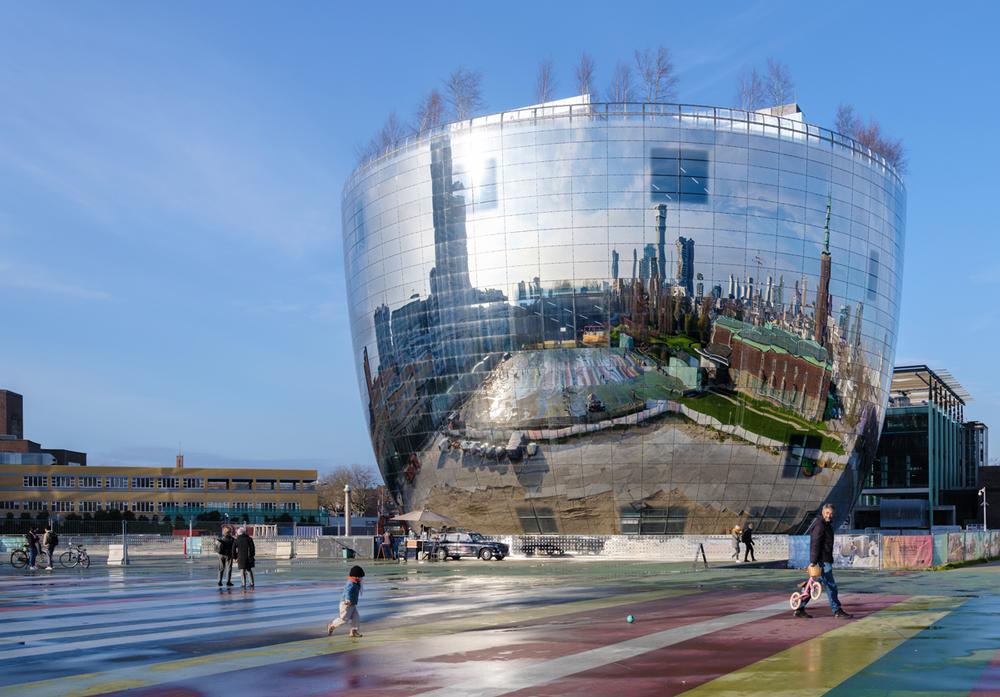
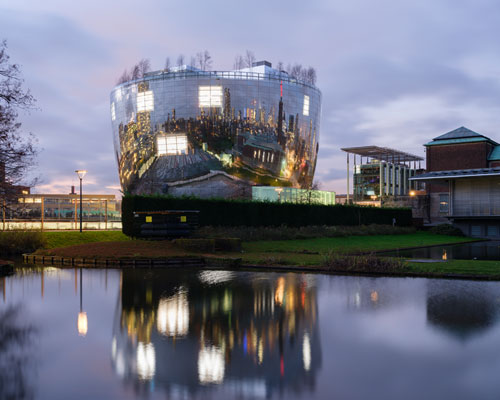
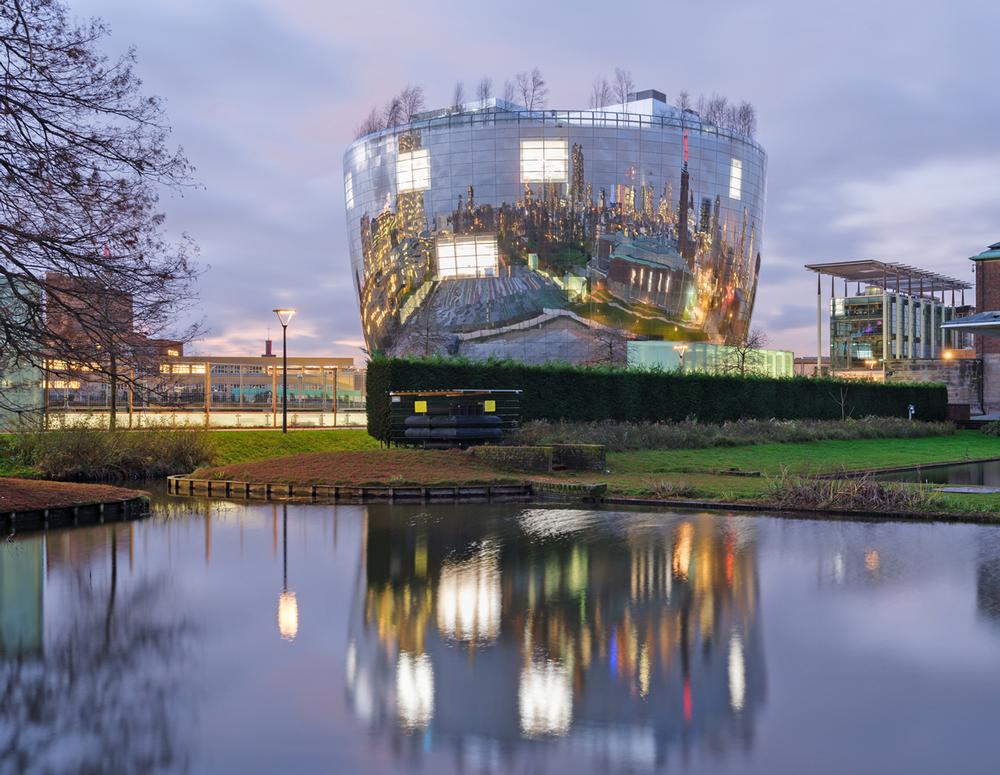
Depot Boijmans Van Beuningen is billed as the world’s first art storage facility with access to a museum’s complete collection / PHOTO: Ossip van Duivenbode
From a block away, it looks like a craft from a more advanced civilisation has landed in the centre of Rotterdam. The structure is futuristic, with walls of mirrored glass curving up some 40 metres, reflecting the iron-grey clouds and the fractured city skyline. It wouldn’t be surprising if it had a tractor beam instead of a door. As I draw close, a middle-aged Dutch couple are debating whether they like it. They decide not, but snap selfies in front of it anyway.
Rotterdammers are used to high-concept architecture, but what makes this building unusual is its function: it’s a warehouse.
Designed by Dutch architecture firm MVRDV and known as the Depot, it has been created for one of the most well-regarded art museums in the Netherlands, the Boijmans Van Beuningen. When I visit, contractors are installing vitrines and polishing concrete floors. Now, several months later [July 2021] art handlers have begun moving in the museum’s collection of Rembrandts, Boschs, Magrittes and Dalís – some 150,000 objects, ready for its opening in November.
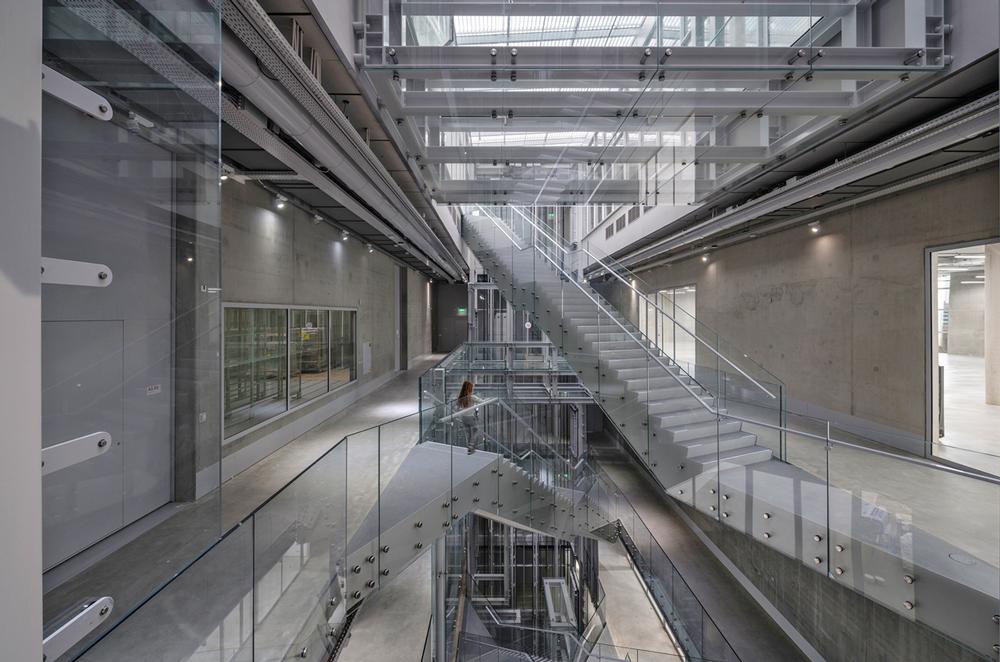
In the atrium, Sjarel Ex, the Boijmans’ director, is wearing the look of a man who can’t quite believe it’s finally happening. “A treasure chest, no?” he exclaims, gesturing towards a dizzying lattice of glass stairwells above our heads. “Every single thing we have will be on display.”
To call the Depot a warehouse is, it turns out, to do it a considerable disservice: the building is an attempt to turn the Boijmans inside out. Instead of locking their crown jewels away behind closed doors, the institution has ploughed €55m (£50m) into an “open storage” facility in the heart of the city, right next to the main 1930s building.
Museums have dabbled with open or visible storage for decades. New York’s Metropolitan made some of its research collections available in the late 1980s, while the V&A’s 2009–10 ceramics galleries put some 26,000 objects on display in tall, tightly crammed glass cabinets. But Ex and his colleagues reckon this is the first time that anyone has built an open-storage facility to house an entire museum collection.
“Radical transparency,” Ex grins. “A little bit Dutch, I’m afraid.”
As we stride from the loading bay to the decontamination zone (“if a piece of furniture has moths, this is where we sort it out,” he explains), Ex rattles through the story. In 2013, the basement stores of the Boijmans flooded. Though the damage was mercifully minimal, it was obvious that the museum needed to upgrade, particularly given that 90 per cent of Rotterdam is below sea level – and with climate change, the percentage is increasing.
But instead of erecting something in an anonymous industrial zone somewhere, Ex had the idea of turning the stores into a visitor attraction. There were already plans to close the main building for seven years for renovation – it’s due to reopen in 2026 – so this would also be a way of bridging the gap.
“So much of what museums do happens in the dark,” says Ex. “We wanted to bring some of it into the light.”
An appealing idea, but fiendishly difficult to pull off, architect Winy Maas tells me – light itself being a major problem. The museum was insistent that, even though the Depot is a public building, conditions should be as good, if not better, than a regular vault: super-high-grade air conditioning will make the environment dust-free, while the structure is divided into five “climate zones” for different kinds of artefacts (colour photographs need to be stored at a lower temperature than black-and-white prints, for example). While some pieces will hang on movable racks, or in 13 display cabinets placed through the building, light-sensitive objects will be kept in sealed cabinets and only inspected by appointment.
Ex doesn’t go into detail about security, but suggests that the building is more than a match for art thieves. “And which is safer, really?” he asks. “Putting your depot on the outskirts of a city, or having it right here in the centre, surrounded by people?”
THE ISSUE OF SPACE There’s more at stake than technical questions about how best to care for fragile artefacts. Although few museums advertise the fact, what we see in their galleries is a tiny fraction of what they possess: the usual estimate is that 95 per cent of most collections are locked away. Research done in 2016 by the magazine Quartz suggested that, in a sample of 20 museums, almost half the Picasso paintings were in storage, while far more Georgia O’Keeffes were in the vault (67) than on permanent display (36).
The problem, of course, is space. Some museums have expanded to make more of their collections visible: Tate Modern’s 2016 extension doubled its gallery capacity, while the redeveloped MoMA in New York now contains a leg-punishing 15,000 square metres of gallery space over six floors – more than a city block. The V&A has open-storage ambitions for its new offshoot in east London, scheduled to open in 2023: the plan is to have 250,000 objects accessible, added to the 60,000-odd currently on display, which visitors will be able to access through guided tours.
But collections, like the universe, are ever-expanding – partly because many public museums are forbidden from “de-accessioning”, or getting rid of artefacts. “Show me a museum that doesn’t have a storage problem,” one director tells me. “I’d love to visit.”
“It’s a real challenge,” agrees Pil Rasmussen, who runs the conservation department at Denmark’s National Gallery. “These collections are owned by the public, but the public cannot see most of them.”
Open storage is one solution, but has its own challenges. For a start, most museums don’t have the resources to build new facilities, particularly in the UK, where institutions have battled with shrinking budgets for at least a decade, putting many on life support, even before the coronavirus crisis hit.
“In redevelopment plans, storage and backroom facilities are often the ones that get cut back,” Rasmussen sighs. It’s as much as some places can do to make sure that existing objects are kept safely, never mind the extra resources it takes to show them safely to the public.
Some professionals also have a suspicion that, eye-catching as visible-storage projects are, they are more of a symbolic than a real change to the way museums operate. Does anyone have the appetite to see the 2.3m-odd objects and books owned by the V&A? How about the Smithsonian, whose 19 institutions possess around 155m artefacts, most of which are stored offsite around Washington DC?
When I raise these points with Ex, he nods. “Sure. Projects like ours are an experiment. Will anyone come? Or will they come to the Depot, and not to the beautifully curated exhibitions we have in the museum?” He shrugs. “We’ll see.”
A train ride away from Rotterdam, another major institution is attempting its own version of radical transparency. Amsterdam’s Rijksmuseum has been conducting what it calls Operation Night Watch – a project to restore Rembrandt’s most famous painting while the rest of us look on.
Rijksmuseum director Taco Dibbits concedes that locking The Night Watch in the conservation studio for years on end wasn’t realistic – it is the reason many thousands of people visit the museum. Restoring it on display has benefits, too. “For museums, the way forward is how you share research,” he suggests. “We sometimes underestimate how fascinated the public is.
For both Dibbits and Ex, opening up marks a powerful shift in how museums see their role, particularly as they emerge from lockdown and re-evaluate their place in the world. Pushing backstage processes and personnel into the limelight is part of it (perhaps the easy part); institutions also need to be open about uncomfortable issues such as funding and ethics, staff diversity, curation and collecting policies, the provenance of disputed or colonial-era objects.
It’s a crunch point, Ex suggests: “We have to think much, much harder about transparency if we want to survive.”
Dibbits concurs. “The objects stay the same,” he says. “But how we talk about and show them – that really has to keep changing.”
THE RIJKSMUSEUM RECONSTRUCTS THE NIGHT WATCH
Visitors to the Rijksmuseum can now enjoy Rembrandt’s Night Watch in its original form for the first time in 300 years. As part of the Rijksmuseum’s Operation Night Watch project, missing strips of the painting – which were removed when it was moved to Amsterdam’s Town Hall in 1715 – have been recreated with the help of artificial intelligence. “Thanks to this reconstruction, we can now see that the composition as it was painted by Rembrandt was even more dynamic,” said Taco Dibbits, director of the Rijksmuseum. “It is wonderful to be able to see with our own eyes The Night Watch as Rembrandt intended it to be seen.”
Read more from this issue of Attractions Management magazine
View contents of Attractions Management 2021 issue 2
Museums: Museum of everything
At Depot Van Beuningen, a new kind of museum is taking shape, with the whole collection on show
Interview: Joe Pine
From mass customised itineraries to hybrid experiences, the pandemic is influencing attractions trends, says thought leader, Joe Pine
Disney: The Art of Marvel
Disneyland Paris has opened its new Marvel-inspired hotel. Art director Caroline May tells us what made it such a special project to work on
Interview: Nicolas de Villiers
As Puy du Fou opens its first park outside France, its president tells Attractions Management about his ambitious global plans and why China is next on his radar
Research: All creatures great and small
Large, charismatic animals drive footfall to zoos, but there are more unusual ways of boosting attendance, says Yvonne Buckley
Research: Power of youth
Teenage volunteers can help tween visitors get more out of their visits to science centres, new research shows
Disney: Reach for the stars
Dreamed up by Star Wars fans and brought to life by Disney Imagineers – a sneak peek at the Star Wars Galactic Starcruiser hotel experience
Research: Animal magic
A national study in Japan has shown how partnering with entertainment companies can help drive visits and donations to zoos
Museums: The way we live
London’s Museum of the Home has reopened after a major refurbishment. We hear from the architects and museum director
In a world first, Rotterdam’s Boijmans museum
is putting its entire collection on display in
a mammoth new warehouse. As the V&A considers
a similar experiment, is this ‘open storage’
model the future, asks Andrew Dickson?
Depot Boijmans Van Beuningen is billed as the world’s first art storage facility with access to a museum’s complete collection / PHOTO: Ossip van Duivenbode
From a block away, it looks like a craft from a more advanced civilisation has landed in the centre of Rotterdam. The structure is futuristic, with walls of mirrored glass curving up some 40 metres, reflecting the iron-grey clouds and the fractured city skyline. It wouldn’t be surprising if it had a tractor beam instead of a door. As I draw close, a middle-aged Dutch couple are debating whether they like it. They decide not, but snap selfies in front of it anyway.
Rotterdammers are used to high-concept architecture, but what makes this building unusual is its function: it’s a warehouse.
Designed by Dutch architecture firm MVRDV and known as the Depot, it has been created for one of the most well-regarded art museums in the Netherlands, the Boijmans Van Beuningen. When I visit, contractors are installing vitrines and polishing concrete floors. Now, several months later [July 2021] art handlers have begun moving in the museum’s collection of Rembrandts, Boschs, Magrittes and Dalís – some 150,000 objects, ready for its opening in November.
In the atrium, Sjarel Ex, the Boijmans’ director, is wearing the look of a man who can’t quite believe it’s finally happening. “A treasure chest, no?” he exclaims, gesturing towards a dizzying lattice of glass stairwells above our heads. “Every single thing we have will be on display.”
To call the Depot a warehouse is, it turns out, to do it a considerable disservice: the building is an attempt to turn the Boijmans inside out. Instead of locking their crown jewels away behind closed doors, the institution has ploughed €55m (£50m) into an “open storage” facility in the heart of the city, right next to the main 1930s building.
Museums have dabbled with open or visible storage for decades. New York’s Metropolitan made some of its research collections available in the late 1980s, while the V&A’s 2009–10 ceramics galleries put some 26,000 objects on display in tall, tightly crammed glass cabinets. But Ex and his colleagues reckon this is the first time that anyone has built an open-storage facility to house an entire museum collection.
“Radical transparency,” Ex grins. “A little bit Dutch, I’m afraid.”
As we stride from the loading bay to the decontamination zone (“if a piece of furniture has moths, this is where we sort it out,” he explains), Ex rattles through the story. In 2013, the basement stores of the Boijmans flooded. Though the damage was mercifully minimal, it was obvious that the museum needed to upgrade, particularly given that 90 per cent of Rotterdam is below sea level – and with climate change, the percentage is increasing.
But instead of erecting something in an anonymous industrial zone somewhere, Ex had the idea of turning the stores into a visitor attraction. There were already plans to close the main building for seven years for renovation – it’s due to reopen in 2026 – so this would also be a way of bridging the gap.
“So much of what museums do happens in the dark,” says Ex. “We wanted to bring some of it into the light.”
An appealing idea, but fiendishly difficult to pull off, architect Winy Maas tells me – light itself being a major problem. The museum was insistent that, even though the Depot is a public building, conditions should be as good, if not better, than a regular vault: super-high-grade air conditioning will make the environment dust-free, while the structure is divided into five “climate zones” for different kinds of artefacts (colour photographs need to be stored at a lower temperature than black-and-white prints, for example). While some pieces will hang on movable racks, or in 13 display cabinets placed through the building, light-sensitive objects will be kept in sealed cabinets and only inspected by appointment.
Ex doesn’t go into detail about security, but suggests that the building is more than a match for art thieves. “And which is safer, really?” he asks. “Putting your depot on the outskirts of a city, or having it right here in the centre, surrounded by people?”
THE ISSUE OF SPACE There’s more at stake than technical questions about how best to care for fragile artefacts. Although few museums advertise the fact, what we see in their galleries is a tiny fraction of what they possess: the usual estimate is that 95 per cent of most collections are locked away. Research done in 2016 by the magazine Quartz suggested that, in a sample of 20 museums, almost half the Picasso paintings were in storage, while far more Georgia O’Keeffes were in the vault (67) than on permanent display (36).
The problem, of course, is space. Some museums have expanded to make more of their collections visible: Tate Modern’s 2016 extension doubled its gallery capacity, while the redeveloped MoMA in New York now contains a leg-punishing 15,000 square metres of gallery space over six floors – more than a city block. The V&A has open-storage ambitions for its new offshoot in east London, scheduled to open in 2023: the plan is to have 250,000 objects accessible, added to the 60,000-odd currently on display, which visitors will be able to access through guided tours.
But collections, like the universe, are ever-expanding – partly because many public museums are forbidden from “de-accessioning”, or getting rid of artefacts. “Show me a museum that doesn’t have a storage problem,” one director tells me. “I’d love to visit.”
“It’s a real challenge,” agrees Pil Rasmussen, who runs the conservation department at Denmark’s National Gallery. “These collections are owned by the public, but the public cannot see most of them.”
Open storage is one solution, but has its own challenges. For a start, most museums don’t have the resources to build new facilities, particularly in the UK, where institutions have battled with shrinking budgets for at least a decade, putting many on life support, even before the coronavirus crisis hit.
“In redevelopment plans, storage and backroom facilities are often the ones that get cut back,” Rasmussen sighs. It’s as much as some places can do to make sure that existing objects are kept safely, never mind the extra resources it takes to show them safely to the public.
Some professionals also have a suspicion that, eye-catching as visible-storage projects are, they are more of a symbolic than a real change to the way museums operate. Does anyone have the appetite to see the 2.3m-odd objects and books owned by the V&A? How about the Smithsonian, whose 19 institutions possess around 155m artefacts, most of which are stored offsite around Washington DC?
When I raise these points with Ex, he nods. “Sure. Projects like ours are an experiment. Will anyone come? Or will they come to the Depot, and not to the beautifully curated exhibitions we have in the museum?” He shrugs. “We’ll see.”
A train ride away from Rotterdam, another major institution is attempting its own version of radical transparency. Amsterdam’s Rijksmuseum has been conducting what it calls Operation Night Watch – a project to restore Rembrandt’s most famous painting while the rest of us look on.
Rijksmuseum director Taco Dibbits concedes that locking The Night Watch in the conservation studio for years on end wasn’t realistic – it is the reason many thousands of people visit the museum. Restoring it on display has benefits, too. “For museums, the way forward is how you share research,” he suggests. “We sometimes underestimate how fascinated the public is.
For both Dibbits and Ex, opening up marks a powerful shift in how museums see their role, particularly as they emerge from lockdown and re-evaluate their place in the world. Pushing backstage processes and personnel into the limelight is part of it (perhaps the easy part); institutions also need to be open about uncomfortable issues such as funding and ethics, staff diversity, curation and collecting policies, the provenance of disputed or colonial-era objects.
It’s a crunch point, Ex suggests: “We have to think much, much harder about transparency if we want to survive.”
Dibbits concurs. “The objects stay the same,” he says. “But how we talk about and show them – that really has to keep changing.”
THE RIJKSMUSEUM RECONSTRUCTS THE NIGHT WATCH
Visitors to the Rijksmuseum can now enjoy Rembrandt’s Night Watch in its original form for the first time in 300 years. As part of the Rijksmuseum’s Operation Night Watch project, missing strips of the painting – which were removed when it was moved to Amsterdam’s Town Hall in 1715 – have been recreated with the help of artificial intelligence. “Thanks to this reconstruction, we can now see that the composition as it was painted by Rembrandt was even more dynamic,” said Taco Dibbits, director of the Rijksmuseum. “It is wonderful to be able to see with our own eyes The Night Watch as Rembrandt intended it to be seen.”
Read more from this issue of Attractions Management magazine
View contents of Attractions Management 2021 issue 2
Museums: Museum of everything
At Depot Van Beuningen, a new kind of museum is taking shape, with the whole collection on show
Interview: Joe Pine
From mass customised itineraries to hybrid experiences, the pandemic is influencing attractions trends, says thought leader, Joe Pine
Disney: The Art of Marvel
Disneyland Paris has opened its new Marvel-inspired hotel. Art director Caroline May tells us what made it such a special project to work on
Interview: Nicolas de Villiers
As Puy du Fou opens its first park outside France, its president tells Attractions Management about his ambitious global plans and why China is next on his radar
Research: All creatures great and small
Large, charismatic animals drive footfall to zoos, but there are more unusual ways of boosting attendance, says Yvonne Buckley
Research: Power of youth
Teenage volunteers can help tween visitors get more out of their visits to science centres, new research shows
Disney: Reach for the stars
Dreamed up by Star Wars fans and brought to life by Disney Imagineers – a sneak peek at the Star Wars Galactic Starcruiser hotel experience
Research: Animal magic
A national study in Japan has shown how partnering with entertainment companies can help drive visits and donations to zoos
Museums: The way we live
London’s Museum of the Home has reopened after a major refurbishment. We hear from the architects and museum director
Abu Dhabi-based investment firm Mubadala Capital has made a binding, fully financed
€1 billion
offer to acquire Pierre and Vacances SA, the European holiday resort operator behind the
continental European Center Parcs business.
Disney has reaffirmed its commitment to investing US$30 billion in its US parks and cruise
business by 2033, using new America250 celebrations to underline the role its attractions play
in supporting jobs, tourism and economic growth.
Expo 2030 Riyadh is being planned as a permanent visitor destination, with organisers
confirming the six-million-square-metre site will become a Global Village after the event closes.
The owner of one of Australia's best-known waterparks has acquired a major competitor,
creating a new attractions business spanning two of the country's largest visitor destinations.
The Toverland theme park in the Netherlands has announced a €98m expansion programme
that will add a resort, new attractions and staff facilities as it pursues plans to become a multi-
day destination.
Hotel de France, located on the British Isle of Jersey, has created a wellness retreat package
that includes a hot yoga session that will take place in Jersey Zoo’s butterfly sanctuary.
A new immersive attraction designed to transport visitors into the final hours of ancient Pompeii
is preparing to open near the world-famous archaeological site in southern Italy.
Experience design company, BRC Imagination Arts, has completed a transition that sees founder
Bob Rogers pass ownership of the business to four long-serving senior executives, while
remaining actively involved with the company.
Movie Park Germany has opened a new Paramount Pictures-themed attraction as part of its 30th
anniversary celebrations, using immersive storytelling and adaptive reuse to reinforce the park’s
longstanding “Hollywood in Germany” positioning.
Therme Manchester’s 28-acre development, which will include interconnected glass pavilions
that measure 65,000sq m, will be the largest bathing and wellbeing attraction in the world once
complete, according to prof David Russell, CEO of Therme UK.
+ More news
COMPANY PROFILES
QubicaAMF UK QubicaAMF is the largest and most
innovative bowling equipment provider with
600 employees worldwi [more...]