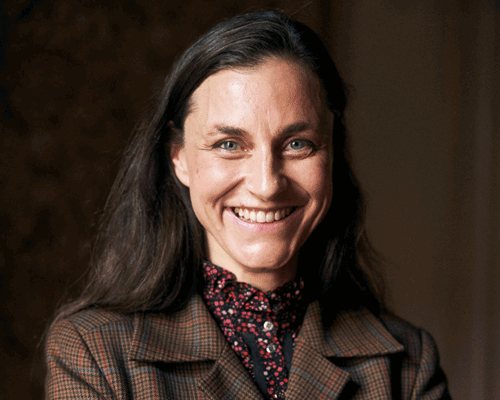
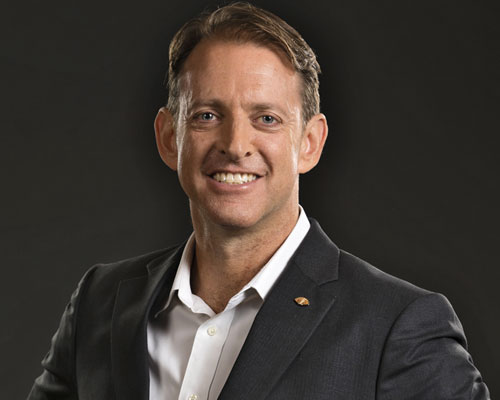
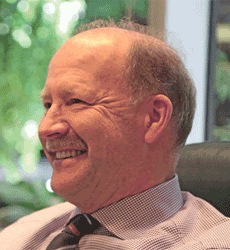
Meow Wolf co-founder Corvas Brinkerhoff is the mastermind behind Submersive / photo: Kate Russell
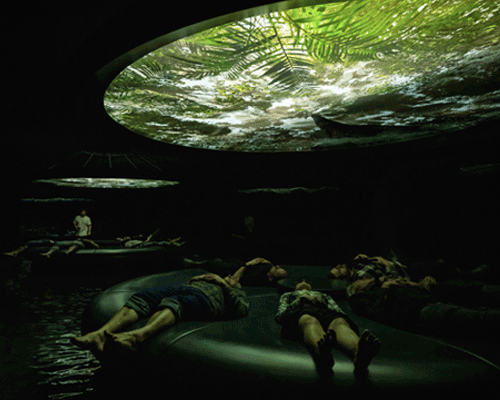
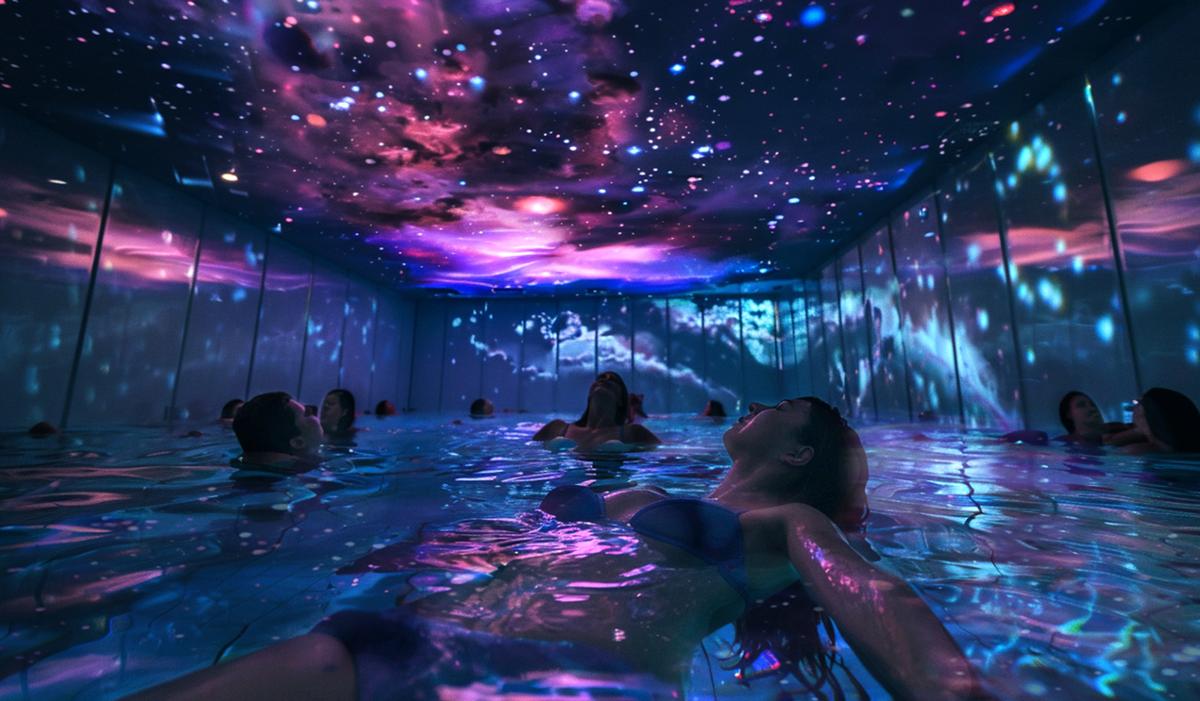
Imagine you’re lying in a warm saltwater pool, gently floating and gazing at astral projections, while listening to underwater sounds in sequence with the images. On top of this, every detail has been meticulously and scientifically developed to transport you into an elevated state of consciousness. And there isn’t just one room, there are 12. And each is designed to induce a different heightened emotion – whether that’s awe, wonder, euphoria, inspiration, connection or transcendence.
It sounds otherworldly and fantastical. But the concept is coming to market and is set to disrupt the global wellness industry. Submersive is billed as the world’s first immersive art bathhouse. The 25,000sq ft facility is due to open in Austin, Texas in 2026 – but we can expect 11 more worldwide.
Submersive brings together elements of a traditional spa such as therapeutic thermal pools, steam and sauna rooms, waterfalls, grottos, floatation and – importantly – cooler options for multiple contrast bathing possibilities and amplifies them with thought-provoking art installations, AI technology, lighting, video and sound effects.
From attractions to spa Corvas Brinkerhoff, co-founder of Meow Wolf – the company behind mind-bending interactive art and entertainment installations across the US – is the creator of Submersive. Yet while he’s made a successful name for himself in the attractions industry, his passion for wellness has been bubbling under for the past 15 years.
“Early on in my career I had an obsession with creating immersive experiences,” he tells Spa Business. “I was always asking – what if artwork came off the walls and surrounded you? What if this world had a story behind it and people who inhabited it?
“But parallel to this, I had a deepening love for contrast therapy. It wasn’t popular at the time and the science behind it wasn’t known, but I knew that every time I did it I felt amazing.”
In fact, his epiphany for Submersive even came in a bathhouse relaxation room, following a rigorous series of hot-cold circuits. “I had a flood of images pouring into my mind,” he recalls, “they were combinations of immersive art and bathing elements. It was wondrous and magical.”
Brinkerhoff put the notion on the back burner to concentrate on Meow Wolf but added to the cluster of ideas over the next decade and a half until he felt the time was right to make a move. “This is about me stepping into a sense of purpose in my lifetime,” he explains.
Over the last year, he gained further insight by visiting 17 bathhouses worldwide. In Japan, he was illuminated by the deep-rooted onsen culture and in western Europe, he was struck by the architecture and inventive bathing experiences. “It was almost like an embarrassment of riches because I received so much inspiration,” he declares.
State-change machine The blueprint for Submersive is based on 12 rooms that “each have a distinct and powerful combination of multisensory elements” around a main communal space, says Brinkerhoff. Hot and cold exposure, with its proven therapeutic benefits, underpins the journey and every aspect, from the varying pool temperatures, intensity of steam and sauna to lighting, sound and visuals, has been intentionally designed to get people feeling a certain way. “It’s essentially a massive state-change machine,” he says. “An art creation that you can literally submerge yourself into and that heals you.”
The first phase of development is scheduled for completion in 2026. After proof of concept, Brinkerhoff plans to double the size of the facility in 2028, adding more immersive environments and other amenities.
Initially, Submersive will be able to accommodate 80 people at a time, with capacity going up to 180 once fully complete. There will be a timed entry and a choice of three-hour, five-hour or full-day experiences. Price points, says Brinkerhoff, will start at US$60 (€55, £47) and the average ticket cost will sit at US$88 (€81, £69). The goal is to attract up to 200,000 visitors a year.
Integrating science and technology When it first opens, guests will get to choose their route around the bathhouse depending on how they feel or want to feel. But behind the scenes, Submersive is looking to create an AI-powered questionnaire that will be used to prescribe a recommended sequence.
It’s this integration of technology, along with its scientific approach, which makes the concept stand out. Firstly, Submersive is planning to use the principles from neuroaesthetics to inform its design and it’s partnering with the International Arts + Mind Lab at Johns Hopkins University for expert guidance. Neuroaesthetics is a field which studies how aesthetic elements, particularly visual arts, positively impact the brain. Biophilic architecture is one well-known area that Brinkerhoff and his team will be tapping into, but they’ll also consider how different images and the way they’re displayed play into the brain’s reward system.
Secondly – and possibly the most innovative aspect of its whole proposition – Submersive’s environments will actually be experiments in themselves. “Our goal is to amass the world’s deepest understanding of how multisensory experiences affect us on a physiological level,” says Brinkerhoff. Spearheaded by lead scientific advisor Beau Lotto, Submersive will periodically test the impact of its rooms on volunteers using wearables such as mobile EEG headsets and heart rate sensors. These findings will give valuable biofeedback data that Submersive will then integrate into its audiovisual systems and the design process as development continues.
“Each environment is designed to get you into a different state so there’s an inherent hypothesis we’re testing to see how the efficacy of that room compares with our intended outcome,” explains Brinkerhoff. “Then we’re also studying how all of these rooms affect you and how different sequences moving through them can affect you.”
He adds: “We could just create the world’s coolest bathhouse and make it really interesting, but the science uncovers a deep understanding of how these elements affect us and with that comes the ability to offer profoundly impactful experiences.”
11 more to come Spa Business first predicted how elements used in visitor attractions – such as immersive environments, virtual and augmented reality and haptic technology – had the potential to create amazing spa experiences in 2015 (www.spabusiness.com/foresight2015). And last year it highlighted the growing momentum in this area (www.spabusiness.com/foresight2023). Brinkerhoff agrees: “It definitely feels like it’s swelling up and I think we’ll see a lot more people bringing together immersive and wellness experiences in the future.”
He shares that Submersive’s roadmap is to have 12 properties globally within the next 10 years. “We plan to start working on our second location soon after opening the first and have ambitions to grow quickly,” he says, stating that beyond the US, western Europe and Japan will be a priority.
“Underneath it all, this is about creating spaces that show us an elevated way of being, that illuminates a part of ourselves,” he concludes. “We want to bring that to as many people as possible. There’s so much power in having an experience that shows you what’s possible.”
Read more from this issue of Attractions Management magazine
View contents of Attractions Management 2024 issue 2
Editor's letter: Cool customers
Spas must adapt to unlock new avenues for growth while mitigating the impact of climate change, says Katie Barnes
Top Team: Therme Group
With its focus on affordable wellness, Therme Group is expanding its social spa concept globally. Jane Kitchen speaks to the people behind the brand
Interview: Susie Ellis
The chair of the Global Wellness Summit has been fundamental in defining the industry and continues to drive it forward
Sponsored: Comfort Zone: Powered by nature
B Corp-certified skincare company Comfort Zone has added a new body lotion to its Hydramemory range, which is inspired by the water-retaining powers of desert plants
Interview: Roger Tempest
The owner of Broughton Sanctuary in the UK is transforming the 900-year-old estate into a retreat-based business
Sponsored: Lemi: touched by tech
Italian spa equipment supplier, Lemi, is embracing the trend towards tech-driven wellness treatments, while also driving sustainable industry practices
First person: The real deal?
What’s the value of an authentic treatment? Andrew and Karin Gibson take to the hammams of Istanbul to find out
Wellness: Full recovery
SIRO is staking a claim to be the world’s first fitness and recovery hotel brand and is planning 100 properties. Lisa Starr visits the first site in Dubai
Sponsored: Gharieni: Defining the well universe
The launch of Gharieni’s new touchless technology brand
Metawell is perfectly aligned with the future direction of spa
and wellness, says the company’s CEO, Sammy Gharieni
Software: Member benefits
Up to a third of spa-goers now have a spa membership. What support can software systems offer?
Sponsored: Myrtha: Herbal Sauna
Pools and wellness facilities expert, Myrtha’s new Herbal Sauna, brings an innovative and therapeutic experience to the spa, says Stefano Cattaneo
Meow Wolf co-founder Corvas Brinkerhoff is the mastermind behind Submersive / photo: Kate Russell
Imagine you’re lying in a warm saltwater pool, gently floating and gazing at astral projections, while listening to underwater sounds in sequence with the images. On top of this, every detail has been meticulously and scientifically developed to transport you into an elevated state of consciousness. And there isn’t just one room, there are 12. And each is designed to induce a different heightened emotion – whether that’s awe, wonder, euphoria, inspiration, connection or transcendence.
It sounds otherworldly and fantastical. But the concept is coming to market and is set to disrupt the global wellness industry. Submersive is billed as the world’s first immersive art bathhouse. The 25,000sq ft facility is due to open in Austin, Texas in 2026 – but we can expect 11 more worldwide.
Submersive brings together elements of a traditional spa such as therapeutic thermal pools, steam and sauna rooms, waterfalls, grottos, floatation and – importantly – cooler options for multiple contrast bathing possibilities and amplifies them with thought-provoking art installations, AI technology, lighting, video and sound effects.
From attractions to spa Corvas Brinkerhoff, co-founder of Meow Wolf – the company behind mind-bending interactive art and entertainment installations across the US – is the creator of Submersive. Yet while he’s made a successful name for himself in the attractions industry, his passion for wellness has been bubbling under for the past 15 years.
“Early on in my career I had an obsession with creating immersive experiences,” he tells Spa Business. “I was always asking – what if artwork came off the walls and surrounded you? What if this world had a story behind it and people who inhabited it?
“But parallel to this, I had a deepening love for contrast therapy. It wasn’t popular at the time and the science behind it wasn’t known, but I knew that every time I did it I felt amazing.”
In fact, his epiphany for Submersive even came in a bathhouse relaxation room, following a rigorous series of hot-cold circuits. “I had a flood of images pouring into my mind,” he recalls, “they were combinations of immersive art and bathing elements. It was wondrous and magical.”
Brinkerhoff put the notion on the back burner to concentrate on Meow Wolf but added to the cluster of ideas over the next decade and a half until he felt the time was right to make a move. “This is about me stepping into a sense of purpose in my lifetime,” he explains.
Over the last year, he gained further insight by visiting 17 bathhouses worldwide. In Japan, he was illuminated by the deep-rooted onsen culture and in western Europe, he was struck by the architecture and inventive bathing experiences. “It was almost like an embarrassment of riches because I received so much inspiration,” he declares.
State-change machine The blueprint for Submersive is based on 12 rooms that “each have a distinct and powerful combination of multisensory elements” around a main communal space, says Brinkerhoff. Hot and cold exposure, with its proven therapeutic benefits, underpins the journey and every aspect, from the varying pool temperatures, intensity of steam and sauna to lighting, sound and visuals, has been intentionally designed to get people feeling a certain way. “It’s essentially a massive state-change machine,” he says. “An art creation that you can literally submerge yourself into and that heals you.”
The first phase of development is scheduled for completion in 2026. After proof of concept, Brinkerhoff plans to double the size of the facility in 2028, adding more immersive environments and other amenities.
Initially, Submersive will be able to accommodate 80 people at a time, with capacity going up to 180 once fully complete. There will be a timed entry and a choice of three-hour, five-hour or full-day experiences. Price points, says Brinkerhoff, will start at US$60 (€55, £47) and the average ticket cost will sit at US$88 (€81, £69). The goal is to attract up to 200,000 visitors a year.
Integrating science and technology When it first opens, guests will get to choose their route around the bathhouse depending on how they feel or want to feel. But behind the scenes, Submersive is looking to create an AI-powered questionnaire that will be used to prescribe a recommended sequence.
It’s this integration of technology, along with its scientific approach, which makes the concept stand out. Firstly, Submersive is planning to use the principles from neuroaesthetics to inform its design and it’s partnering with the International Arts + Mind Lab at Johns Hopkins University for expert guidance. Neuroaesthetics is a field which studies how aesthetic elements, particularly visual arts, positively impact the brain. Biophilic architecture is one well-known area that Brinkerhoff and his team will be tapping into, but they’ll also consider how different images and the way they’re displayed play into the brain’s reward system.
Secondly – and possibly the most innovative aspect of its whole proposition – Submersive’s environments will actually be experiments in themselves. “Our goal is to amass the world’s deepest understanding of how multisensory experiences affect us on a physiological level,” says Brinkerhoff. Spearheaded by lead scientific advisor Beau Lotto, Submersive will periodically test the impact of its rooms on volunteers using wearables such as mobile EEG headsets and heart rate sensors. These findings will give valuable biofeedback data that Submersive will then integrate into its audiovisual systems and the design process as development continues.
“Each environment is designed to get you into a different state so there’s an inherent hypothesis we’re testing to see how the efficacy of that room compares with our intended outcome,” explains Brinkerhoff. “Then we’re also studying how all of these rooms affect you and how different sequences moving through them can affect you.”
He adds: “We could just create the world’s coolest bathhouse and make it really interesting, but the science uncovers a deep understanding of how these elements affect us and with that comes the ability to offer profoundly impactful experiences.”
11 more to come Spa Business first predicted how elements used in visitor attractions – such as immersive environments, virtual and augmented reality and haptic technology – had the potential to create amazing spa experiences in 2015 (www.spabusiness.com/foresight2015). And last year it highlighted the growing momentum in this area (www.spabusiness.com/foresight2023). Brinkerhoff agrees: “It definitely feels like it’s swelling up and I think we’ll see a lot more people bringing together immersive and wellness experiences in the future.”
He shares that Submersive’s roadmap is to have 12 properties globally within the next 10 years. “We plan to start working on our second location soon after opening the first and have ambitions to grow quickly,” he says, stating that beyond the US, western Europe and Japan will be a priority.
“Underneath it all, this is about creating spaces that show us an elevated way of being, that illuminates a part of ourselves,” he concludes. “We want to bring that to as many people as possible. There’s so much power in having an experience that shows you what’s possible.”
Read more from this issue of Attractions Management magazine
View contents of Attractions Management 2024 issue 2
Editor's letter: Cool customers
Spas must adapt to unlock new avenues for growth while mitigating the impact of climate change, says Katie Barnes
Top Team: Therme Group
With its focus on affordable wellness, Therme Group is expanding its social spa concept globally. Jane Kitchen speaks to the people behind the brand
Interview: Susie Ellis
The chair of the Global Wellness Summit has been fundamental in defining the industry and continues to drive it forward
Sponsored: Comfort Zone: Powered by nature
B Corp-certified skincare company Comfort Zone has added a new body lotion to its Hydramemory range, which is inspired by the water-retaining powers of desert plants
Interview: Roger Tempest
The owner of Broughton Sanctuary in the UK is transforming the 900-year-old estate into a retreat-based business
Sponsored: Lemi: touched by tech
Italian spa equipment supplier, Lemi, is embracing the trend towards tech-driven wellness treatments, while also driving sustainable industry practices
First person: The real deal?
What’s the value of an authentic treatment? Andrew and Karin Gibson take to the hammams of Istanbul to find out
Wellness: Full recovery
SIRO is staking a claim to be the world’s first fitness and recovery hotel brand and is planning 100 properties. Lisa Starr visits the first site in Dubai
Sponsored: Gharieni: Defining the well universe
The launch of Gharieni’s new touchless technology brand
Metawell is perfectly aligned with the future direction of spa
and wellness, says the company’s CEO, Sammy Gharieni
Software: Member benefits
Up to a third of spa-goers now have a spa membership. What support can software systems offer?
Sponsored: Myrtha: Herbal Sauna
Pools and wellness facilities expert, Myrtha’s new Herbal Sauna, brings an innovative and therapeutic experience to the spa, says Stefano Cattaneo
Abu Dhabi-based investment firm Mubadala Capital has made a binding, fully financed
€1 billion
offer to acquire Pierre and Vacances SA, the European holiday resort operator behind the
continental European Center Parcs business.
Expo 2030 Riyadh is being planned as a permanent visitor destination, with organisers
confirming the six-million-square-metre site will become a Global Village after the event closes.
The owner of one of Australia's best-known waterparks has acquired a major competitor,
creating a new attractions business spanning two of the country's largest visitor destinations.
The Toverland theme park in the Netherlands has announced a €98m expansion programme
that will add a resort, new attractions and staff facilities as it pursues plans to become a multi-
day destination.
Hotel de France, located on the British Isle of Jersey, has created a wellness retreat package
that includes a hot yoga session that will take place in Jersey Zoo’s butterfly sanctuary.
A new immersive attraction designed to transport visitors into the final hours of ancient Pompeii
is preparing to open near the world-famous archaeological site in southern Italy.
Experience design company, BRC Imagination Arts, has completed a transition that sees founder
Bob Rogers pass ownership of the business to four long-serving senior executives, while
remaining actively involved with the company.
Movie Park Germany has opened a new Paramount Pictures-themed attraction as part of its 30th
anniversary celebrations, using immersive storytelling and adaptive reuse to reinforce the park’s
longstanding “Hollywood in Germany” positioning.
Therme Manchester’s 28-acre development, which will include interconnected glass pavilions
that measure 65,000sq m, will be the largest bathing and wellbeing attraction in the world once
complete, according to prof David Russell, CEO of Therme UK.
Efteling has opened Hooghmoed, a new family drop tower designed to broaden the appeal of its
recently launched Sirene Island themed area and introduce younger visitors to thrill attractions.