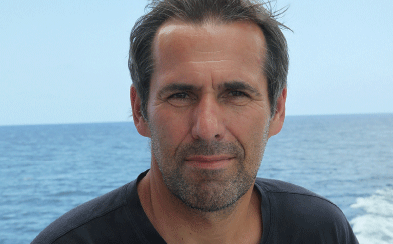
Influential spa commentator Susie Ellis has an uncanny knack for predicting the industry’s future. On the sixth anniversary of the Global Spa & Wellness Summit she helped pioneer, the SpaFinder president explains what drives her
By Rhianon Howells | Published in Spa Business 2012 issue 2
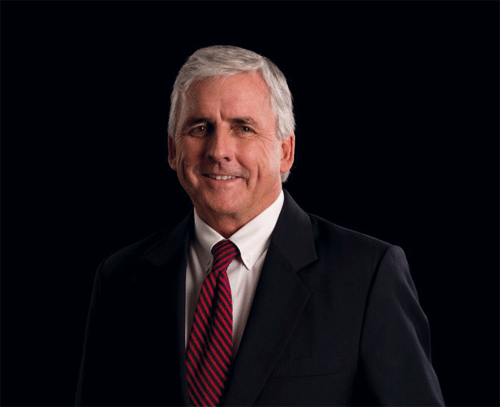
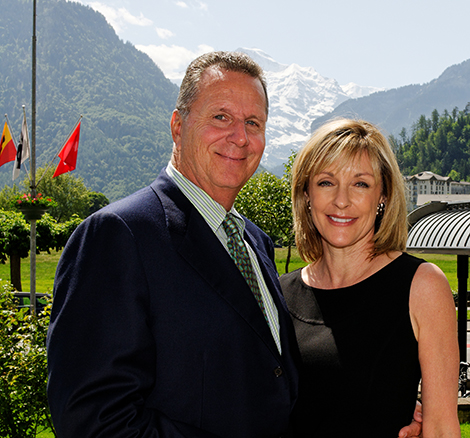
Anyone who spends just a few minutes talking to Susie Ellis will know that she’s a consummate people-person: unfailingly warm and courteous. They’ll also recognise how passionate she is about the spa and wellness industry she champions, both as president of SpaFinder – the sector’s largest marketing and media company – and as a founding board member of the Global Spa & Wellness Summit (GSWS). But if they delve just a little deeper, they’ll also find something edgier: a sharp business mind underpinned both by pragmatism and an ability to think laterally.
Nowhere is this more apparent than in SpaFinder’s annual Spa Trend Report™, which has won Ellis a reputation as a soothsayer since the first one was published nine years ago. Over the last decade, she’s frequently been on target in identifying up-and-coming trends, including spa lifestyle real estate (2005), sleep health (2007) and wellness tourism (2009) – so much so that, today, its publication is eagerly awaited by both the consumer press and the industry.
Bird’s eye seat Part of what gives Ellis her perspicacity, she believes, is her long career in the spa industry. She began her journey in the 70s as a fitness instructor at California’s Golden Door destination spa, where she quickly progressed into management. After leaving, she worked as a consultant and got an MBA from the University of California Los Angeles, before working as an assistant to two consecutive International Spa Association presidents. Then, in 1995, she was recruited by Donald Trump to open and manage his first spa at The Mar-a-Lago Club in Florida.
By that time, she was happily married to Pete Ellis – now SpaFinder’s chair and CEO – who she had met at the Golden Door (she was staff, he was a guest). In 1995, Pete launched the pioneering online car sales and marketing company Autobytel and when he took it public in 1999, the couple started investing in a number of different companies – including a New York-based travel agency and magazine publisher called SpaFinder.
Today, SpaFinder is no longer a travel agency, although it works with over 25,000 travel agents. Instead, it promotes spa and wellness experiences direct to the consumer through its website, vertical search technology, reservation system and gifting programme. More than 25,000 wellness-focused consumers visit spafinder.com each day, and over the last few years, the company has also launched sister sites in the UK, France, Germany, Italy, Spain, Canada and Japan. It’s this global perspective, believes Ellis, that is her other great advantage when compiling the annual trends report. “We have a sort of bird’s eye seat here at SpaFinder,” she says.
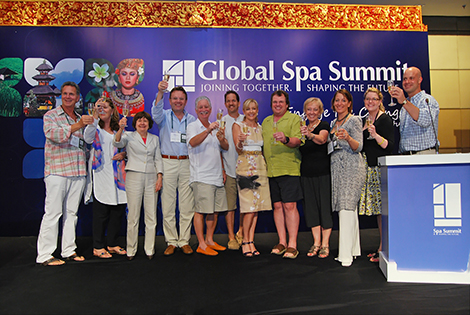
In fact, it was a vision of creating greater unity in the global industry that motivated Susie and Pete – along with a small group of leading spa professionals – to launch the Global Spa Summit (now the Global Spa & Wellness Summit) in New York City six years ago. Although many of the founding members are still on the board, it’s Ellis who’s been the driving force behind the initiative and annual conference.
Shining a light Although much of Ellis’s time is taken up by the GSWS, she’s still the face of SpaFinder and remains very involved in the business – especially in the annual trends report. “We do three studies a year at SpaFinder, one with consumers, one with the industry and one with travel agents, which gives us a lot of information,” she says. “We can also see from our website what’s trending. Finally, we have a team who travel to spas all over the world, and I count on their input. Personally, I always keep a notebook on me to jot down trends to track.”
What sets SpaFinder’s report apart from others is the focus on emerging trends – such as wellness gaming on the 2011 list (see p80) – rather than established ones. “To make those sorts of predictions, you have to do a fair amount of research,” she says “and that means reading a wide variety of newspapers and publications, going to [non-spa] conferences like TED and TEDMED, and talking to many people around the world about what’s going on.”
As a result of such intense interest, the list is no longer only identifying emerging trends – it’s also driving them. Ellis says: “I noticed maybe four or five years ago that shining a light on an emerging trend would oftentimes accelerate that trend. So now one of the things I consider is what’s good for the industry… and if I think a trend will have a negative impact, I won’t include it.”
Another reason a trend might not make the cut is that it’s too early in its evolution. “One that didn’t make it this year is the trend for spas to make their facilities and programmes available to the disabled,” she says. “It’s a small niche, but it’s increasing and it really dovetails into one of our trends from last year, which was pain relief for the ageing, so we’re watching that.”
A third consideration, says Ellis, is making sure they’re consumer-friendly. “That happened this year with employee wellness [the trend for corporate wellness programmes],” she says. “That’s a very interesting opportunity for the industry, but we didn’t feel consumers could relate to it yet; it’s too soon. So we put it in at number 11 as a bonus trend.”
An ethical challenge The popular success of the SpaFinder Spa Trend Report has inevitably led to it being widely quoted in both the consumer and industry press, as well as referenced by other experts. Yet while this kind of publicity is good for both SpaFinder and the industry, there is also a downside to the report’s ubiquity. “A few years ago, we started seeing other people in the industry putting together their own trends lists,” says Ellis. “And we noticed that many of these lists were basically our list. It would maybe have a slightly different name or a slightly different order, a little bit of cosmetic work to make it look new. But it really wasn’t new.
“There’s a lot of work involved in compiling our trends report, so a couple of years ago we decided we had to step up and start protecting our copyright. Since then, our lawyers have sent out a fair number of letters to people [trying to pass off the trends we identified as their own].”
Plagiarism is not a problem unique to SpaFinder, however. According to Ellis, it is an industry-wide issue, with numerous spa operators, consultants and suppliers apparently believing that the creative work of others is theirs for the taking. As an example, she cites the case of the Golden Door in California (established in 1958), which was involved in a long legal battle with Australian spa operator Golden Door Health Retreats (established in 1993) over the unauthorised use of its name.
Ellis admits it’s a complex issue. Copyright law is generally territorial, and although there are a number of international treaties requiring member countries to acknowledge the rights of each other’s nationals, these are often difficult to enforce – especially in the internet age, where there are no clear borders and everyone is a writer. International patent or trademark infringements are no less of a legal minefield. However, Ellis believes it as much an ethical challenge as a legal one, and one that could be damaging to the industry if not addressed.
The good news is that, based on SpaFinder’s experience, Ellis believes the problem has more to do with ignorance than wilful wrongdoing. “I would say that in almost every case, when we’ve sent out a letter [about copyright infringement of our trends], we’ve had an apology from whoever made the mistake, and it has not been repeated,” she says.
Innovation through imagination Although at the time of writing, the final agenda for this year’s GSWS (taking place this June in Aspen, Colorado) is still under discussion, Ellis is hopeful that the issue of plagiarism might get some air time – if not directly, then under the banner of the summit’s overarching theme of Innovation through Imagination.
The theme of innovation in general is a topic close to Ellis’ heart, and one she believes will be central to the growth of the industry as it matures. “Because our industry is young, we haven’t really needed to talk about innovation before,” she says. “That’s still the case in parts of the world where there aren’t yet a lot of spas, such as China, India and South America. But in more mature markets such as the US and Europe… a lack of innovation could become a problem, because if we’re not growing in terms of development and revenue, we’re vulnerable.”
To achieve continued growth, Ellis believes the industry needs to look to beyond itself for inspiration. With this in mind, many of the speakers at this year’s GSWS are drawn from outside the industry, from John Kao, author of Innovation Nation, to Peter Rummell, chair of Disney Imagineering. “We’re also going to have one whole day where we’re not going to talk about the spa industry at all,” says Ellis. “Instead we’ll be looking at other industries and how their innovations have moved them along and changed the world.”
Something else Ellis believes is crucial to the future of the industry, and also on the agenda at this year’s summit, is ‘spa evidence’ – the growing body of scientific research that gives credence to the health and wellness benefits of spa treatments. Last year’s summit saw the launch of spaevidence.com, a website designed to help both consumers and professionals find medical evidence for specific therapies. However, Ellis admits to being surprised that more spas haven’t been quick to get on board. “Feedback from people who have gone to the site has been terrific, but we haven’t had as many companies linking to it as we’d hoped,” she says. “We’ve discussed tying it in a bit more with social media and trying some other things… but fundamentally we have to do a better job encouraging the industry to engage with it, so we have more people linking to it and sharing the information with their clients.”
But whatever the future holds, this much is certain: for Ellis, the success of the global spa and wellness industry remains a very personal goal. “What I enjoy most about what I do is seeing the growth of the industry and perhaps having some influence on that, in a positive way, for both the industry and the consumer,” she says. “That is really very satisfying.”
Read more from this issue of Attractions Management magazine
View contents of Attractions Management 2012 issue 2
Ask an expert...: overbuilding
Are large, extravagant spas and treatment rooms really sustainable? Or is it time to wise up about spa design? Katie Barnes reports
Interview: Darrell Metzger
Destination Resorts is creating world-class tourist developments in Malaysia on behalf of the government. Jennifer Harbottle speaks to the man heading it all up
Spa management training: The learning curve – part one
On the eve of a new GSWS study into the state of spa management training globally, we launch a three-part series to delve into our industry’s educational offering and operational needs. Rhianon Howells gets studying
US Hotel spa research: Closer look
Leonor Stanton analyses the findings from PKF’s latest Trends® in the Hotel Spa Industry study and gets the reaction of top spa professionals
Profile: Susie Ellis
SpaFinder Inc president and the face of the Global Spa & Wellness Summit talks to Rhianon Howells about the art of uncovering up-and-coming industry trends, ethics and the importance of innovation
Resort Spa: Dual purpose
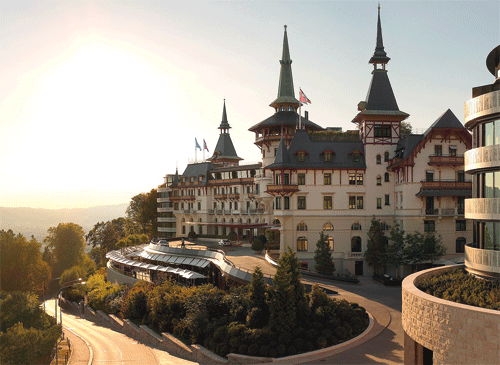
Switzerland’s renown Dolder Grand Spa has an offering to satisfy its onsite, longer-staying guests as well as local day spa customers. Katie Barnes pays a visit to this standout facility
Design: Jean-Michel Gathy
The owner of Asia-based design company Denniston has worked on some of the world’s leading spas and resorts. Jennifer Harbottle finds out about his passion for creativity
Samui spotlight:
The second most popular Thai island has been transformed from a backpackers haven to a luxury lifestyle destination with a number of new five-star spa resorts. Neena Dhillon reports
Middle East benchmarks: Peaks & Troughs
Leonor Stanton reviews hotel spa performance in Lebanon, Jordan and Doha following the 2011 benchmark surveys recently released by PwC in the Middle East
Online wellness gaming: Game Changer
Scoreboards, socialisation, challenges, rewards and feedback – the compelling components of online gaming could be key to getting people to become healthy says Susie Ellis
Kuwait focus: Cue Kuwait
The first in a two-part series on the Kuwaiti spa market by Kate Cracknell focuses on the spa-goers in the capital and the new Six Senses Spa at the Hotel Missoni
Research: Happiness
Older adults who are the most content and have a more positive outlook are likely to live longer according to a new study based on 3,800 participants
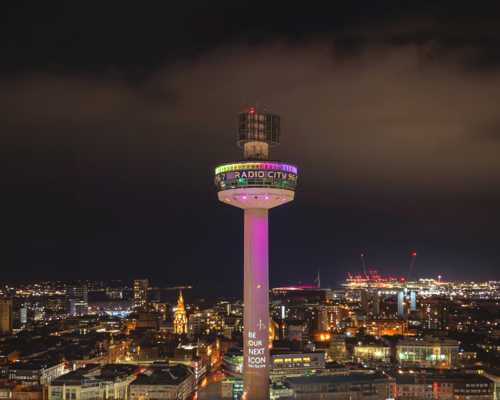
An opportunity to reimagine one of the UK’s most recognisable towers has been formally
opened by Rivington Hark, as St Johns Beacon invites operators and partners to shape its
next phase. [more...]
Influential spa commentator Susie Ellis has an uncanny knack for predicting the industry’s future. On the sixth anniversary of the Global Spa & Wellness Summit she helped pioneer, the SpaFinder president explains what drives her
By Rhianon Howells | Published in Spa Business 2012 issue 2
Anyone who spends just a few minutes talking to Susie Ellis will know that she’s a consummate people-person: unfailingly warm and courteous. They’ll also recognise how passionate she is about the spa and wellness industry she champions, both as president of SpaFinder – the sector’s largest marketing and media company – and as a founding board member of the Global Spa & Wellness Summit (GSWS). But if they delve just a little deeper, they’ll also find something edgier: a sharp business mind underpinned both by pragmatism and an ability to think laterally.
Nowhere is this more apparent than in SpaFinder’s annual Spa Trend Report™, which has won Ellis a reputation as a soothsayer since the first one was published nine years ago. Over the last decade, she’s frequently been on target in identifying up-and-coming trends, including spa lifestyle real estate (2005), sleep health (2007) and wellness tourism (2009) – so much so that, today, its publication is eagerly awaited by both the consumer press and the industry.
Bird’s eye seat Part of what gives Ellis her perspicacity, she believes, is her long career in the spa industry. She began her journey in the 70s as a fitness instructor at California’s Golden Door destination spa, where she quickly progressed into management. After leaving, she worked as a consultant and got an MBA from the University of California Los Angeles, before working as an assistant to two consecutive International Spa Association presidents. Then, in 1995, she was recruited by Donald Trump to open and manage his first spa at The Mar-a-Lago Club in Florida.
By that time, she was happily married to Pete Ellis – now SpaFinder’s chair and CEO – who she had met at the Golden Door (she was staff, he was a guest). In 1995, Pete launched the pioneering online car sales and marketing company Autobytel and when he took it public in 1999, the couple started investing in a number of different companies – including a New York-based travel agency and magazine publisher called SpaFinder.
Today, SpaFinder is no longer a travel agency, although it works with over 25,000 travel agents. Instead, it promotes spa and wellness experiences direct to the consumer through its website, vertical search technology, reservation system and gifting programme. More than 25,000 wellness-focused consumers visit spafinder.com each day, and over the last few years, the company has also launched sister sites in the UK, France, Germany, Italy, Spain, Canada and Japan. It’s this global perspective, believes Ellis, that is her other great advantage when compiling the annual trends report. “We have a sort of bird’s eye seat here at SpaFinder,” she says.
In fact, it was a vision of creating greater unity in the global industry that motivated Susie and Pete – along with a small group of leading spa professionals – to launch the Global Spa Summit (now the Global Spa & Wellness Summit) in New York City six years ago. Although many of the founding members are still on the board, it’s Ellis who’s been the driving force behind the initiative and annual conference.
Shining a light Although much of Ellis’s time is taken up by the GSWS, she’s still the face of SpaFinder and remains very involved in the business – especially in the annual trends report. “We do three studies a year at SpaFinder, one with consumers, one with the industry and one with travel agents, which gives us a lot of information,” she says. “We can also see from our website what’s trending. Finally, we have a team who travel to spas all over the world, and I count on their input. Personally, I always keep a notebook on me to jot down trends to track.”
What sets SpaFinder’s report apart from others is the focus on emerging trends – such as wellness gaming on the 2011 list (see p80) – rather than established ones. “To make those sorts of predictions, you have to do a fair amount of research,” she says “and that means reading a wide variety of newspapers and publications, going to [non-spa] conferences like TED and TEDMED, and talking to many people around the world about what’s going on.”
As a result of such intense interest, the list is no longer only identifying emerging trends – it’s also driving them. Ellis says: “I noticed maybe four or five years ago that shining a light on an emerging trend would oftentimes accelerate that trend. So now one of the things I consider is what’s good for the industry… and if I think a trend will have a negative impact, I won’t include it.”
Another reason a trend might not make the cut is that it’s too early in its evolution. “One that didn’t make it this year is the trend for spas to make their facilities and programmes available to the disabled,” she says. “It’s a small niche, but it’s increasing and it really dovetails into one of our trends from last year, which was pain relief for the ageing, so we’re watching that.”
A third consideration, says Ellis, is making sure they’re consumer-friendly. “That happened this year with employee wellness [the trend for corporate wellness programmes],” she says. “That’s a very interesting opportunity for the industry, but we didn’t feel consumers could relate to it yet; it’s too soon. So we put it in at number 11 as a bonus trend.”
An ethical challenge The popular success of the SpaFinder Spa Trend Report has inevitably led to it being widely quoted in both the consumer and industry press, as well as referenced by other experts. Yet while this kind of publicity is good for both SpaFinder and the industry, there is also a downside to the report’s ubiquity. “A few years ago, we started seeing other people in the industry putting together their own trends lists,” says Ellis. “And we noticed that many of these lists were basically our list. It would maybe have a slightly different name or a slightly different order, a little bit of cosmetic work to make it look new. But it really wasn’t new.
“There’s a lot of work involved in compiling our trends report, so a couple of years ago we decided we had to step up and start protecting our copyright. Since then, our lawyers have sent out a fair number of letters to people [trying to pass off the trends we identified as their own].”
Plagiarism is not a problem unique to SpaFinder, however. According to Ellis, it is an industry-wide issue, with numerous spa operators, consultants and suppliers apparently believing that the creative work of others is theirs for the taking. As an example, she cites the case of the Golden Door in California (established in 1958), which was involved in a long legal battle with Australian spa operator Golden Door Health Retreats (established in 1993) over the unauthorised use of its name.
Ellis admits it’s a complex issue. Copyright law is generally territorial, and although there are a number of international treaties requiring member countries to acknowledge the rights of each other’s nationals, these are often difficult to enforce – especially in the internet age, where there are no clear borders and everyone is a writer. International patent or trademark infringements are no less of a legal minefield. However, Ellis believes it as much an ethical challenge as a legal one, and one that could be damaging to the industry if not addressed.
The good news is that, based on SpaFinder’s experience, Ellis believes the problem has more to do with ignorance than wilful wrongdoing. “I would say that in almost every case, when we’ve sent out a letter [about copyright infringement of our trends], we’ve had an apology from whoever made the mistake, and it has not been repeated,” she says.
Innovation through imagination Although at the time of writing, the final agenda for this year’s GSWS (taking place this June in Aspen, Colorado) is still under discussion, Ellis is hopeful that the issue of plagiarism might get some air time – if not directly, then under the banner of the summit’s overarching theme of Innovation through Imagination.
The theme of innovation in general is a topic close to Ellis’ heart, and one she believes will be central to the growth of the industry as it matures. “Because our industry is young, we haven’t really needed to talk about innovation before,” she says. “That’s still the case in parts of the world where there aren’t yet a lot of spas, such as China, India and South America. But in more mature markets such as the US and Europe… a lack of innovation could become a problem, because if we’re not growing in terms of development and revenue, we’re vulnerable.”
To achieve continued growth, Ellis believes the industry needs to look to beyond itself for inspiration. With this in mind, many of the speakers at this year’s GSWS are drawn from outside the industry, from John Kao, author of Innovation Nation, to Peter Rummell, chair of Disney Imagineering. “We’re also going to have one whole day where we’re not going to talk about the spa industry at all,” says Ellis. “Instead we’ll be looking at other industries and how their innovations have moved them along and changed the world.”
Something else Ellis believes is crucial to the future of the industry, and also on the agenda at this year’s summit, is ‘spa evidence’ – the growing body of scientific research that gives credence to the health and wellness benefits of spa treatments. Last year’s summit saw the launch of spaevidence.com, a website designed to help both consumers and professionals find medical evidence for specific therapies. However, Ellis admits to being surprised that more spas haven’t been quick to get on board. “Feedback from people who have gone to the site has been terrific, but we haven’t had as many companies linking to it as we’d hoped,” she says. “We’ve discussed tying it in a bit more with social media and trying some other things… but fundamentally we have to do a better job encouraging the industry to engage with it, so we have more people linking to it and sharing the information with their clients.”
But whatever the future holds, this much is certain: for Ellis, the success of the global spa and wellness industry remains a very personal goal. “What I enjoy most about what I do is seeing the growth of the industry and perhaps having some influence on that, in a positive way, for both the industry and the consumer,” she says. “That is really very satisfying.”
Read more from this issue of Attractions Management magazine
View contents of Attractions Management 2012 issue 2
Ask an expert...: overbuilding
Are large, extravagant spas and treatment rooms really sustainable? Or is it time to wise up about spa design? Katie Barnes reports
Interview: Darrell Metzger
Destination Resorts is creating world-class tourist developments in Malaysia on behalf of the government. Jennifer Harbottle speaks to the man heading it all up
Spa management training: The learning curve – part one
On the eve of a new GSWS study into the state of spa management training globally, we launch a three-part series to delve into our industry’s educational offering and operational needs. Rhianon Howells gets studying
US Hotel spa research: Closer look
Leonor Stanton analyses the findings from PKF’s latest Trends® in the Hotel Spa Industry study and gets the reaction of top spa professionals
Profile: Susie Ellis
SpaFinder Inc president and the face of the Global Spa & Wellness Summit talks to Rhianon Howells about the art of uncovering up-and-coming industry trends, ethics and the importance of innovation
Resort Spa: Dual purpose
Switzerland’s renown Dolder Grand Spa has an offering to satisfy its onsite, longer-staying guests as well as local day spa customers. Katie Barnes pays a visit to this standout facility
Design: Jean-Michel Gathy
The owner of Asia-based design company Denniston has worked on some of the world’s leading spas and resorts. Jennifer Harbottle finds out about his passion for creativity
Samui spotlight:
The second most popular Thai island has been transformed from a backpackers haven to a luxury lifestyle destination with a number of new five-star spa resorts. Neena Dhillon reports
Middle East benchmarks: Peaks & Troughs
Leonor Stanton reviews hotel spa performance in Lebanon, Jordan and Doha following the 2011 benchmark surveys recently released by PwC in the Middle East
Online wellness gaming: Game Changer
Scoreboards, socialisation, challenges, rewards and feedback – the compelling components of online gaming could be key to getting people to become healthy says Susie Ellis
Kuwait focus: Cue Kuwait
The first in a two-part series on the Kuwaiti spa market by Kate Cracknell focuses on the spa-goers in the capital and the new Six Senses Spa at the Hotel Missoni
Research: Happiness
Older adults who are the most content and have a more positive outlook are likely to live longer according to a new study based on 3,800 participants
Hotel de France, located on the British Isle of Jersey, has created a wellness retreat package
that includes a hot yoga session that will take place in Jersey Zoo’s butterfly sanctuary.
A new immersive attraction designed to transport visitors into the final hours of ancient Pompeii
is preparing to open near the world-famous archaeological site in southern Italy.
Experience design company, BRC Imagination Arts, has completed a transition that sees founder
Bob Rogers pass ownership of the business to four long-serving senior executives, while
remaining actively involved with the company.
Movie Park Germany has opened a new Paramount Pictures-themed attraction as part of its 30th
anniversary celebrations, using immersive storytelling and adaptive reuse to reinforce the park’s
longstanding “Hollywood in Germany” positioning.
Therme Manchester’s 28-acre development, which will include interconnected glass pavilions
that measure 65,000sq m, will be the largest bathing and wellbeing attraction in the world once
complete, according to prof David Russell, CEO of Therme UK.
Efteling has opened Hooghmoed, a new family drop tower designed to broaden the appeal of its
recently launched Sirene Island themed area and introduce younger visitors to thrill attractions.
A proposed Puy du Fou development near Bicester and Universal Destinations and Experiences’
planned resort in Bedford are emerging as part of a wider transformation of the Oxford–
Cambridge Growth Corridor into a major centre for UK leisure and tourism inv
Shedd Aquarium has opened the Immersion Theater developed in partnership with SimEx-
Iwerks, as part of a wider strategy to enhance the guest experience and create additional
revenue opportunities.
The UK government has announced a temporary reduction in VAT on visitor attractions and
children’s meals as part of a summer cost-of-living support package designed to stimulate the
visitor economy and encourage family days out.
As designer Yinka Ilori prepares for his first solo gallery show in London, he speaks exclusively
to CLADmag about his mission to spread joy, the power of play, and his bold approach to using
colour (including the colours you won’t see in his work).
The government of Thailand is exploring plans for a THB300bn (£6.3bn, US$8.3bn)
entertainment complex in the country’s Eastern Economic Corridor (EEC), with officials
proposing a large-scale theme park and sports destination as part of a broader tourism and
economic development strategy.
An opportunity to reimagine one of the UK’s most recognisable towers has been formally
opened by Rivington Hark, as St Johns Beacon invites operators and partners to shape its
next phase. [more...]