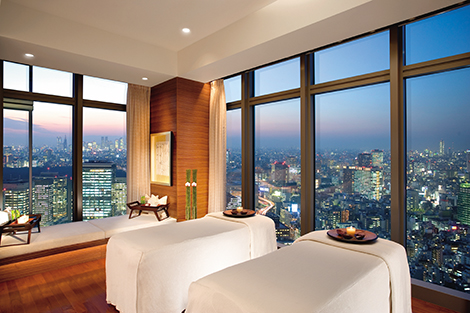
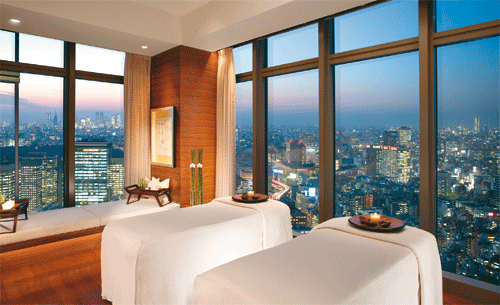
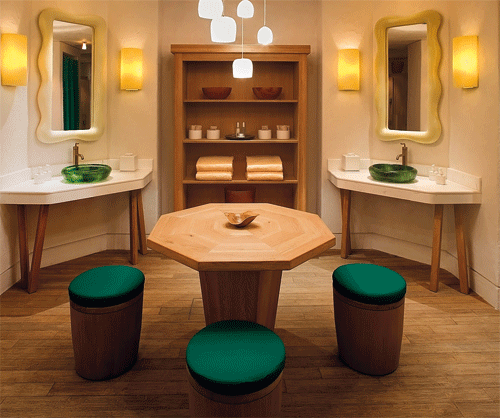
Mandarin Oriental gives a very detailed spec on spa size and facilities to make the most of space
In the early decades of the spa industry, large, opulent facilities – often costing millions – were built and launched with much fanfare and pride.
Owners, architects and designers competed to be the best and got swept up in the buzz. The bigger the spa the better, with operators vying to showcase more facilities, equipment, experiences and space than before.
However, in some cases, more attention was paid to design than budget and overbuilt spas struggled to break even on operating costs, let alone paying back capital or then going to make a true profit.
When the credit crunch struck, many struggled, and as spas are costed on a per square metre (sq m) or square foot (sq ft) basis, the bigger a spa, the more revenue it has to generate to hit target.
With operators facing increasing pressure to make figures stack up, many are starting to ask whether the building of such big facilities is justifiable or wise.
Pivotal to the question is the size and number of treatment rooms – the main revenue generating areas of spas. Large treatment rooms will limit the number which can be accommodated. And big echoing spaces don’t necessarily create the best experience – they can leave guests feeling intimidated and uncomfortable.
On the other hand, can operators charge more for treatments delivered in larger rooms? Does the size contribute to a superior experience and justify higher rates? Spa suites for more than one person with showers, heat experiences and whirlpools – which are suitable for use when delivering packages and longer, signature treatments – are example of this category of room.
What’s the optimum size for a treatment room? What’s too big and what’s the smallest space operators can get away with?
Is it possible to build a future-proof spa – one with a flexible design, where the size and number of treatment rooms can be easily reconfigured to accommodate demand? And is there a quick-fix solution for existing facilities that were built too big? We ask the experts.
Read more from this issue of Attractions Management magazine
View contents of Attractions Management 2012 issue 2
Ask an expert...: overbuilding
Are large, extravagant spas and treatment rooms really sustainable? Or is it time to wise up about spa design? Katie Barnes reports
Interview: Darrell Metzger
Destination Resorts is creating world-class tourist developments in Malaysia on behalf of the government. Jennifer Harbottle speaks to the man heading it all up
Spa management training: The learning curve – part one
On the eve of a new GSWS study into the state of spa management training globally, we launch a three-part series to delve into our industry’s educational offering and operational needs. Rhianon Howells gets studying
US Hotel spa research: Closer look
Leonor Stanton analyses the findings from PKF’s latest Trends® in the Hotel Spa Industry study and gets the reaction of top spa professionals
Profile: Susie Ellis
SpaFinder Inc president and the face of the Global Spa & Wellness Summit talks to Rhianon Howells about the art of uncovering up-and-coming industry trends, ethics and the importance of innovation
Resort Spa: Dual purpose
Switzerland’s renown Dolder Grand Spa has an offering to satisfy its onsite, longer-staying guests as well as local day spa customers. Katie Barnes pays a visit to this standout facility
Design: Jean-Michel Gathy
The owner of Asia-based design company Denniston has worked on some of the world’s leading spas and resorts. Jennifer Harbottle finds out about his passion for creativity
Samui spotlight:
The second most popular Thai island has been transformed from a backpackers haven to a luxury lifestyle destination with a number of new five-star spa resorts. Neena Dhillon reports
Middle East benchmarks: Peaks & Troughs
Leonor Stanton reviews hotel spa performance in Lebanon, Jordan and Doha following the 2011 benchmark surveys recently released by PwC in the Middle East
Online wellness gaming: Game Changer
Scoreboards, socialisation, challenges, rewards and feedback – the compelling components of online gaming could be key to getting people to become healthy says Susie Ellis
Kuwait focus: Cue Kuwait
The first in a two-part series on the Kuwaiti spa market by Kate Cracknell focuses on the spa-goers in the capital and the new Six Senses Spa at the Hotel Missoni
Research: Happiness
Older adults who are the most content and have a more positive outlook are likely to live longer according to a new study based on 3,800 participants
Simon ShepherdsonManaging directorInternational Leisure Consultants
Simon Shepherdson
The debate on spa sizing is between the marketing men – “give me a large spa so I can get a great hero shot, good PR and boost the hotel’s profile” and the accountant – “does the spa give me a good return on investment?”
Currently, the accountant holds greater sway and chains such as Shangri-La are down-playing the luxurious CHI, The Spa their in newer properties. Meanwhile, Mandarin Oriental no longer looks to have a minimum 15,000sq ft (1,394sq m) allocated to the spa and its new spas now fit the size of the property being developed.
But this doesn’t apply to all and individual hotel owners often think of the spa as a status symbol and that ‘biggest is best’.
An 80-bedroom Starwood hotel planned in western China has 12 treatment rooms; while a new Luxury Collection hotel in Shanghai includes a 1,000sq ft (93sq m) VIP spa suite. You could ask if this is practical or sustainable, but what if the owners are using these facilities for business entertaining, as they increasingly do, and conclude a us$30m deal this way?
Generally, the size of a hotel spa can be linked to the number of bedrooms and the potential capture rate – 5-8 per cent in city hotels and 10-15 per cent in resorts. In resorts, spa treatment rooms tend to be bigger – 400-500sq ft (37-46sq m) – to give a greater sense of escape, while 150-200sq ft (14-16 sq m) is adequate for a city location.
Do these different sizes create equal revenues? Smaller rooms, without showers and toilets but with a minimum size of 120sq ft (11sq m) for comfort, are suited to shorter, straightforward treatments so can generate greater revenues with quicker turnover. Yet double rooms, with a 180sq ft (17sq m) minimum, are increasingly important with spas being visited more often by couples, friends and business associates. Treatment rooms over 500sq ft (46sq m), however, are too large to allow for an intimate experience.
Good design can make treatment rooms seem larger and also to appear more lavish and it helps when spas are taken out of the basement to allow for natural light.
It’s difficult to reconfigure treatment rooms because of sinks and showers. But allowing additional space in the design gives some flexibility – an extra relaxation lounge planned early on can be turned into treatment rooms as demand grows. And if your rooms are already too big? Work with your marketing team to sell the size and create packages to promote this feature.
Don’t let the accountants win. A spa can be a good return on investment – though small (120sq ft) to medium (180sq ft) size treatment rooms are the most efficient.
A spa can be a good return on investment – though small (120sq ft) to medium (180 sq ft) size treatment rooms are the most efficient
Shepherdson set up ILC, which specialises in spa and club design across Asia, 15 years ago. Details: www.ilc-world.com
Andrew Gibson Group director of spaMandarin Oriental
Andrew Gibson
There are few standards for how much space should be allocated to spas and what components they should have. This can result in costly design faults ranging from overbuilding to under-sizing. Common errors include lack of consideration being given to operational flow and back of house space (see sb08/1 p76), the omission of facilities that would enhance the experience and incorrectly sized treatment rooms.
The size of treatment rooms varies considerably – I’ve seen rooms larger than 100sq m (1,076sq ft) and as small as 6sq m (66sq ft). The larger rooms are more often in resorts where there’s less premium on cost per square metre. In my opinion, there’s no doubt that guests appreciate space in a treatment room, but once it exceeds a certain size satisfaction diminishes. In a single treatment room for example 12-16sq m (129-172sq ft) with a shower could be considered adequate. Our minimum is 20sq m (215sq ft) because we also allow for a seating area.
Frequently, however, the operator is not the one deciding the size and layout of the spa. Yet they’re left with working out how to generate sufficient revenue from the space.
Ideally, a rough treatment menu should be in place before allocating size. In this scenario, the operator will be able to include features such as a shower, steam shower, toilet and seating, enabling them to create treatments and packages that are sold at a premium. Spa suites – with such features – are suitable for multiple types of treatments and therefore present more revenue opportunities. They also enable operators to sell couples treatments (which are becoming very popular around the globe), or a premium service for individuals and couples, as well as an upgrade opportunity to regular guests. If there’s enough space, they can also be hired by groups on a time basis.
The optimum size of a treatment room is subjective as it needs to fit the concept of the spa. At Mandarin Oriental, for example, we give designers a very detailed specification of what services we need to provide in the room and how big it should be.
That said, the size of the room is only one consideration when it comes to luxury. The overall impression, attention to detail, placement of controls, lighting and safety features all add to the guest experience.
There’s no magic formula for calculating the number of treatment rooms. We’ve used equations that focus on the number of hotel bedrooms, urban versus resort location, average length of stay and leisure versus business guests – but they’re guidelines at best. As a very loose rule of thumb, I would suggest one treatment room for 15-20 guestrooms. Then the anticipated hotel occupancy divided by 10 will give the number of treatments from in-house guests per day. Using both of these figures, you can roughly determine the number of treatment rooms.
Gibson oversees the operations of 22 spas worldwide in his role at Mandarin Oriental.
Details: www.mandarinoriental.com
Dan shackleton-Jones
President/partnerNiki Bryan Inc
Dan shackleton-Jones
There are certainly more overbuilt spas than effective builds, especially in resorts and hotels where they know customers have the means to pay for that experience and luxury space.
This is changing though, as overbuilt spas become a burden on the books. Over the past year, we’ve seen resorts/hotels questioning the cost of support and upkeep of a spa, or even the need for one going forward.
I’m not convinced that larger treatment rooms command more money – while the novelty of something grandiose may work in the short-term, it’s not a sustainable approach. And imagine telling your guest that, that was the reason why you’re charging more: I doubt it would win them over.
In my experience, you can only charge more money if you offer an exceptional, exclusive or tailored experience. Yet as the majority of what the guest considers the paid-for experience happens in treatment rooms, if you miss the mark on sizing you stand to miss the mark on aligning with the guest expectation. Brands are commonly articulated through a series of expressions and it’s this environment that defines the experience and its delivery. Too small is the room that will not enable you to do this.
But too big is the room you cannot pay for. Space has an operating cost and a need to capture revenue to offset this. Do you want a massage room 24 x 24ft (7 x 7m) averaging us$130 per services hour or two rooms 12 x 12ft (3.5 x 3.5m) averaging us$260 an hour total? The cost of the space is almost the same, yet the limit on revenue can be very different for the oversized room.
Over 28 years, I’ve found that 12 x 12ft is ideal for profitability and our guest brand experience in mainstream body and skin services. It’s functional, provides storage, has enough room for therapist movement and is intimate enough to make the guest feel comfortable. What makes it profitable is the ability to consistently book and charge an appropriate service rate that will pay for all operating costs associated with the space while protecting the guest experience and ensuring a strong margin.
There are multiple formulas with variations on calculating the appropriate number of treatment rooms. And these depend on guest occupancy, average length of stay, number of bedrooms and capture rate. I’d suggest looking at existing properties in the immediate market that provide KPIs for you to consider. And above all, know your guest demographic and what services they demand. That way you won’t get drawn into offering fad treatments or services that have little or no demand from your customers.
Over the past year, we’ve seen resorts/hotels questioning the cost of support and upkeep of a spa, or even the need for one going forward
Approaching 30 years in business, Niki Bryan is a leading US spa consultancy and management company which has a number of clients, including Disney.
Details: www.relaxedyet.com.
Susan HarmsworthFounder and CEOESPA International
Susan Harmsworth
A big bug bear of mine is that owners and operators are being ill-advised by consultants – typically ex spa directors who’ve set up on their own – who have no idea how to design a spa. I’ve picked up at least eight projects recently where the design is a complete mess for this reason. As an industry, we should have some kind of governing body for this.
Do I think spas are being overbuilt and aren’t seeing a good return on investment? Yes is the short answer. But it depends entirely on how the owners are looking at yield – is the spa a complete standalone facility, or is it sharing expenses with the hotel? Do they take into account that the spa can boost hotel revenues at off peak times and out of high season? If not, spas probably won’t achieve the figures they want and we’ll be going back to spas with just treatment and changing rooms.
Do I think spas have too many treatment rooms? That’s very difficult to answer, because I can give examples of where we might have included too many. On several occasions, clients have requested big spas to cope with group business (sometimes renting out the whole hotel) to boost numbers in the off-peak season – in one case a client wanted 20 treatment rooms to cope with group business but was prepared to run only 12-14 for the rest of the time. Also, if spas are going to boost occupancy by 20 per cent at the weekend, then they might be able to justify having rooms empty in the week.
I’d say that a good size for a single treatment room for massage would be 14-16sq m (151-172sq ft), although that is on the luxury level because we build in storage for all equipment, products and linen. Anything bigger than that, then the client won’t be comfortable, you’ll be looking at high energy costs and you’ll also need to increase the revenue generated.
As 60 per cent of our business globally is massage, we’ve started to reduce the number of multi-functional treatment rooms we include due to energy costs and space. Also as the standard of therapists has decreased, we’ve found they’re no longer able to perform treatments and that they specialise in just one or two services such as massage or facials, or personal grooming/beauty. It’s really important to design a spa with the treatment menu in mind at the start, but you do also need to think about the availability of practitioners. If you can’t find suitably-trained staff for those treatments in the region, for example, then that will impact on design too.
For operators who already have too many treatment rooms, they could consider renting some out to high-end specialists – this has worked well for us in the past.
Spa management and skincare company ESPA was founded by Harmsworth over 35 years ago. It has a portfolio of 250-plus spas in 55 countries. Details www.espaonline.com
COMPANY PROFILES
Painting With Light
By combining lighting, video, scenic and architectural elements, sound and special effects we tell s [more...]
RMA Ltd
RMA Ltd is a one-stop global company
that can design, build and produce from a
greenfield site upw [more...]
Taylor Made Designs
Founded in 1993, Taylor Made
Designs supply corporate clothing
and brand-enhancing merchandise
to [more...]
Sally Corporation
Our services include: Dark ride design & build; Redevelopment of existing attractions; High-quality [more...]
An opportunity to reimagine one of the UK’s most recognisable towers has been formally
opened by Rivington Hark, as St Johns Beacon invites operators and partners to shape its
next phase. [more...]
Mandarin Oriental gives a very detailed spec on spa size and facilities to make the most of space
In the early decades of the spa industry, large, opulent facilities – often costing millions – were built and launched with much fanfare and pride.
Owners, architects and designers competed to be the best and got swept up in the buzz. The bigger the spa the better, with operators vying to showcase more facilities, equipment, experiences and space than before.
However, in some cases, more attention was paid to design than budget and overbuilt spas struggled to break even on operating costs, let alone paying back capital or then going to make a true profit.
When the credit crunch struck, many struggled, and as spas are costed on a per square metre (sq m) or square foot (sq ft) basis, the bigger a spa, the more revenue it has to generate to hit target.
With operators facing increasing pressure to make figures stack up, many are starting to ask whether the building of such big facilities is justifiable or wise.
Pivotal to the question is the size and number of treatment rooms – the main revenue generating areas of spas. Large treatment rooms will limit the number which can be accommodated. And big echoing spaces don’t necessarily create the best experience – they can leave guests feeling intimidated and uncomfortable.
On the other hand, can operators charge more for treatments delivered in larger rooms? Does the size contribute to a superior experience and justify higher rates? Spa suites for more than one person with showers, heat experiences and whirlpools – which are suitable for use when delivering packages and longer, signature treatments – are example of this category of room.
What’s the optimum size for a treatment room? What’s too big and what’s the smallest space operators can get away with?
Is it possible to build a future-proof spa – one with a flexible design, where the size and number of treatment rooms can be easily reconfigured to accommodate demand? And is there a quick-fix solution for existing facilities that were built too big? We ask the experts.
Read more from this issue of Attractions Management magazine
View contents of Attractions Management 2012 issue 2
Ask an expert...: overbuilding
Are large, extravagant spas and treatment rooms really sustainable? Or is it time to wise up about spa design? Katie Barnes reports
Interview: Darrell Metzger
Destination Resorts is creating world-class tourist developments in Malaysia on behalf of the government. Jennifer Harbottle speaks to the man heading it all up
Spa management training: The learning curve – part one
On the eve of a new GSWS study into the state of spa management training globally, we launch a three-part series to delve into our industry’s educational offering and operational needs. Rhianon Howells gets studying
US Hotel spa research: Closer look
Leonor Stanton analyses the findings from PKF’s latest Trends® in the Hotel Spa Industry study and gets the reaction of top spa professionals
Profile: Susie Ellis
SpaFinder Inc president and the face of the Global Spa & Wellness Summit talks to Rhianon Howells about the art of uncovering up-and-coming industry trends, ethics and the importance of innovation
Resort Spa: Dual purpose
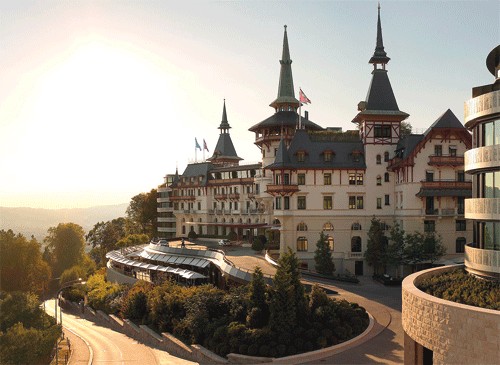
Switzerland’s renown Dolder Grand Spa has an offering to satisfy its onsite, longer-staying guests as well as local day spa customers. Katie Barnes pays a visit to this standout facility
Design: Jean-Michel Gathy
The owner of Asia-based design company Denniston has worked on some of the world’s leading spas and resorts. Jennifer Harbottle finds out about his passion for creativity
Samui spotlight:
The second most popular Thai island has been transformed from a backpackers haven to a luxury lifestyle destination with a number of new five-star spa resorts. Neena Dhillon reports
Middle East benchmarks: Peaks & Troughs
Leonor Stanton reviews hotel spa performance in Lebanon, Jordan and Doha following the 2011 benchmark surveys recently released by PwC in the Middle East
Online wellness gaming: Game Changer
Scoreboards, socialisation, challenges, rewards and feedback – the compelling components of online gaming could be key to getting people to become healthy says Susie Ellis
Kuwait focus: Cue Kuwait
The first in a two-part series on the Kuwaiti spa market by Kate Cracknell focuses on the spa-goers in the capital and the new Six Senses Spa at the Hotel Missoni
Research: Happiness
Older adults who are the most content and have a more positive outlook are likely to live longer according to a new study based on 3,800 participants
Simon ShepherdsonManaging directorInternational Leisure Consultants
Simon Shepherdson
The debate on spa sizing is between the marketing men – “give me a large spa so I can get a great hero shot, good PR and boost the hotel’s profile” and the accountant – “does the spa give me a good return on investment?”
Currently, the accountant holds greater sway and chains such as Shangri-La are down-playing the luxurious CHI, The Spa their in newer properties. Meanwhile, Mandarin Oriental no longer looks to have a minimum 15,000sq ft (1,394sq m) allocated to the spa and its new spas now fit the size of the property being developed.
But this doesn’t apply to all and individual hotel owners often think of the spa as a status symbol and that ‘biggest is best’.
An 80-bedroom Starwood hotel planned in western China has 12 treatment rooms; while a new Luxury Collection hotel in Shanghai includes a 1,000sq ft (93sq m) VIP spa suite. You could ask if this is practical or sustainable, but what if the owners are using these facilities for business entertaining, as they increasingly do, and conclude a us$30m deal this way?
Generally, the size of a hotel spa can be linked to the number of bedrooms and the potential capture rate – 5-8 per cent in city hotels and 10-15 per cent in resorts. In resorts, spa treatment rooms tend to be bigger – 400-500sq ft (37-46sq m) – to give a greater sense of escape, while 150-200sq ft (14-16 sq m) is adequate for a city location.
Do these different sizes create equal revenues? Smaller rooms, without showers and toilets but with a minimum size of 120sq ft (11sq m) for comfort, are suited to shorter, straightforward treatments so can generate greater revenues with quicker turnover. Yet double rooms, with a 180sq ft (17sq m) minimum, are increasingly important with spas being visited more often by couples, friends and business associates. Treatment rooms over 500sq ft (46sq m), however, are too large to allow for an intimate experience.
Good design can make treatment rooms seem larger and also to appear more lavish and it helps when spas are taken out of the basement to allow for natural light.
It’s difficult to reconfigure treatment rooms because of sinks and showers. But allowing additional space in the design gives some flexibility – an extra relaxation lounge planned early on can be turned into treatment rooms as demand grows. And if your rooms are already too big? Work with your marketing team to sell the size and create packages to promote this feature.
Don’t let the accountants win. A spa can be a good return on investment – though small (120sq ft) to medium (180sq ft) size treatment rooms are the most efficient.
A spa can be a good return on investment – though small (120sq ft) to medium (180 sq ft) size treatment rooms are the most efficient
Shepherdson set up ILC, which specialises in spa and club design across Asia, 15 years ago. Details: www.ilc-world.com
Andrew Gibson Group director of spaMandarin Oriental
Andrew Gibson
There are few standards for how much space should be allocated to spas and what components they should have. This can result in costly design faults ranging from overbuilding to under-sizing. Common errors include lack of consideration being given to operational flow and back of house space (see sb08/1 p76), the omission of facilities that would enhance the experience and incorrectly sized treatment rooms.
The size of treatment rooms varies considerably – I’ve seen rooms larger than 100sq m (1,076sq ft) and as small as 6sq m (66sq ft). The larger rooms are more often in resorts where there’s less premium on cost per square metre. In my opinion, there’s no doubt that guests appreciate space in a treatment room, but once it exceeds a certain size satisfaction diminishes. In a single treatment room for example 12-16sq m (129-172sq ft) with a shower could be considered adequate. Our minimum is 20sq m (215sq ft) because we also allow for a seating area.
Frequently, however, the operator is not the one deciding the size and layout of the spa. Yet they’re left with working out how to generate sufficient revenue from the space.
Ideally, a rough treatment menu should be in place before allocating size. In this scenario, the operator will be able to include features such as a shower, steam shower, toilet and seating, enabling them to create treatments and packages that are sold at a premium. Spa suites – with such features – are suitable for multiple types of treatments and therefore present more revenue opportunities. They also enable operators to sell couples treatments (which are becoming very popular around the globe), or a premium service for individuals and couples, as well as an upgrade opportunity to regular guests. If there’s enough space, they can also be hired by groups on a time basis.
The optimum size of a treatment room is subjective as it needs to fit the concept of the spa. At Mandarin Oriental, for example, we give designers a very detailed specification of what services we need to provide in the room and how big it should be.
That said, the size of the room is only one consideration when it comes to luxury. The overall impression, attention to detail, placement of controls, lighting and safety features all add to the guest experience.
There’s no magic formula for calculating the number of treatment rooms. We’ve used equations that focus on the number of hotel bedrooms, urban versus resort location, average length of stay and leisure versus business guests – but they’re guidelines at best. As a very loose rule of thumb, I would suggest one treatment room for 15-20 guestrooms. Then the anticipated hotel occupancy divided by 10 will give the number of treatments from in-house guests per day. Using both of these figures, you can roughly determine the number of treatment rooms.
Gibson oversees the operations of 22 spas worldwide in his role at Mandarin Oriental.
Details: www.mandarinoriental.com
Dan shackleton-Jones
President/partnerNiki Bryan Inc
Dan shackleton-Jones
There are certainly more overbuilt spas than effective builds, especially in resorts and hotels where they know customers have the means to pay for that experience and luxury space.
This is changing though, as overbuilt spas become a burden on the books. Over the past year, we’ve seen resorts/hotels questioning the cost of support and upkeep of a spa, or even the need for one going forward.
I’m not convinced that larger treatment rooms command more money – while the novelty of something grandiose may work in the short-term, it’s not a sustainable approach. And imagine telling your guest that, that was the reason why you’re charging more: I doubt it would win them over.
In my experience, you can only charge more money if you offer an exceptional, exclusive or tailored experience. Yet as the majority of what the guest considers the paid-for experience happens in treatment rooms, if you miss the mark on sizing you stand to miss the mark on aligning with the guest expectation. Brands are commonly articulated through a series of expressions and it’s this environment that defines the experience and its delivery. Too small is the room that will not enable you to do this.
But too big is the room you cannot pay for. Space has an operating cost and a need to capture revenue to offset this. Do you want a massage room 24 x 24ft (7 x 7m) averaging us$130 per services hour or two rooms 12 x 12ft (3.5 x 3.5m) averaging us$260 an hour total? The cost of the space is almost the same, yet the limit on revenue can be very different for the oversized room.
Over 28 years, I’ve found that 12 x 12ft is ideal for profitability and our guest brand experience in mainstream body and skin services. It’s functional, provides storage, has enough room for therapist movement and is intimate enough to make the guest feel comfortable. What makes it profitable is the ability to consistently book and charge an appropriate service rate that will pay for all operating costs associated with the space while protecting the guest experience and ensuring a strong margin.
There are multiple formulas with variations on calculating the appropriate number of treatment rooms. And these depend on guest occupancy, average length of stay, number of bedrooms and capture rate. I’d suggest looking at existing properties in the immediate market that provide KPIs for you to consider. And above all, know your guest demographic and what services they demand. That way you won’t get drawn into offering fad treatments or services that have little or no demand from your customers.
Over the past year, we’ve seen resorts/hotels questioning the cost of support and upkeep of a spa, or even the need for one going forward
Approaching 30 years in business, Niki Bryan is a leading US spa consultancy and management company which has a number of clients, including Disney.
Details: www.relaxedyet.com.
Susan HarmsworthFounder and CEOESPA International
Susan Harmsworth
A big bug bear of mine is that owners and operators are being ill-advised by consultants – typically ex spa directors who’ve set up on their own – who have no idea how to design a spa. I’ve picked up at least eight projects recently where the design is a complete mess for this reason. As an industry, we should have some kind of governing body for this.
Do I think spas are being overbuilt and aren’t seeing a good return on investment? Yes is the short answer. But it depends entirely on how the owners are looking at yield – is the spa a complete standalone facility, or is it sharing expenses with the hotel? Do they take into account that the spa can boost hotel revenues at off peak times and out of high season? If not, spas probably won’t achieve the figures they want and we’ll be going back to spas with just treatment and changing rooms.
Do I think spas have too many treatment rooms? That’s very difficult to answer, because I can give examples of where we might have included too many. On several occasions, clients have requested big spas to cope with group business (sometimes renting out the whole hotel) to boost numbers in the off-peak season – in one case a client wanted 20 treatment rooms to cope with group business but was prepared to run only 12-14 for the rest of the time. Also, if spas are going to boost occupancy by 20 per cent at the weekend, then they might be able to justify having rooms empty in the week.
I’d say that a good size for a single treatment room for massage would be 14-16sq m (151-172sq ft), although that is on the luxury level because we build in storage for all equipment, products and linen. Anything bigger than that, then the client won’t be comfortable, you’ll be looking at high energy costs and you’ll also need to increase the revenue generated.
As 60 per cent of our business globally is massage, we’ve started to reduce the number of multi-functional treatment rooms we include due to energy costs and space. Also as the standard of therapists has decreased, we’ve found they’re no longer able to perform treatments and that they specialise in just one or two services such as massage or facials, or personal grooming/beauty. It’s really important to design a spa with the treatment menu in mind at the start, but you do also need to think about the availability of practitioners. If you can’t find suitably-trained staff for those treatments in the region, for example, then that will impact on design too.
For operators who already have too many treatment rooms, they could consider renting some out to high-end specialists – this has worked well for us in the past.
Spa management and skincare company ESPA was founded by Harmsworth over 35 years ago. It has a portfolio of 250-plus spas in 55 countries. Details www.espaonline.com
Hotel de France, located on the British Isle of Jersey, has created a wellness retreat package
that includes a hot yoga session that will take place in Jersey Zoo’s butterfly sanctuary.
A new immersive attraction designed to transport visitors into the final hours of ancient Pompeii
is preparing to open near the world-famous archaeological site in southern Italy.
Experience design company, BRC Imagination Arts, has completed a transition that sees founder
Bob Rogers pass ownership of the business to four long-serving senior executives, while
remaining actively involved with the company.
Movie Park Germany has opened a new Paramount Pictures-themed attraction as part of its 30th
anniversary celebrations, using immersive storytelling and adaptive reuse to reinforce the park’s
longstanding “Hollywood in Germany” positioning.
Therme Manchester’s 28-acre development, which will include interconnected glass pavilions
that measure 65,000sq m, will be the largest bathing and wellbeing attraction in the world once
complete, according to prof David Russell, CEO of Therme UK.
Efteling has opened Hooghmoed, a new family drop tower designed to broaden the appeal of its
recently launched Sirene Island themed area and introduce younger visitors to thrill attractions.
A proposed Puy du Fou development near Bicester and Universal Destinations and Experiences’
planned resort in Bedford are emerging as part of a wider transformation of the Oxford–
Cambridge Growth Corridor into a major centre for UK leisure and tourism inv
Shedd Aquarium has opened the Immersion Theater developed in partnership with SimEx-
Iwerks, as part of a wider strategy to enhance the guest experience and create additional
revenue opportunities.
The UK government has announced a temporary reduction in VAT on visitor attractions and
children’s meals as part of a summer cost-of-living support package designed to stimulate the
visitor economy and encourage family days out.
As designer Yinka Ilori prepares for his first solo gallery show in London, he speaks exclusively
to CLADmag about his mission to spread joy, the power of play, and his bold approach to using
colour (including the colours you won’t see in his work).
The government of Thailand is exploring plans for a THB300bn (£6.3bn, US$8.3bn)
entertainment complex in the country’s Eastern Economic Corridor (EEC), with officials
proposing a large-scale theme park and sports destination as part of a broader tourism and
economic development strategy.
+ More news
COMPANY PROFILES
Painting With Light By combining lighting, video, scenic and architectural elements, sound and special effects we tell s [more...]
RMA Ltd RMA Ltd is a one-stop global company
that can design, build and produce from a
greenfield site upw [more...]
Taylor Made Designs Founded in 1993, Taylor Made
Designs supply corporate clothing
and brand-enhancing merchandise
to [more...]
Sally Corporation Our services include: Dark ride design & build; Redevelopment of existing attractions; High-quality [more...]
An opportunity to reimagine one of the UK’s most recognisable towers has been formally
opened by Rivington Hark, as St Johns Beacon invites operators and partners to shape its
next phase. [more...]