New research from the ISPA Foundation shows clear evidence of a swift bounceback in the industry’s key metrics right across the US. The pre-pandemic heights of 2019 have come back into sight, and the industry has moved well down the road to recovery as it welcomes back customers.
Challenges persist, however, amid an uncertain economic climate – not least when it comes to staffing – a problematic issue the industry has been facing long before the arrival of COVID-19.
At the same time, the so-called ‘new normal’ has created opportunities, with spas ever conscious of the need to show agility and make important choices and decisions to keep the industry moving forward in this new era.
A return to growth The economic shock in the second quarter of 2020 inevitably had a major effect on the spa industry. The 2021 US Spa Industry Study, compiled by ISPA in collaboration with PricewaterhouseCoopers (PwC), showed a sharp fall in each of the industry’s ‘Big Five’ statistics in 2020, with revenues falling 36 per cent year-on-year, their first significant fall since the impact of the Great Recession in the late 2000s.
However, comparisons between these two periods of economic turmoil may not be all that helpful, as the pandemic saw a very different economic context to that of just over a decade ago.
The Great Recession generated a crisis of demand – people had less disposable income, so demand for activities such as spa-going fell. Conversely, the pandemic was a short-term crisis of supply and like so many businesses, most spas had to temporarily close, so spa-going became one of the many things people were unable to do.
At the same time, large parts of the population were able to save more money than usual, creating pent-up demand for the time when some normalcy resumed. That generated a ‘V-shaped recovery’ in the wider US economy – a relatively quick recovery after a sharp decline. And with consumers flocking back to spas, the data from ISPA’s 2022 US Spa Industry Study shows the sector has benefited from this phenomenon, with the surge in demand.
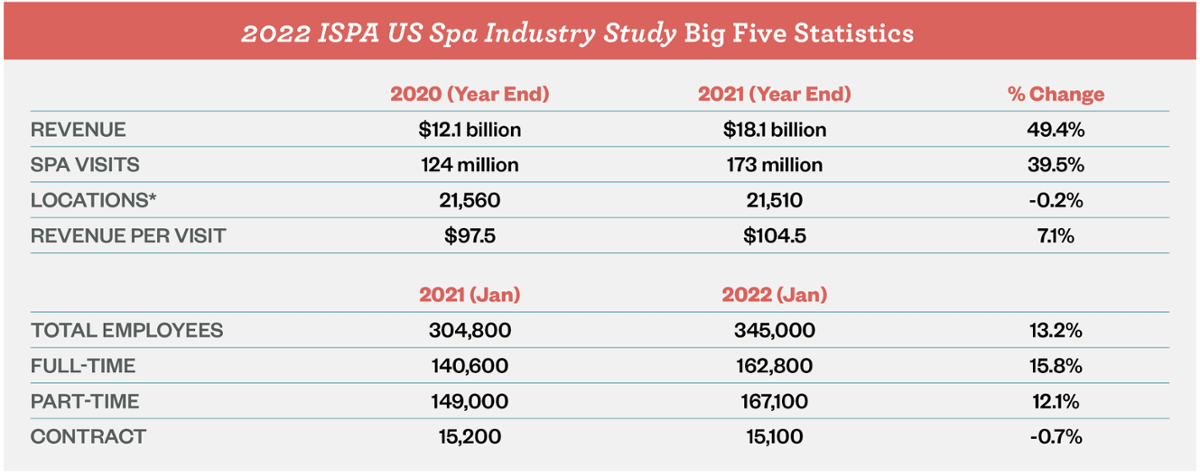
Industry revenues bounced back to US$18.1bn (€17.9bn, £15bn) in 2021, a 49 per cent rebound from the 2020 figure, bringing the long sought-after target of US$20bn (€19.7bn, £16.6bn) back into view. Spa visits recovered by 40 per cent to 173 million, and bringing these two metrics together sees a sharp jump in the ever-important revenue-per-visit metric which – at US$104.50 (€103.13, £86.79) – now sits at an all-time high for the industry.
This said, the visitation number is still almost 20 million visits short of 2019’s record high, so where have the other 20 million visits gone? Consumer data suggests this is partly down to people finding it difficult to get an appointment – but there is also a group of people who feel they need a little more time before they venture back to the spa.
So this means that, put simply, those who were visiting spas in 2021 were spending more.
The staffing challenge We know the pandemic had an impact on the total number of spa sites and people who work in them. Despite the difficulties, openings and closures appear to have stayed steady in the last year after the 2020 hardships, with the number of US spas still in excess of 21,500.
The pandemic severely restricted spas’ operational capacity during 2020, and while the majority were fully functioning again in 2021, ISPA’s study shows that almost a third (31 per cent) were either operating at reduced hours (29 per cent) or temporarily closed (2 per cent). When asked about the reasons for this, the overwhelming factor is staffing.
For the majority (70 per cent), staff shortages are a problem; but staff sickness has also played its part (41 per cent).
ISPA’s latest research estimates that there were over 345,000 people working in the US spa industry in 2021, making it a significant contributor to the health of the wider economy. But staffing remains a hot topic for industry leaders. It’s not a new challenge for the industry, but few spa leaders would likely disagree that the pandemic has made it a problem of greater magnitude.
More than two thirds (68 per cent) of spa professionals who responded to this year’s industry study said they don’t have enough staff to service guest requests, meaning lost revenue for the industry, but unfilled vacancies are an old problem. Back in 2019, ISPA’s research estimated almost 29,000 service provider vacancies. This year’s research estimates a 46,760 shortfall in total across all service provider positions, with around 30,000 massage therapist vacancies alone.
Looking specifically at massage therapists, half of spas responding to the survey said the recruitment challenges were driven by a lack of qualified candidates. A smaller number (43 per cent) said recruitment was being made more difficult by therapist concerns about COVID-19 and the close-contact nature of the work – perhaps a statistic that will fall as time moves on from the pandemic’s darkest days.
challenges & opportunities A specific challenge for the industry will be reinforcing the attractiveness of the work to potential candidates, with many spas saying recruitment of massage therapists is hindered by simply attracting candidates to apply (39 per cent), work schedules (32 per cent) and perceptions of compensation (26 per cent). Perhaps it’s no surprise that 82 per cent of spas reported at least some level of increase in massage therapist compensation in 2021. In spite of the concerns around staffing and the wider economic picture, spa leaders see cause for optimism. When asked about what they see as the single biggest opportunity for the industry in the US, many saw the current staffing challenges as giving impetus to further enhance both service provider education and staff wellbeing to help encourage greater retention of staff, with ‘workplace wellness’ featuring as a theme in a number of responses.
More widely, wellness continues to be viewed by leaders as a big opportunity for the industry, and is an important service that spas can provide as ‘safe spaces’ for the public at a time when concerns around anxiety, isolation and stress remain high.
In the wake of the pandemic, for many spa leaders the opportunity is for a return to what the industry does best. With many people becoming more comfortable with a gradual return to ‘close contact services’ and the return of travel and tourism, many see the time ahead as an opportunity to capitalise on what remains of the pent-up demand created by the pandemic.
foundation for the future The pandemic’s impact on the US spa industry seems, thankfully, to have been a short, sharp dip and not the onset of a sustained downturn. Spa-going surged as the economy reopened and the pent-up demand for services was unleashed as people started to spend the money they saved during the economic shutdown. Spa-going’s resurgence has also benefited from the increased focus on health and wellbeing following the physical and mental scars left on society by the pandemic, with wellness on the minds of many consumers.
All the same, the sudden upturn in demand continues to shine a light on the industry’s staffing challenges. Many industries have had trouble recruiting during the pandemic, but for the spa industry it has made a difficult issue even more challenging and will remain a top priority in industry leaders’ minds.
The other major immediate concern for spas is challenges for the wider economy. The spa industry’s performance has long been regarded as a bellwether of the wider US economy – so far, demand generally seems to have remained steady, but if the last two years have taught us anything, it’s the impossibility of knowing what lies ahead. So, the risks of headwinds in the wider economy influencing the spa industry remain. That said, ISPA’s US Spa Industry Study 2022 shows that the spa industry has returned to a strong position after the shock of the pandemic and has real momentum to fuel its long-term growth.
Russell Donaldson / Photo: PwC
More: A full copy of the 2022 ISPA US Spa Industry Study is available at www.experienceispa.com
Read more from this issue of Attractions Management magazine
View contents of Attractions Management 2022 issue 3
Editor's letter: Salus per natura
Although great buildings lie at the heart of the spa and wellness experience, operators are turning to nature to deliver healing journeys, says Liz Terry
Spa People: Thierry Malleret
We talk to the economist behind Monthly Barometer about key trends emerging in the wellness sector, such as a greater connection with nature
Spa People: Verena Lasvigne
The founder of VLF Spa Consulting shares her learnings from a career running spas on three continents
Spa People: Kim Weller
The wellbeing director of Banyan Tree tells us about the rollout of the company's new brand, Veya – for mind/body wellness
New opening: Loisium Spa
A look at the new luxurious spa situated at the heart of France's celebrated Champagne region
Interview: Neil Jacobs
The CEO of Six Senses talks about creating an eco-system around the brand to deliver hotels, clubs, residential, offices and resorts
Project preview: Next generation wellness
We take our first look at Tulah, the new clinical wellness retreat brand about to make its debut in Kerala, India, and speak to its CEO
ISPA Research: Rate of recovery
Russell Donaldson digs deeper into ISPA's 2022 US Spa Industry Study and considers the industry's resurgence since the end of pandemic lockdowns
Sponsored: Gharieni: Delivering results
Innovation is the hallmark of Gharieni experiences, meeting the rapidly
evolving needs of wellness seekers within the spa and wellness environment
New opening: Lanserhof Sylt
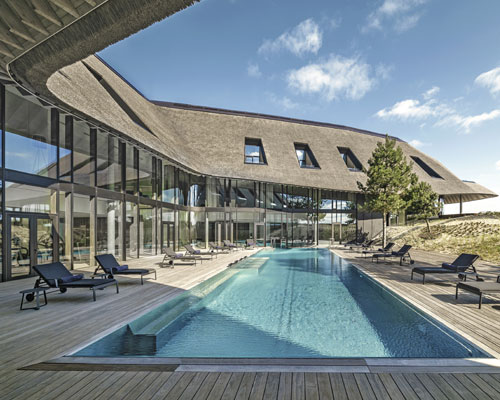
Lisa Starr reports on the industry's eagerly awaited wellness experience – nestled within sand dunes on the German island of Sylt
Healing: Emotional rescue
As people increasingly seek support for their emotional wellbeing, Jane Kitchen talks to the operators who are digging deeper to deliver genuine transformation
Promotion: TechnoAlpin: Powerful contrast
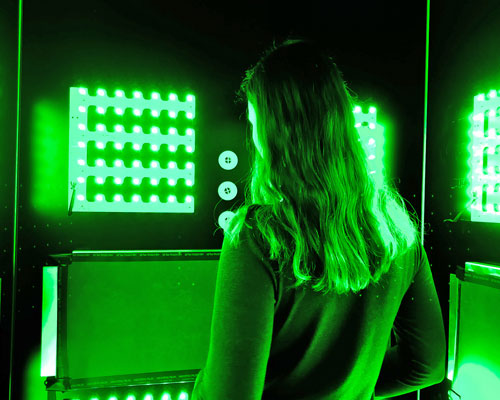
Spa clients can enjoy super-cool relaxation and pain-relief at Sächsische Staatsbäder in Bad Brambach thanks to a TechnoAlpin SnowRoom
Concept: Soneva Soul
The CEO and co-founder of Soneva, Sonu Shivdasani, talks about the philosophy behind the company's new wellness concept, Soneva Soul
New research from the ISPA Foundation shows clear evidence of a swift bounceback in the industry’s key metrics right across the US. The pre-pandemic heights of 2019 have come back into sight, and the industry has moved well down the road to recovery as it welcomes back customers.
Challenges persist, however, amid an uncertain economic climate – not least when it comes to staffing – a problematic issue the industry has been facing long before the arrival of COVID-19.
At the same time, the so-called ‘new normal’ has created opportunities, with spas ever conscious of the need to show agility and make important choices and decisions to keep the industry moving forward in this new era.
A return to growth The economic shock in the second quarter of 2020 inevitably had a major effect on the spa industry. The 2021 US Spa Industry Study, compiled by ISPA in collaboration with PricewaterhouseCoopers (PwC), showed a sharp fall in each of the industry’s ‘Big Five’ statistics in 2020, with revenues falling 36 per cent year-on-year, their first significant fall since the impact of the Great Recession in the late 2000s.
However, comparisons between these two periods of economic turmoil may not be all that helpful, as the pandemic saw a very different economic context to that of just over a decade ago.
The Great Recession generated a crisis of demand – people had less disposable income, so demand for activities such as spa-going fell. Conversely, the pandemic was a short-term crisis of supply and like so many businesses, most spas had to temporarily close, so spa-going became one of the many things people were unable to do.
At the same time, large parts of the population were able to save more money than usual, creating pent-up demand for the time when some normalcy resumed. That generated a ‘V-shaped recovery’ in the wider US economy – a relatively quick recovery after a sharp decline. And with consumers flocking back to spas, the data from ISPA’s 2022 US Spa Industry Study shows the sector has benefited from this phenomenon, with the surge in demand.
Industry revenues bounced back to US$18.1bn (€17.9bn, £15bn) in 2021, a 49 per cent rebound from the 2020 figure, bringing the long sought-after target of US$20bn (€19.7bn, £16.6bn) back into view. Spa visits recovered by 40 per cent to 173 million, and bringing these two metrics together sees a sharp jump in the ever-important revenue-per-visit metric which – at US$104.50 (€103.13, £86.79) – now sits at an all-time high for the industry.
This said, the visitation number is still almost 20 million visits short of 2019’s record high, so where have the other 20 million visits gone? Consumer data suggests this is partly down to people finding it difficult to get an appointment – but there is also a group of people who feel they need a little more time before they venture back to the spa.
So this means that, put simply, those who were visiting spas in 2021 were spending more.
The staffing challenge We know the pandemic had an impact on the total number of spa sites and people who work in them. Despite the difficulties, openings and closures appear to have stayed steady in the last year after the 2020 hardships, with the number of US spas still in excess of 21,500.
The pandemic severely restricted spas’ operational capacity during 2020, and while the majority were fully functioning again in 2021, ISPA’s study shows that almost a third (31 per cent) were either operating at reduced hours (29 per cent) or temporarily closed (2 per cent). When asked about the reasons for this, the overwhelming factor is staffing.
For the majority (70 per cent), staff shortages are a problem; but staff sickness has also played its part (41 per cent).
ISPA’s latest research estimates that there were over 345,000 people working in the US spa industry in 2021, making it a significant contributor to the health of the wider economy. But staffing remains a hot topic for industry leaders. It’s not a new challenge for the industry, but few spa leaders would likely disagree that the pandemic has made it a problem of greater magnitude.
More than two thirds (68 per cent) of spa professionals who responded to this year’s industry study said they don’t have enough staff to service guest requests, meaning lost revenue for the industry, but unfilled vacancies are an old problem. Back in 2019, ISPA’s research estimated almost 29,000 service provider vacancies. This year’s research estimates a 46,760 shortfall in total across all service provider positions, with around 30,000 massage therapist vacancies alone.
Looking specifically at massage therapists, half of spas responding to the survey said the recruitment challenges were driven by a lack of qualified candidates. A smaller number (43 per cent) said recruitment was being made more difficult by therapist concerns about COVID-19 and the close-contact nature of the work – perhaps a statistic that will fall as time moves on from the pandemic’s darkest days.
challenges & opportunities A specific challenge for the industry will be reinforcing the attractiveness of the work to potential candidates, with many spas saying recruitment of massage therapists is hindered by simply attracting candidates to apply (39 per cent), work schedules (32 per cent) and perceptions of compensation (26 per cent). Perhaps it’s no surprise that 82 per cent of spas reported at least some level of increase in massage therapist compensation in 2021. In spite of the concerns around staffing and the wider economic picture, spa leaders see cause for optimism. When asked about what they see as the single biggest opportunity for the industry in the US, many saw the current staffing challenges as giving impetus to further enhance both service provider education and staff wellbeing to help encourage greater retention of staff, with ‘workplace wellness’ featuring as a theme in a number of responses.
More widely, wellness continues to be viewed by leaders as a big opportunity for the industry, and is an important service that spas can provide as ‘safe spaces’ for the public at a time when concerns around anxiety, isolation and stress remain high.
In the wake of the pandemic, for many spa leaders the opportunity is for a return to what the industry does best. With many people becoming more comfortable with a gradual return to ‘close contact services’ and the return of travel and tourism, many see the time ahead as an opportunity to capitalise on what remains of the pent-up demand created by the pandemic.
foundation for the future The pandemic’s impact on the US spa industry seems, thankfully, to have been a short, sharp dip and not the onset of a sustained downturn. Spa-going surged as the economy reopened and the pent-up demand for services was unleashed as people started to spend the money they saved during the economic shutdown. Spa-going’s resurgence has also benefited from the increased focus on health and wellbeing following the physical and mental scars left on society by the pandemic, with wellness on the minds of many consumers.
All the same, the sudden upturn in demand continues to shine a light on the industry’s staffing challenges. Many industries have had trouble recruiting during the pandemic, but for the spa industry it has made a difficult issue even more challenging and will remain a top priority in industry leaders’ minds.
The other major immediate concern for spas is challenges for the wider economy. The spa industry’s performance has long been regarded as a bellwether of the wider US economy – so far, demand generally seems to have remained steady, but if the last two years have taught us anything, it’s the impossibility of knowing what lies ahead. So, the risks of headwinds in the wider economy influencing the spa industry remain. That said, ISPA’s US Spa Industry Study 2022 shows that the spa industry has returned to a strong position after the shock of the pandemic and has real momentum to fuel its long-term growth.
Russell Donaldson / Photo: PwC
More: A full copy of the 2022 ISPA US Spa Industry Study is available at www.experienceispa.com
Read more from this issue of Attractions Management magazine
View contents of Attractions Management 2022 issue 3
Editor's letter: Salus per natura
Although great buildings lie at the heart of the spa and wellness experience, operators are turning to nature to deliver healing journeys, says Liz Terry
Spa People: Thierry Malleret
We talk to the economist behind Monthly Barometer about key trends emerging in the wellness sector, such as a greater connection with nature
Spa People: Verena Lasvigne
The founder of VLF Spa Consulting shares her learnings from a career running spas on three continents
Spa People: Kim Weller
The wellbeing director of Banyan Tree tells us about the rollout of the company's new brand, Veya – for mind/body wellness
New opening: Loisium Spa
A look at the new luxurious spa situated at the heart of France's celebrated Champagne region
Interview: Neil Jacobs
The CEO of Six Senses talks about creating an eco-system around the brand to deliver hotels, clubs, residential, offices and resorts
Project preview: Next generation wellness
We take our first look at Tulah, the new clinical wellness retreat brand about to make its debut in Kerala, India, and speak to its CEO
ISPA Research: Rate of recovery
Russell Donaldson digs deeper into ISPA's 2022 US Spa Industry Study and considers the industry's resurgence since the end of pandemic lockdowns
Sponsored: Gharieni: Delivering results
Innovation is the hallmark of Gharieni experiences, meeting the rapidly
evolving needs of wellness seekers within the spa and wellness environment
New opening: Lanserhof Sylt
Lisa Starr reports on the industry's eagerly awaited wellness experience – nestled within sand dunes on the German island of Sylt
Healing: Emotional rescue
As people increasingly seek support for their emotional wellbeing, Jane Kitchen talks to the operators who are digging deeper to deliver genuine transformation
Promotion: TechnoAlpin: Powerful contrast
Spa clients can enjoy super-cool relaxation and pain-relief at Sächsische Staatsbäder in Bad Brambach thanks to a TechnoAlpin SnowRoom
Concept: Soneva Soul
The CEO and co-founder of Soneva, Sonu Shivdasani, talks about the philosophy behind the company's new wellness concept, Soneva Soul
A US$50 million (£44.2 million, €51.2 million) transformation of Chicago's historic McCormick
Mansion has created a new destination that combines live magic, immersive theatre, dining and
private membership under one roof.
The Montana Historical Society has officially celebrated the opening of its new Montana
Heritage
Center, a US$107 million (£79 million, €92 million) destination that combines immersive
storytelling with cutting-edge audiovisual technology to bring the sta
San Antonio Zoo has reported a US$283 million economic impact for 2025, following a decade-
long transformation programme that has seen almost US$200 million invested into the Texas
attraction.
Plans for the AU$180 million redevelopment of Reef HQ Aquarium in Townsville, Australia, are
progressing, with the project set to transform the attraction into a global centre for reef
education and conservation.
Abu Dhabi-based investment firm Mubadala Capital has made a binding, fully financed
€1 billion
offer to acquire Pierre and Vacances SA, the European holiday resort operator behind the
continental European Center Parcs business.
Disney has reaffirmed its commitment to investing US$30 billion in its US parks and cruise
business by 2033, using new America250 celebrations to underline the role its attractions play
in supporting jobs, tourism and economic growth.
Expo 2030 Riyadh is being planned as a permanent visitor destination, with organisers
confirming the six-million-square-metre site will become a Global Village after the event closes.
The owner of one of Australia's best-known waterparks has acquired a major competitor,
creating a new attractions business spanning two of the country's largest visitor destinations.
The Toverland theme park in the Netherlands has announced a €98m expansion programme
that will add a resort, new attractions and staff facilities as it pursues plans to become a multi-
day destination.
Hotel de France, located on the British Isle of Jersey, has created a wellness retreat package
that includes a hot yoga session that will take place in Jersey Zoo’s butterfly sanctuary.