Global growth in some parts of the attractions and tourism industry is being held back by confusing and antiquated visa regulations. That's the view of a number of industry leaders – most recently Merlin Entertainments' CEO, Nick Varney, who's flagged up the UK's visa policies as "a joke", and is calling for reform.
Tourists are put off visiting some world destinations by visa palavers and cost. As a result, profits don't follow investment to the extent they could and the cross-marketing of attractions by operators with global portfolios doesn't have the impact it would in a more open market.
Even a small change could make a big difference given the volumes of tourists who hit the road each year. Global arrivals exceeded the billion mark for the first time in 2012 and the UN World Tourism Organisation (UNWTO) is forecasting growth of per cent a year on this number to 2030.
Nations which recognise the value of tourists to their economies and make it easy and cheap for people to visit are seeing the benefits, as are the visitor attractions which sit within their borders.
Some regions, such as the EU, have streamlined their systems. The Schengen Agreement – signed in 1985 – created the Schengen Area, which operates like a single state for visa purposes and covers 26 European countries, including most EU members, plus Iceland and Norway. The UK and Ireland opted out of Schengen – one of the reasons for Varney's ire.
The G20 meeting in Mexico in 2012 historically recognised travel and tourism as a "vehicle for job creation, economic growth and development", with G20 leaders committing, for the first time, to support the industry.
Of the 656 million tourists who visited G20 countries in 2011, 110 million needed a visa, but millions more were found to have been deterred from travelling by the cost and difficulty of obtaining one.
Research by the World Travel and Tourism Council and the UNWTO showed the G20 could boost international tourist numbers by 122 million, generate an extra US$206bn (£131bn, E154bn) and create five million extra jobs by 2015, simply by improving visa processes. With this item firmly on the agenda internationally, the industry needs to join the lobby with all possible haste.
Varney is right to be bringing it to our attention.
Read more from this issue of Attractions Management magazine
View contents of Attractions Management 2013 issue 1
Editor's letter: VISAS – Not sexy, but vital
Of the 656 million tourists who visited G20 countries in 2011,
110 million needed a visa, but millions more were deterred
from travelling by the cost and difficulty of obtaining one
Profile: Sim Choo Kheng
The creator of Escape, Malaysia's new,
sustainable theme park, describes how
his free range childhood and a desire
to coax Asian children away from their
computers inspired the park's ethos
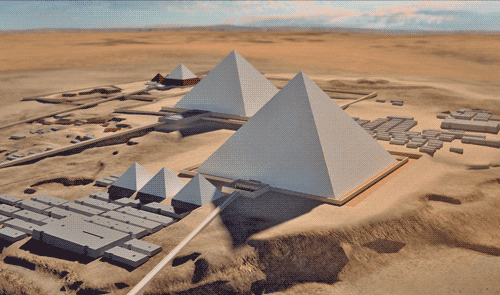
Heritage: Points of view
Egypt's Giza pyramids have been
brought to life by a 3D project, which
enables them to be shared worldwide
while protecting their heritage
Top team: Play and display
Contemporary art is used to encourage
children's interest and participation in art
as well as making them better citizens at
the New Children's Museum in San Diego
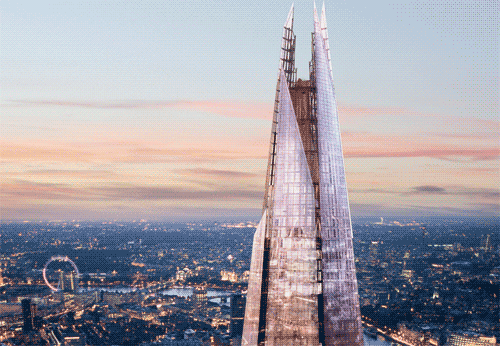
New opening: High life
At 310m, The View From The Shard is
Europe's tallest viewing platform as well
as being London's latest landmark. CE
Anders Nyberg describes the project
Global growth in some parts of the attractions and tourism industry is being held back by confusing and antiquated visa regulations. That's the view of a number of industry leaders – most recently Merlin Entertainments' CEO, Nick Varney, who's flagged up the UK's visa policies as "a joke", and is calling for reform.
Tourists are put off visiting some world destinations by visa palavers and cost. As a result, profits don't follow investment to the extent they could and the cross-marketing of attractions by operators with global portfolios doesn't have the impact it would in a more open market.
Even a small change could make a big difference given the volumes of tourists who hit the road each year. Global arrivals exceeded the billion mark for the first time in 2012 and the UN World Tourism Organisation (UNWTO) is forecasting growth of per cent a year on this number to 2030.
Nations which recognise the value of tourists to their economies and make it easy and cheap for people to visit are seeing the benefits, as are the visitor attractions which sit within their borders.
Some regions, such as the EU, have streamlined their systems. The Schengen Agreement – signed in 1985 – created the Schengen Area, which operates like a single state for visa purposes and covers 26 European countries, including most EU members, plus Iceland and Norway. The UK and Ireland opted out of Schengen – one of the reasons for Varney's ire.
The G20 meeting in Mexico in 2012 historically recognised travel and tourism as a "vehicle for job creation, economic growth and development", with G20 leaders committing, for the first time, to support the industry.
Of the 656 million tourists who visited G20 countries in 2011, 110 million needed a visa, but millions more were found to have been deterred from travelling by the cost and difficulty of obtaining one.
Research by the World Travel and Tourism Council and the UNWTO showed the G20 could boost international tourist numbers by 122 million, generate an extra US$206bn (£131bn, E154bn) and create five million extra jobs by 2015, simply by improving visa processes. With this item firmly on the agenda internationally, the industry needs to join the lobby with all possible haste.
Varney is right to be bringing it to our attention.
Read more from this issue of Attractions Management magazine
View contents of Attractions Management 2013 issue 1
Editor's letter: VISAS – Not sexy, but vital
Of the 656 million tourists who visited G20 countries in 2011,
110 million needed a visa, but millions more were deterred
from travelling by the cost and difficulty of obtaining one
Profile: Sim Choo Kheng
The creator of Escape, Malaysia's new,
sustainable theme park, describes how
his free range childhood and a desire
to coax Asian children away from their
computers inspired the park's ethos
Heritage: Points of view
Egypt's Giza pyramids have been
brought to life by a 3D project, which
enables them to be shared worldwide
while protecting their heritage
Top team: Play and display
Contemporary art is used to encourage
children's interest and participation in art
as well as making them better citizens at
the New Children's Museum in San Diego
New opening: High life
At 310m, The View From The Shard is
Europe's tallest viewing platform as well
as being London's latest landmark. CE
Anders Nyberg describes the project
Abu Dhabi-based investment firm Mubadala Capital has made a binding, fully financed
€1 billion
offer to acquire Pierre and Vacances SA, the European holiday resort operator behind the
continental European Center Parcs business.
Expo 2030 Riyadh is being planned as a permanent visitor destination, with organisers
confirming the six-million-square-metre site will become a Global Village after the event closes.
The owner of one of Australia's best-known waterparks has acquired a major competitor,
creating a new attractions business spanning two of the country's largest visitor destinations.
The Toverland theme park in the Netherlands has announced a €98m expansion programme
that will add a resort, new attractions and staff facilities as it pursues plans to become a multi-
day destination.
Hotel de France, located on the British Isle of Jersey, has created a wellness retreat package
that includes a hot yoga session that will take place in Jersey Zoo’s butterfly sanctuary.
A new immersive attraction designed to transport visitors into the final hours of ancient Pompeii
is preparing to open near the world-famous archaeological site in southern Italy.
Experience design company, BRC Imagination Arts, has completed a transition that sees founder
Bob Rogers pass ownership of the business to four long-serving senior executives, while
remaining actively involved with the company.
Movie Park Germany has opened a new Paramount Pictures-themed attraction as part of its 30th
anniversary celebrations, using immersive storytelling and adaptive reuse to reinforce the park’s
longstanding “Hollywood in Germany” positioning.
Therme Manchester’s 28-acre development, which will include interconnected glass pavilions
that measure 65,000sq m, will be the largest bathing and wellbeing attraction in the world once
complete, according to prof David Russell, CEO of Therme UK.
Efteling has opened Hooghmoed, a new family drop tower designed to broaden the appeal of its
recently launched Sirene Island themed area and introduce younger visitors to thrill attractions.
+ More news
COMPANY PROFILES
IDEATTACK IDEATTACK is a full-service planning and
design company with headquarters in
Los Angeles. [more...]
Alterface Alterface’s Creative Division team is
seasoned in concept and ride development,
as well as storyte [more...]
Painting With Light By combining lighting, video, scenic and architectural elements, sound and special effects we tell s [more...]
instantprint We’re a Yorkshire-based online printer, founded
in 2009 by Adam Carnell and James Kinsella. [more...]