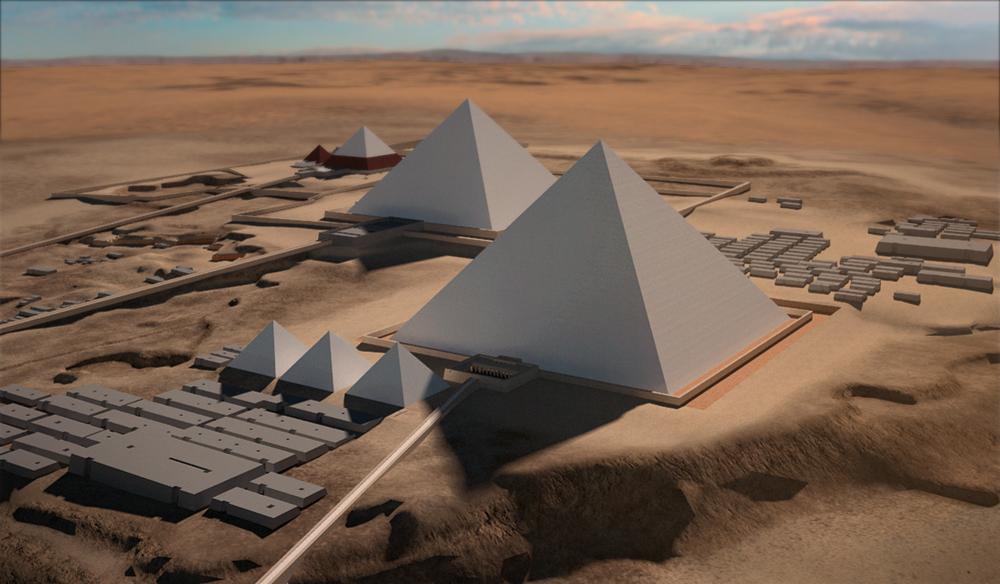
Rectangular buildings called mastabas covered Giza Plateau
Situated on the outskirts of Cairo, Africa’s largest city, the Giza Plateau is a little-known archaeological jewel. Over the centuries, the ancient Egyptians built Giza into a vast necropolis, rich in lessons about their civilization, conception of the afterlife, architectural knowledge, art and writing.
The area is subject to threats from all sides, from rampant urban sprawl, the elements and even vandalism. This raises two questions – how can this heritage be preserved and how can it be shared with as many as possible? The Giza 3D project has the answers.
On the Nile’s west bank, opposite the ancient city of Cairo, the Giza Plateau constitutes a vast necropolis at the desert’s edge, spread across 2,000m (6,562ft) from east to west and 1,500m (4,921ft) from north to south.
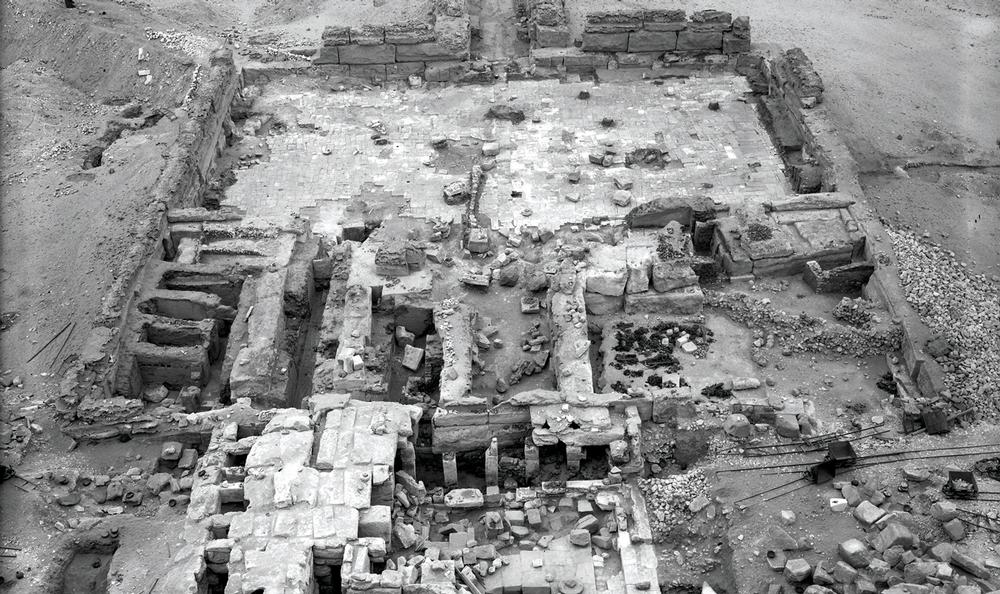
Around the pyramids, where the kings are entombed, flanked by smaller satellite pyramids for their queens, the Egyptians customarily buried family members and dignitaries, so that they could enjoy the beneficent influence of the proximity of their sovereign in their journey to the hereafter. Over the centuries, the Giza Plateau was gradually covered with rectangular buildings called mastabas (mastaba means bench in Arabic), temples which were dedicated to worship, pits containing giant funerary boats and a network of passages and causeways.
It all constitutes a rich funerary complex, unfortunately much the worse for looting and the passage of time. The best-preserved royal mortuary complex, dedicated to the pharaoh Khafre, gives us an idea of what the necropolis must have been like in its heyday.
Endangered zone The Giza Plateau is an endangered heritage zone. The entire site is threatened by a combination of adverse factors. In addition to erosion by the weather, with sandstorms and temperature fluctuations, there’s also the human element. With growing urbanisation, Cairo’s megalopolis is now encroaching on the site itself with problems including pollution that attacks limestone. Moreover, the site is victim to its own success. Abrasion from millions of footsteps, and carbon dioxide exhalations of vast numbers of visitors attack the stone of the pyramids and mastaba. There’s additional damage from graffiti and people who have tried to extract stones.
Add this to the worldwide museum diaspora of objects extracted from the plateau since Egyptology’s infancy, and the Giza Necropolis is practically impossible to study in its entirety. To do so would involve bringing together information and objects that have been scattered throughout the world, listing, classifying and documenting them. The task is massive. And yet, a good start has been made.
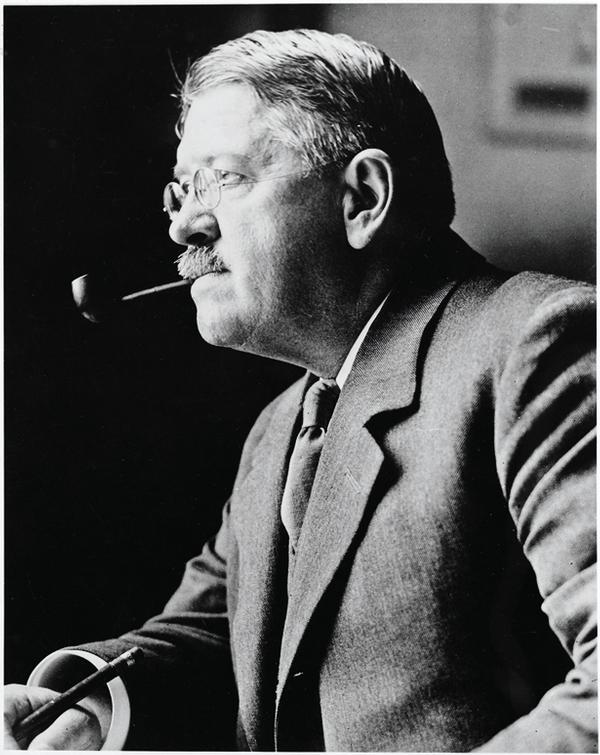
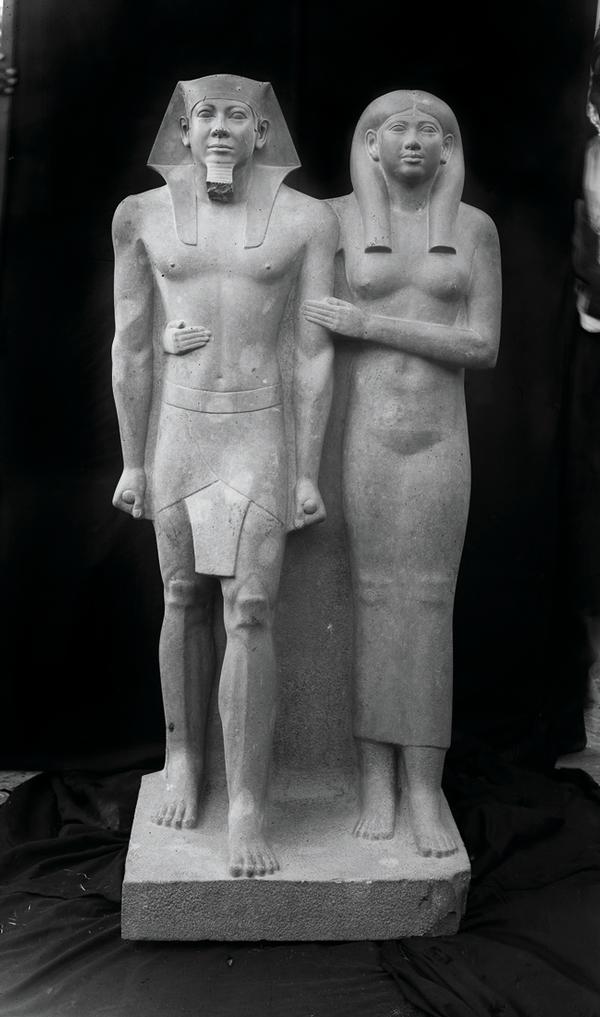
Excavations In 1904, Egyptologist George Reisner began work on the Giza Necropolis. During 40 years of excavations, he unearthed thousands of remains and works of art and left a thorough catalogue of his explorations, with 45,000 photographic glass plate negatives, tens of thousands of pages of diaries, manuscripts, and reports, countless maps, diagrams, notes and copious correspondence.
George Reisner’s death in 1942 and the Second World War eventually put an end to the mission, and the fruits of the expedition archives were sent home to the Museum of Fine Arts Boston (MFA), USA, along with all the reports and other materials.
This immense resource remained practically unused until the beginning of the 1970s when the MFA’s curator, William Kelly Simpson, returned to Giza for new excavations. Continuing Reisner’s work, he embarked on systematically logging the mastaba tombs in a monograph series. The task was a daunting one, as finding the information about a given mastaba on the ground was very difficult. Moreover, seeking remote access to the archives, for example by foreign students, was practically impossible. And the fragility of certain media, such as the famous glass plate photographs, complicated their transport and handling.
Digitisation In 2000, thanks to the support of the Andrew W Mellon Foundation, the MFA was able to launch a major project. Technical progress and the democratisation of digital technology made it possible to initiate the Giza Archives Project, involving the digitisation of both the immense Reisner collection and selected data scattered among universities and museums worldwide.
The challenges were manifold: a gigantic task of digitising the available records, entering data, establishing coherent cross-indexing and constructing a database to facilitate search by various criteria. It took years of dedicated work to complete the digitisation of the Reisner expedition archives. The next task was to provide the simplest and most effective access possible to the archives, whether for university researchers or the public looking for more on the wonders of Giza.
The Web was the preferred solution, and the website of the Giza Archives Project was put online. Several modes of searching the database catered to the needs of all types of users, along with explanatory videos.
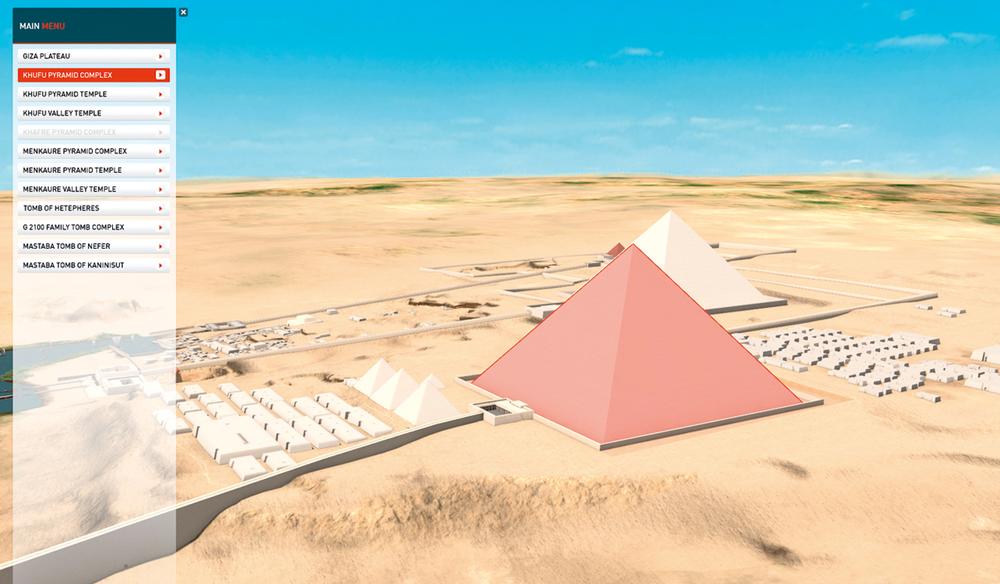
Now people can click on a mastaba while flying over a photo of the Giza Plateau and obtain a wealth of information, such as the identity of its occupants, the date of its discovery, the exploration report, the list and photographs of remains and more. Visitors can also search the database by entering the specific identifier of a tomb or object in the catalogue and quickly obtain all the desired information.
The depth of its content and interface have made the Giza Archives Project website the leading reference resource on the Giza Necropolis.
A new dimension Fantastic as this achievement was, Dr Peter Der Manuelian, director of the Giza Archive Project, wanted to take it further. In 2007 he saw a 3D presentation of the theory of the building of the Khufu pyramid, which took audiences to the heart of the original construction work on the Great Pyramid.
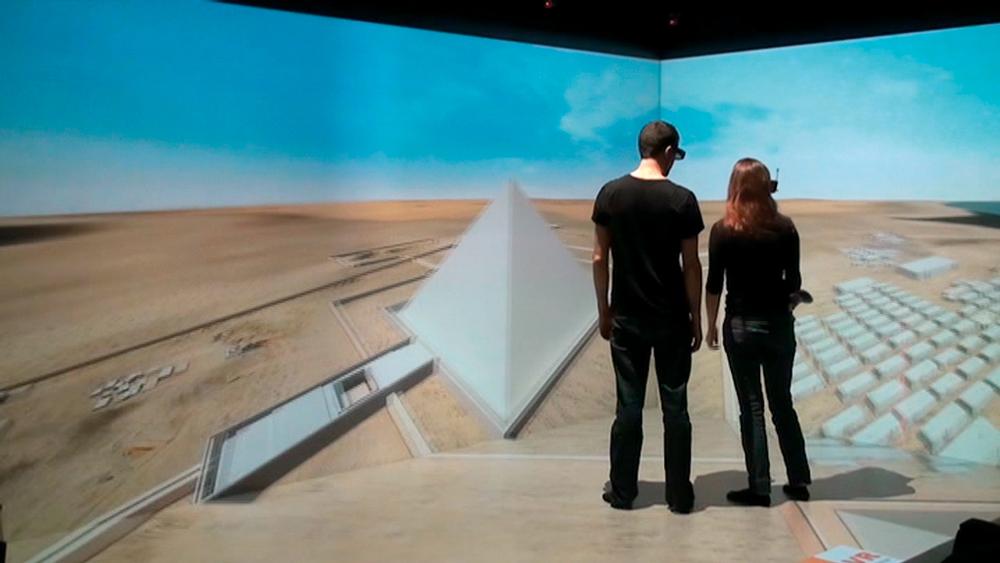
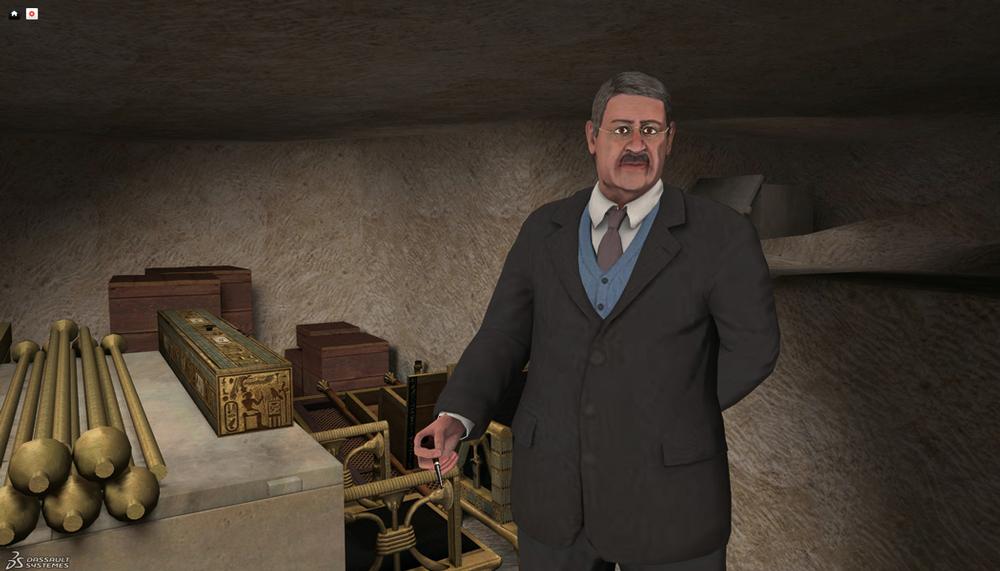
Created by 3D experience company Dassault Systèmes, the 3D immersion in a virtual Egypt offered unprecedented realism, all the more so as the experience was interactive. It wasn’t a film with a fixed screenplay, where the 3D was calculated in advance, but a live adventure where the 3D was presented in real time and depended on the movements made in the virtual world.
A 3D-jockey, or 3DJ led the spectators around the Khufu construction site, following directions to approach certain details or enter particular spaces. The 3D virtual experience was also uploaded to the Dassault Systèmes website, allowing millions of internet users to take off for the Egypt of Khufu’s time. A documentary mixing footage shot in the field and 3D images of the experience was produced the following year.
Der Manuelian realised the added value potential of immersive 3D for navigating through the immense data pertaining to Giza, so approached the team at Dassault Systèmes. Different eras in the history of the Giza Necropolis had to be reconstituted and the data digitised to create an interactive experience that put the finds in their proper context. In this way, the general public could visit an extremely realistic, virtual Giza Necropolis. Researchers and academics could also share new data and collaborate to advance the state of knowledge of the Giza Plateau together.
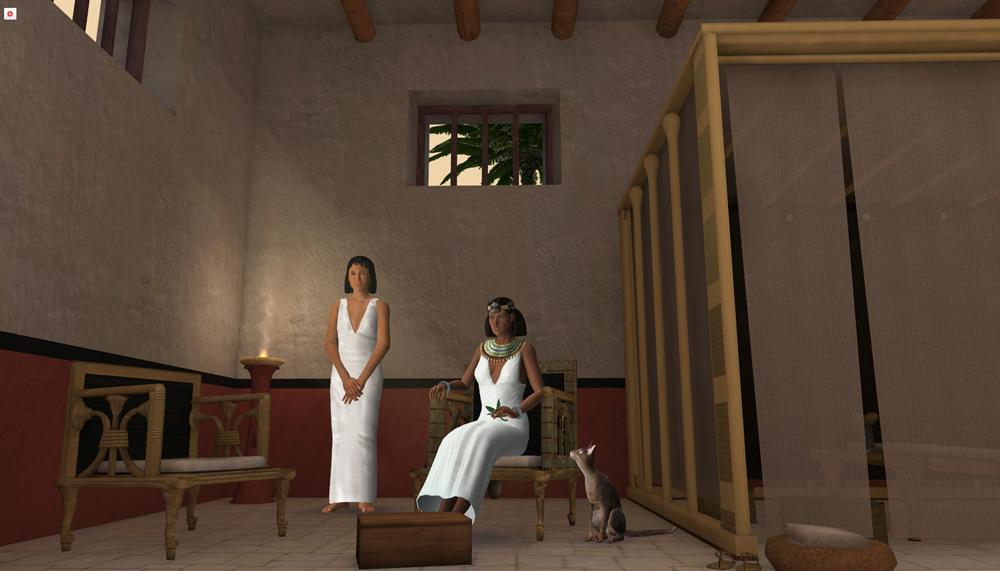
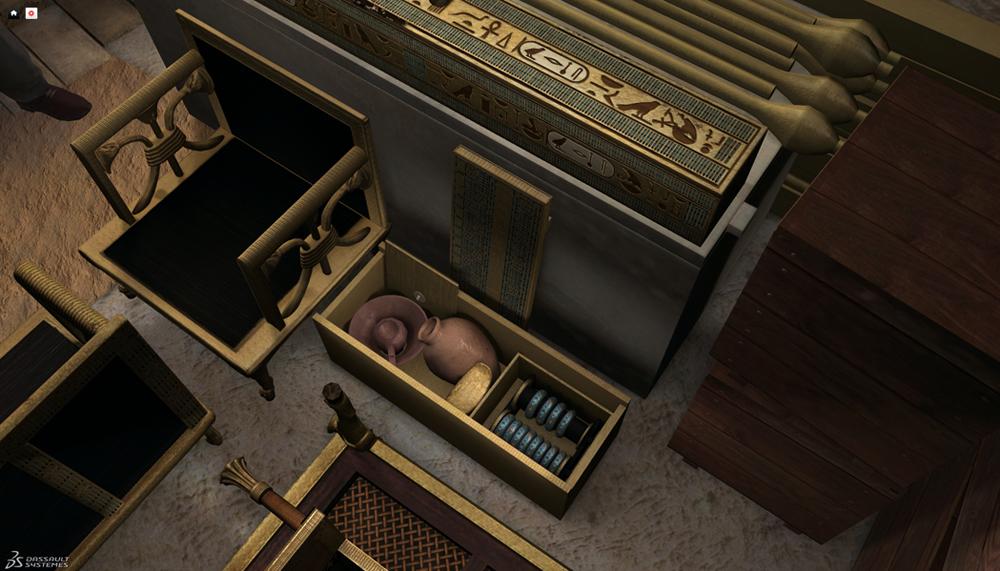
Time travel The ravages of weather have left tombs on the Giza Plateau in poor condition. Using information compiled in expeditions, the Necropolis has been reconstituted at various periods in time. As a result, the mastabas and other monuments can be visited in 3D in a state of virtual conservation considerably better than the reality, as some have entirely disappeared.
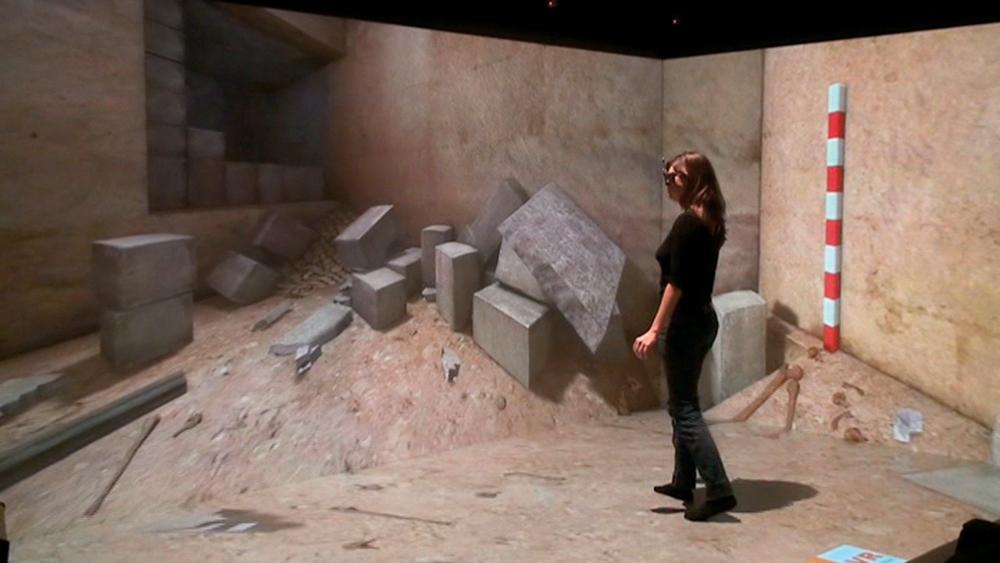
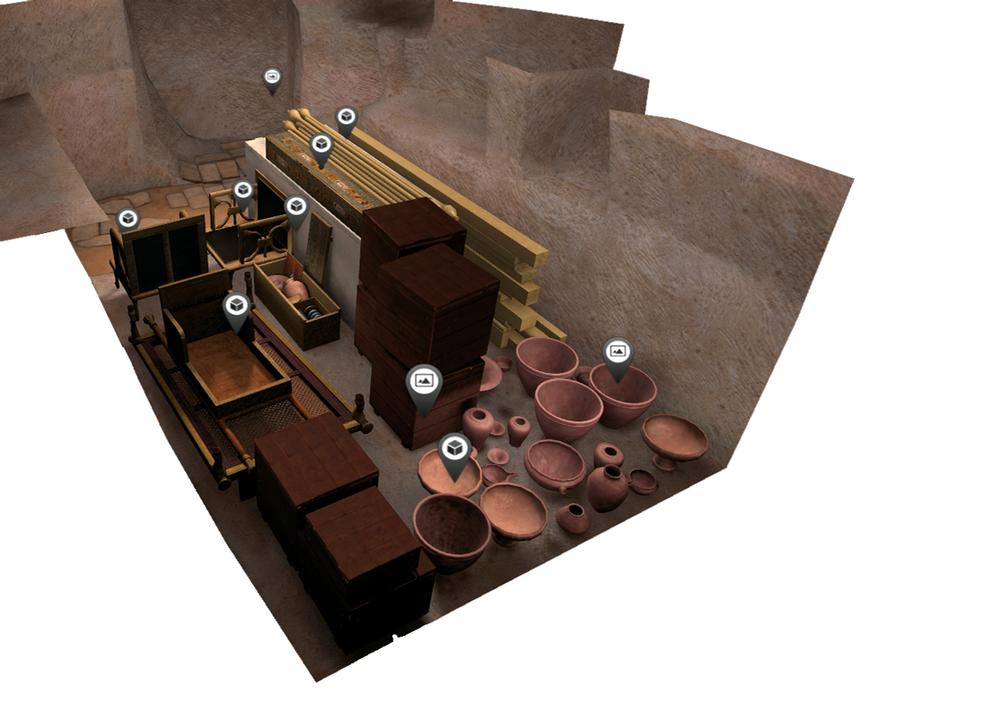
The Necropolis can now be viewed in various stages of completion and from any angle, including aerial 3D views, cross sections of the ground and passing through walls. People can visit a mastaba, restore all the finds discovered there to their original context and consult the available documentation from the database.
The tombs can also be considered from other angles, such as isolating a sub-group and observing the relations between the tombs of a single family or going below ground to follow the complicated maze of shafts linking tombs in search of a logical system or a story.
Reconstruction of vanished temples or tombs from available information makes it possible to trace the entire history of the Giza Plateau at different eras and follow the development of the Necropolis down through the centuries. Various arrangements of the monuments can be quickly prototyped, allowing simple and speedy testing of multiple hypotheses. The use of 3D has enabled the discovery of new correlations, raising fresh questions and helping to advance the overall knowledge of Giza.
Tomorrow’s museums The online publication of the Giza 3D project makes sharing it much easier. Instead of shipping fragile archival photos and documents from collections around the world for temporary exhibitions, the digitilised, 3D can be placed in context of the tombs they came from, with all the corresponding information.
Installed in interactive terminals or on pads provided, interactive 3D can give visitors a new dimension to objects exhibited in glass cases, showing them in their context and bringing them to life, balancing scientific discipline and technological creativity.
Museums can equip themselves with everything from simple 3D televisions, such as those used in the At the Foot of the Great Pyramids temporary exhibition at Germany’s Pelizaeus-Museum in Hildesheim and a forthcoming exhibition in Vienna planned for this year – to more complex immersive systems. These include a virtual reality cave with interactive tours where visitors wear special glasses and visit the restored tombs, shafts and burial chambers.
Giza 3D is a complex project involving management of a wealth of data in an attractive, realistic and user-friendly presentation. It’s both a demonstration of the power of 3D in the service of specialised research and an example of universal knowledge sharing.
For more information, visit http://giza3d.3ds.com
Read more from this issue of Attractions Management magazine
View contents of Attractions Management 2013 issue 1
Editor's letter: VISAS – Not sexy, but vital
Of the 656 million tourists who visited G20 countries in 2011,
110 million needed a visa, but millions more were deterred
from travelling by the cost and difficulty of obtaining one
Profile: Sim Choo Kheng
The creator of Escape, Malaysia's new,
sustainable theme park, describes how
his free range childhood and a desire
to coax Asian children away from their
computers inspired the park's ethos
Heritage: Points of view
Egypt's Giza pyramids have been
brought to life by a 3D project, which
enables them to be shared worldwide
while protecting their heritage
Top team: Play and display
Contemporary art is used to encourage
children's interest and participation in art
as well as making them better citizens at
the New Children's Museum in San Diego
New opening: High life
At 310m, The View From The Shard is
Europe's tallest viewing platform as well
as being London's latest landmark. CE
Anders Nyberg describes the project
Rectangular buildings called mastabas covered Giza Plateau
Situated on the outskirts of Cairo, Africa’s largest city, the Giza Plateau is a little-known archaeological jewel. Over the centuries, the ancient Egyptians built Giza into a vast necropolis, rich in lessons about their civilization, conception of the afterlife, architectural knowledge, art and writing.
The area is subject to threats from all sides, from rampant urban sprawl, the elements and even vandalism. This raises two questions – how can this heritage be preserved and how can it be shared with as many as possible? The Giza 3D project has the answers.
On the Nile’s west bank, opposite the ancient city of Cairo, the Giza Plateau constitutes a vast necropolis at the desert’s edge, spread across 2,000m (6,562ft) from east to west and 1,500m (4,921ft) from north to south.
Around the pyramids, where the kings are entombed, flanked by smaller satellite pyramids for their queens, the Egyptians customarily buried family members and dignitaries, so that they could enjoy the beneficent influence of the proximity of their sovereign in their journey to the hereafter. Over the centuries, the Giza Plateau was gradually covered with rectangular buildings called mastabas (mastaba means bench in Arabic), temples which were dedicated to worship, pits containing giant funerary boats and a network of passages and causeways.
It all constitutes a rich funerary complex, unfortunately much the worse for looting and the passage of time. The best-preserved royal mortuary complex, dedicated to the pharaoh Khafre, gives us an idea of what the necropolis must have been like in its heyday.
Endangered zone The Giza Plateau is an endangered heritage zone. The entire site is threatened by a combination of adverse factors. In addition to erosion by the weather, with sandstorms and temperature fluctuations, there’s also the human element. With growing urbanisation, Cairo’s megalopolis is now encroaching on the site itself with problems including pollution that attacks limestone. Moreover, the site is victim to its own success. Abrasion from millions of footsteps, and carbon dioxide exhalations of vast numbers of visitors attack the stone of the pyramids and mastaba. There’s additional damage from graffiti and people who have tried to extract stones.
Add this to the worldwide museum diaspora of objects extracted from the plateau since Egyptology’s infancy, and the Giza Necropolis is practically impossible to study in its entirety. To do so would involve bringing together information and objects that have been scattered throughout the world, listing, classifying and documenting them. The task is massive. And yet, a good start has been made.
Excavations In 1904, Egyptologist George Reisner began work on the Giza Necropolis. During 40 years of excavations, he unearthed thousands of remains and works of art and left a thorough catalogue of his explorations, with 45,000 photographic glass plate negatives, tens of thousands of pages of diaries, manuscripts, and reports, countless maps, diagrams, notes and copious correspondence.
George Reisner’s death in 1942 and the Second World War eventually put an end to the mission, and the fruits of the expedition archives were sent home to the Museum of Fine Arts Boston (MFA), USA, along with all the reports and other materials.
This immense resource remained practically unused until the beginning of the 1970s when the MFA’s curator, William Kelly Simpson, returned to Giza for new excavations. Continuing Reisner’s work, he embarked on systematically logging the mastaba tombs in a monograph series. The task was a daunting one, as finding the information about a given mastaba on the ground was very difficult. Moreover, seeking remote access to the archives, for example by foreign students, was practically impossible. And the fragility of certain media, such as the famous glass plate photographs, complicated their transport and handling.
Digitisation In 2000, thanks to the support of the Andrew W Mellon Foundation, the MFA was able to launch a major project. Technical progress and the democratisation of digital technology made it possible to initiate the Giza Archives Project, involving the digitisation of both the immense Reisner collection and selected data scattered among universities and museums worldwide.
The challenges were manifold: a gigantic task of digitising the available records, entering data, establishing coherent cross-indexing and constructing a database to facilitate search by various criteria. It took years of dedicated work to complete the digitisation of the Reisner expedition archives. The next task was to provide the simplest and most effective access possible to the archives, whether for university researchers or the public looking for more on the wonders of Giza.
The Web was the preferred solution, and the website of the Giza Archives Project was put online. Several modes of searching the database catered to the needs of all types of users, along with explanatory videos.
Now people can click on a mastaba while flying over a photo of the Giza Plateau and obtain a wealth of information, such as the identity of its occupants, the date of its discovery, the exploration report, the list and photographs of remains and more. Visitors can also search the database by entering the specific identifier of a tomb or object in the catalogue and quickly obtain all the desired information.
The depth of its content and interface have made the Giza Archives Project website the leading reference resource on the Giza Necropolis.
A new dimension Fantastic as this achievement was, Dr Peter Der Manuelian, director of the Giza Archive Project, wanted to take it further. In 2007 he saw a 3D presentation of the theory of the building of the Khufu pyramid, which took audiences to the heart of the original construction work on the Great Pyramid.
Created by 3D experience company Dassault Systèmes, the 3D immersion in a virtual Egypt offered unprecedented realism, all the more so as the experience was interactive. It wasn’t a film with a fixed screenplay, where the 3D was calculated in advance, but a live adventure where the 3D was presented in real time and depended on the movements made in the virtual world.
A 3D-jockey, or 3DJ led the spectators around the Khufu construction site, following directions to approach certain details or enter particular spaces. The 3D virtual experience was also uploaded to the Dassault Systèmes website, allowing millions of internet users to take off for the Egypt of Khufu’s time. A documentary mixing footage shot in the field and 3D images of the experience was produced the following year.
Der Manuelian realised the added value potential of immersive 3D for navigating through the immense data pertaining to Giza, so approached the team at Dassault Systèmes. Different eras in the history of the Giza Necropolis had to be reconstituted and the data digitised to create an interactive experience that put the finds in their proper context. In this way, the general public could visit an extremely realistic, virtual Giza Necropolis. Researchers and academics could also share new data and collaborate to advance the state of knowledge of the Giza Plateau together.
Time travel The ravages of weather have left tombs on the Giza Plateau in poor condition. Using information compiled in expeditions, the Necropolis has been reconstituted at various periods in time. As a result, the mastabas and other monuments can be visited in 3D in a state of virtual conservation considerably better than the reality, as some have entirely disappeared.
The Necropolis can now be viewed in various stages of completion and from any angle, including aerial 3D views, cross sections of the ground and passing through walls. People can visit a mastaba, restore all the finds discovered there to their original context and consult the available documentation from the database.
The tombs can also be considered from other angles, such as isolating a sub-group and observing the relations between the tombs of a single family or going below ground to follow the complicated maze of shafts linking tombs in search of a logical system or a story.
Reconstruction of vanished temples or tombs from available information makes it possible to trace the entire history of the Giza Plateau at different eras and follow the development of the Necropolis down through the centuries. Various arrangements of the monuments can be quickly prototyped, allowing simple and speedy testing of multiple hypotheses. The use of 3D has enabled the discovery of new correlations, raising fresh questions and helping to advance the overall knowledge of Giza.
Tomorrow’s museums The online publication of the Giza 3D project makes sharing it much easier. Instead of shipping fragile archival photos and documents from collections around the world for temporary exhibitions, the digitilised, 3D can be placed in context of the tombs they came from, with all the corresponding information.
Installed in interactive terminals or on pads provided, interactive 3D can give visitors a new dimension to objects exhibited in glass cases, showing them in their context and bringing them to life, balancing scientific discipline and technological creativity.
Museums can equip themselves with everything from simple 3D televisions, such as those used in the At the Foot of the Great Pyramids temporary exhibition at Germany’s Pelizaeus-Museum in Hildesheim and a forthcoming exhibition in Vienna planned for this year – to more complex immersive systems. These include a virtual reality cave with interactive tours where visitors wear special glasses and visit the restored tombs, shafts and burial chambers.
Giza 3D is a complex project involving management of a wealth of data in an attractive, realistic and user-friendly presentation. It’s both a demonstration of the power of 3D in the service of specialised research and an example of universal knowledge sharing.
For more information, visit http://giza3d.3ds.com
Read more from this issue of Attractions Management magazine
View contents of Attractions Management 2013 issue 1
Editor's letter: VISAS – Not sexy, but vital
Of the 656 million tourists who visited G20 countries in 2011,
110 million needed a visa, but millions more were deterred
from travelling by the cost and difficulty of obtaining one
Profile: Sim Choo Kheng
The creator of Escape, Malaysia's new,
sustainable theme park, describes how
his free range childhood and a desire
to coax Asian children away from their
computers inspired the park's ethos
Heritage: Points of view
Egypt's Giza pyramids have been
brought to life by a 3D project, which
enables them to be shared worldwide
while protecting their heritage
Top team: Play and display
Contemporary art is used to encourage
children's interest and participation in art
as well as making them better citizens at
the New Children's Museum in San Diego
New opening: High life
At 310m, The View From The Shard is
Europe's tallest viewing platform as well
as being London's latest landmark. CE
Anders Nyberg describes the project
Abu Dhabi-based investment firm Mubadala Capital has made a binding, fully financed
€1 billion
offer to acquire Pierre and Vacances SA, the European holiday resort operator behind the
continental European Center Parcs business.
Expo 2030 Riyadh is being planned as a permanent visitor destination, with organisers
confirming the six-million-square-metre site will become a Global Village after the event closes.
The owner of one of Australia's best-known waterparks has acquired a major competitor,
creating a new attractions business spanning two of the country's largest visitor destinations.
The Toverland theme park in the Netherlands has announced a €98m expansion programme
that will add a resort, new attractions and staff facilities as it pursues plans to become a multi-
day destination.
Hotel de France, located on the British Isle of Jersey, has created a wellness retreat package
that includes a hot yoga session that will take place in Jersey Zoo’s butterfly sanctuary.
A new immersive attraction designed to transport visitors into the final hours of ancient Pompeii
is preparing to open near the world-famous archaeological site in southern Italy.
Experience design company, BRC Imagination Arts, has completed a transition that sees founder
Bob Rogers pass ownership of the business to four long-serving senior executives, while
remaining actively involved with the company.
Movie Park Germany has opened a new Paramount Pictures-themed attraction as part of its 30th
anniversary celebrations, using immersive storytelling and adaptive reuse to reinforce the park’s
longstanding “Hollywood in Germany” positioning.
Therme Manchester’s 28-acre development, which will include interconnected glass pavilions
that measure 65,000sq m, will be the largest bathing and wellbeing attraction in the world once
complete, according to prof David Russell, CEO of Therme UK.
Efteling has opened Hooghmoed, a new family drop tower designed to broaden the appeal of its
recently launched Sirene Island themed area and introduce younger visitors to thrill attractions.
+ More news
COMPANY PROFILES
instantprint We’re a Yorkshire-based online printer, founded
in 2009 by Adam Carnell and James Kinsella. [more...]
Taylor Made Designs Founded in 1993, Taylor Made
Designs supply corporate clothing
and brand-enhancing merchandise
to [more...]
DJW David & Lynn Willrich started the Company
over thirty years ago, from the Audio Visual
Department [more...]
Alterface Alterface’s Creative Division team is
seasoned in concept and ride development,
as well as storyte [more...]