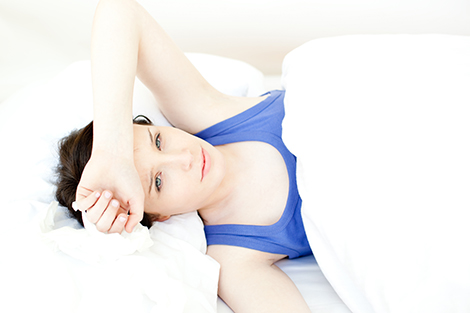
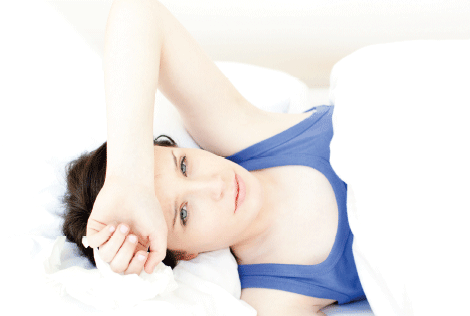
Ten per cent of people worldwide suffer from migraines
"This non-pharmacological approach (physical activity) may be an option for the prophylactic (preventative) treatment of migraine in patients who do not benefit from or do not want daily medication," wrote Dr Emma Varkey, lead author of a Swedish study published in the journal Cephalalgia in October.*
The aim of the research was to evaluate the effect of exercise in warding off migraine – a chronic neurological disorder characterised by moderate to severe headaches and nausea, which affects 10 per cent of people around the world.
Doctors use a variety of methods to prevent migraines, including topiramate – an anti-epilepsy drug – and relaxation exercises. While exercise is also prescribed, there has not previously been sufficient evidence to demonstrate that it works.
Three-month study Conducted by scientists at the University of Gothenburg, the randomised, controlled trial comprised 91 migraine patients aged 18-65 attending a headache clinic. All were women – the disorder is known to be more prominent in females – suffering from headaches two to eight times a month.
The women were split into three groups. One-third were prescribed a daily dose of topiramate – slowly increased to the individual’s highest tolerable level (with a maximum of 200mg a day). Another third carried out common forms of relaxation, breathing and stress-management techniques according to a recorded programme. The final group exercised on a static bike for 40 minutes, for three times a week, under the supervision of a physiotherapist.
Throughout the three-month study, the patients’ migraine status, quality of life, aerobic capacity and level of physical activity were evaluated before, during and after their respective treatment.
Surprising results The results show that migraine attacks decreased by approximately 75 per cent across all three groups and that there was no significant difference between them.
Commenting to Reuters Health, Dr Varkey said: “Topiramate is a drug of first choice that’s shown great effects in studies. It was a bit surprising and very interesting that the change in the number of migraine attacks was similar in all three groups. The only parameter where topiramate was better than exercise and relaxation was the reduction of pain intensity.
“On the other hand, the non-pharmacological options were free from adverse events and the exercise group increased oxygen uptake, which is very positive.”
While women in the exercise and relaxation groups had no issues, eight women taking topiramate had side-effects – tingling, fatigue, depression, vertigo and constipation – and consequently three left the study.
Varkey told Reuters Health: “From a wider health-based perspective, it should be stressed that patients with migraine are less physically active than the general population, and that exercise has positive effects in terms of general wellbeing and the prevention of disease.
“Additional and larger studies are, of course, needed to verify our results and to gain evidence for exercise as migraine treatment, but our results are hopeful.”
*Varkey, E et al. Exercise as migraine prophylaxis: A randomized study using relaxation and topiramate as controls. Cephalalgia. Vol 31, no 14, 1428–1438, Oct 2011.
Read more from this issue of Attractions Management magazine
View contents of Attractions Management 2012 issue 1
Top team: Peninsula Hotels
Kath Hudson talks to key figures behind the leading Asian hotel chain about how they run their spas and exciting future plans
Profile: Cynthia Chua
The Singapore entrepreneur behind Ministry of Waxing and Browhaus has revolutionised personal grooming worldwide. She talks to Katie Barnes about the business of beauty and integration with spas
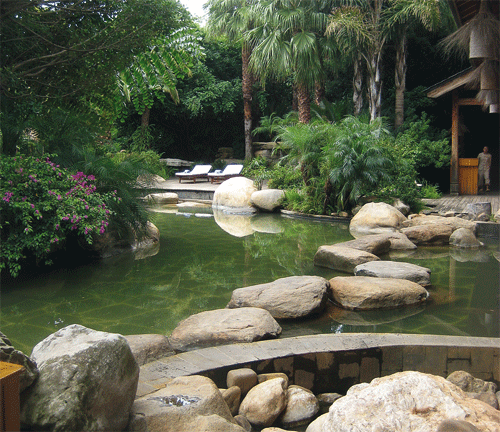
Hot springs: Chinese-style!
Lisa Starr tries out two hot spring spas - one catering to international visitors and the other to the domestic market - in China's Yunnan province
Bath time: The Chinese bathhouse
Lee David Stephens gives an insight into a traditional Chinese bathhouse and how Chinese people like to spa
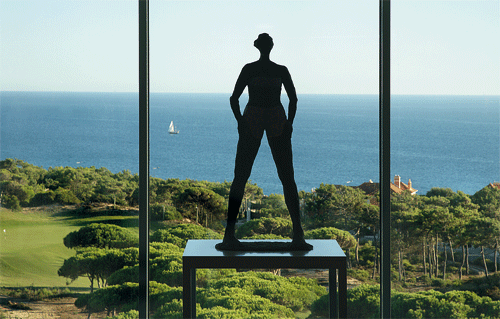
Resort Spa: Sands of time
The Oitavos hotel and spa on Portugal's Estoril coast is 90 years in the making. Tom Walker pays a visit
Interview: Gary Henkin
The president and founder of WTS International - the US-based spa management and consultancy firm - talks to Rhianon Howells about expanding globally
Ask an expert: Crisis control
The Arab Spring, the Japanese tsunami and bombings in Mumbai - what's the best way of dealing with a crisis? We ask those who have first-hand experience of the events
New Zealand thermal spa: Pooling resources
The Polynesian Spa in the geothermal town of Rotorua in New Zealand boasts 25 thermal pools and is one of the longest running attractions in the country. Chris McBeath takes a look
Tourism: Booming Baku
Terry Stevens reports on the Azerbaijan capital which has seen a surge of international hotel openings in the past two years
Fitness: Pilates pure vs applied
Pure vs applied - should pilates only ever involve the exercises designed by Joseph Pilates, or can his philosophy be applied while keeping the product moving with the times?
An opportunity to reimagine one of the UK’s most recognisable towers has been formally
opened by Rivington Hark, as St Johns Beacon invites operators and partners to shape its
next phase. [more...]
Ten per cent of people worldwide suffer from migraines
"This non-pharmacological approach (physical activity) may be an option for the prophylactic (preventative) treatment of migraine in patients who do not benefit from or do not want daily medication," wrote Dr Emma Varkey, lead author of a Swedish study published in the journal Cephalalgia in October.*
The aim of the research was to evaluate the effect of exercise in warding off migraine – a chronic neurological disorder characterised by moderate to severe headaches and nausea, which affects 10 per cent of people around the world.
Doctors use a variety of methods to prevent migraines, including topiramate – an anti-epilepsy drug – and relaxation exercises. While exercise is also prescribed, there has not previously been sufficient evidence to demonstrate that it works.
Three-month study Conducted by scientists at the University of Gothenburg, the randomised, controlled trial comprised 91 migraine patients aged 18-65 attending a headache clinic. All were women – the disorder is known to be more prominent in females – suffering from headaches two to eight times a month.
The women were split into three groups. One-third were prescribed a daily dose of topiramate – slowly increased to the individual’s highest tolerable level (with a maximum of 200mg a day). Another third carried out common forms of relaxation, breathing and stress-management techniques according to a recorded programme. The final group exercised on a static bike for 40 minutes, for three times a week, under the supervision of a physiotherapist.
Throughout the three-month study, the patients’ migraine status, quality of life, aerobic capacity and level of physical activity were evaluated before, during and after their respective treatment.
Surprising results The results show that migraine attacks decreased by approximately 75 per cent across all three groups and that there was no significant difference between them.
Commenting to Reuters Health, Dr Varkey said: “Topiramate is a drug of first choice that’s shown great effects in studies. It was a bit surprising and very interesting that the change in the number of migraine attacks was similar in all three groups. The only parameter where topiramate was better than exercise and relaxation was the reduction of pain intensity.
“On the other hand, the non-pharmacological options were free from adverse events and the exercise group increased oxygen uptake, which is very positive.”
While women in the exercise and relaxation groups had no issues, eight women taking topiramate had side-effects – tingling, fatigue, depression, vertigo and constipation – and consequently three left the study.
Varkey told Reuters Health: “From a wider health-based perspective, it should be stressed that patients with migraine are less physically active than the general population, and that exercise has positive effects in terms of general wellbeing and the prevention of disease.
“Additional and larger studies are, of course, needed to verify our results and to gain evidence for exercise as migraine treatment, but our results are hopeful.”
*Varkey, E et al. Exercise as migraine prophylaxis: A randomized study using relaxation and topiramate as controls. Cephalalgia. Vol 31, no 14, 1428–1438, Oct 2011.
Read more from this issue of Attractions Management magazine
View contents of Attractions Management 2012 issue 1
Top team: Peninsula Hotels
Kath Hudson talks to key figures behind the leading Asian hotel chain about how they run their spas and exciting future plans
Profile: Cynthia Chua
The Singapore entrepreneur behind Ministry of Waxing and Browhaus has revolutionised personal grooming worldwide. She talks to Katie Barnes about the business of beauty and integration with spas
Hot springs: Chinese-style!
Lisa Starr tries out two hot spring spas - one catering to international visitors and the other to the domestic market - in China's Yunnan province
Bath time: The Chinese bathhouse
Lee David Stephens gives an insight into a traditional Chinese bathhouse and how Chinese people like to spa
Resort Spa: Sands of time
The Oitavos hotel and spa on Portugal's Estoril coast is 90 years in the making. Tom Walker pays a visit
Interview: Gary Henkin
The president and founder of WTS International - the US-based spa management and consultancy firm - talks to Rhianon Howells about expanding globally
Ask an expert: Crisis control
The Arab Spring, the Japanese tsunami and bombings in Mumbai - what's the best way of dealing with a crisis? We ask those who have first-hand experience of the events
New Zealand thermal spa: Pooling resources
The Polynesian Spa in the geothermal town of Rotorua in New Zealand boasts 25 thermal pools and is one of the longest running attractions in the country. Chris McBeath takes a look
Tourism: Booming Baku
Terry Stevens reports on the Azerbaijan capital which has seen a surge of international hotel openings in the past two years
Fitness: Pilates pure vs applied
Pure vs applied - should pilates only ever involve the exercises designed by Joseph Pilates, or can his philosophy be applied while keeping the product moving with the times?
Experience design company, BRC Imagination Arts, has completed a transition that sees founder
Bob Rogers pass ownership of the business to four long-serving senior executives, while
remaining actively involved with the company.
Movie Park Germany has opened a new Paramount Pictures-themed attraction as part of its 30th
anniversary celebrations, using immersive storytelling and adaptive reuse to reinforce the park’s
longstanding “Hollywood in Germany” positioning.
Therme Manchester’s 28-acre development, which will include interconnected glass pavilions
that measure 65,000sq m, will be the largest bathing and wellbeing attraction in the world once
complete, according to prof David Russell, CEO of Therme UK.
Efteling has opened Hooghmoed, a new family drop tower designed to broaden the appeal of its
recently launched Sirene Island themed area and introduce younger visitors to thrill attractions.
A proposed Puy du Fou development near Bicester and Universal Destinations and Experiences’
planned resort in Bedford are emerging as part of a wider transformation of the Oxford–
Cambridge Growth Corridor into a major centre for UK leisure and tourism inv
Shedd Aquarium has opened the Immersion Theater developed in partnership with SimEx-
Iwerks, as part of a wider strategy to enhance the guest experience and create additional
revenue opportunities.
The UK government has announced a temporary reduction in VAT on visitor attractions and
children’s meals as part of a summer cost-of-living support package designed to stimulate the
visitor economy and encourage family days out.
As designer Yinka Ilori prepares for his first solo gallery show in London, he speaks exclusively
to CLADmag about his mission to spread joy, the power of play, and his bold approach to using
colour (including the colours you won’t see in his work).
The government of Thailand is exploring plans for a THB300bn (£6.3bn, US$8.3bn)
entertainment complex in the country’s Eastern Economic Corridor (EEC), with officials
proposing a large-scale theme park and sports destination as part of a broader tourism and
economic development strategy.
Royal Caribbean has revealed its Hero of the Seas cruise ship, home to the most pools at sea
(nine), and a record-breaking 28 dining venues, as well as attractions including a waterpark
with two new family raft slides.
+ More news
COMPANY PROFILES
IDEATTACK IDEATTACK is a full-service planning and
design company with headquarters in
Los Angeles. [more...]
Polin Waterparks Polin was founded in Istanbul in 1976. Polin
has since grown into a leading company in
the waterpa [more...]
An opportunity to reimagine one of the UK’s most recognisable towers has been formally
opened by Rivington Hark, as St Johns Beacon invites operators and partners to shape its
next phase. [more...]