A new Malaysian wellness resort, modelled on a French Chateau, is aiming to be the first of its kind in the world by offering a completely organic spa experience to guests
By Jennifer Harbottle | Published in Spa Business 2012 issue 3
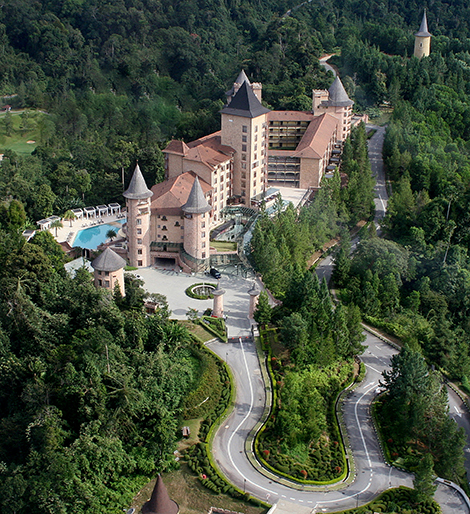
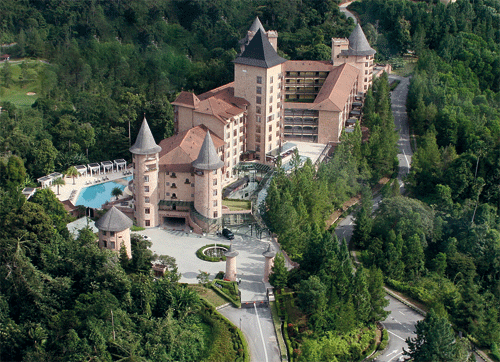
The castle is modelled on the 18th century Haut Koenigsbourg chateau in Alsace, France
At the top of a mountain in the cool, fresh air, a medieval-style wall stands protectively around an 18th century castle, set among lush green pine trees. Since late 2011, the castle has been home to the spa and organic wellness resort called The Chateau, where reception staff welcome guests in perfect French. The resort’s L’Assiette haute cuisine French fine dining restaurant beckons guests in one direction, La Santé organic wellness spa in another. The twist? The pine trees are actually rainforest, the staff members are Asian and the castle is only 10 years old. For this is not, in fact, France, but a tourism development called Berjaya Hills, 45 minutes outside of Kuala Lumpur (KL), Malaysia.
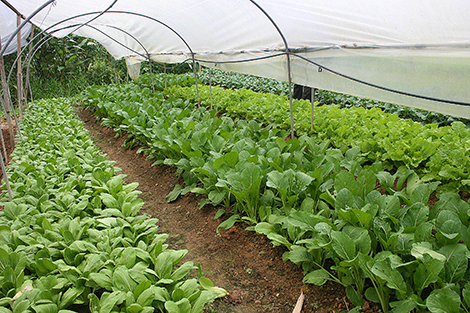
French replica The Chateau Spa and Organic Wellness Resort is owned by Berjaya Hills Berhad, part of the Berjaya Corporation Group of Companies – a public listed Malaysian conglomerate. As part of its leisure and tourism portfolio, Berjaya also owns Berjaya Hills – 16,000 acres (6,475 hectares) of jungle set on a hillside. Since it acquired the land in 1990, Berjaya has invested over myr1.2bn (us$381m, €310m, £243m) to turn it into an attraction popular with KL-based families. As well as The Chateau Spa and Organic Wellness Resort, Berjaya Hills has a French themed village, botanical gardens, Japanese village and teahouse, an organic farm, horse trails, an animal park and a golf course.
The French village was built in 1994 and is modelled on the village of Colmar in Alsace, France. In 2002, Berjaya built a castle on the outskirts, inspired by the 18th century Haut Koenigsbourg chateau in Alsace. Originally, the castle was to host luxury condominiums but due to the economic climate the castle lay empty until April 2010, when a decision was made by Berjaya to invest myr250m (us$79m, €65m, £51m) to turn it into a spa and wellness resort instead.
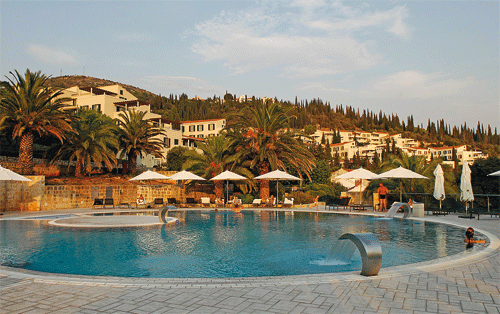
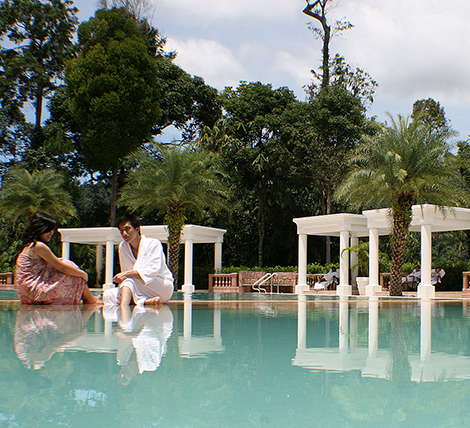
Following an extensive 18-month refurbishment, the transformed site reopened in October 2011 with a 128-bedroom resort, comprising three restaurants, two lounges, an outdoor saltwater pool, terrace and an organic gift shop. The 13,550sq ft (1,259sq m) European-inspired spa is called La Santé.
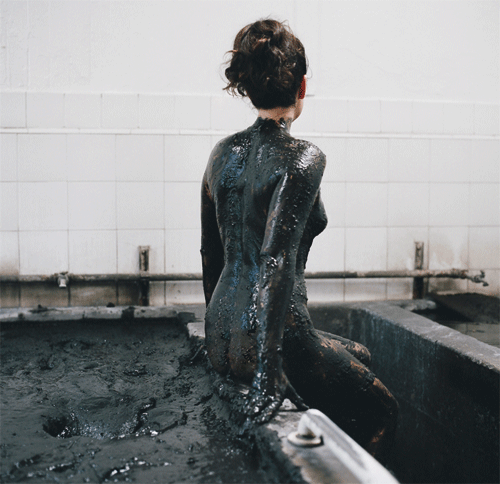
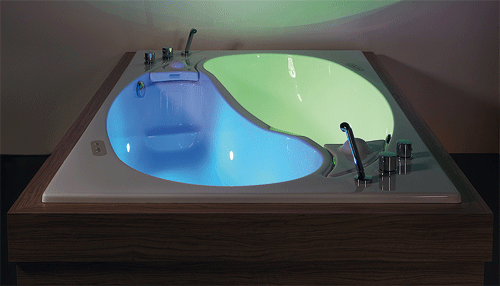
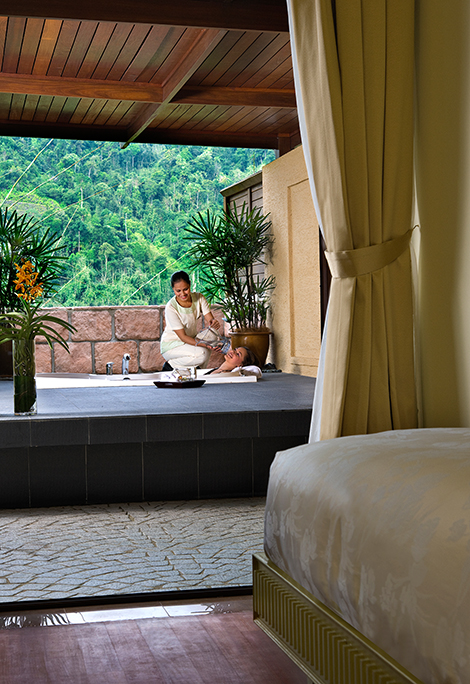
La Santé La Santé spa features 12 single treatment rooms, three doubles (including one for females-only) and two for wet treatments – one with a hydrobath and another featuring an Austrian-made Aquaveda heated bed for wet treatments and scrubs. Other treatment beds are supplied by Gharieni.
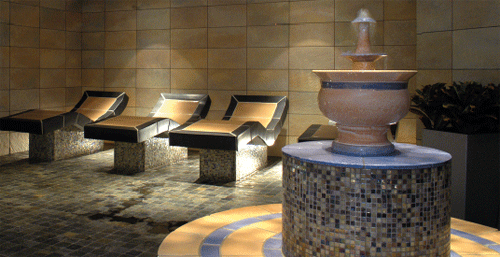
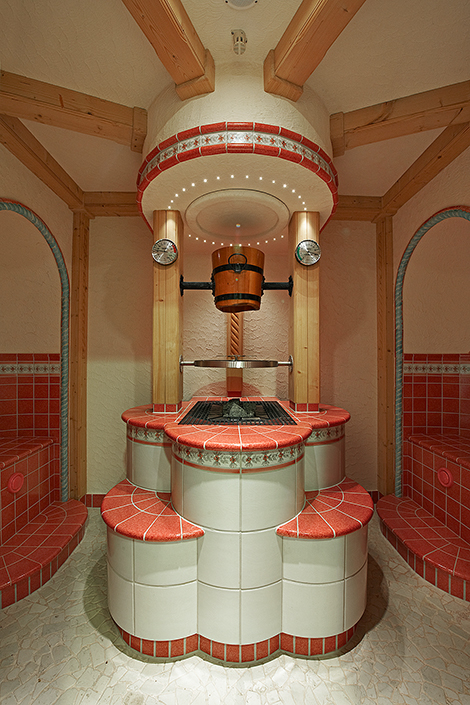
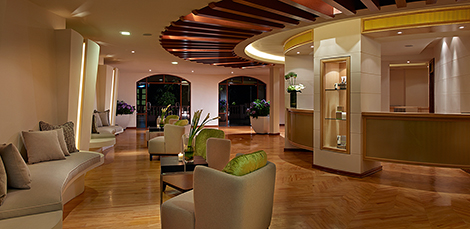
The heat experiences by Thermarium include a herbal-infused sauna and salt grotto/mud chamber. The spa also features an outdoor relaxation area, an enormous reception room plus a spa café, a hair salon with Logona products from Germany, a gym equipped by Cybex and a workout studio. Other facilities include three consultation rooms, a nail studio and a retail boutique.
Guests at the Chateau can choose between a deluxe or premier bedroom and a 60sq m (646sq ft) spa suite, which comes with an outdoor whirlpool. The Chateau also offers 13 spa programmes, which run for between two and seven nights and focus on beauty, stress relief, body cleansing, wellness, fitness and pre- and post- natal experiences. There’s also a couples and a men-only retreat.
Each programme includes physical and nutritional consultation followed by a tailor-made treatment/experience package depending on needs and goals. Some programmes include counsellors who work on an as-needed basis and specialise in advice on stress management, detox, relationship enhancement and weight management.
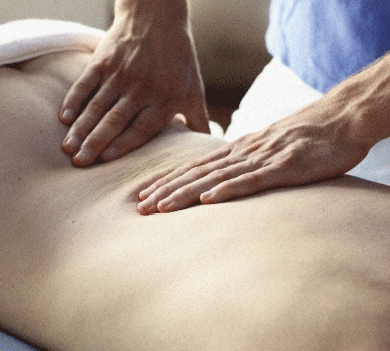
The comprehensive spa menu, with 50 treatments, includes facials ranging from myr300-480 (us$95-152, €78-124, £61-97); and massages from myr290-450 (us$92-143, €75-116, £59-91); as well as a selection of baths, scrubs, wraps and mud treatments. The 75-minute La Santé signature massage combines Swedish and shiatsu techniques and costs myr420 (us$133, €109, £85).
Despite the wellness tag line, La Santé also offers beauty-focused, machine-based services. These include Alma RF ™ face, eye and neck treatments, plus LPG Endermolift face, eye and neck treatments which are all non-invasive. The demand for these types of treatments are on the rise, says spa director Alice Yap, because people want a quick-fix solution to ageing without any downtime or uncomfortable side effects.
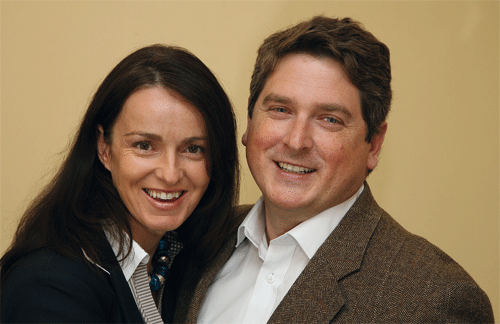
Organic at heart Teh Ming Wah, The Chateau’s general manager and CEO, has been a driving force behind the whole creation. A former spa consultant and ex-banker, she oversaw the refurbishment and also advised Berjaya to turn The Chateau into the world’s first organic spa and wellness resort to give it a unique selling point. Her ambitious plans to make the entire resort organic, mean the spa resort is the first of its kind in Malaysia and arguably, the first of its kind in the world. She is hoping to have gained organic certification from the European Organic Committee but so far, no such classification exists for spa resorts.
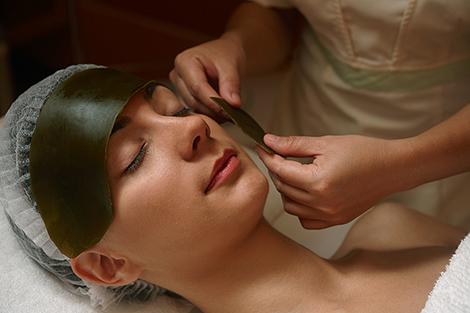
The resort’s philosophy is “we have a heart for our planet”. In the bedroom suites, sheets, US-made Coyuchi bathrobes, slippers, towels and laundry bags are made from organic cotton and the shoehorn and toothbrush are made from biodegradable cornstarch. The castle, which has been certified by the Green Buildings Index, was built using organic materials wherever possible and the salt water swimming pool uses water from the resort’s own wells. In addition, a principal spa product house is the organic, hand-harvested seaweed line Voya (see p78).
Yet despite all these ecological initiatives, Teh says they draw the line at “anything that affects the comfort and enjoyment of the guests if an environmentally friendly alternative can’t be found.”
Service with an Asian smile Service standards are impeccable throughout the resort. Teh is deliberately focused on this, because under her guidance, Berjaya wants The Chateau to help put Malaysian hospitality into the global spotlight. “We want to make a statement to the world that hospitality in Malaysia can compete on the international stage,” Teh explains. “At The Chateau, we’re offering European hardware with Asian softness and service.”
In La Santé, for example, the 20 therapists are from Asia. Interestingly, all therapists are female and none are from Malaysia, but according to Yap (who is Malaysian), this is a reflection of the lack of spa therapists in Malaysia rather than company policy.
Given this agenda, it is somewhat of a surprise, then, that The Chateau is designed to look and feel like a French destination resort. The restaurants offer mainly European cuisine, all spa treatments are from Europe and the 250 employees are treated to regular French lessons in order that they speak and act in as ‘French’ a way as possible. Still, the overall feeling is that nothing is too much trouble for staff and that luxury knows no bounds.
In late 2011, The Chateau won four awards from luxury travel body Seven Stars and Stripes. This, along with a host of other awards, has already helped it attract attention in the Malaysian press and early reviews from independent travellers on TripAdvisor have been very positive.
In terms of helping to put Malaysia on the global wellness map, Teh says the government tourism department really needs to come on board to help promote the spa industry. Until that point, she says, it will be up to operators and spa professionals to change the opinions of Malaysian spas. “Everywhere I go, I get the same feedback – that Malaysia is not known for its spa industry,” she says. “People from overseas tend to go to Thailand or Bali for their spa experience and locally, Malaysians are yet to grasp the spa concept.”
A satisfying business In terms of marketing, The Chateau is going after a high-end clientele and so far, the majority of guests come from affluent source markets such as the UK, Australia, Singapore and Japan. The resort is also proving popular with Russians. Locally, Malaysians are visiting the resort but they’re staying for shorter periods of time.
The majority of resort guests opt for a seven-night spa programme – priced at myr13,930-16,680 (us$4,400-5,300, €3,600-4,300, £2,800-3,400) – with the weight loss and stress relief options proving most popular so far. Day spa visits are also available and currently make up around 20 per cent of the spa’s overall business. Teh says that while the spa programmes are working well in general, she knows she must limit the number of classes and activities that she expects each guest to try. “Wellness for some guests is about relaxing and I’m learning not to try to get them involved in absolutely everything all the time,” she says.
In the short-term, Teh’s main concern is making sure every guest leaves the Chateau happy: “At the end of each guest’s visit, my first question is not how much they’ve spent but what their feedback form says.”
Yet she also acknowledges the importance of key performance targets and is giving herself six months to reach an occupancy level of between 80-100 spa guests per day. Total spa capacity is 120.
Financially, Teh believes it will be a challenge for the resort to generate as much revenue as resorts in neighbouring countries. The Chateau’s room rates are myr765-1,275 (us$243-404, €198-329, £155-258) per night, while an equivalent property in Thailand could command as much as myr2,000-3,000 (us$634-951, €517-775, £405-607). Luckily, Teh says her bosses are understanding and they realise she’s creating something new for both the company and the Malaysian wellness industry. They also acknowledge that success for The Chateau will mean recognition for Berjaya on the international wellness stage.
Longer term, Teh says if The Chateau is a success, she can see a future for other high-end spa brands in Malaysia. Although Berjaya has been approached to replicate The Chateau in other countries, Teh says they need to walk before they can run.
“The Chateau is Malaysia’s opportunity to set a new benchmark for the spa industry in the country. For now, that’s our primary focus,” she concludes.
Read more from this issue of Attractions Management magazine
View contents of Attractions Management 2012 issue 3
Ask an expert: Corporate wellness
Wellness programmes for corporate employees is a lucrative and growing market. What can spas do to tap into this possible new revenue generator?
Training: Anne Bramham
ASTECC is the sole spa training organisation working with Montage. Founder Anne Bramham explains what makes them stand out
Resort spa: Castles & dreams
Jennifer Harbottle looks round The Chateau – an organic wellness resort modelled on a French castle but located in the Malaysian rainforest
Mother & Baby spas: Latching on
Independent, wealthy women are redefining motherhood. Mari Stevens investigates this new emerging group
City focus – Chicago: Chicagoland
Lisa Starr takes a look at a cross-section of spas in Chicago and how they differentiate themselves in the thriving urban spa location
Summit review: Outside the box
The sixth Global Spa & Wellness Summit in Aspen hosted a number of expert speakers. Katie Barnes reports
Spa tourism – Madeira: Madeiran Marvel
The Portuguese island of Madeira holds much promise as a wellness destination. Anni Hood finds out about its spa tourism strategy
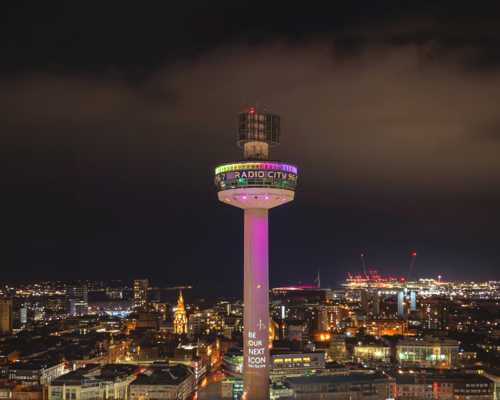
An opportunity to reimagine one of the UK’s most recognisable towers has been formally
opened by Rivington Hark, as St Johns Beacon invites operators and partners to shape its
next phase. [more...]
A new Malaysian wellness resort, modelled on a French Chateau, is aiming to be the first of its kind in the world by offering a completely organic spa experience to guests
By Jennifer Harbottle | Published in Spa Business 2012 issue 3
The castle is modelled on the 18th century Haut Koenigsbourg chateau in Alsace, France
At the top of a mountain in the cool, fresh air, a medieval-style wall stands protectively around an 18th century castle, set among lush green pine trees. Since late 2011, the castle has been home to the spa and organic wellness resort called The Chateau, where reception staff welcome guests in perfect French. The resort’s L’Assiette haute cuisine French fine dining restaurant beckons guests in one direction, La Santé organic wellness spa in another. The twist? The pine trees are actually rainforest, the staff members are Asian and the castle is only 10 years old. For this is not, in fact, France, but a tourism development called Berjaya Hills, 45 minutes outside of Kuala Lumpur (KL), Malaysia.
French replica The Chateau Spa and Organic Wellness Resort is owned by Berjaya Hills Berhad, part of the Berjaya Corporation Group of Companies – a public listed Malaysian conglomerate. As part of its leisure and tourism portfolio, Berjaya also owns Berjaya Hills – 16,000 acres (6,475 hectares) of jungle set on a hillside. Since it acquired the land in 1990, Berjaya has invested over myr1.2bn (us$381m, €310m, £243m) to turn it into an attraction popular with KL-based families. As well as The Chateau Spa and Organic Wellness Resort, Berjaya Hills has a French themed village, botanical gardens, Japanese village and teahouse, an organic farm, horse trails, an animal park and a golf course.
The French village was built in 1994 and is modelled on the village of Colmar in Alsace, France. In 2002, Berjaya built a castle on the outskirts, inspired by the 18th century Haut Koenigsbourg chateau in Alsace. Originally, the castle was to host luxury condominiums but due to the economic climate the castle lay empty until April 2010, when a decision was made by Berjaya to invest myr250m (us$79m, €65m, £51m) to turn it into a spa and wellness resort instead.
Following an extensive 18-month refurbishment, the transformed site reopened in October 2011 with a 128-bedroom resort, comprising three restaurants, two lounges, an outdoor saltwater pool, terrace and an organic gift shop. The 13,550sq ft (1,259sq m) European-inspired spa is called La Santé.
La Santé La Santé spa features 12 single treatment rooms, three doubles (including one for females-only) and two for wet treatments – one with a hydrobath and another featuring an Austrian-made Aquaveda heated bed for wet treatments and scrubs. Other treatment beds are supplied by Gharieni.
The heat experiences by Thermarium include a herbal-infused sauna and salt grotto/mud chamber. The spa also features an outdoor relaxation area, an enormous reception room plus a spa café, a hair salon with Logona products from Germany, a gym equipped by Cybex and a workout studio. Other facilities include three consultation rooms, a nail studio and a retail boutique.
Guests at the Chateau can choose between a deluxe or premier bedroom and a 60sq m (646sq ft) spa suite, which comes with an outdoor whirlpool. The Chateau also offers 13 spa programmes, which run for between two and seven nights and focus on beauty, stress relief, body cleansing, wellness, fitness and pre- and post- natal experiences. There’s also a couples and a men-only retreat.
Each programme includes physical and nutritional consultation followed by a tailor-made treatment/experience package depending on needs and goals. Some programmes include counsellors who work on an as-needed basis and specialise in advice on stress management, detox, relationship enhancement and weight management.
The comprehensive spa menu, with 50 treatments, includes facials ranging from myr300-480 (us$95-152, €78-124, £61-97); and massages from myr290-450 (us$92-143, €75-116, £59-91); as well as a selection of baths, scrubs, wraps and mud treatments. The 75-minute La Santé signature massage combines Swedish and shiatsu techniques and costs myr420 (us$133, €109, £85).
Despite the wellness tag line, La Santé also offers beauty-focused, machine-based services. These include Alma RF ™ face, eye and neck treatments, plus LPG Endermolift face, eye and neck treatments which are all non-invasive. The demand for these types of treatments are on the rise, says spa director Alice Yap, because people want a quick-fix solution to ageing without any downtime or uncomfortable side effects.
Organic at heart Teh Ming Wah, The Chateau’s general manager and CEO, has been a driving force behind the whole creation. A former spa consultant and ex-banker, she oversaw the refurbishment and also advised Berjaya to turn The Chateau into the world’s first organic spa and wellness resort to give it a unique selling point. Her ambitious plans to make the entire resort organic, mean the spa resort is the first of its kind in Malaysia and arguably, the first of its kind in the world. She is hoping to have gained organic certification from the European Organic Committee but so far, no such classification exists for spa resorts.
The resort’s philosophy is “we have a heart for our planet”. In the bedroom suites, sheets, US-made Coyuchi bathrobes, slippers, towels and laundry bags are made from organic cotton and the shoehorn and toothbrush are made from biodegradable cornstarch. The castle, which has been certified by the Green Buildings Index, was built using organic materials wherever possible and the salt water swimming pool uses water from the resort’s own wells. In addition, a principal spa product house is the organic, hand-harvested seaweed line Voya (see p78).
Yet despite all these ecological initiatives, Teh says they draw the line at “anything that affects the comfort and enjoyment of the guests if an environmentally friendly alternative can’t be found.”
Service with an Asian smile Service standards are impeccable throughout the resort. Teh is deliberately focused on this, because under her guidance, Berjaya wants The Chateau to help put Malaysian hospitality into the global spotlight. “We want to make a statement to the world that hospitality in Malaysia can compete on the international stage,” Teh explains. “At The Chateau, we’re offering European hardware with Asian softness and service.”
In La Santé, for example, the 20 therapists are from Asia. Interestingly, all therapists are female and none are from Malaysia, but according to Yap (who is Malaysian), this is a reflection of the lack of spa therapists in Malaysia rather than company policy.
Given this agenda, it is somewhat of a surprise, then, that The Chateau is designed to look and feel like a French destination resort. The restaurants offer mainly European cuisine, all spa treatments are from Europe and the 250 employees are treated to regular French lessons in order that they speak and act in as ‘French’ a way as possible. Still, the overall feeling is that nothing is too much trouble for staff and that luxury knows no bounds.
In late 2011, The Chateau won four awards from luxury travel body Seven Stars and Stripes. This, along with a host of other awards, has already helped it attract attention in the Malaysian press and early reviews from independent travellers on TripAdvisor have been very positive.
In terms of helping to put Malaysia on the global wellness map, Teh says the government tourism department really needs to come on board to help promote the spa industry. Until that point, she says, it will be up to operators and spa professionals to change the opinions of Malaysian spas. “Everywhere I go, I get the same feedback – that Malaysia is not known for its spa industry,” she says. “People from overseas tend to go to Thailand or Bali for their spa experience and locally, Malaysians are yet to grasp the spa concept.”
A satisfying business In terms of marketing, The Chateau is going after a high-end clientele and so far, the majority of guests come from affluent source markets such as the UK, Australia, Singapore and Japan. The resort is also proving popular with Russians. Locally, Malaysians are visiting the resort but they’re staying for shorter periods of time.
The majority of resort guests opt for a seven-night spa programme – priced at myr13,930-16,680 (us$4,400-5,300, €3,600-4,300, £2,800-3,400) – with the weight loss and stress relief options proving most popular so far. Day spa visits are also available and currently make up around 20 per cent of the spa’s overall business. Teh says that while the spa programmes are working well in general, she knows she must limit the number of classes and activities that she expects each guest to try. “Wellness for some guests is about relaxing and I’m learning not to try to get them involved in absolutely everything all the time,” she says.
In the short-term, Teh’s main concern is making sure every guest leaves the Chateau happy: “At the end of each guest’s visit, my first question is not how much they’ve spent but what their feedback form says.”
Yet she also acknowledges the importance of key performance targets and is giving herself six months to reach an occupancy level of between 80-100 spa guests per day. Total spa capacity is 120.
Financially, Teh believes it will be a challenge for the resort to generate as much revenue as resorts in neighbouring countries. The Chateau’s room rates are myr765-1,275 (us$243-404, €198-329, £155-258) per night, while an equivalent property in Thailand could command as much as myr2,000-3,000 (us$634-951, €517-775, £405-607). Luckily, Teh says her bosses are understanding and they realise she’s creating something new for both the company and the Malaysian wellness industry. They also acknowledge that success for The Chateau will mean recognition for Berjaya on the international wellness stage.
Longer term, Teh says if The Chateau is a success, she can see a future for other high-end spa brands in Malaysia. Although Berjaya has been approached to replicate The Chateau in other countries, Teh says they need to walk before they can run.
“The Chateau is Malaysia’s opportunity to set a new benchmark for the spa industry in the country. For now, that’s our primary focus,” she concludes.
Read more from this issue of Attractions Management magazine
View contents of Attractions Management 2012 issue 3
Ask an expert: Corporate wellness
Wellness programmes for corporate employees is a lucrative and growing market. What can spas do to tap into this possible new revenue generator?
Training: Anne Bramham
ASTECC is the sole spa training organisation working with Montage. Founder Anne Bramham explains what makes them stand out
Resort spa: Castles & dreams
Jennifer Harbottle looks round The Chateau – an organic wellness resort modelled on a French castle but located in the Malaysian rainforest
Mother & Baby spas: Latching on
Independent, wealthy women are redefining motherhood. Mari Stevens investigates this new emerging group
City focus – Chicago: Chicagoland
Lisa Starr takes a look at a cross-section of spas in Chicago and how they differentiate themselves in the thriving urban spa location
Summit review: Outside the box
The sixth Global Spa & Wellness Summit in Aspen hosted a number of expert speakers. Katie Barnes reports
Spa tourism – Madeira: Madeiran Marvel
The Portuguese island of Madeira holds much promise as a wellness destination. Anni Hood finds out about its spa tourism strategy
Hotel de France, located on the British Isle of Jersey, has created a wellness retreat package
that includes a hot yoga session that will take place in Jersey Zoo’s butterfly sanctuary.
A new immersive attraction designed to transport visitors into the final hours of ancient Pompeii
is preparing to open near the world-famous archaeological site in southern Italy.
Experience design company, BRC Imagination Arts, has completed a transition that sees founder
Bob Rogers pass ownership of the business to four long-serving senior executives, while
remaining actively involved with the company.
Movie Park Germany has opened a new Paramount Pictures-themed attraction as part of its 30th
anniversary celebrations, using immersive storytelling and adaptive reuse to reinforce the park’s
longstanding “Hollywood in Germany” positioning.
Therme Manchester’s 28-acre development, which will include interconnected glass pavilions
that measure 65,000sq m, will be the largest bathing and wellbeing attraction in the world once
complete, according to prof David Russell, CEO of Therme UK.
Efteling has opened Hooghmoed, a new family drop tower designed to broaden the appeal of its
recently launched Sirene Island themed area and introduce younger visitors to thrill attractions.
A proposed Puy du Fou development near Bicester and Universal Destinations and Experiences’
planned resort in Bedford are emerging as part of a wider transformation of the Oxford–
Cambridge Growth Corridor into a major centre for UK leisure and tourism inv
Shedd Aquarium has opened the Immersion Theater developed in partnership with SimEx-
Iwerks, as part of a wider strategy to enhance the guest experience and create additional
revenue opportunities.
The UK government has announced a temporary reduction in VAT on visitor attractions and
children’s meals as part of a summer cost-of-living support package designed to stimulate the
visitor economy and encourage family days out.
As designer Yinka Ilori prepares for his first solo gallery show in London, he speaks exclusively
to CLADmag about his mission to spread joy, the power of play, and his bold approach to using
colour (including the colours you won’t see in his work).
The government of Thailand is exploring plans for a THB300bn (£6.3bn, US$8.3bn)
entertainment complex in the country’s Eastern Economic Corridor (EEC), with officials
proposing a large-scale theme park and sports destination as part of a broader tourism and
economic development strategy.
+ More news
COMPANY PROFILES
Holovis Holovis is a privately owned company
established in 2004 by CEO Stuart
Hetherington. [more...]
Simworx Ltd The company was initially established
in 1997. Terry Monkton and Andrew
Roberts are the key stakeh [more...]
QubicaAMF UK QubicaAMF is the largest and most
innovative bowling equipment provider with
600 employees worldwi [more...]
instantprint We’re a Yorkshire-based online printer, founded
in 2009 by Adam Carnell and James Kinsella. [more...]
An opportunity to reimagine one of the UK’s most recognisable towers has been formally
opened by Rivington Hark, as St Johns Beacon invites operators and partners to shape its
next phase. [more...]