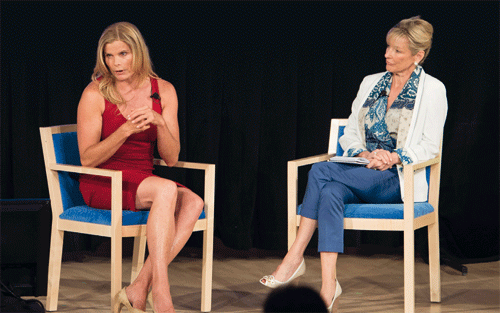
The original Global Spa & Wellness Summit panel give their advice on setting up employee wellness schemes
Corporate wellness generally refers to programmes and/or services that are carried out in the workplace or externally and which address the health and energy levels of employees. They can include a variety of elements from medical screenings, health education and lifestyle coaching to subsidised gym memberships or resort visits and nutritional/weight loss advice.
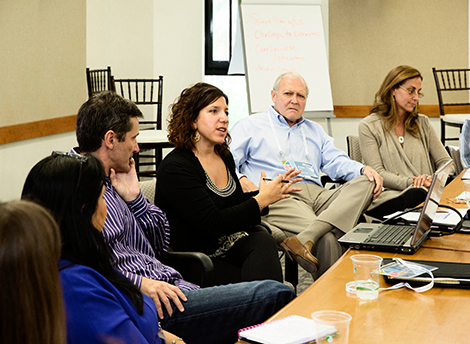
Spas should, could and can get involved in offering corporate wellness, heard delegates at a breakout session at this year’s Global Spa & Wellness Summit (see p54).
The need is already there, says spa, wellness and hospitality consultant Mia Kyricos who chaired the session. Countries the world over are experiencing rising healthcare costs – even in the developing world. Heart disease, stroke and diabetes will cost China us$558bn (€456bn, £359bn) within 10 years according to the World Health Organization, while in 20 years the number of obese people in Mexico has risen by 58 per cent.
The benefits of corporate wellness programmes are clear. Having a healthy workforce not only eases the medical care costs – for healthcare systems and company insurance schemes – it leads to less absenteeism and more productivity and loyalty. Fitness programmes, for example, can reduce sick days by 13 per cent and lessen staff turnover by 250 per cent according to the American Fitness Professionals and Associates organisation.
Unsurprisingly, the employee wellness market is tipped to grow by 50 per cent – from us$1.45bn-2.9bn (€1.2bn-2.4bn, £0.9bn-1.9bn) – in the US alone by 2016 according to industry research specialist IBIS World.
Kyricos says: “Three issues come up repeatedly in the spa industry. Firstly, the opportunity to prevent sickness; secondly, the need to introduce wellness and spa to the masses rather than the top 1 per cent; thirdly, the need to identify ways to evolve our businesses and profits. I honestly believe, having been an operator and a corporate wellness provider, that employee wellness feeds into all three – and that’s why it’s exciting.”
So, how can spas play a part in the future of corporate wellness and what makes a successful programme? We ask some panel members from the original summit breakout session.
Read more from this issue of Attractions Management magazine
View contents of Attractions Management 2012 issue 3
Ask an expert: Corporate wellness
Wellness programmes for corporate employees is a lucrative and growing market. What can spas do to tap into this possible new revenue generator?
Training: Anne Bramham
ASTECC is the sole spa training organisation working with Montage. Founder Anne Bramham explains what makes them stand out
Resort spa: Castles & dreams
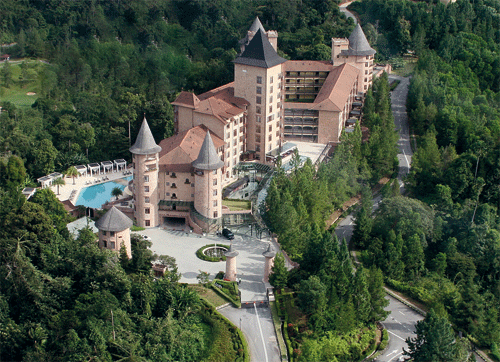
Jennifer Harbottle looks round The Chateau – an organic wellness resort modelled on a French castle but located in the Malaysian rainforest
Mother & Baby spas: Latching on
Independent, wealthy women are redefining motherhood. Mari Stevens investigates this new emerging group
City focus – Chicago: Chicagoland
Lisa Starr takes a look at a cross-section of spas in Chicago and how they differentiate themselves in the thriving urban spa location
Summit review: Outside the box
The sixth Global Spa & Wellness Summit in Aspen hosted a number of expert speakers. Katie Barnes reports
Spa tourism – Madeira: Madeiran Marvel
The Portuguese island of Madeira holds much promise as a wellness destination. Anni Hood finds out about its spa tourism strategy
As corporate wellness can be quite sterile, spas have the opportunity to provide it in a warmer, more relaxed environment. They already offer modalities recommended in care plans, although spas still need to educate employers about how services could fit into an employee programme – such as highlighting the evidence of how massage and touch therapies can effectively lower blood pressure. Business wise, this drives traffic back to the spa, and also delivers a caring service to employees.
The sweet spot for small- to mid-size spas will be the corporations in the 50-300 plus employee range. This way, spas can get to know the employees and really engage them in their care plans. Although larger spas may want to approach bigger companies.
Engaging employees and having a hands-on approach to implementing wellness programmes is key to success. We’ve been delivering evidence-based wellness programmes for five years and our clients include banks, manufacturers and consultancy firms ranging from 10-500 plus employees. Early on, we found the initial consultation with the employer is very important because it sets the stage for their expectations. We also get very involved in the programme design, liaising with insurance firms if necessary, mapping it out and suggesting incentives to ensure participation.
In addition, we conduct onsite employee enrolment meetings so staff understand what participation we expect from them and what they need to do to collect incentives. This in itself also encourages employees to sign up – we aim for a 75 per cent involvement.
We now want to take our turnkey model to the spa market to help operators link up with corporations looking to introduce wellness programmes. Our programme covers everything from BMI, body fat, waist circumference and blood screenings and measuring stress to offering education and one-to-one coaching.
A crucial feature to any programme is tracking biometric results and participation levels. We developed an electronic medical record platform, certified by the US government health service, to do this as it’s the only way to prove corporate wellness programmes work... and we’ve had very good results.
One of our clients, Gateway Travel Plaza, had a medical loss ratio of 110 per cent in 2008-09, which meant that its insurance company Health America was spending us$1.10 just on claims for every us$1 premium. This was reduced to a remarkable 80 per cent in 2010-11 after implementing its wellness programme.
We conduct onsite employee enrolment meetings so staff understand what participation we expect from them and why they need to do to collect incentives
ECOSPA 360 was formed in early 2012 in a buyout by healthcare firm Apex Energetics. It began life as a water technology firm, Quantum Health &Wellness, that ventured into corporate wellness in 2007. Details: www.ecospa360.com
Dr Daniel FriedlandCEOSuperSmartHealth
Dr Daniel Friedland
Corporate wellness in the US is intrinsically linked to the medical system and health insurance. We don’t have free national healthcare, so insurance for medical services is vital.
Recently, there’s a growing trend for consumer driven health plans. In these plans, premiums are relatively low and the consumer and/or company will contribute towards a healthcare fund. But if the person gets sick, they have to pay a deducible – say the first us$1,000 – out of the fund and may have to cost share on medical expenses. As the individual is on the hook for a larger proportion of upfront expenses, they’re more likely to invest in their health and engage in wellness prevention and programmes.
So how can spas get involved? Well, there’s a natural overlap between existing corporate wellness programmes – tackling stress, healthy eating, exercise and habit modification – and spa services. There’s a great possibility for spas to link up with corporations/insurance companies and those which focus on wellness, rather than just pampering will be most successful at creating alliances. Spas that are able to demonstrate models of economic sustainability and deliver a return on investment (of the programme) will also have a clear advantage.
The holy grail of corporate wellness is how to facilitate employee engagement. And the key is stress management or what I call stress navigation. The 2009 Stress in America Survey showed that only 43 per cent of people with self-reported high stress levels engage in weight-loss endeavours compared to 77 per cent with low levels of stress. That tells us there’s no point offering a programme unless you deal with stress to begin with. Yet you need to know how to navigate stress intelligently as some amount of healthy stress can help drive performance too.
I’m currently piloting a programme – 4 in 4 Framework to Achieve Peak Performance – with large firms including Bridgepoint, IMC2 and Group Health as well as the Australian destination spa Gwinganna (see sb09/3 p50).
The eight-week programme, based on neuroscience and rewiring the brain, begins with an onsite launch by myself or a two-day immersion workshop, plus 60-90 minute videos and webinars each week which are integrated with a 140-page workbook. Specifically, it covers four steps: how to recognise and deal with your reaction to stress; how to neutralise the underlying triggers of stress and self-doubt; how to optimise your health, relationships and productivity; and how to stay on this track.
I’ll be tracking the results via an extensive pre- and post-programme self-report questionnaire and my long-term aim is to tie it up with databases to work out the impact on absenteeism and medical costs.
Dr Friedland wrote one of the first books on evidence-based medicine and co-founded spaevidence.com. He delivers health coaching and wellness programmes and is the medical director of insurance brokers Barney & Barney. Details: www.supersmarthealth.com
Peter SmithCOOCanyon Ranch
Spas thinking of getting into corporate wellness should start by looking at their own workforce. When Mel and Enid Zuckerman set up Canyon Ranch in 1979, they believed success would be down to employees connecting with guests. So, they encouraged staff to use the gym, attend the lectures on health and lifestyle and, when invited, have meals with guests. It was really the beginning of a corporate wellness programme – it just wasn’t called that.
In 2008, we formalised our Life Enhancement Program. We encouraged staff to participate in onsite wellness and fitness classes with gift, book and movie certificates. Around 30-40 per cent got involved, but it seemed like it was only those already engaging in healthy lifestyle.
So, in 2009, we required all employees in our health insurance plan – where Canyon Ranch pays towards medical insurance and covers medical costs – to complete a health risk assessment. This amounted to roughly 1,200 eligible employees out of a 2,200-strong workforce. In return, we provided a monetary ‘well credit’ as a healthy discount towards their monthly health insurance.
Then in 2010, we required them to also complete onsite biometric tests which included measuring blood pressure, glucose levels, cholesterol/triglyceride levels, body composition percentage and BMI as well as screening for breast, cervical, colon and prostate cancer. Alternatively, they could opt for an annual physical at their doctors. In return, we doubled the value of their well credit and 98 per cent of eligible employees took part. Last year, we opened it out to family members aged 18 and above and 92 per cent participated (while the number of doctors visits rose by 7.3 per cent).
The annual screenings are supplemented by 14-18 monthly fitness sessions, classes on health and lifestyle topics and weight management and eating programmes. Uniquely, they can also spend a week at our Tucson resort at far less than cost. During their stay they learn take-home healthy lifestyle strategies.
While this obviously comes at [an undisclosed] expense, the results from 2010 to 2011 speak for themselves. Our high risk population dropped by 6.8 per cent in the blood pressure category and by 6.4 per cent per cent in cholesterol ratios. And since 2008, our healthcare costs have only risen by 4.9 per cent compared to the industry average of 8.9 per cent and the US average of 11.5 per cent. The average amount we spend on healthcare for participants is also 14 per cent less a month than the national average which saves us thousands a year.
The average amount we spend on healthcare for [programme] participants is 14 per cent a month less than the national average, saving us thousands a year
Canyon Ranch, a respected destination resort spa operator, has three properties in the US in Tucson, Lenox and Miami. Details: www.canyonranch.com.
Spas have a unique opportunity in employee wellness to position themselves as pivotal to addressing ongoing health maintenance. They already have much of what’s needed – not least the ability to manage stress – so it’s just a case of appropriately positioning themselves and engaging stakeholder attention.
The biggest obstacle, however, is to motivate employees to participate in wellness programmes – it’s not enough just to have the offering and that’s where incentives come in. A study released by the National Business Group on Health in June found that 57 per cent of employees agreed that incentive-based health and wellness programmes had a better than expected success rate at increasing employee participation and that 73 per cent of employers use financial incentives to do this. It also found that incentive spending per employee is up again – us$460 (€375, £293) in 2011, compared to us$430 (€351, £274) in 2010 and us$260 (€212, £166) back in 2009.
But what makes a good incentive? Classic attributes are that incentives are aspirational; that they’re achievable, so employees have a reasonable opportunity to earn them; and that they leave a lasting impression and create some kind of feeling of goodwill.
It’s important that each incentive is tailored to meet an individual’s needs and to stretch them to move the needle – whether in wellness, sales or any other behaviour. A blanket approach could have the opposite effect, with some employees reaching targets and being rewarded and others missing out and feeling discouraged.
As a caution, however, I would not advise operators to survey their participants/employees and ask them what incentives they’d like. Because what they want, might not be what’s best for them –like giving candy to a baby. Similarly, beware of rewards that could backfire such as gift cards for a supermarket which could just as easily be redeemed on cigarettes and alcohol as on healthy food. In this respect, I think spas could position themselves in a very positive way: as a reward and incentive for employee wellness programmes. This is certainly what we’re focusing on with our new Worklife Wellness gift card offering.
Indeed, gift cards are a popular incentive and they’re rapidly becoming a key driver of wellness programme success stories. In a Compdata Survey, of those companies offering incentives, 38.7 per cent use gift cards. But there are other types to consider too – in the survey, 25.4 per cent of employers also provide medical insurance discounts; 29.6 per cent offer contributions to health savings accounts and another 28.8 per cent offer free health and fitness memberships.
Weinkle has 25 year’s experience in the incentives industry. She recently joined SpaFinder to help develop its Worklife Wellness offering. Details www.spafinder.com
COMPANY PROFILES
Polin Waterparks
Polin was founded in Istanbul in 1976. Polin
has since grown into a leading company in
the waterpa [more...]
instantprint
We’re a Yorkshire-based online printer, founded
in 2009 by Adam Carnell and James Kinsella. [more...]
An opportunity to reimagine one of the UK’s most recognisable towers has been formally
opened by Rivington Hark, as St Johns Beacon invites operators and partners to shape its
next phase. [more...]
The original Global Spa & Wellness Summit panel give their advice on setting up employee wellness schemes
Corporate wellness generally refers to programmes and/or services that are carried out in the workplace or externally and which address the health and energy levels of employees. They can include a variety of elements from medical screenings, health education and lifestyle coaching to subsidised gym memberships or resort visits and nutritional/weight loss advice.
Spas should, could and can get involved in offering corporate wellness, heard delegates at a breakout session at this year’s Global Spa & Wellness Summit (see p54).
The need is already there, says spa, wellness and hospitality consultant Mia Kyricos who chaired the session. Countries the world over are experiencing rising healthcare costs – even in the developing world. Heart disease, stroke and diabetes will cost China us$558bn (€456bn, £359bn) within 10 years according to the World Health Organization, while in 20 years the number of obese people in Mexico has risen by 58 per cent.
The benefits of corporate wellness programmes are clear. Having a healthy workforce not only eases the medical care costs – for healthcare systems and company insurance schemes – it leads to less absenteeism and more productivity and loyalty. Fitness programmes, for example, can reduce sick days by 13 per cent and lessen staff turnover by 250 per cent according to the American Fitness Professionals and Associates organisation.
Unsurprisingly, the employee wellness market is tipped to grow by 50 per cent – from us$1.45bn-2.9bn (€1.2bn-2.4bn, £0.9bn-1.9bn) – in the US alone by 2016 according to industry research specialist IBIS World.
Kyricos says: “Three issues come up repeatedly in the spa industry. Firstly, the opportunity to prevent sickness; secondly, the need to introduce wellness and spa to the masses rather than the top 1 per cent; thirdly, the need to identify ways to evolve our businesses and profits. I honestly believe, having been an operator and a corporate wellness provider, that employee wellness feeds into all three – and that’s why it’s exciting.”
So, how can spas play a part in the future of corporate wellness and what makes a successful programme? We ask some panel members from the original summit breakout session.
Read more from this issue of Attractions Management magazine
View contents of Attractions Management 2012 issue 3
Ask an expert: Corporate wellness
Wellness programmes for corporate employees is a lucrative and growing market. What can spas do to tap into this possible new revenue generator?
Training: Anne Bramham
ASTECC is the sole spa training organisation working with Montage. Founder Anne Bramham explains what makes them stand out
Resort spa: Castles & dreams
Jennifer Harbottle looks round The Chateau – an organic wellness resort modelled on a French castle but located in the Malaysian rainforest
Mother & Baby spas: Latching on
Independent, wealthy women are redefining motherhood. Mari Stevens investigates this new emerging group
City focus – Chicago: Chicagoland
Lisa Starr takes a look at a cross-section of spas in Chicago and how they differentiate themselves in the thriving urban spa location
Summit review: Outside the box
The sixth Global Spa & Wellness Summit in Aspen hosted a number of expert speakers. Katie Barnes reports
Spa tourism – Madeira: Madeiran Marvel
The Portuguese island of Madeira holds much promise as a wellness destination. Anni Hood finds out about its spa tourism strategy
As corporate wellness can be quite sterile, spas have the opportunity to provide it in a warmer, more relaxed environment. They already offer modalities recommended in care plans, although spas still need to educate employers about how services could fit into an employee programme – such as highlighting the evidence of how massage and touch therapies can effectively lower blood pressure. Business wise, this drives traffic back to the spa, and also delivers a caring service to employees.
The sweet spot for small- to mid-size spas will be the corporations in the 50-300 plus employee range. This way, spas can get to know the employees and really engage them in their care plans. Although larger spas may want to approach bigger companies.
Engaging employees and having a hands-on approach to implementing wellness programmes is key to success. We’ve been delivering evidence-based wellness programmes for five years and our clients include banks, manufacturers and consultancy firms ranging from 10-500 plus employees. Early on, we found the initial consultation with the employer is very important because it sets the stage for their expectations. We also get very involved in the programme design, liaising with insurance firms if necessary, mapping it out and suggesting incentives to ensure participation.
In addition, we conduct onsite employee enrolment meetings so staff understand what participation we expect from them and what they need to do to collect incentives. This in itself also encourages employees to sign up – we aim for a 75 per cent involvement.
We now want to take our turnkey model to the spa market to help operators link up with corporations looking to introduce wellness programmes. Our programme covers everything from BMI, body fat, waist circumference and blood screenings and measuring stress to offering education and one-to-one coaching.
A crucial feature to any programme is tracking biometric results and participation levels. We developed an electronic medical record platform, certified by the US government health service, to do this as it’s the only way to prove corporate wellness programmes work... and we’ve had very good results.
One of our clients, Gateway Travel Plaza, had a medical loss ratio of 110 per cent in 2008-09, which meant that its insurance company Health America was spending us$1.10 just on claims for every us$1 premium. This was reduced to a remarkable 80 per cent in 2010-11 after implementing its wellness programme.
We conduct onsite employee enrolment meetings so staff understand what participation we expect from them and why they need to do to collect incentives
ECOSPA 360 was formed in early 2012 in a buyout by healthcare firm Apex Energetics. It began life as a water technology firm, Quantum Health &Wellness, that ventured into corporate wellness in 2007. Details: www.ecospa360.com
Dr Daniel FriedlandCEOSuperSmartHealth
Dr Daniel Friedland
Corporate wellness in the US is intrinsically linked to the medical system and health insurance. We don’t have free national healthcare, so insurance for medical services is vital.
Recently, there’s a growing trend for consumer driven health plans. In these plans, premiums are relatively low and the consumer and/or company will contribute towards a healthcare fund. But if the person gets sick, they have to pay a deducible – say the first us$1,000 – out of the fund and may have to cost share on medical expenses. As the individual is on the hook for a larger proportion of upfront expenses, they’re more likely to invest in their health and engage in wellness prevention and programmes.
So how can spas get involved? Well, there’s a natural overlap between existing corporate wellness programmes – tackling stress, healthy eating, exercise and habit modification – and spa services. There’s a great possibility for spas to link up with corporations/insurance companies and those which focus on wellness, rather than just pampering will be most successful at creating alliances. Spas that are able to demonstrate models of economic sustainability and deliver a return on investment (of the programme) will also have a clear advantage.
The holy grail of corporate wellness is how to facilitate employee engagement. And the key is stress management or what I call stress navigation. The 2009 Stress in America Survey showed that only 43 per cent of people with self-reported high stress levels engage in weight-loss endeavours compared to 77 per cent with low levels of stress. That tells us there’s no point offering a programme unless you deal with stress to begin with. Yet you need to know how to navigate stress intelligently as some amount of healthy stress can help drive performance too.
I’m currently piloting a programme – 4 in 4 Framework to Achieve Peak Performance – with large firms including Bridgepoint, IMC2 and Group Health as well as the Australian destination spa Gwinganna (see sb09/3 p50).
The eight-week programme, based on neuroscience and rewiring the brain, begins with an onsite launch by myself or a two-day immersion workshop, plus 60-90 minute videos and webinars each week which are integrated with a 140-page workbook. Specifically, it covers four steps: how to recognise and deal with your reaction to stress; how to neutralise the underlying triggers of stress and self-doubt; how to optimise your health, relationships and productivity; and how to stay on this track.
I’ll be tracking the results via an extensive pre- and post-programme self-report questionnaire and my long-term aim is to tie it up with databases to work out the impact on absenteeism and medical costs.
Dr Friedland wrote one of the first books on evidence-based medicine and co-founded spaevidence.com. He delivers health coaching and wellness programmes and is the medical director of insurance brokers Barney & Barney. Details: www.supersmarthealth.com
Peter SmithCOOCanyon Ranch
Spas thinking of getting into corporate wellness should start by looking at their own workforce. When Mel and Enid Zuckerman set up Canyon Ranch in 1979, they believed success would be down to employees connecting with guests. So, they encouraged staff to use the gym, attend the lectures on health and lifestyle and, when invited, have meals with guests. It was really the beginning of a corporate wellness programme – it just wasn’t called that.
In 2008, we formalised our Life Enhancement Program. We encouraged staff to participate in onsite wellness and fitness classes with gift, book and movie certificates. Around 30-40 per cent got involved, but it seemed like it was only those already engaging in healthy lifestyle.
So, in 2009, we required all employees in our health insurance plan – where Canyon Ranch pays towards medical insurance and covers medical costs – to complete a health risk assessment. This amounted to roughly 1,200 eligible employees out of a 2,200-strong workforce. In return, we provided a monetary ‘well credit’ as a healthy discount towards their monthly health insurance.
Then in 2010, we required them to also complete onsite biometric tests which included measuring blood pressure, glucose levels, cholesterol/triglyceride levels, body composition percentage and BMI as well as screening for breast, cervical, colon and prostate cancer. Alternatively, they could opt for an annual physical at their doctors. In return, we doubled the value of their well credit and 98 per cent of eligible employees took part. Last year, we opened it out to family members aged 18 and above and 92 per cent participated (while the number of doctors visits rose by 7.3 per cent).
The annual screenings are supplemented by 14-18 monthly fitness sessions, classes on health and lifestyle topics and weight management and eating programmes. Uniquely, they can also spend a week at our Tucson resort at far less than cost. During their stay they learn take-home healthy lifestyle strategies.
While this obviously comes at [an undisclosed] expense, the results from 2010 to 2011 speak for themselves. Our high risk population dropped by 6.8 per cent in the blood pressure category and by 6.4 per cent per cent in cholesterol ratios. And since 2008, our healthcare costs have only risen by 4.9 per cent compared to the industry average of 8.9 per cent and the US average of 11.5 per cent. The average amount we spend on healthcare for participants is also 14 per cent less a month than the national average which saves us thousands a year.
The average amount we spend on healthcare for [programme] participants is 14 per cent a month less than the national average, saving us thousands a year
Canyon Ranch, a respected destination resort spa operator, has three properties in the US in Tucson, Lenox and Miami. Details: www.canyonranch.com.
Spas have a unique opportunity in employee wellness to position themselves as pivotal to addressing ongoing health maintenance. They already have much of what’s needed – not least the ability to manage stress – so it’s just a case of appropriately positioning themselves and engaging stakeholder attention.
The biggest obstacle, however, is to motivate employees to participate in wellness programmes – it’s not enough just to have the offering and that’s where incentives come in. A study released by the National Business Group on Health in June found that 57 per cent of employees agreed that incentive-based health and wellness programmes had a better than expected success rate at increasing employee participation and that 73 per cent of employers use financial incentives to do this. It also found that incentive spending per employee is up again – us$460 (€375, £293) in 2011, compared to us$430 (€351, £274) in 2010 and us$260 (€212, £166) back in 2009.
But what makes a good incentive? Classic attributes are that incentives are aspirational; that they’re achievable, so employees have a reasonable opportunity to earn them; and that they leave a lasting impression and create some kind of feeling of goodwill.
It’s important that each incentive is tailored to meet an individual’s needs and to stretch them to move the needle – whether in wellness, sales or any other behaviour. A blanket approach could have the opposite effect, with some employees reaching targets and being rewarded and others missing out and feeling discouraged.
As a caution, however, I would not advise operators to survey their participants/employees and ask them what incentives they’d like. Because what they want, might not be what’s best for them –like giving candy to a baby. Similarly, beware of rewards that could backfire such as gift cards for a supermarket which could just as easily be redeemed on cigarettes and alcohol as on healthy food. In this respect, I think spas could position themselves in a very positive way: as a reward and incentive for employee wellness programmes. This is certainly what we’re focusing on with our new Worklife Wellness gift card offering.
Indeed, gift cards are a popular incentive and they’re rapidly becoming a key driver of wellness programme success stories. In a Compdata Survey, of those companies offering incentives, 38.7 per cent use gift cards. But there are other types to consider too – in the survey, 25.4 per cent of employers also provide medical insurance discounts; 29.6 per cent offer contributions to health savings accounts and another 28.8 per cent offer free health and fitness memberships.
Weinkle has 25 year’s experience in the incentives industry. She recently joined SpaFinder to help develop its Worklife Wellness offering. Details www.spafinder.com
Hotel de France, located on the British Isle of Jersey, has created a wellness retreat package
that includes a hot yoga session that will take place in Jersey Zoo’s butterfly sanctuary.
A new immersive attraction designed to transport visitors into the final hours of ancient Pompeii
is preparing to open near the world-famous archaeological site in southern Italy.
Experience design company, BRC Imagination Arts, has completed a transition that sees founder
Bob Rogers pass ownership of the business to four long-serving senior executives, while
remaining actively involved with the company.
Movie Park Germany has opened a new Paramount Pictures-themed attraction as part of its 30th
anniversary celebrations, using immersive storytelling and adaptive reuse to reinforce the park’s
longstanding “Hollywood in Germany” positioning.
Therme Manchester’s 28-acre development, which will include interconnected glass pavilions
that measure 65,000sq m, will be the largest bathing and wellbeing attraction in the world once
complete, according to prof David Russell, CEO of Therme UK.
Efteling has opened Hooghmoed, a new family drop tower designed to broaden the appeal of its
recently launched Sirene Island themed area and introduce younger visitors to thrill attractions.
A proposed Puy du Fou development near Bicester and Universal Destinations and Experiences’
planned resort in Bedford are emerging as part of a wider transformation of the Oxford–
Cambridge Growth Corridor into a major centre for UK leisure and tourism inv
Shedd Aquarium has opened the Immersion Theater developed in partnership with SimEx-
Iwerks, as part of a wider strategy to enhance the guest experience and create additional
revenue opportunities.
The UK government has announced a temporary reduction in VAT on visitor attractions and
children’s meals as part of a summer cost-of-living support package designed to stimulate the
visitor economy and encourage family days out.
As designer Yinka Ilori prepares for his first solo gallery show in London, he speaks exclusively
to CLADmag about his mission to spread joy, the power of play, and his bold approach to using
colour (including the colours you won’t see in his work).
The government of Thailand is exploring plans for a THB300bn (£6.3bn, US$8.3bn)
entertainment complex in the country’s Eastern Economic Corridor (EEC), with officials
proposing a large-scale theme park and sports destination as part of a broader tourism and
economic development strategy.
+ More news
COMPANY PROFILES
Polin Waterparks Polin was founded in Istanbul in 1976. Polin
has since grown into a leading company in
the waterpa [more...]
instantprint We’re a Yorkshire-based online printer, founded
in 2009 by Adam Carnell and James Kinsella. [more...]
An opportunity to reimagine one of the UK’s most recognisable towers has been formally
opened by Rivington Hark, as St Johns Beacon invites operators and partners to shape its
next phase. [more...]