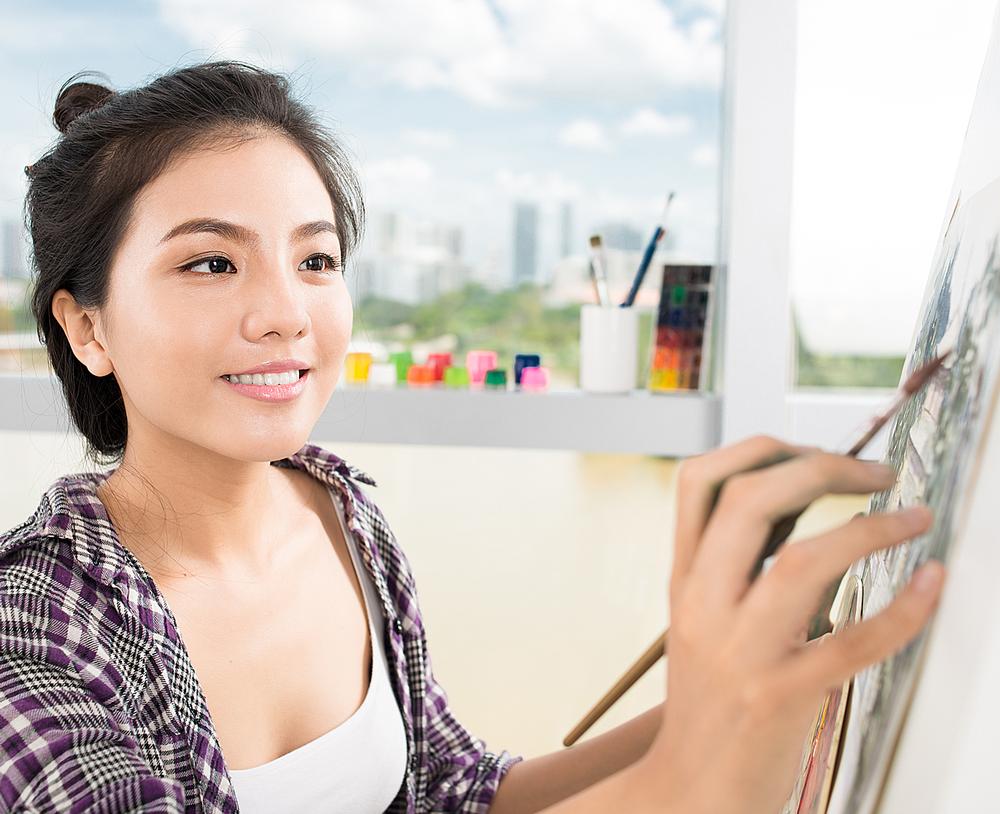
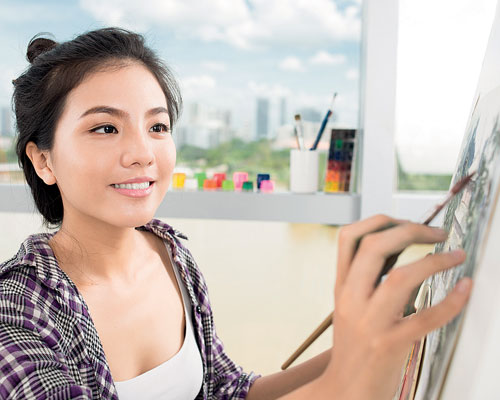
Seventy-five per cent of participants had lower cortisol levels thanks to art therapy / Dragon Images/SHUTTERSTOCK
Operators such as Morgans and Miraval which offer mindfulness colouring sessions and art therapy could be doing more than just helping guests to unleash their inner creativity. A new study by Drexel University, USA, has found that whether you’re a Van Gogh in the making or a stick-figure sketcher, making art significantly reduces stress-related hormones in your body.
Although researchers believed that those who had past experience in creating art might have an advantage, their study found stress-reducing benefits across the board.
“It was surprising and it also wasn’t,” says Girija Kaimal, assistant professor of creative arts therapies. “It wasn’t surprising because that’s the core idea in art therapy: everyone is creative and can be expressive in the visual arts when working in a supportive setting. That said, I did expect that perhaps the effects would be stronger for those with prior experience.”
Freestyle art For the study 39 adults, aged 18 to 59, participated in 45 minutes of art-making and just under half of them described their art experience as “limited”. Levels of the stress hormone cortisol were recorded via a saliva sample before and afterwards.
Materials available to the ‘artists’ included markers and paper, modelling clay and collage accessories. As it was a freestyle session, no directions were given as to what materials to use and participants could create anything they desired. An art therapist was on hand to help if requested.
Cortisol reduction The results of the study, published in the journal Art Therapy*, showed that cortisol levels went down in 75 per cent of the participants during their 45 minutes of making art. And while there was some variation in how much cortisol levels lowered, there was no correlation between past art experiences and lower levels.
Written testimonies of their experiences afterward revealed how the participants felt about the creating art. “It was very relaxing,” one wrote. “After about five minutes, I felt less anxious. I was able to obsess less about things that I had not done or need[ed] to get done. Doing art allowed me to put things into perspective.”
It was revealed that the younger study participants had the lowest levels of cortisol. As a result, Kaimal suggested that they may find using art as a form of de-stressing to be particularly effective.
Kaimal, G et al. Reduction of Cortisol Levels and Participants’ Responses Following Art Making. Art Therapy. May 2016
Read more from this issue of Attractions Management magazine
View contents of Attractions Management 2016 issue 4
Promotional feature: Phytomer
As a pioneer of marine skincare, Phytomer represents a story of three impassioned generations and a dedication to cultivating the purest spa ingredients from the northern French coast
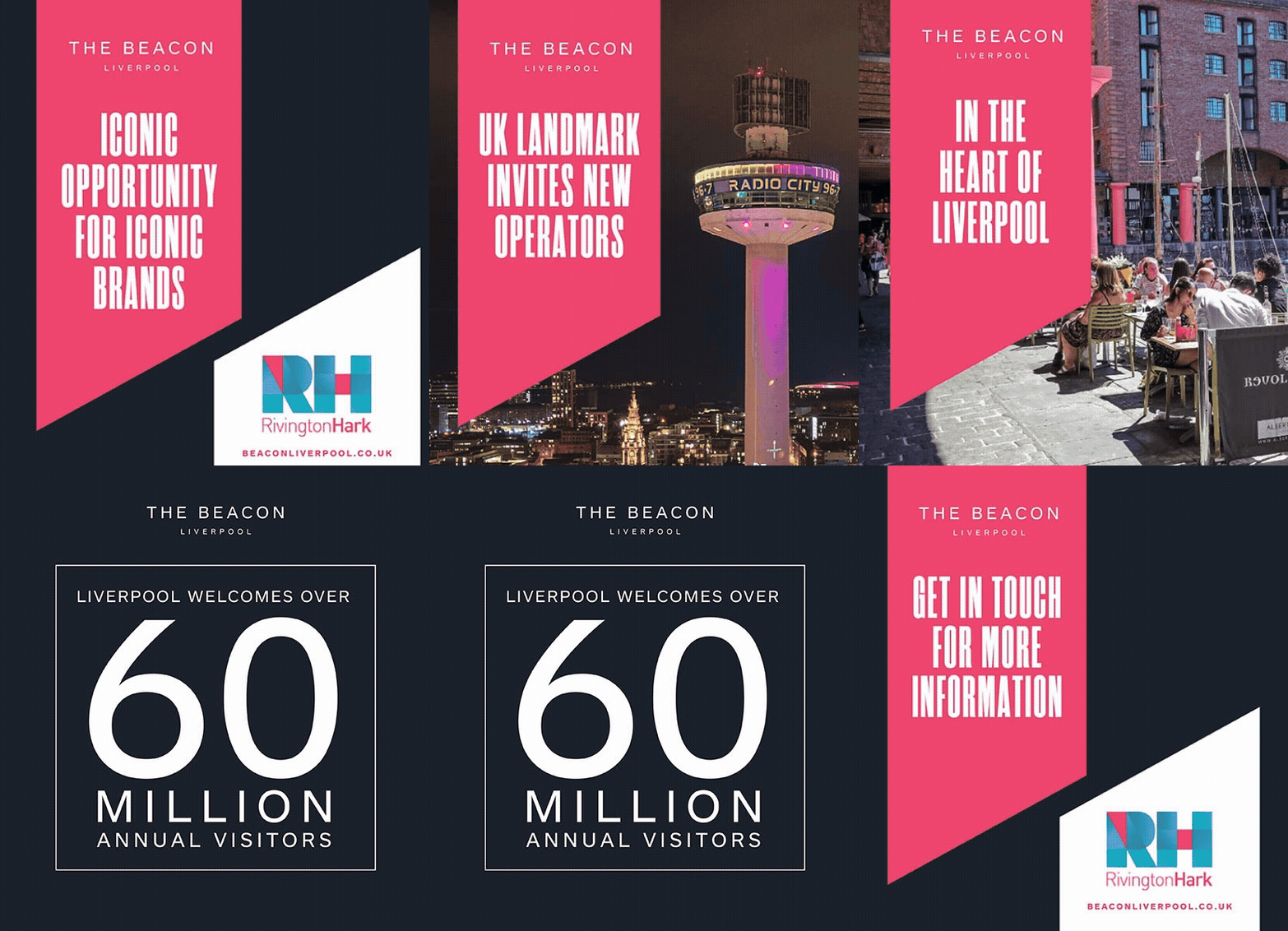
An opportunity to reimagine one of the UK’s most recognisable towers has been formally
opened by Rivington Hark, as St Johns Beacon invites operators and partners to shape its
next phase. [more...]
Seventy-five per cent of participants had lower cortisol levels thanks to art therapy / Dragon Images/SHUTTERSTOCK
Operators such as Morgans and Miraval which offer mindfulness colouring sessions and art therapy could be doing more than just helping guests to unleash their inner creativity. A new study by Drexel University, USA, has found that whether you’re a Van Gogh in the making or a stick-figure sketcher, making art significantly reduces stress-related hormones in your body.
Although researchers believed that those who had past experience in creating art might have an advantage, their study found stress-reducing benefits across the board.
“It was surprising and it also wasn’t,” says Girija Kaimal, assistant professor of creative arts therapies. “It wasn’t surprising because that’s the core idea in art therapy: everyone is creative and can be expressive in the visual arts when working in a supportive setting. That said, I did expect that perhaps the effects would be stronger for those with prior experience.”
Freestyle art For the study 39 adults, aged 18 to 59, participated in 45 minutes of art-making and just under half of them described their art experience as “limited”. Levels of the stress hormone cortisol were recorded via a saliva sample before and afterwards.
Materials available to the ‘artists’ included markers and paper, modelling clay and collage accessories. As it was a freestyle session, no directions were given as to what materials to use and participants could create anything they desired. An art therapist was on hand to help if requested.
Cortisol reduction The results of the study, published in the journal Art Therapy*, showed that cortisol levels went down in 75 per cent of the participants during their 45 minutes of making art. And while there was some variation in how much cortisol levels lowered, there was no correlation between past art experiences and lower levels.
Written testimonies of their experiences afterward revealed how the participants felt about the creating art. “It was very relaxing,” one wrote. “After about five minutes, I felt less anxious. I was able to obsess less about things that I had not done or need[ed] to get done. Doing art allowed me to put things into perspective.”
It was revealed that the younger study participants had the lowest levels of cortisol. As a result, Kaimal suggested that they may find using art as a form of de-stressing to be particularly effective.
Kaimal, G et al. Reduction of Cortisol Levels and Participants’ Responses Following Art Making. Art Therapy. May 2016
Read more from this issue of Attractions Management magazine
View contents of Attractions Management 2016 issue 4
Promotional feature: Phytomer
As a pioneer of marine skincare, Phytomer represents a story of three impassioned generations and a dedication to cultivating the purest spa ingredients from the northern French coast
Hotel de France, located on the British Isle of Jersey, has created a wellness retreat package
that includes a hot yoga session that will take place in Jersey Zoo’s butterfly sanctuary.
A new immersive attraction designed to transport visitors into the final hours of ancient Pompeii
is preparing to open near the world-famous archaeological site in southern Italy.
Experience design company, BRC Imagination Arts, has completed a transition that sees founder
Bob Rogers pass ownership of the business to four long-serving senior executives, while
remaining actively involved with the company.
Movie Park Germany has opened a new Paramount Pictures-themed attraction as part of its 30th
anniversary celebrations, using immersive storytelling and adaptive reuse to reinforce the park’s
longstanding “Hollywood in Germany” positioning.
Therme Manchester’s 28-acre development, which will include interconnected glass pavilions
that measure 65,000sq m, will be the largest bathing and wellbeing attraction in the world once
complete, according to prof David Russell, CEO of Therme UK.
Efteling has opened Hooghmoed, a new family drop tower designed to broaden the appeal of its
recently launched Sirene Island themed area and introduce younger visitors to thrill attractions.
A proposed Puy du Fou development near Bicester and Universal Destinations and Experiences’
planned resort in Bedford are emerging as part of a wider transformation of the Oxford–
Cambridge Growth Corridor into a major centre for UK leisure and tourism inv
Shedd Aquarium has opened the Immersion Theater developed in partnership with SimEx-
Iwerks, as part of a wider strategy to enhance the guest experience and create additional
revenue opportunities.
The UK government has announced a temporary reduction in VAT on visitor attractions and
children’s meals as part of a summer cost-of-living support package designed to stimulate the
visitor economy and encourage family days out.
As designer Yinka Ilori prepares for his first solo gallery show in London, he speaks exclusively
to CLADmag about his mission to spread joy, the power of play, and his bold approach to using
colour (including the colours you won’t see in his work).
The government of Thailand is exploring plans for a THB300bn (£6.3bn, US$8.3bn)
entertainment complex in the country’s Eastern Economic Corridor (EEC), with officials
proposing a large-scale theme park and sports destination as part of a broader tourism and
economic development strategy.
+ More news
COMPANY PROFILES
instantprint We’re a Yorkshire-based online printer, founded
in 2009 by Adam Carnell and James Kinsella. [more...]
Sally Corporation Our services include: Dark ride design & build; Redevelopment of existing attractions; High-quality [more...]
Taylor Made Designs Founded in 1993, Taylor Made
Designs supply corporate clothing
and brand-enhancing merchandise
to [more...]
Alterface Alterface’s Creative Division team is
seasoned in concept and ride development,
as well as storyte [more...]
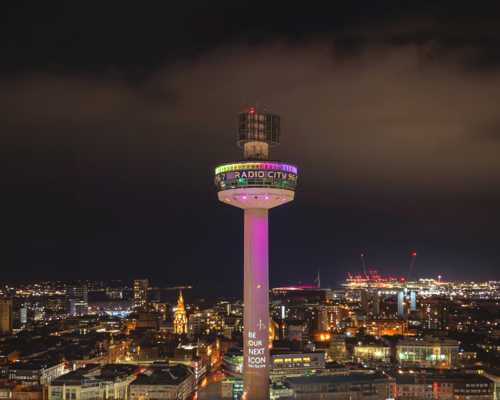
An opportunity to reimagine one of the UK’s most recognisable towers has been formally
opened by Rivington Hark, as St Johns Beacon invites operators and partners to shape its
next phase. [more...]