The world’s spa economy grew by 5 per cent between 2013 and 2015 to reach US$98.6bn (€90.1bn, £80.6bn), according to preliminary findings from the 2016 Global Wellness Economy Monitor
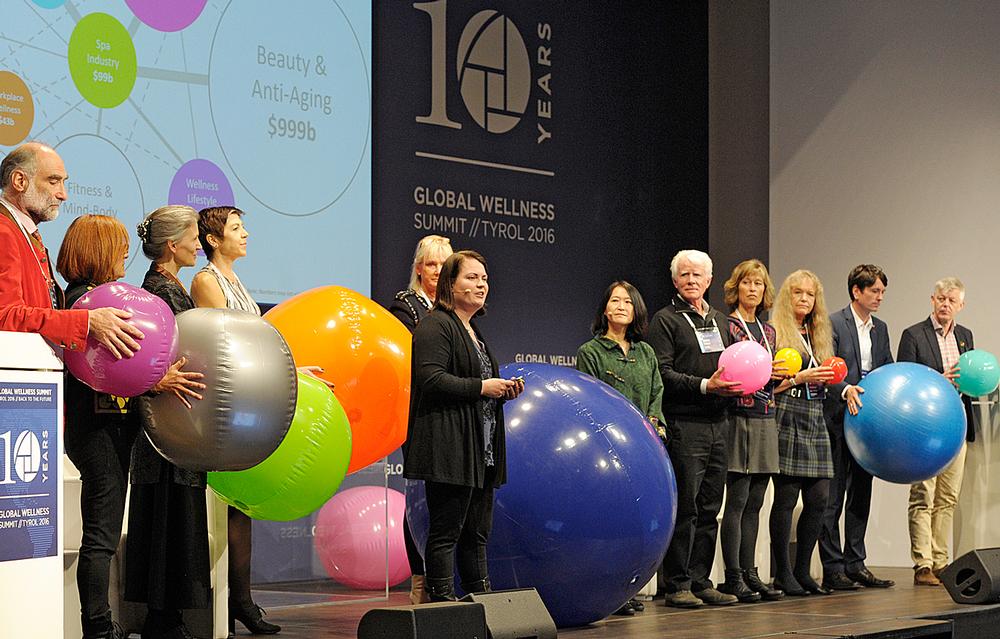
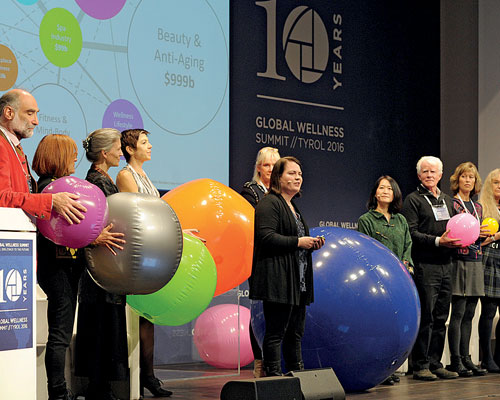
Presenting the data: different size balls represent the 10 sectors in the US$3.72tn wellness industry
The topline figure includes spa facility revenues of US$77.6bn (€71.1bn, £63.4bn) as well as the associations and education, consulting, media and event sectors that support spas, which are valued at US$21bn (€19.2bn, £17.2bn).
And while worldwide spa revenues increased by a modest 2.3 per cent from 2013 to 2015, researchers at the Global Wellness Institute (GWI) – the organisation behind the report – says this is largely due to the US dollar currency conversion from large spa markets across Europe and Asia. If global spa facility revenues are converted to the euro instead, the market actually grew at a robust 25 per cent.
Spa locations worldwide jumped from 105,591 in 2013 to 121,595 in 2015 – meaning the industry has added just over 16,000 spas, more than 230,000 workers (to reach 2.1m) and US$3.5bn (€3.2bn, £2.9bn) in revenue.
These figures from the spa sector feed into the wider international wellness market which the GWI estimates is now a US$3.72 trillion (€3.4tn, £3tn) industry, a number which has increased by 10.6 per cent since 2013.
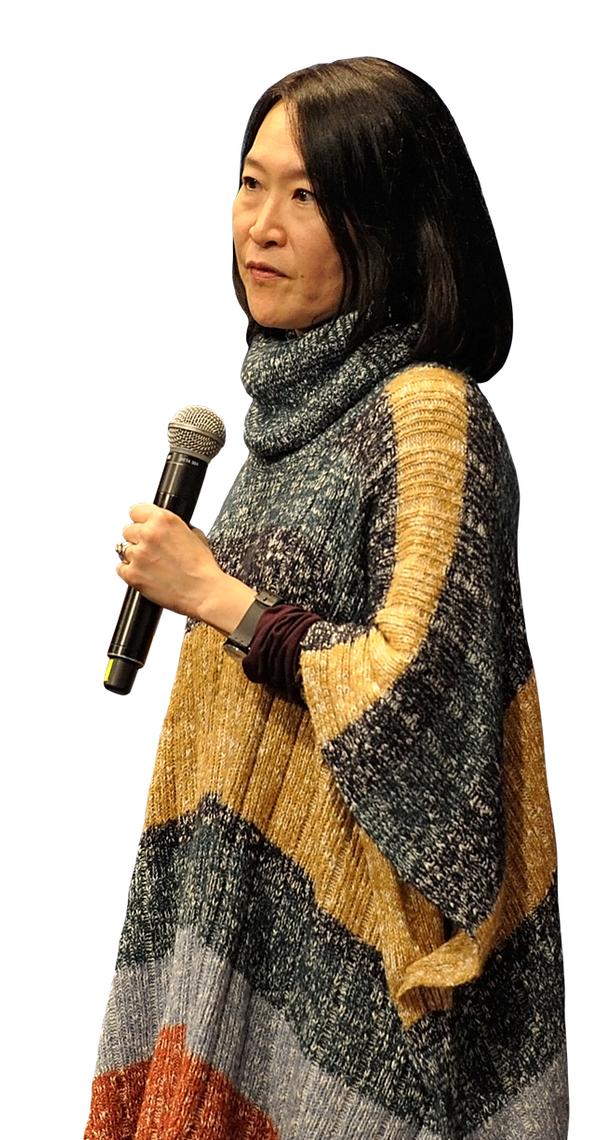
“Recent years have been marked by global economic contraction and disruptive geopolitical events, but a ‘wellness economy’ just keeps rising, with an upward trajectory that seems unstoppable,” says GWI senior research fellow Ophelia Yeung.
Yeung pointed to ‘megatrends’ of an emerging global middle class, a rapidly ageing population, increase in chronic disease and stress, the failure of the ‘sick-care’ medical model, and a growing subset of more affluent, educated consumers “seeking experiences rooted in meaning, purpose, authenticity and nature”, as fuelling the growth in the market.
Revenue-earning thermal and mineral springs added 660 facilities across 109 countries between 2013 and 2015, earning US$51bn (€46.7bn, £42bn) in 2015, up 2 per cent from 2013. The GWI said that while these gains look modest, its research finds rapidly rising consumer interest in springs-based activities – and similarly, 2015 revenues are also heavily impacted by the depreciation of European currencies against the dollar.
Wellness tourism grew 14 per cent in the same two-year period – more than twice as fast as overall tourism expenditures. World travellers made 691 million wellness trips in 2015.
Wellness real estate – which includes residential, hospitality and mixed-use developments incorporating wellness – was one of the fastest-growing sectors, up 19 per cent to US$118.6bn (€108.6bn, £97bn) in 2015.
Other subsets measured in the report include beauty and anti-ageing; workplace wellness; fitness and mind-body; healthy eating, nutrition and weight loss; preventative and personalised medicine and public health; and complementary and alternative medicine.
* The preliminary figures were unveiled at the Global Wellness Summit in late October, ahead of the full research which will be released in January. Turn to p80 to read about the summit in more depth.
Read more from this issue of Attractions Management magazine
View contents of Attractions Management 2016 issue 4
Promotional feature: Phytomer
As a pioneer of marine skincare, Phytomer represents a story of three impassioned generations and a dedication to cultivating the purest spa ingredients from the northern French coast
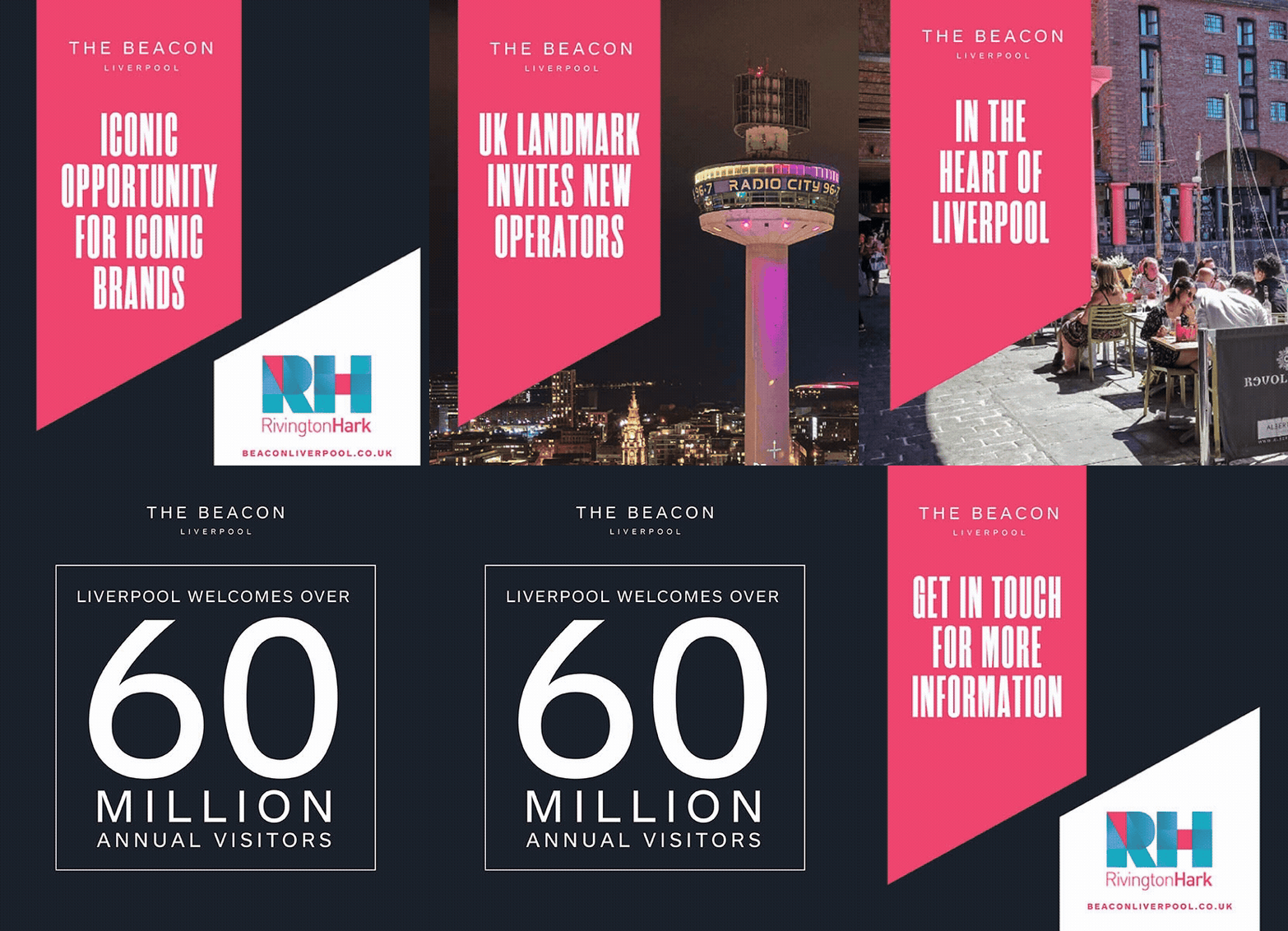
An opportunity to reimagine one of the UK’s most recognisable towers has been formally
opened by Rivington Hark, as St Johns Beacon invites operators and partners to shape its
next phase. [more...]
The world’s spa economy grew by 5 per cent between 2013 and 2015 to reach US$98.6bn (€90.1bn, £80.6bn), according to preliminary findings from the 2016 Global Wellness Economy Monitor
Presenting the data: different size balls represent the 10 sectors in the US$3.72tn wellness industry
The topline figure includes spa facility revenues of US$77.6bn (€71.1bn, £63.4bn) as well as the associations and education, consulting, media and event sectors that support spas, which are valued at US$21bn (€19.2bn, £17.2bn).
And while worldwide spa revenues increased by a modest 2.3 per cent from 2013 to 2015, researchers at the Global Wellness Institute (GWI) – the organisation behind the report – says this is largely due to the US dollar currency conversion from large spa markets across Europe and Asia. If global spa facility revenues are converted to the euro instead, the market actually grew at a robust 25 per cent.
Spa locations worldwide jumped from 105,591 in 2013 to 121,595 in 2015 – meaning the industry has added just over 16,000 spas, more than 230,000 workers (to reach 2.1m) and US$3.5bn (€3.2bn, £2.9bn) in revenue.
These figures from the spa sector feed into the wider international wellness market which the GWI estimates is now a US$3.72 trillion (€3.4tn, £3tn) industry, a number which has increased by 10.6 per cent since 2013.
“Recent years have been marked by global economic contraction and disruptive geopolitical events, but a ‘wellness economy’ just keeps rising, with an upward trajectory that seems unstoppable,” says GWI senior research fellow Ophelia Yeung.
Yeung pointed to ‘megatrends’ of an emerging global middle class, a rapidly ageing population, increase in chronic disease and stress, the failure of the ‘sick-care’ medical model, and a growing subset of more affluent, educated consumers “seeking experiences rooted in meaning, purpose, authenticity and nature”, as fuelling the growth in the market.
Revenue-earning thermal and mineral springs added 660 facilities across 109 countries between 2013 and 2015, earning US$51bn (€46.7bn, £42bn) in 2015, up 2 per cent from 2013. The GWI said that while these gains look modest, its research finds rapidly rising consumer interest in springs-based activities – and similarly, 2015 revenues are also heavily impacted by the depreciation of European currencies against the dollar.
Wellness tourism grew 14 per cent in the same two-year period – more than twice as fast as overall tourism expenditures. World travellers made 691 million wellness trips in 2015.
Wellness real estate – which includes residential, hospitality and mixed-use developments incorporating wellness – was one of the fastest-growing sectors, up 19 per cent to US$118.6bn (€108.6bn, £97bn) in 2015.
Other subsets measured in the report include beauty and anti-ageing; workplace wellness; fitness and mind-body; healthy eating, nutrition and weight loss; preventative and personalised medicine and public health; and complementary and alternative medicine.
* The preliminary figures were unveiled at the Global Wellness Summit in late October, ahead of the full research which will be released in January. Turn to p80 to read about the summit in more depth.
Read more from this issue of Attractions Management magazine
View contents of Attractions Management 2016 issue 4
Promotional feature: Phytomer
As a pioneer of marine skincare, Phytomer represents a story of three impassioned generations and a dedication to cultivating the purest spa ingredients from the northern French coast
Hotel de France, located on the British Isle of Jersey, has created a wellness retreat package
that includes a hot yoga session that will take place in Jersey Zoo’s butterfly sanctuary.
A new immersive attraction designed to transport visitors into the final hours of ancient Pompeii
is preparing to open near the world-famous archaeological site in southern Italy.
Experience design company, BRC Imagination Arts, has completed a transition that sees founder
Bob Rogers pass ownership of the business to four long-serving senior executives, while
remaining actively involved with the company.
Movie Park Germany has opened a new Paramount Pictures-themed attraction as part of its 30th
anniversary celebrations, using immersive storytelling and adaptive reuse to reinforce the park’s
longstanding “Hollywood in Germany” positioning.
Therme Manchester’s 28-acre development, which will include interconnected glass pavilions
that measure 65,000sq m, will be the largest bathing and wellbeing attraction in the world once
complete, according to prof David Russell, CEO of Therme UK.
Efteling has opened Hooghmoed, a new family drop tower designed to broaden the appeal of its
recently launched Sirene Island themed area and introduce younger visitors to thrill attractions.
A proposed Puy du Fou development near Bicester and Universal Destinations and Experiences’
planned resort in Bedford are emerging as part of a wider transformation of the Oxford–
Cambridge Growth Corridor into a major centre for UK leisure and tourism inv
Shedd Aquarium has opened the Immersion Theater developed in partnership with SimEx-
Iwerks, as part of a wider strategy to enhance the guest experience and create additional
revenue opportunities.
The UK government has announced a temporary reduction in VAT on visitor attractions and
children’s meals as part of a summer cost-of-living support package designed to stimulate the
visitor economy and encourage family days out.
As designer Yinka Ilori prepares for his first solo gallery show in London, he speaks exclusively
to CLADmag about his mission to spread joy, the power of play, and his bold approach to using
colour (including the colours you won’t see in his work).
The government of Thailand is exploring plans for a THB300bn (£6.3bn, US$8.3bn)
entertainment complex in the country’s Eastern Economic Corridor (EEC), with officials
proposing a large-scale theme park and sports destination as part of a broader tourism and
economic development strategy.
+ More news
COMPANY PROFILES
QubicaAMF UK QubicaAMF is the largest and most
innovative bowling equipment provider with
600 employees worldwi [more...]
Sally Corporation Our services include: Dark ride design & build; Redevelopment of existing attractions; High-quality [more...]
Polin Waterparks Polin was founded in Istanbul in 1976. Polin
has since grown into a leading company in
the waterpa [more...]
RMA Ltd RMA Ltd is a one-stop global company
that can design, build and produce from a
greenfield site upw [more...]
An opportunity to reimagine one of the UK’s most recognisable towers has been formally
opened by Rivington Hark, as St Johns Beacon invites operators and partners to shape its
next phase. [more...]