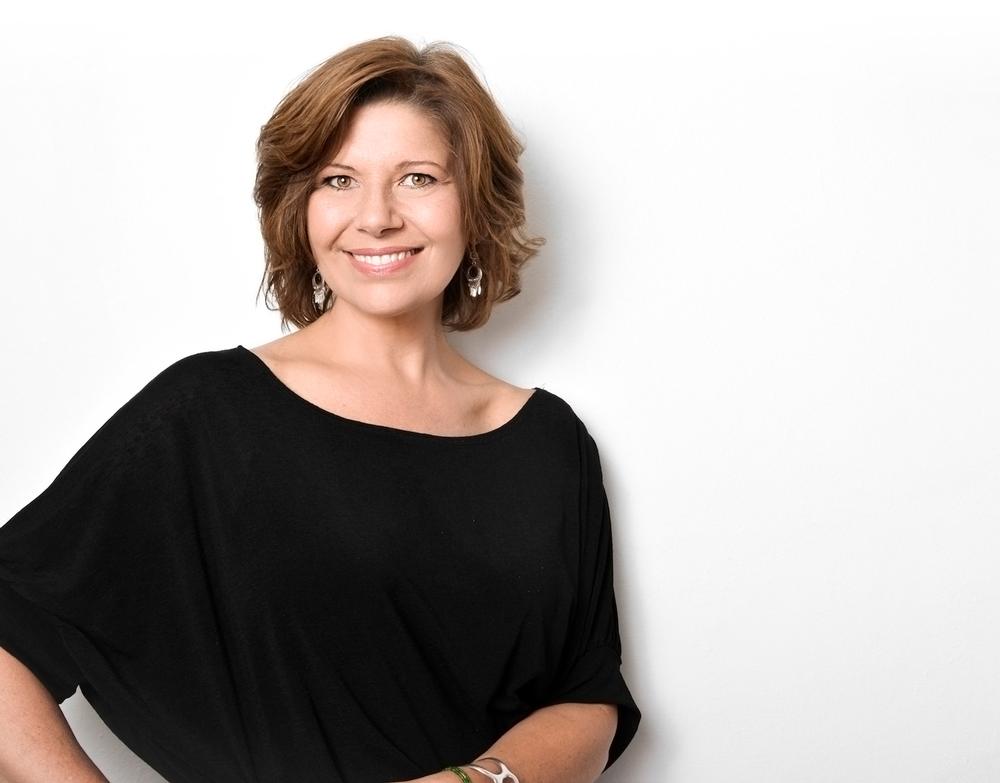
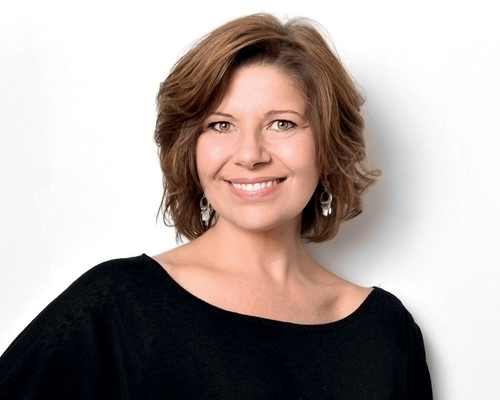
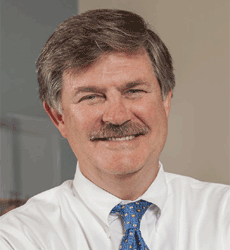
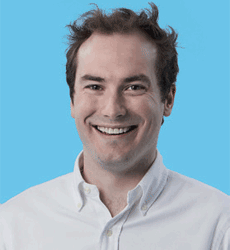
Baker is part of a new Wellness Tourism Council working with the local government
Think of the Mexico spa scene and you’re likely to imagine luxury hotel spas in the coastal resorts of Riviera Maya or Cabo San Lucas. Travel further inland, however, and you’ll find a corridor of hot springs fed by extinct, underground volcanoes. Around three hours north of the capital of Mexico City, the picturesque, colonial-era city of San Miguel de Allende lies at the heart of that corridor. Already popular with both domestic and international tourists (there’s a big US ex-pat community there), the city, lined with cobbled streets and traditional buildings, has huge potential to become a wellness hub for the region. Bonnie Baker, who lives in San Miguel and runs independent spa consultancy Satteva, explains how a newly-formed, local Wellness Tourism Council is working with the state government to make it happen.
Tell us about your spa career to date My background is in anthropology and in 2000, while working on a community development in Costa Rica, I began working with botanical and traditional therapies, which lead me to my first opportunity to manage a spa at the [well-known] Tabacón Grand Spa Thermal Resort. I went on to manage facilities for Mandarin Oriental and Four Seasons before moving to Mexico in 2008 and working independently on a number of projects in the Americas. I created my consultancy, Satteva, over three years ago.
Why is San Miguel popular with tourists? There’s a rich history here. It sits on the original Spanish Royal Path silver mine and trading route, has [beautiful] traditional buildings and some family legacies here even date back to colonial times. On a more modern scale, it’s a mecca for international travellers and ex-pats who bring a range of art and other cultural experiences. There’s also a rich tapestry of natural landscapes – hidden gems like botanical gardens, canyons and naturalist programmes.
Rosewood is the only international hotel chain in the city at the moment, but there’s interest from others. There are independent boutique hotels, such as Hotel Matilda and thanks to Airbnb, locals are also opening up their houses for bed and breakfast too.
How important is tourism to the economy? San Miguel survives on tourism. Last year it had 1,078,701 visitors amounting to 1.8 million bed nights. International tourists account for under 10 per cent of business, with most coming from the US, followed by Europe and a growing number from Asia, especially China.
A lot of tourism is related to weddings as well as festivals – there’s a new festival nearly every month in San Miguel, whether it’s for writers, film buffs or those interested in ecology. There’s also quite a big emphasis on wine, vineyards and organic / biodynamic farming.
How would wellness tourism benefit the region? A lot of San Miguel’s tourism is orientated towards the weekend, so the local state government of Guanajuato has embraced wellness tourism as a way to encourage visitors to stay longer, to come during the week and fill extra room nights – either by taking in the thermal waters, or hiking, or exploring nature.
It could also provide an antidote to the social crisis we’re seeing in Mexico in terms of the drug wars, poverty and other imbalances. Volun-tourism, an aspect of wellness tourism concerned with community work, would be a great for the region as well.
What makes San Miguel suitable for wellness tourism? It has many factors coming together – the culture, history, arts and natural environment – with the richness of the mineral hot springs and thermal waters. Combined with traditional, indigenous medicines and healing practices, such as temazcal sweat lodges (see p91), there’s just a wealth of wellness.
What can you tell us about the hot springs? There’s a corridor of hot springs in the area between San Miguel and Dolores Hidalgo fed by extinct volcanoes deep underground. It’s believed that the rocks and stones are full of crystals, which filter and cleanse the water. The local perception is that the crystals give the water and San Miguel itself a ‘good vibe/energy’.
We know the water isn’t sulphurous, but its mineral content isn’t officially recorded and this is something a local university is addressing as a project this year. It definitely addresses skin conditions, works on a muscular level and aids detoxification (although ingestion is not recommended).
How many hot spring facilities are there and how popular are they? In and around San Miguel there are 10 open to the public. Some of the standout facilities include those at Escondido Place (above) the Mayan Baths (p87), Los Senderos and Hotel Atotonilco (both p90). Most of the hot springs have been on family plots for many years and there’s a local tradition of soaking in the waters, which is slowly becoming more known in Mexico and with international tourists. If I had to gauge their popularity on a scale of one to 10, I’d say a nine.
How much scope is there for hot springs development? They’re facing rapid growth, especially as local families see the economic potential and interest from international tourists. But we don’t want lots of quick-build water parks. So we’re trying to address those issues by working with associations like the Global Wellness Institute and Termatalia, an international thermal water association, to create guidelines that take agriculture, water, hygiene and solar resources into account.
Who’s the target market? I think San Miguel is still very much a draw for international tourists, but there’s much to be done to ensure the hot springs here meet international facility, hygiene and quality-control standards.
Attracting international tourists will benefit the local economy, however, I do think it will create some limitations for locals in terms of pricing. So there’s an opportunity for certain areas, maybe on the outskirts of San Miguel, to cater more for that [local] market.
Where do spas fit in all of this? They’re the second priority in wellness tourism for us after hot springs and there’s an opportunity to focus on the therapeutic aspect. But I do think there needs to be an evolution where spa directors and developers look at the foundation for true wellbeing – thinking about things like prevention and the natural local environment, plants and therapies rather than superficial aspects. I think that’s the future of spas in Mexico, if not the US and Europe as well.
What can you tell us about San Miguel’s Wellness Tourism Council? It’s a branch of the local tourism board and is in the process of just starting up. There’s a core group of eight to 10 ‘crusaders’ including local business owners, spa operators and other people like myself and Dr Robert Maxwell. Dr Maxwell is cardiologist and although he’s been brought up in the allopathic medical world, he’s now a wellness convert.
Policy makers in Mexico are in power for three years and usually look at what’s going to make money quickly. But for once, we feel the new state government in Guanajuato is open to hearing about the long-term benefits offered by wellness and sustainable tourism.
What is the council currently working on? We’re focused on creating awareness of the [hot spring and wellneess] offering here and are looking to align ourselves with certain governing bodies that already have established guidelines and standards that we can follow as we develop and unite tourism with community development.
This September, Termatalia will have its annual thermal spa expo in Mexico and we recently hosted representatives from it on a two-day wellness programme in San Miguel. We did the same thing after the Global Wellness Summit last November, introducing 23 spa delegates from around the world to the local hot springs scene. So we’re already creating our own network that can help us as the sector matures.
Next on our agenda is to work with the tourism board in Mexico City and select spas located there to highlight the wellness tourism potential in San Miguel.
When will San Miguel realise its potential as a wellness hub? We’ve got three years with the current state administration, which wants wellness tourism to be its success story, so I don’t think it’s very far down the line. I’m confident that we’re making enough noise around San Miguel and if we get the right model here, I think we can create a wellness tourism prototype for country-wide implementation.
Read more from this issue of Attractions Management magazine
View contents of Attractions Management 2016 issue 3
Top team: Gwinganna Lifestyle Retreat
The people behind this world-renowned lifestyle retreat share their business insights with Julie Cramer. Plus a focus on co-investor Hugh Jackman
Ask an expert: Visiting practitioners
Done well, visiting practitioner programmes can boost profits by up to 40 per cent. But how can spas get the offer right? Kate Parker investigates
Promotional feature: Esadore - creating a splash
The MD of Esadore International, Theodora Kioussis, explains how the company’s creative, manufacturing and operational skill sets can bring an international managing director
of UAE-based esadore International to life in a short space of time
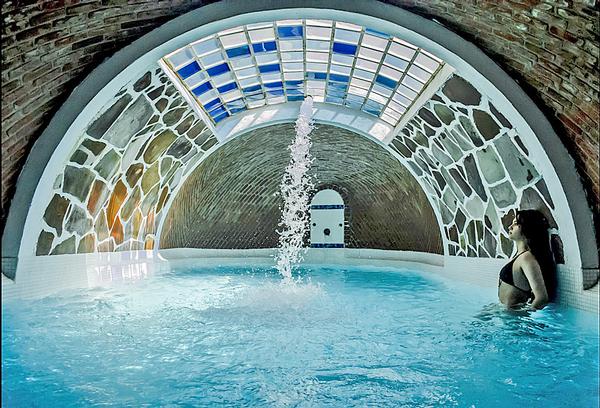
Mayan Baths Representing high-end hot spring bathing in San Miguel, the Mayan Baths comprise a network of subterranean tunnels and caves with multiple thermal pools and cascading waterfalls. The 18,686sq ft (1,736sq m) baths pay tribute to Mayan culture with a communal pyramid room and a passageway aligned with the winter solstice – when the sun’s at its lowest it shines down the tunnel, reflecting off the quartz and crystal rock walls. It’s accessed by appointment only and is popular with both corporate and leisure groups.
The baths form part of the 19-hectare (47-acre) Hacienda Arcángel hilltop estate owned by a US ex-pat. The master plan for the estate, which is up for sale for US$5.8m (€5.2m, £4m), includes an extension to the underground baths, a standalone 26,500sq ft (2,462sq m) spa, up to 20 spa suites and a private residence.
themayanbaths.com/en
The Mayan Baths is one of the top hot spring facilities in San Miguel
The Mayan Baths is one of the top hot spring facilities in San Miguel
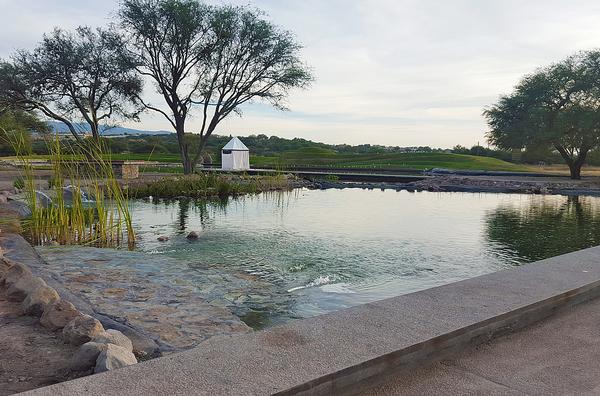
Escondido Place Escondido Place, Atotonilco, offers a range of thermal baths set within a park/woodland setting with man-made lakes. The public baths are owned by a local family and are very popular in the surrounding community. The family is currently developing a boutique hotel with five bedrooms, a restaurant and spa separate to the baths to help attract more international tourists. escondidoplace.com
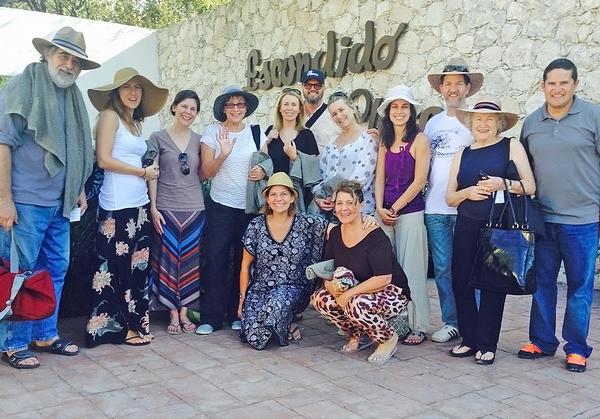
Global spa professionals on a regional geothermal tour last November
Escondido Place, Atotonilco
Los Senderos Los Senderos is a 300-acre (121-hectare) sustainable residential/lifestyle community that’s being developed on the outskirts of San Miguel. Owner Francesca Fisher is a former film and video producer and her vision is to create a development that’s anchored by wellness with amenities to “help our guests push the ‘reset’ button and get back to a healthier way of living”.
A key feature at Los Senderos is the Manaia luxury thermal spa, which will include an indoor thermal pool with private lounge areas, a natural thermal swimming lagoon, treatment tents, yoga and meditation decks, a Japanese tea house, and steamrooms/hammams and a traditional temazcal within landscaped grounds.
There’s already a farm-to-table restaurant, vineyard, equestrian centre and a wedding venue on-site. The spa will open by 2017. Residential units, condos, a boutique hotel and luxury tented camp are also in the planning.
los-senderos.mx
Photo by michaelamici.com
A thermal spa and pool complex is key to the 300-acre development
Photo by michaelamici.com
A thermal spa and pool complex is key to the 300-acre development
Hotel Atotonilco An old hotel in the UNESCO World Heritage site of Atotonilco, about 15 minutes from San Miguel, is undergoing renovations to become a boutique 30-bed property with a European-style therapeutic centre. Atotonilco means ‘taking the waters’ in an Aztec dialect and the town is traditionally known for its healing hot springs. Local waters and hydrotherapy programmes will be a key feature of the wellness centre once it’s developed.
atotonilcoelviejo.com
First-person experience: Katie Barnes
Temazcal at El Charco del Ingenio botanical gardens San Miguel de Allende, Mexico
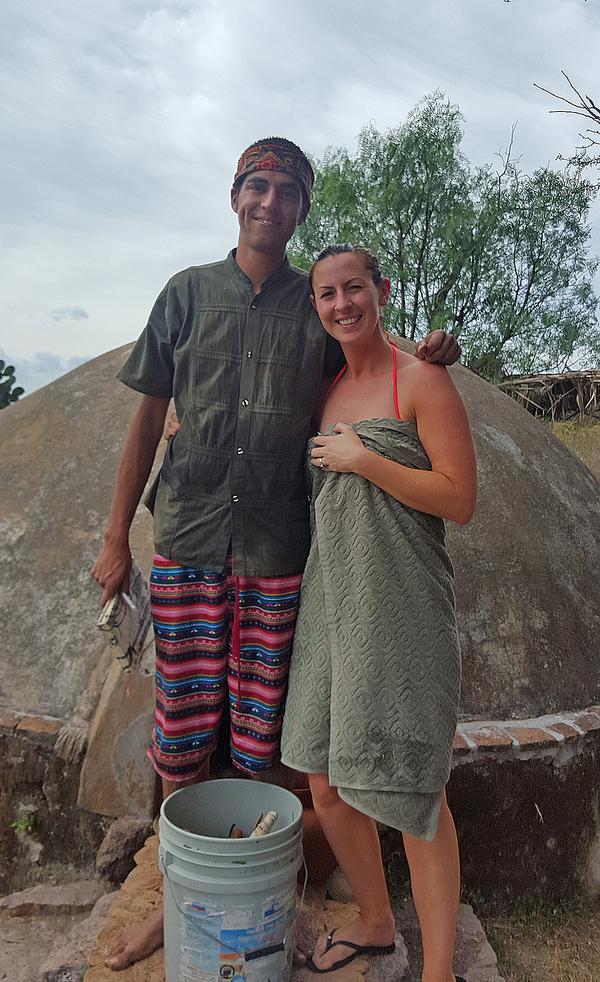
Barnes with the temazcal ceremony master after the memorable experience
Katie BarnesEditorSpa Business magazine
I sit hugging my knees in darkness, half on/half off a thin rattan mat on the earth with a handful of delegates from the Global Wellness Summit who are on a geothermal mineral water tour in Mexico. I’m sweating within minutes as I try to calm my breathing in the oppressively hot, smoky air. The thought of enduring this for 20 minutes to an hour – the duration never was made clear – is not alluring.
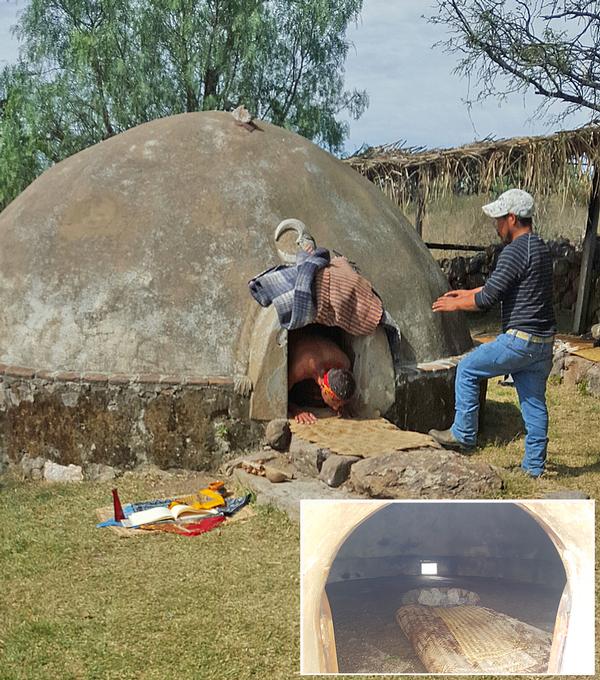
Welcome to the temazcal: a traditional sweat lodge in Central and South America which has been used by natives since ancient Mesoamerica times (and is still used regularly to this day) for curative and spiritual healing.
Before crawling into the small, stone-built dome our ceremony master – a young, softly spoken man dressed in bright patterned shorts and bandana – explains that the temazcal is a place of healing energy where people let go of negative feelings to be reborn. During a pre-ceremony cleansing, in which we acknowledge the gods, he asks us to make a wish or intent for our experience.
It’s this – the health of myself and loved ones – that I try hard to concentrate on to get through the time in the dome. A fire pit in the middle with smouldering embers belts out distractingly high heat but thankfully the ceremony master introduces elements along the way to help keep us centred. We carry out deep breathing exercises to expel bad energy, gently move our body to encourage awareness and hold hands while rhythmically chanting to remind ourselves of how blessed we are. Just when it seems to get too much, herb bundles are used to flick fragrant water on us and the embers to provide some respite.
Overall, the feeling was slightly uncomfortable both from a physical and mental perspective. There was nothing to support the body and, not used to sitting cross-legged for so long, pins and needles we never far away. At times I also found myself welling up with emotion and quickly internalised the feeling – although that probably wasn’t the right thing to do.
The experience was over quicker than I thought and I was crawling back out in less than 30 minutes. I felt shaky and light headed at first, but having tepid water tipped over my head helped to bring me round, as did a cool light breeze sweeping through the chillout area. A feeling of tranquility and elation washed over me and my skin felt amazingly soft too. Despite an emotionally draining experience, I felt awake, alive and happy.
"Just when it seems to get too much, herb bundles are used to flick fragrant water on us and the embers to provide some respite"
The temazcal is said to be a place of curative and spiritual healing
COMPANY PROFILES
Sally Corporation
Our services include: Dark ride design & build; Redevelopment of existing attractions; High-quality [more...]
instantprint
We’re a Yorkshire-based online printer, founded
in 2009 by Adam Carnell and James Kinsella. [more...]
RMA Ltd
RMA Ltd is a one-stop global company
that can design, build and produce from a
greenfield site upw [more...]
Baker is part of a new Wellness Tourism Council working with the local government
Think of the Mexico spa scene and you’re likely to imagine luxury hotel spas in the coastal resorts of Riviera Maya or Cabo San Lucas. Travel further inland, however, and you’ll find a corridor of hot springs fed by extinct, underground volcanoes. Around three hours north of the capital of Mexico City, the picturesque, colonial-era city of San Miguel de Allende lies at the heart of that corridor. Already popular with both domestic and international tourists (there’s a big US ex-pat community there), the city, lined with cobbled streets and traditional buildings, has huge potential to become a wellness hub for the region. Bonnie Baker, who lives in San Miguel and runs independent spa consultancy Satteva, explains how a newly-formed, local Wellness Tourism Council is working with the state government to make it happen.
Tell us about your spa career to date My background is in anthropology and in 2000, while working on a community development in Costa Rica, I began working with botanical and traditional therapies, which lead me to my first opportunity to manage a spa at the [well-known] Tabacón Grand Spa Thermal Resort. I went on to manage facilities for Mandarin Oriental and Four Seasons before moving to Mexico in 2008 and working independently on a number of projects in the Americas. I created my consultancy, Satteva, over three years ago.
Why is San Miguel popular with tourists? There’s a rich history here. It sits on the original Spanish Royal Path silver mine and trading route, has [beautiful] traditional buildings and some family legacies here even date back to colonial times. On a more modern scale, it’s a mecca for international travellers and ex-pats who bring a range of art and other cultural experiences. There’s also a rich tapestry of natural landscapes – hidden gems like botanical gardens, canyons and naturalist programmes.
Rosewood is the only international hotel chain in the city at the moment, but there’s interest from others. There are independent boutique hotels, such as Hotel Matilda and thanks to Airbnb, locals are also opening up their houses for bed and breakfast too.
How important is tourism to the economy? San Miguel survives on tourism. Last year it had 1,078,701 visitors amounting to 1.8 million bed nights. International tourists account for under 10 per cent of business, with most coming from the US, followed by Europe and a growing number from Asia, especially China.
A lot of tourism is related to weddings as well as festivals – there’s a new festival nearly every month in San Miguel, whether it’s for writers, film buffs or those interested in ecology. There’s also quite a big emphasis on wine, vineyards and organic / biodynamic farming.
How would wellness tourism benefit the region? A lot of San Miguel’s tourism is orientated towards the weekend, so the local state government of Guanajuato has embraced wellness tourism as a way to encourage visitors to stay longer, to come during the week and fill extra room nights – either by taking in the thermal waters, or hiking, or exploring nature.
It could also provide an antidote to the social crisis we’re seeing in Mexico in terms of the drug wars, poverty and other imbalances. Volun-tourism, an aspect of wellness tourism concerned with community work, would be a great for the region as well.
What makes San Miguel suitable for wellness tourism? It has many factors coming together – the culture, history, arts and natural environment – with the richness of the mineral hot springs and thermal waters. Combined with traditional, indigenous medicines and healing practices, such as temazcal sweat lodges (see p91), there’s just a wealth of wellness.
What can you tell us about the hot springs? There’s a corridor of hot springs in the area between San Miguel and Dolores Hidalgo fed by extinct volcanoes deep underground. It’s believed that the rocks and stones are full of crystals, which filter and cleanse the water. The local perception is that the crystals give the water and San Miguel itself a ‘good vibe/energy’.
We know the water isn’t sulphurous, but its mineral content isn’t officially recorded and this is something a local university is addressing as a project this year. It definitely addresses skin conditions, works on a muscular level and aids detoxification (although ingestion is not recommended).
How many hot spring facilities are there and how popular are they? In and around San Miguel there are 10 open to the public. Some of the standout facilities include those at Escondido Place (above) the Mayan Baths (p87), Los Senderos and Hotel Atotonilco (both p90). Most of the hot springs have been on family plots for many years and there’s a local tradition of soaking in the waters, which is slowly becoming more known in Mexico and with international tourists. If I had to gauge their popularity on a scale of one to 10, I’d say a nine.
How much scope is there for hot springs development? They’re facing rapid growth, especially as local families see the economic potential and interest from international tourists. But we don’t want lots of quick-build water parks. So we’re trying to address those issues by working with associations like the Global Wellness Institute and Termatalia, an international thermal water association, to create guidelines that take agriculture, water, hygiene and solar resources into account.
Who’s the target market? I think San Miguel is still very much a draw for international tourists, but there’s much to be done to ensure the hot springs here meet international facility, hygiene and quality-control standards.
Attracting international tourists will benefit the local economy, however, I do think it will create some limitations for locals in terms of pricing. So there’s an opportunity for certain areas, maybe on the outskirts of San Miguel, to cater more for that [local] market.
Where do spas fit in all of this? They’re the second priority in wellness tourism for us after hot springs and there’s an opportunity to focus on the therapeutic aspect. But I do think there needs to be an evolution where spa directors and developers look at the foundation for true wellbeing – thinking about things like prevention and the natural local environment, plants and therapies rather than superficial aspects. I think that’s the future of spas in Mexico, if not the US and Europe as well.
What can you tell us about San Miguel’s Wellness Tourism Council? It’s a branch of the local tourism board and is in the process of just starting up. There’s a core group of eight to 10 ‘crusaders’ including local business owners, spa operators and other people like myself and Dr Robert Maxwell. Dr Maxwell is cardiologist and although he’s been brought up in the allopathic medical world, he’s now a wellness convert.
Policy makers in Mexico are in power for three years and usually look at what’s going to make money quickly. But for once, we feel the new state government in Guanajuato is open to hearing about the long-term benefits offered by wellness and sustainable tourism.
What is the council currently working on? We’re focused on creating awareness of the [hot spring and wellneess] offering here and are looking to align ourselves with certain governing bodies that already have established guidelines and standards that we can follow as we develop and unite tourism with community development.
This September, Termatalia will have its annual thermal spa expo in Mexico and we recently hosted representatives from it on a two-day wellness programme in San Miguel. We did the same thing after the Global Wellness Summit last November, introducing 23 spa delegates from around the world to the local hot springs scene. So we’re already creating our own network that can help us as the sector matures.
Next on our agenda is to work with the tourism board in Mexico City and select spas located there to highlight the wellness tourism potential in San Miguel.
When will San Miguel realise its potential as a wellness hub? We’ve got three years with the current state administration, which wants wellness tourism to be its success story, so I don’t think it’s very far down the line. I’m confident that we’re making enough noise around San Miguel and if we get the right model here, I think we can create a wellness tourism prototype for country-wide implementation.
Read more from this issue of Attractions Management magazine
View contents of Attractions Management 2016 issue 3
Top team: Gwinganna Lifestyle Retreat
The people behind this world-renowned lifestyle retreat share their business insights with Julie Cramer. Plus a focus on co-investor Hugh Jackman
Ask an expert: Visiting practitioners
Done well, visiting practitioner programmes can boost profits by up to 40 per cent. But how can spas get the offer right? Kate Parker investigates
Promotional feature: Esadore - creating a splash
The MD of Esadore International, Theodora Kioussis, explains how the company’s creative, manufacturing and operational skill sets can bring an international managing director
of UAE-based esadore International to life in a short space of time
Mayan Baths Representing high-end hot spring bathing in San Miguel, the Mayan Baths comprise a network of subterranean tunnels and caves with multiple thermal pools and cascading waterfalls. The 18,686sq ft (1,736sq m) baths pay tribute to Mayan culture with a communal pyramid room and a passageway aligned with the winter solstice – when the sun’s at its lowest it shines down the tunnel, reflecting off the quartz and crystal rock walls. It’s accessed by appointment only and is popular with both corporate and leisure groups.
The baths form part of the 19-hectare (47-acre) Hacienda Arcángel hilltop estate owned by a US ex-pat. The master plan for the estate, which is up for sale for US$5.8m (€5.2m, £4m), includes an extension to the underground baths, a standalone 26,500sq ft (2,462sq m) spa, up to 20 spa suites and a private residence.
themayanbaths.com/en
The Mayan Baths is one of the top hot spring facilities in San Miguel
The Mayan Baths is one of the top hot spring facilities in San Miguel
Escondido Place Escondido Place, Atotonilco, offers a range of thermal baths set within a park/woodland setting with man-made lakes. The public baths are owned by a local family and are very popular in the surrounding community. The family is currently developing a boutique hotel with five bedrooms, a restaurant and spa separate to the baths to help attract more international tourists. escondidoplace.com
Global spa professionals on a regional geothermal tour last November
Escondido Place, Atotonilco
Los Senderos Los Senderos is a 300-acre (121-hectare) sustainable residential/lifestyle community that’s being developed on the outskirts of San Miguel. Owner Francesca Fisher is a former film and video producer and her vision is to create a development that’s anchored by wellness with amenities to “help our guests push the ‘reset’ button and get back to a healthier way of living”.
A key feature at Los Senderos is the Manaia luxury thermal spa, which will include an indoor thermal pool with private lounge areas, a natural thermal swimming lagoon, treatment tents, yoga and meditation decks, a Japanese tea house, and steamrooms/hammams and a traditional temazcal within landscaped grounds.
There’s already a farm-to-table restaurant, vineyard, equestrian centre and a wedding venue on-site. The spa will open by 2017. Residential units, condos, a boutique hotel and luxury tented camp are also in the planning.
los-senderos.mx
Photo by michaelamici.com
A thermal spa and pool complex is key to the 300-acre development
Photo by michaelamici.com
A thermal spa and pool complex is key to the 300-acre development
Hotel Atotonilco An old hotel in the UNESCO World Heritage site of Atotonilco, about 15 minutes from San Miguel, is undergoing renovations to become a boutique 30-bed property with a European-style therapeutic centre. Atotonilco means ‘taking the waters’ in an Aztec dialect and the town is traditionally known for its healing hot springs. Local waters and hydrotherapy programmes will be a key feature of the wellness centre once it’s developed.
atotonilcoelviejo.com
First-person experience: Katie Barnes
Temazcal at El Charco del Ingenio botanical gardens San Miguel de Allende, Mexico
Barnes with the temazcal ceremony master after the memorable experience
Katie BarnesEditorSpa Business magazine
I sit hugging my knees in darkness, half on/half off a thin rattan mat on the earth with a handful of delegates from the Global Wellness Summit who are on a geothermal mineral water tour in Mexico. I’m sweating within minutes as I try to calm my breathing in the oppressively hot, smoky air. The thought of enduring this for 20 minutes to an hour – the duration never was made clear – is not alluring.
Welcome to the temazcal: a traditional sweat lodge in Central and South America which has been used by natives since ancient Mesoamerica times (and is still used regularly to this day) for curative and spiritual healing.
Before crawling into the small, stone-built dome our ceremony master – a young, softly spoken man dressed in bright patterned shorts and bandana – explains that the temazcal is a place of healing energy where people let go of negative feelings to be reborn. During a pre-ceremony cleansing, in which we acknowledge the gods, he asks us to make a wish or intent for our experience.
It’s this – the health of myself and loved ones – that I try hard to concentrate on to get through the time in the dome. A fire pit in the middle with smouldering embers belts out distractingly high heat but thankfully the ceremony master introduces elements along the way to help keep us centred. We carry out deep breathing exercises to expel bad energy, gently move our body to encourage awareness and hold hands while rhythmically chanting to remind ourselves of how blessed we are. Just when it seems to get too much, herb bundles are used to flick fragrant water on us and the embers to provide some respite.
Overall, the feeling was slightly uncomfortable both from a physical and mental perspective. There was nothing to support the body and, not used to sitting cross-legged for so long, pins and needles we never far away. At times I also found myself welling up with emotion and quickly internalised the feeling – although that probably wasn’t the right thing to do.
The experience was over quicker than I thought and I was crawling back out in less than 30 minutes. I felt shaky and light headed at first, but having tepid water tipped over my head helped to bring me round, as did a cool light breeze sweeping through the chillout area. A feeling of tranquility and elation washed over me and my skin felt amazingly soft too. Despite an emotionally draining experience, I felt awake, alive and happy.
"Just when it seems to get too much, herb bundles are used to flick fragrant water on us and the embers to provide some respite"
The temazcal is said to be a place of curative and spiritual healing
Abu Dhabi-based investment firm Mubadala Capital has made a binding, fully financed
€1 billion
offer to acquire Pierre and Vacances SA, the European holiday resort operator behind the
continental European Center Parcs business.
Disney has reaffirmed its commitment to investing US$30 billion in its US parks and cruise
business by 2033, using new America250 celebrations to underline the role its attractions play
in supporting jobs, tourism and economic growth.
Expo 2030 Riyadh is being planned as a permanent visitor destination, with organisers
confirming the six-million-square-metre site will become a Global Village after the event closes.
The owner of one of Australia's best-known waterparks has acquired a major competitor,
creating a new attractions business spanning two of the country's largest visitor destinations.
The Toverland theme park in the Netherlands has announced a €98m expansion programme
that will add a resort, new attractions and staff facilities as it pursues plans to become a multi-
day destination.
Hotel de France, located on the British Isle of Jersey, has created a wellness retreat package
that includes a hot yoga session that will take place in Jersey Zoo’s butterfly sanctuary.
A new immersive attraction designed to transport visitors into the final hours of ancient Pompeii
is preparing to open near the world-famous archaeological site in southern Italy.
Experience design company, BRC Imagination Arts, has completed a transition that sees founder
Bob Rogers pass ownership of the business to four long-serving senior executives, while
remaining actively involved with the company.
Movie Park Germany has opened a new Paramount Pictures-themed attraction as part of its 30th
anniversary celebrations, using immersive storytelling and adaptive reuse to reinforce the park’s
longstanding “Hollywood in Germany” positioning.
Therme Manchester’s 28-acre development, which will include interconnected glass pavilions
that measure 65,000sq m, will be the largest bathing and wellbeing attraction in the world once
complete, according to prof David Russell, CEO of Therme UK.
+ More news
COMPANY PROFILES
Sally Corporation Our services include: Dark ride design & build; Redevelopment of existing attractions; High-quality [more...]
instantprint We’re a Yorkshire-based online printer, founded
in 2009 by Adam Carnell and James Kinsella. [more...]
RMA Ltd RMA Ltd is a one-stop global company
that can design, build and produce from a
greenfield site upw [more...]