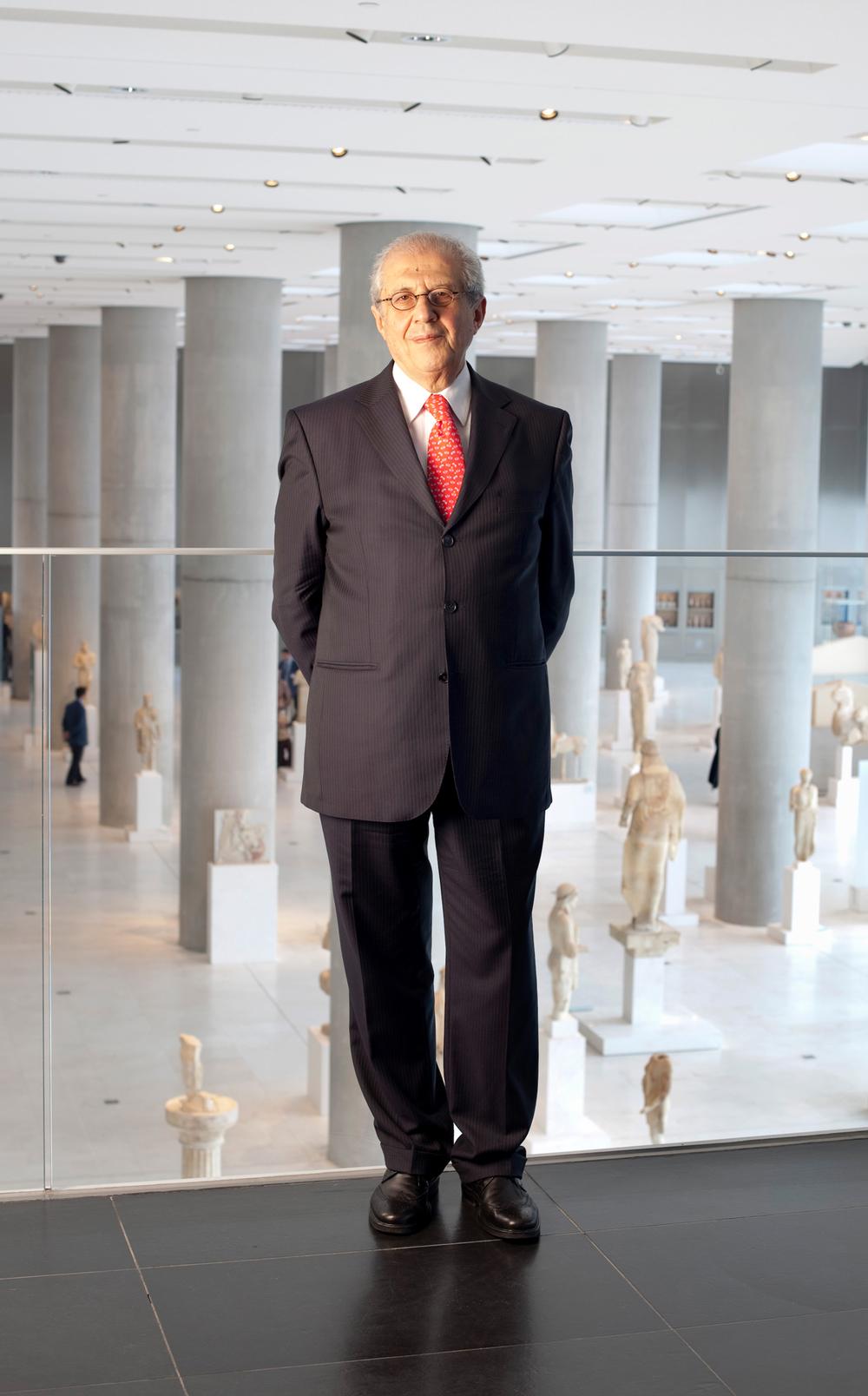
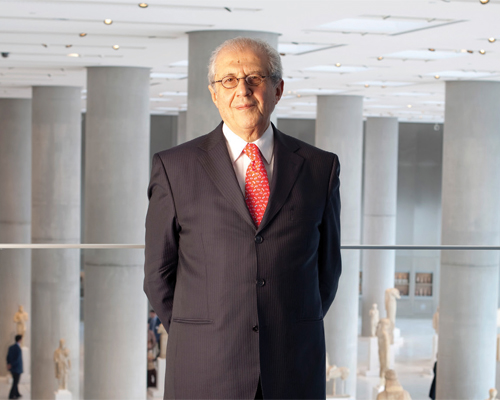
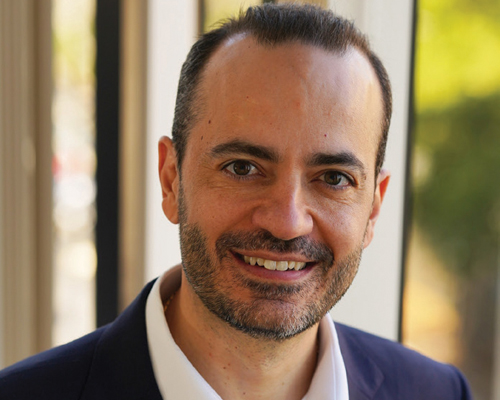
Dimitrios Pandermalis has been president of the Acropolis Museum since its foundation a decade ago
It wasn’t a smooth start for Greece’s Acropolis Museum. First touted in the early 2000s, some questioned whether or not the Greek gods themselves were trying to intervene in the €130m (US$145m) development.
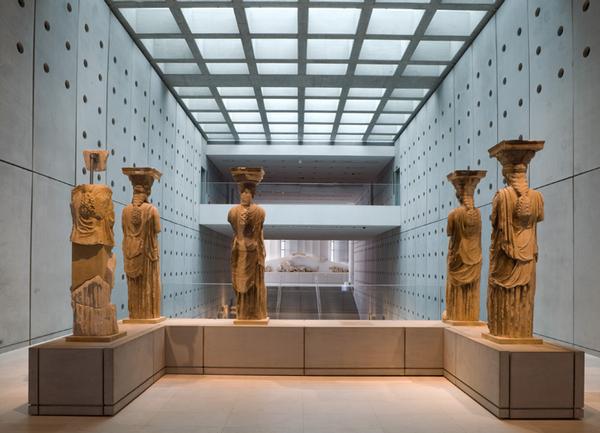
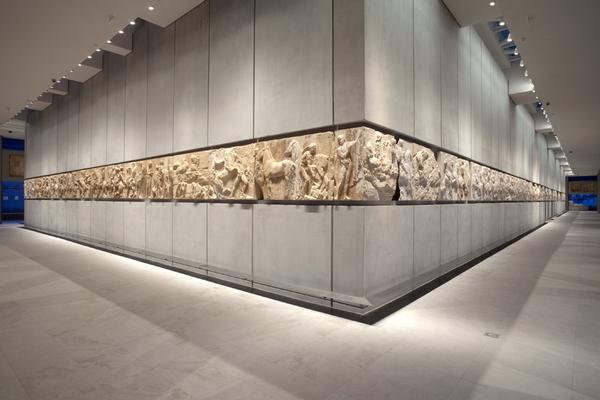
The museum, which sits on the archaeological site of the Acropolis of Athens, Greece, was built to house every artefact found on the rock and its slopes.
Initial plans were plagued by problems and delays, including disputes with architects and contractors, as well as complaints from local residents trying to protect historic buildings from demolition. When work was finally approved, an ancient urban development was discovered in the ground dug for foundations of the museum, immediately halting construction.
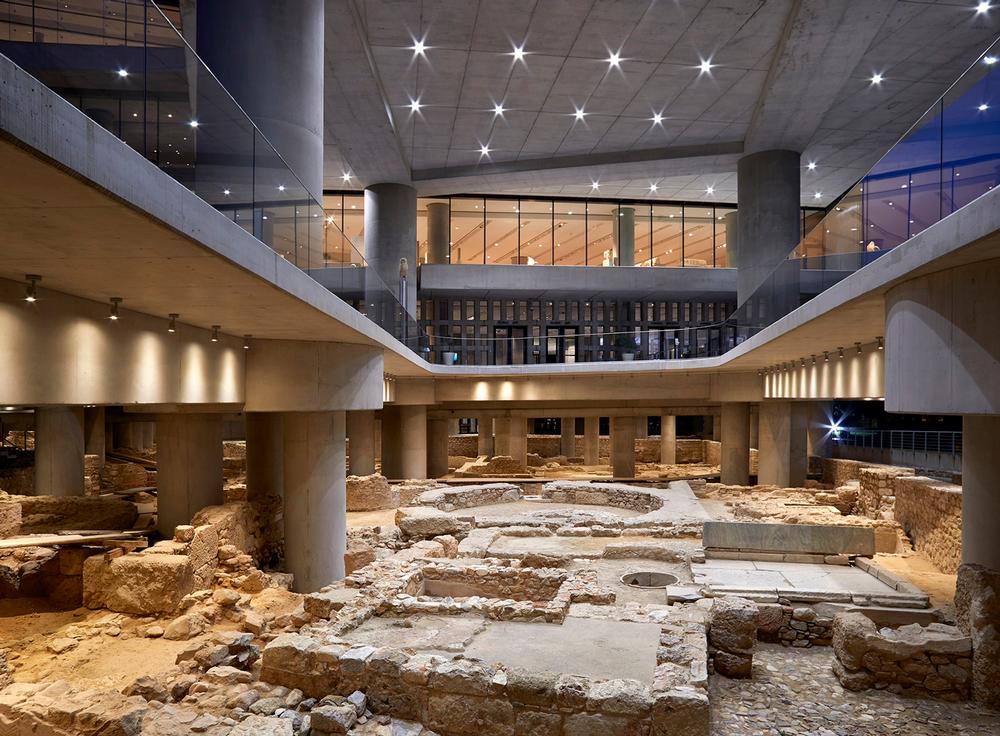
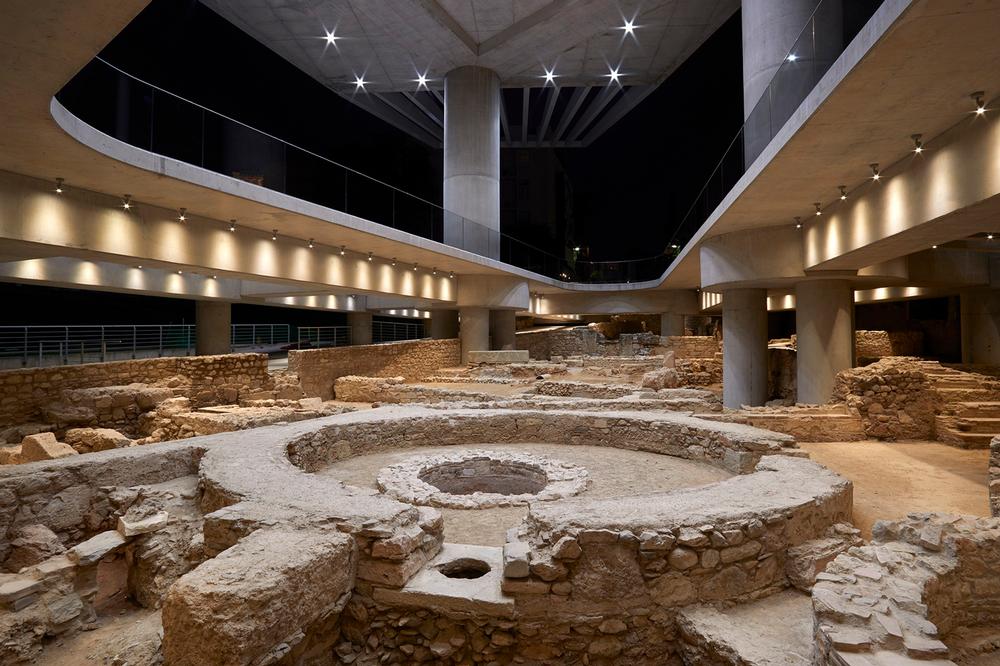
Turning the page Rather than take this as a negative, however, the museum’s leaders opted for a redesign so the building could be constructed on top of a series of columns, preserving the ancient site for future generations. Now, exactly a decade on from the opening, the dig has opened to the public for the first time.
“More than 4,000sq m (43,000sq ft) of the remains of the neighbourhood can now be seen at close quarters by visitors, who walk on metal ramps erected over the excavation,” says the museum’s president, Dimitrios Pandermalis. “Visitors can have a unique experience in a fascinating environment, becoming familiar with the day-to-day life of the ancient Athenians.”
Pandermalis, who has been with the museum since its foundation, has overseen the excavation project, which comprises houses, workshops, bathhouses and streets, dating from the late classical era in the 5th century BC, up to the early Byzantine period in the 12th century AD.
Opened to the public on 21 June this year, the ancient site has been excavated over a period of 13 years, with around 50,000 artefacts discovered during the process. The most representative findings of the excavation – such as a Roman-era copy of a 4th century BC marble bust of Aristotle – will soon be put on display inside the museum.
“The presentation of the ruins of the Ancient Athenian urban fabric that were revealed on the site has been optimally presented, with natural light reaching down to the architectural remains with the roads, houses, workshops and public baths,” says Pandermalis.
“We wanted to avoid a basement feeling and not to restrict these findings to a dark space that deprives them of their vitality. The entire excavation is the exhibit and our visitors are invited to explore throughout, giving them a strong sense of life in this ancient neighbourhood.”
Turning the page According to Pandermalis, the introduction of the excavated site represents a new chapter in the museum’s history.
“Ten years have passed quickly, but they’ve left a strong mark on this new beginning for the Acropolis Museum,” he says. “For the first time we’re able to see how people lived in the shadow of the Acropolis and through the display of discoveries such as plates and toys, visitors will have a glimpse into the daily lives of ancient Greeks.”
Not only has work been done underneath the museum, but within the institution itself. Over the last decade, in order to offer a fuller appreciation of the exhibits, the museum has developed innovative digital representations of exhibits, discreetly presented next to the originals. It’s also introduced modern technologies to narrate the history of the Parthenon – the iconic temple that’s regarded as an enduring symbol of Ancient Greece, Athenian democracy and Western civilisation. Not only that, but research carried out on newly-discovered artefacts is educating the museum’s ongoing programmes and exhibitions.
“Our museum conservators and the site’s archaeologists work closely together,” says Pandermalis. “This has led to the discovery of significant fragments that assist in the reconstitution of well-known museum exhibits.
“In a number of cases, new displays have been introduced following research, correcting earlier exhibit mounts and interpretations. In 2011 we completely renewed the museum’s explanatory texts in the exhibition galleries, enriching each text panel with fuller historical, sociopolitical and archaeological information as a result.”
Continuing to work with its archaeologists, the museum introduced the role of archaeologist host soon after opening. In these roles, qualified archaeologists with skills in communication convey accurate information to visitors, presenting gallery talks, school presentations and gallery-centred activities for children and families.
Entering the digital age A large part of the work undertaken to digitise the museum’s collections has been part of a broader program of multimedia projects supported by funding from the European Union.
“The project has involved a broad range of museum staff and is approaching finalisation, with the development of a new museum website and a large range of adult and children’s digital applications, videos and games that communicate the museum and its exhibits both onsite in the museum and online on its new website,” says Pandermalis.
Enduring appeal Since its grand opening in 2009, 14.5 million people have visited the museum, travelling from locations around Greece and from destinations abroad. “During the museum’s first years of operation, which coincided with the economic crisis, the number of visitors reached one million,” says Pandermalis. “In 2018 however, we received 1.8 million visitors, which is a significant increase.”
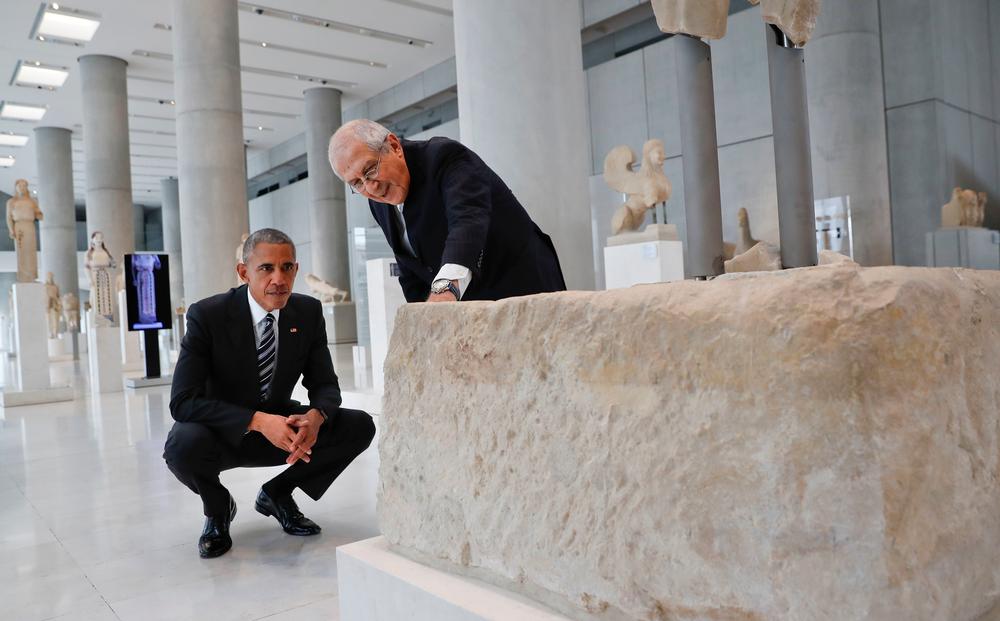
Most of the museum’s overseas visitors have come from the US. Of the millions to pass through its doors, one of the most notable was former US President Barack Obama, who on the last foreign trip of his term in office, toured the Acropolis in a closed-site visit in November 2016.
Marking the first official visit to Greece by a sitting US president since Bill Clinton, the hilltop complex said Obama, was a “monument to free thought, artistic expression and architectural prowess”, something echoed by its millions of visitors over the last decade and the International Council of Museums (ICOM), which has included it among the five most significant museums anywhere in the world.
The museum’s anniversary was marked by a series of events in the lead up to the opening of the archaeological site. These included a lecture on Parthenon sculptures; a music concert by the Greek composer Stavros Xarchakos and an orchestra of eight renowned Greek soloists.
Aiming to shed light on the Acropolis restoration process, a temporary exhibition, titled Chisel and Memory, opened on 11 June and will remain open until 31 October.
Read more from this issue of Attractions Management magazine
View contents of Attractions Management 2019 issue 3
People profile: Tom Hennes
Tom Hennes discusses how he has transformed the Empire State Building's visitor experience
People profile: Dimitrios Pandermalis
The Acropolis Museum has just celebrated its 10-year anniversary. Its president, Dimitrios Pandermalis, talks about his plans to take the museum forward in the next decade and beyond
People profile: Gus Antorcha
SeaWorld's new CEO Gus Antorcha on the company's new direction as it starts to recover following several years of turmoil
Museums: A museum in motion
The Australian Centre for the Moving Image
is undergoing a AUS$40m renewal. CEO
Katrina Sedgwick talks about the plans
Tourism: The dark side
With locations like Chernobyl increasing
in popularity, Kath Hudson looks at the
dark side of the global tourism sector
Promotional feature: Whitewater
WhiteWater thinks outside the box to create memorable,
immersive experiences that go beyond the thrill
Rides: Monsters, myths and motorbikes
We take a look at some of the biggest ride
openings for visitor attractions worldwide,
including Universal’s new Hagrid coaster
Promotional feature: OurPeople
Home to the world-revered peppa pig world and welcoming more than one
million visitors every year, paultons park was voted Tripadvisor’s number
one UK amusement park for the fourth year running in 2019
The museum was built on columns to preserve an ancient Roman site found underneath the building
The museum was built on columns to preserve an ancient Roman site found underneath the building
Former US President Barack Obama toured the Acropolis Museum on a closed-site visit in November 2016 on his last foreign trip during his term in office
COMPANY PROFILES
DJW
David & Lynn Willrich started the Company
over thirty years ago, from the Audio Visual
Department [more...]
Alterface
Alterface’s Creative Division team is
seasoned in concept and ride development,
as well as storyte [more...]
IAAPA EMEA
IAAPA Expo Europe was established in 2006 and has grown to the largest international conference and [more...]
Dimitrios Pandermalis has been president of the Acropolis Museum since its foundation a decade ago
It wasn’t a smooth start for Greece’s Acropolis Museum. First touted in the early 2000s, some questioned whether or not the Greek gods themselves were trying to intervene in the €130m (US$145m) development.
The museum, which sits on the archaeological site of the Acropolis of Athens, Greece, was built to house every artefact found on the rock and its slopes.
Initial plans were plagued by problems and delays, including disputes with architects and contractors, as well as complaints from local residents trying to protect historic buildings from demolition. When work was finally approved, an ancient urban development was discovered in the ground dug for foundations of the museum, immediately halting construction.
Turning the page Rather than take this as a negative, however, the museum’s leaders opted for a redesign so the building could be constructed on top of a series of columns, preserving the ancient site for future generations. Now, exactly a decade on from the opening, the dig has opened to the public for the first time.
“More than 4,000sq m (43,000sq ft) of the remains of the neighbourhood can now be seen at close quarters by visitors, who walk on metal ramps erected over the excavation,” says the museum’s president, Dimitrios Pandermalis. “Visitors can have a unique experience in a fascinating environment, becoming familiar with the day-to-day life of the ancient Athenians.”
Pandermalis, who has been with the museum since its foundation, has overseen the excavation project, which comprises houses, workshops, bathhouses and streets, dating from the late classical era in the 5th century BC, up to the early Byzantine period in the 12th century AD.
Opened to the public on 21 June this year, the ancient site has been excavated over a period of 13 years, with around 50,000 artefacts discovered during the process. The most representative findings of the excavation – such as a Roman-era copy of a 4th century BC marble bust of Aristotle – will soon be put on display inside the museum.
“The presentation of the ruins of the Ancient Athenian urban fabric that were revealed on the site has been optimally presented, with natural light reaching down to the architectural remains with the roads, houses, workshops and public baths,” says Pandermalis.
“We wanted to avoid a basement feeling and not to restrict these findings to a dark space that deprives them of their vitality. The entire excavation is the exhibit and our visitors are invited to explore throughout, giving them a strong sense of life in this ancient neighbourhood.”
Turning the page According to Pandermalis, the introduction of the excavated site represents a new chapter in the museum’s history.
“Ten years have passed quickly, but they’ve left a strong mark on this new beginning for the Acropolis Museum,” he says. “For the first time we’re able to see how people lived in the shadow of the Acropolis and through the display of discoveries such as plates and toys, visitors will have a glimpse into the daily lives of ancient Greeks.”
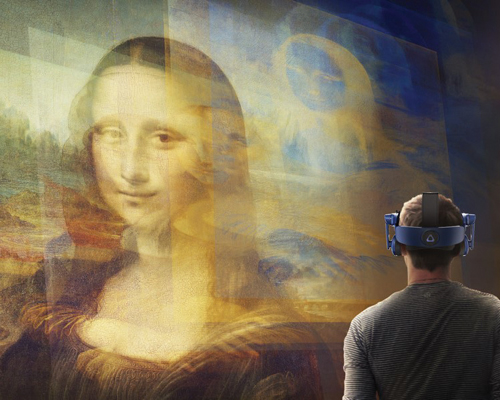
Not only has work been done underneath the museum, but within the institution itself. Over the last decade, in order to offer a fuller appreciation of the exhibits, the museum has developed innovative digital representations of exhibits, discreetly presented next to the originals. It’s also introduced modern technologies to narrate the history of the Parthenon – the iconic temple that’s regarded as an enduring symbol of Ancient Greece, Athenian democracy and Western civilisation. Not only that, but research carried out on newly-discovered artefacts is educating the museum’s ongoing programmes and exhibitions.
“Our museum conservators and the site’s archaeologists work closely together,” says Pandermalis. “This has led to the discovery of significant fragments that assist in the reconstitution of well-known museum exhibits.
“In a number of cases, new displays have been introduced following research, correcting earlier exhibit mounts and interpretations. In 2011 we completely renewed the museum’s explanatory texts in the exhibition galleries, enriching each text panel with fuller historical, sociopolitical and archaeological information as a result.”
Continuing to work with its archaeologists, the museum introduced the role of archaeologist host soon after opening. In these roles, qualified archaeologists with skills in communication convey accurate information to visitors, presenting gallery talks, school presentations and gallery-centred activities for children and families.
Entering the digital age A large part of the work undertaken to digitise the museum’s collections has been part of a broader program of multimedia projects supported by funding from the European Union.
“The project has involved a broad range of museum staff and is approaching finalisation, with the development of a new museum website and a large range of adult and children’s digital applications, videos and games that communicate the museum and its exhibits both onsite in the museum and online on its new website,” says Pandermalis.
Enduring appeal Since its grand opening in 2009, 14.5 million people have visited the museum, travelling from locations around Greece and from destinations abroad. “During the museum’s first years of operation, which coincided with the economic crisis, the number of visitors reached one million,” says Pandermalis. “In 2018 however, we received 1.8 million visitors, which is a significant increase.”
Most of the museum’s overseas visitors have come from the US. Of the millions to pass through its doors, one of the most notable was former US President Barack Obama, who on the last foreign trip of his term in office, toured the Acropolis in a closed-site visit in November 2016.
Marking the first official visit to Greece by a sitting US president since Bill Clinton, the hilltop complex said Obama, was a “monument to free thought, artistic expression and architectural prowess”, something echoed by its millions of visitors over the last decade and the International Council of Museums (ICOM), which has included it among the five most significant museums anywhere in the world.
The museum’s anniversary was marked by a series of events in the lead up to the opening of the archaeological site. These included a lecture on Parthenon sculptures; a music concert by the Greek composer Stavros Xarchakos and an orchestra of eight renowned Greek soloists.
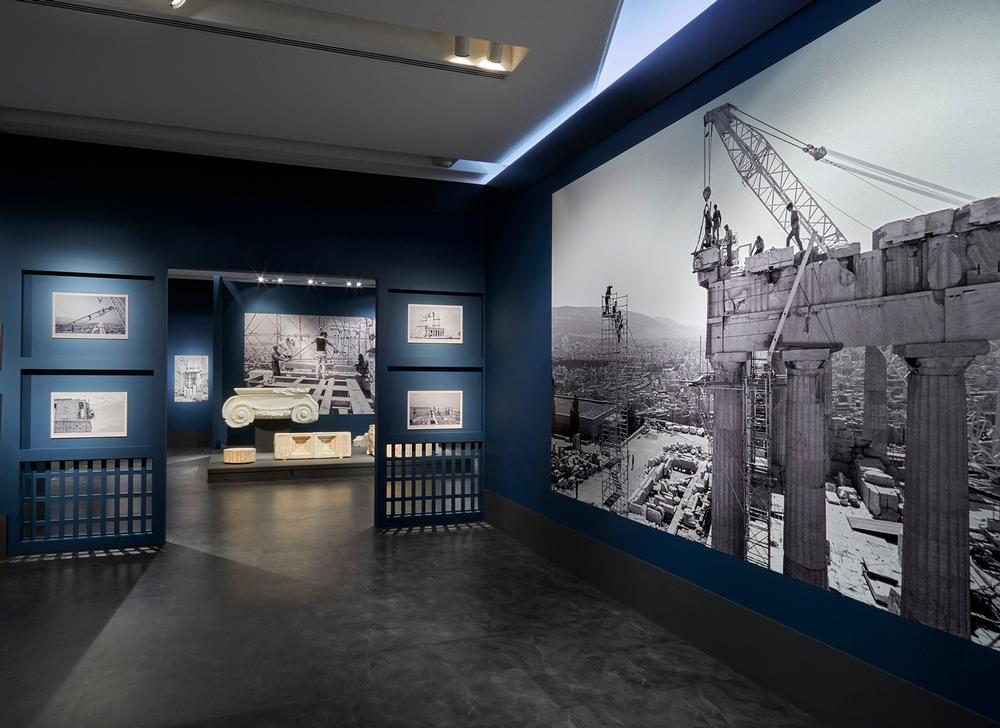
Aiming to shed light on the Acropolis restoration process, a temporary exhibition, titled Chisel and Memory, opened on 11 June and will remain open until 31 October.
Read more from this issue of Attractions Management magazine
View contents of Attractions Management 2019 issue 3
People profile: Tom Hennes
Tom Hennes discusses how he has transformed the Empire State Building's visitor experience
People profile: Dimitrios Pandermalis
The Acropolis Museum has just celebrated its 10-year anniversary. Its president, Dimitrios Pandermalis, talks about his plans to take the museum forward in the next decade and beyond
People profile: Gus Antorcha
SeaWorld's new CEO Gus Antorcha on the company's new direction as it starts to recover following several years of turmoil
Museums: A museum in motion
The Australian Centre for the Moving Image
is undergoing a AUS$40m renewal. CEO
Katrina Sedgwick talks about the plans
Tourism: The dark side
With locations like Chernobyl increasing
in popularity, Kath Hudson looks at the
dark side of the global tourism sector
Promotional feature: Whitewater
WhiteWater thinks outside the box to create memorable,
immersive experiences that go beyond the thrill
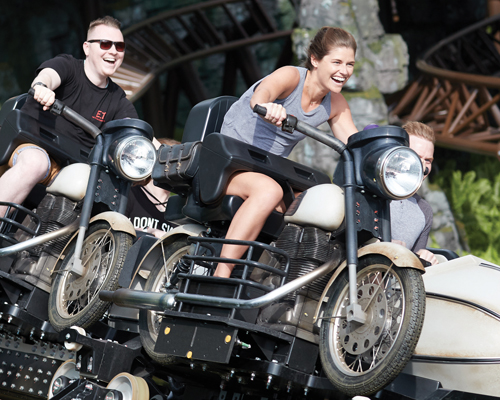
Rides: Monsters, myths and motorbikes
We take a look at some of the biggest ride
openings for visitor attractions worldwide,
including Universal’s new Hagrid coaster
Promotional feature: OurPeople
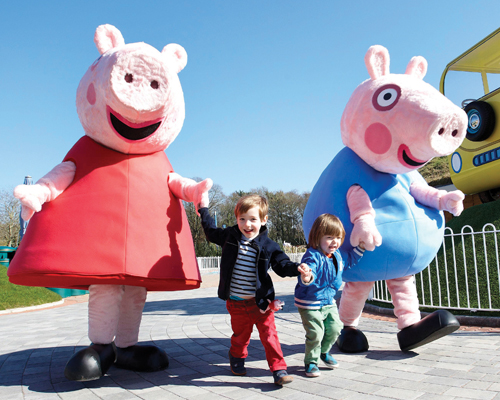
Home to the world-revered peppa pig world and welcoming more than one
million visitors every year, paultons park was voted Tripadvisor’s number
one UK amusement park for the fourth year running in 2019
The museum was built on columns to preserve an ancient Roman site found underneath the building
The museum was built on columns to preserve an ancient Roman site found underneath the building
Former US President Barack Obama toured the Acropolis Museum on a closed-site visit in November 2016 on his last foreign trip during his term in office
A US$50 million (£44.2 million, €51.2 million) transformation of Chicago's historic McCormick
Mansion has created a new destination that combines live magic, immersive theatre, dining and
private membership under one roof.
The Montana Historical Society has officially celebrated the opening of its new Montana
Heritage
Center, a US$107 million (£79 million, €92 million) destination that combines immersive
storytelling with cutting-edge audiovisual technology to bring the sta
San Antonio Zoo has reported a US$283 million economic impact for 2025, following a decade-
long transformation programme that has seen almost US$200 million invested into the Texas
attraction.
Plans for the AU$180 million redevelopment of Reef HQ Aquarium in Townsville, Australia, are
progressing, with the project set to transform the attraction into a global centre for reef
education and conservation.
Abu Dhabi-based investment firm Mubadala Capital has made a binding, fully financed
€1 billion
offer to acquire Pierre and Vacances SA, the European holiday resort operator behind the
continental European Center Parcs business.
Disney has reaffirmed its commitment to investing US$30 billion in its US parks and cruise
business by 2033, using new America250 celebrations to underline the role its attractions play
in supporting jobs, tourism and economic growth.
Expo 2030 Riyadh is being planned as a permanent visitor destination, with organisers
confirming the six-million-square-metre site will become a Global Village after the event closes.
The owner of one of Australia's best-known waterparks has acquired a major competitor,
creating a new attractions business spanning two of the country's largest visitor destinations.
The Toverland theme park in the Netherlands has announced a €98m expansion programme
that will add a resort, new attractions and staff facilities as it pursues plans to become a multi-
day destination.
Hotel de France, located on the British Isle of Jersey, has created a wellness retreat package
that includes a hot yoga session that will take place in Jersey Zoo’s butterfly sanctuary.
+ More news
COMPANY PROFILES
DJW David & Lynn Willrich started the Company
over thirty years ago, from the Audio Visual
Department [more...]
Alterface Alterface’s Creative Division team is
seasoned in concept and ride development,
as well as storyte [more...]
IAAPA EMEA IAAPA Expo Europe was established in 2006 and has grown to the largest international conference and [more...]