Three concepts shared at the recent MuseumNext conference illustrate how technology can reimagine the future, recreate the past and preserve a collection once decommissioned
By Tom Anstey | Published in Attractions Management 2014 issue 3
Read more from this issue of Attractions Management magazine
View contents of Attractions Management 2014 issue 3
Editor’s letter: Here comes China
As China opens up to the West, the nation’s attractions are
booming, with existing attractions reporting record attendances and
new museums, theme parks and science centres planned
Teamworking: The Art of Collaboration
Merlin’s Mark Fisher talks about working
with Hollywood studio DreamWorks on
the upcoming Shrek-themed midways,
how to spot a winning IP and the
importance of creative collaboration
Talking Point: Whose Museum Is It Anyway?
Five experts debate how museums
can tackle the controversial issue
of balancing the needs of the visitor
with their curatorial responsibilities
Analysis: TEA/AECOM Enduring Appeal
Theme park attendance for 2013
reached an all-time high, and museums
worldwide performed well. AECOM’s
economics experts crunch the numbers
Theme Parks: Oceans of Fun
Chimelong International Ocean Resort
is a big development on a small island.
Will its proximity to the gambling haven
of Macau be a help or a hindrance?
Museums: Virtual Visits
Europe’s biggest museum conference
looks at how technology and the digital
revolution can enhance the attraction. We
report from the event in Newcastle, UK
Technology: Face Reality
As Facebook’s Mark Zuckerberg buys
Oculus VR and its Rift device, we look at
how far VR has come, and ask whether
it has a place in the attractions industry
Profile: Sarah Maltby
As Jorvik turns 30, director Sarah
Maltby talks about keeping archaeology
at the heart of what the Viking centre
does, and moving with the times
Storytelling: Inside Story
Abu Dhabi’s Yas Waterworld draws on
the local culture to create a narrative
journey for its visitors. Atkins Global
tells us about an innovative approach
Interview: Rick Schwartz
San Diego Zoo Global ambassador on the
Tiger Trail and conservation initiatives
Eyeing the future A method of drawing the next generation to museums and galleries was offered by freelance artist and digital guru Adam Clarke at the MuseumNext conference in Newcastle in June. He said that Minecraft – a sandbox indie game which allows players to build constructions out of textured cubes in a 3D-generated world – could be used to educate children and promote their interest in museums worldwide.
A forefront creator within the online Minecraft community, Clarke has instigated numerous groundbreaking Minecraft projects and is widely involved in the use of Minecraft within cultural, heritage and educational settings.
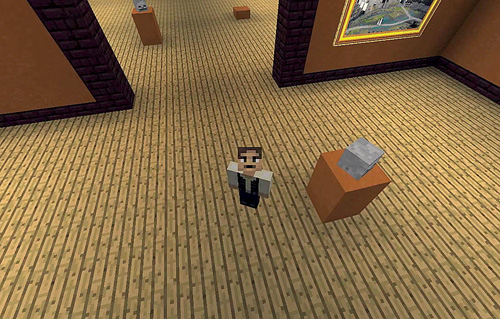
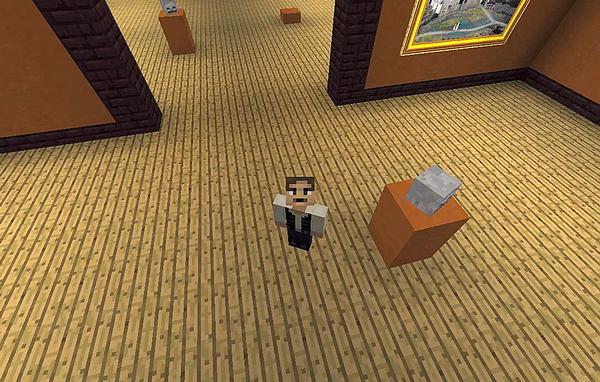
Clarke suggested using Minecraft to teach young people about museums, artefacts, science and archaeology. Among the innovations created by Clarke in the game, one of the most outstanding is Tatecraft – a project shortlisted for the Tate Britain IK Prize, which celebrates talent in the digital industry. In Tatecraft, Tate Britain is recreated in-game, with players able to enter the works of art, explore the scene and see “behind” the image depicted.
“It’s an adventure in art and culture – not learning in the traditional sense, but kids are making these connections from gameplay,” Clarke says. “If you look to the side there are a lot of opportunities to turn games like Minecraft into learning.”
Objects created in Minecraft can now be 3D printed in the real world, bringing virtual creations to life.
This also benefits learning institutions such as science museums, who find hi-tech tools like this appeal to a young generation of visitors to their attractions.
Adam Clarke
Tatecraft is a Minecraft-rendered representation of the Tate Britain, which players can explore
In Tatecraft, players “walk in” to gallery works. For example, one can explore the streets of this painting ‘Liverpool Quays By Moonlight’
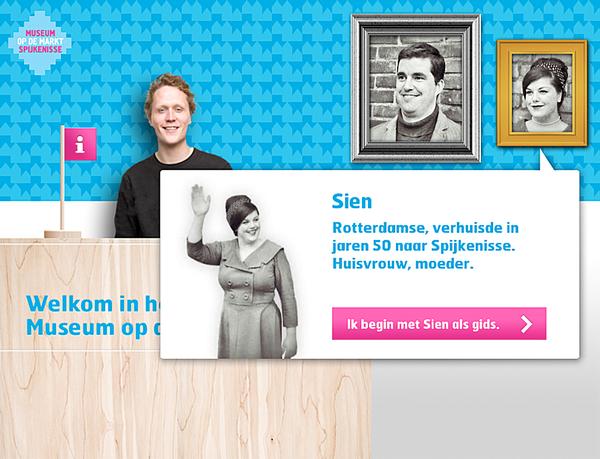
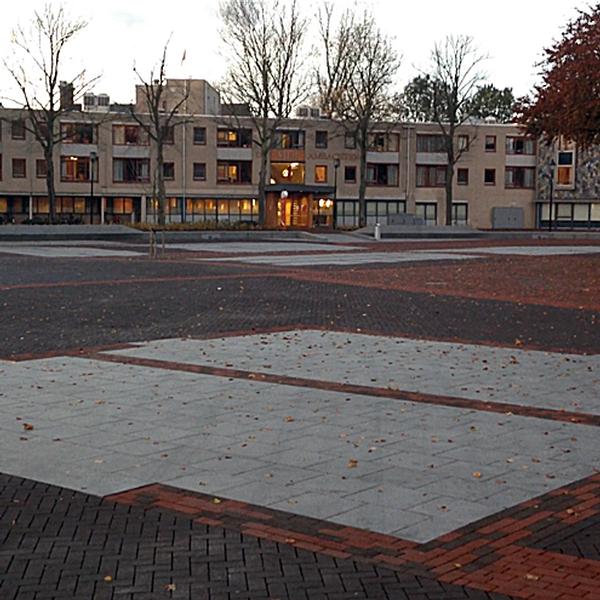
Reliving history An entirely virtual museum was presented at MuseumNext. The De Museum op de Markt Spijkenisse – an augmented reality museum – operates as an app, and uses a marketplace in the town of Spijkenisse in the Netherlands as the backdrop on which it creates the “museum”.
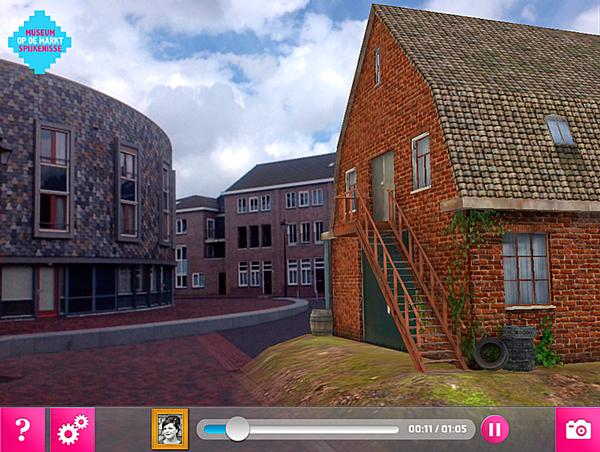
Using the app, visitors walk around the market place and observe the virtual museum, which asks your height and then uses floor mechanics to activate sensors reacting with the device. Full-size three-dimensional objects and long-demolished buildings seem to appear.
“We worked with two groups,” says app creator Ferry Piekart. “The older group who are nostalgic and the tech-savvy children who like the app. When you look at things, an audioguide will tell you the story of what you’re looking at and the app will pop up further images.”
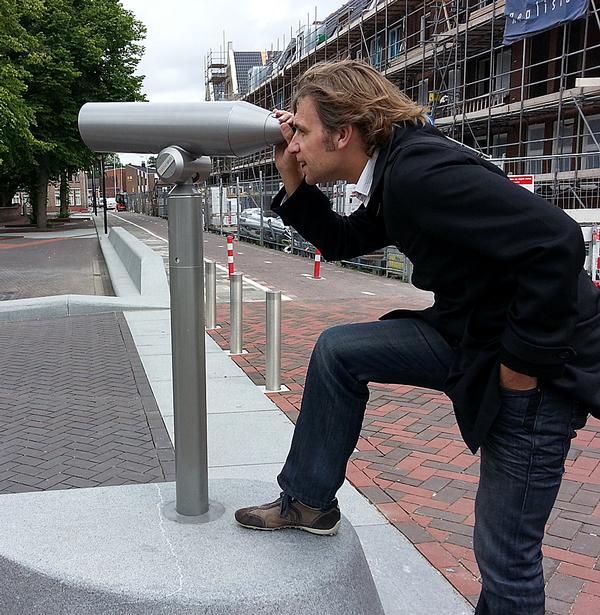
For those without an android device, fixed telescopes have been introduced around the marketplace with the same augmented reality technology installed for what is at present a one-of-a-kind experience.
An app created by Dutch firm Twnkls Augmented Reality reconstructs an old village square in 3D as it would have appeared in the past. The experience, for a tablet or smartphone, is accompanied by an audio narrative
An app created by Dutch firm Twnkls Augmented Reality reconstructs an old village square in 3D as it would have appeared in the past. The experience, for a tablet or smartphone, is accompanied by an audio narrative
An app created by Dutch firm Twnkls Augmented Reality reconstructs an old village square in 3D as it would have appeared in the past. The experience, for a tablet or smartphone, is accompanied by an audio narrative
An app created by Dutch firm Twnkls Augmented Reality reconstructs an old village square in 3D as it would have appeared in the past. The experience, for a tablet or smartphone, is accompanied by an audio narrative
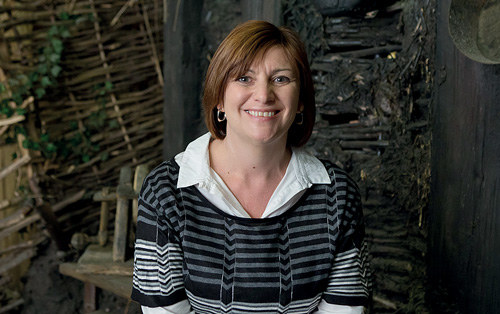
Ferry Piekart uses the on-site telescope to view the market
Preserving Past Collections Using a different tactic, Scanlab and the Science Museum in London used cutting-edge 3D laser-scanning technology to 3D scan an entire area of the museum before it was decommissioned, preserving the exhibits for generations to come.
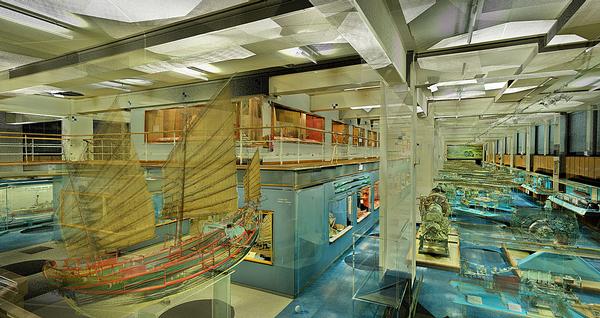
The museum’s shipping galleries, which originally opened in 1963, closed in 2012. They formed the largest gallery in the Science Museum. The entrance was a huge floor mural of a compass rose and beyond this was a two-tiered exhibition space of hundreds of exhibits chronicling maritime technology. Hundreds of incredibly detailed models of various sea vessels were included.
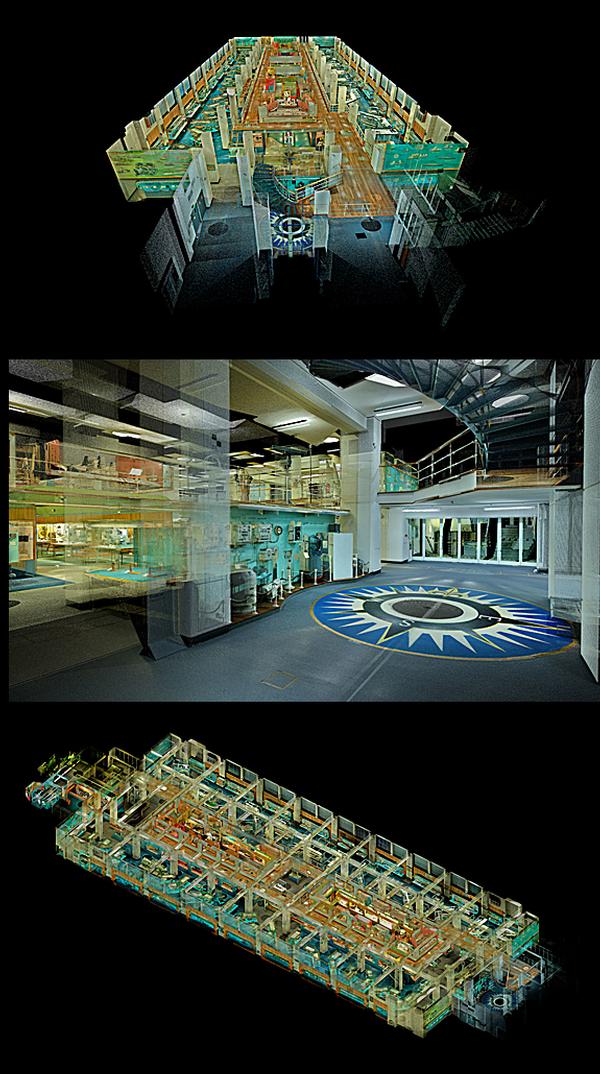
Scanlab’s Matthew Shaw and William Trossell told MuseumNext how they used two Faro Photo 120 terrestrial laser scanners. Rotating mirrors recorded 1 million reflections per second in a 360o scan at sub-millimetre resolution. Over five nights, 275 scans made 2 billion precise measurements to build a 3D model called a “point cloud” composed of 256GB of data that took 16 weeks to process.
Colour was later added to the scans by means of a digital camera on top of the scanner taking panoramic images. The colours from these images were mapped on to the monochromatic model.
Because of the size and scope of the scan it has so far only been used to produce a three-dimensional video fly-around of the gallery representing just one-tenth of the data collected, though in the future the museum hopes to find a way to make the data readily available for anyone who wishes to use it.
Scanning the Shipping Galleries at London’s Science Museum meant they were digitally captured before they were decommissioned
Scanning the Shipping Galleries at London’s Science Museum meant they were digitally captured before they were decommissioned
Scanlab’s William Trossell
About MuseumNext
MuseumNext is Europe’s largest conference dedicated to museums. Making its debut in 2009, the event asks what the future holds for museums, showcasing tech innovations and best practice for the museums of tomorrow. For 2014, keynote speakers debating the hot topics included museums expert Koven J Smith, Colleen Dilenschneider of market intelligence analysts IMPACT and design agency founder Jason Minyo. The networking and seminar event took place this year at Newcastle’s Sage Gateshead, UK, with next year’s host to be announced in August. The conference covered everything from how Minecraft can get more kids into museums to how love affects how we view a museum.
An opportunity to reimagine one of the UK’s most recognisable towers has been formally
opened by Rivington Hark, as St Johns Beacon invites operators and partners to shape its
next phase. [more...]
Three concepts shared at the recent MuseumNext conference illustrate how technology can reimagine the future, recreate the past and preserve a collection once decommissioned
By Tom Anstey | Published in Attractions Management 2014 issue 3
Read more from this issue of Attractions Management magazine
View contents of Attractions Management 2014 issue 3
Editor’s letter: Here comes China
As China opens up to the West, the nation’s attractions are
booming, with existing attractions reporting record attendances and
new museums, theme parks and science centres planned
Teamworking: The Art of Collaboration
Merlin’s Mark Fisher talks about working
with Hollywood studio DreamWorks on
the upcoming Shrek-themed midways,
how to spot a winning IP and the
importance of creative collaboration
Talking Point: Whose Museum Is It Anyway?
Five experts debate how museums
can tackle the controversial issue
of balancing the needs of the visitor
with their curatorial responsibilities
Analysis: TEA/AECOM Enduring Appeal
Theme park attendance for 2013
reached an all-time high, and museums
worldwide performed well. AECOM’s
economics experts crunch the numbers
Theme Parks: Oceans of Fun
Chimelong International Ocean Resort
is a big development on a small island.
Will its proximity to the gambling haven
of Macau be a help or a hindrance?
Museums: Virtual Visits
Europe’s biggest museum conference
looks at how technology and the digital
revolution can enhance the attraction. We
report from the event in Newcastle, UK
Technology: Face Reality
As Facebook’s Mark Zuckerberg buys
Oculus VR and its Rift device, we look at
how far VR has come, and ask whether
it has a place in the attractions industry
Profile: Sarah Maltby
As Jorvik turns 30, director Sarah
Maltby talks about keeping archaeology
at the heart of what the Viking centre
does, and moving with the times
Storytelling: Inside Story
Abu Dhabi’s Yas Waterworld draws on
the local culture to create a narrative
journey for its visitors. Atkins Global
tells us about an innovative approach
Interview: Rick Schwartz
San Diego Zoo Global ambassador on the
Tiger Trail and conservation initiatives
Eyeing the future A method of drawing the next generation to museums and galleries was offered by freelance artist and digital guru Adam Clarke at the MuseumNext conference in Newcastle in June. He said that Minecraft – a sandbox indie game which allows players to build constructions out of textured cubes in a 3D-generated world – could be used to educate children and promote their interest in museums worldwide.
A forefront creator within the online Minecraft community, Clarke has instigated numerous groundbreaking Minecraft projects and is widely involved in the use of Minecraft within cultural, heritage and educational settings.
Clarke suggested using Minecraft to teach young people about museums, artefacts, science and archaeology. Among the innovations created by Clarke in the game, one of the most outstanding is Tatecraft – a project shortlisted for the Tate Britain IK Prize, which celebrates talent in the digital industry. In Tatecraft, Tate Britain is recreated in-game, with players able to enter the works of art, explore the scene and see “behind” the image depicted.
“It’s an adventure in art and culture – not learning in the traditional sense, but kids are making these connections from gameplay,” Clarke says. “If you look to the side there are a lot of opportunities to turn games like Minecraft into learning.”
Objects created in Minecraft can now be 3D printed in the real world, bringing virtual creations to life.
This also benefits learning institutions such as science museums, who find hi-tech tools like this appeal to a young generation of visitors to their attractions.
Adam Clarke
Tatecraft is a Minecraft-rendered representation of the Tate Britain, which players can explore
In Tatecraft, players “walk in” to gallery works. For example, one can explore the streets of this painting ‘Liverpool Quays By Moonlight’
Reliving history An entirely virtual museum was presented at MuseumNext. The De Museum op de Markt Spijkenisse – an augmented reality museum – operates as an app, and uses a marketplace in the town of Spijkenisse in the Netherlands as the backdrop on which it creates the “museum”.
Using the app, visitors walk around the market place and observe the virtual museum, which asks your height and then uses floor mechanics to activate sensors reacting with the device. Full-size three-dimensional objects and long-demolished buildings seem to appear.
“We worked with two groups,” says app creator Ferry Piekart. “The older group who are nostalgic and the tech-savvy children who like the app. When you look at things, an audioguide will tell you the story of what you’re looking at and the app will pop up further images.”
For those without an android device, fixed telescopes have been introduced around the marketplace with the same augmented reality technology installed for what is at present a one-of-a-kind experience.
An app created by Dutch firm Twnkls Augmented Reality reconstructs an old village square in 3D as it would have appeared in the past. The experience, for a tablet or smartphone, is accompanied by an audio narrative
An app created by Dutch firm Twnkls Augmented Reality reconstructs an old village square in 3D as it would have appeared in the past. The experience, for a tablet or smartphone, is accompanied by an audio narrative
An app created by Dutch firm Twnkls Augmented Reality reconstructs an old village square in 3D as it would have appeared in the past. The experience, for a tablet or smartphone, is accompanied by an audio narrative
An app created by Dutch firm Twnkls Augmented Reality reconstructs an old village square in 3D as it would have appeared in the past. The experience, for a tablet or smartphone, is accompanied by an audio narrative
Ferry Piekart uses the on-site telescope to view the market
Preserving Past Collections Using a different tactic, Scanlab and the Science Museum in London used cutting-edge 3D laser-scanning technology to 3D scan an entire area of the museum before it was decommissioned, preserving the exhibits for generations to come.
The museum’s shipping galleries, which originally opened in 1963, closed in 2012. They formed the largest gallery in the Science Museum. The entrance was a huge floor mural of a compass rose and beyond this was a two-tiered exhibition space of hundreds of exhibits chronicling maritime technology. Hundreds of incredibly detailed models of various sea vessels were included.
Scanlab’s Matthew Shaw and William Trossell told MuseumNext how they used two Faro Photo 120 terrestrial laser scanners. Rotating mirrors recorded 1 million reflections per second in a 360o scan at sub-millimetre resolution. Over five nights, 275 scans made 2 billion precise measurements to build a 3D model called a “point cloud” composed of 256GB of data that took 16 weeks to process.
Colour was later added to the scans by means of a digital camera on top of the scanner taking panoramic images. The colours from these images were mapped on to the monochromatic model.
Because of the size and scope of the scan it has so far only been used to produce a three-dimensional video fly-around of the gallery representing just one-tenth of the data collected, though in the future the museum hopes to find a way to make the data readily available for anyone who wishes to use it.
Scanning the Shipping Galleries at London’s Science Museum meant they were digitally captured before they were decommissioned
Scanning the Shipping Galleries at London’s Science Museum meant they were digitally captured before they were decommissioned
Scanlab’s William Trossell
About MuseumNext
MuseumNext is Europe’s largest conference dedicated to museums. Making its debut in 2009, the event asks what the future holds for museums, showcasing tech innovations and best practice for the museums of tomorrow. For 2014, keynote speakers debating the hot topics included museums expert Koven J Smith, Colleen Dilenschneider of market intelligence analysts IMPACT and design agency founder Jason Minyo. The networking and seminar event took place this year at Newcastle’s Sage Gateshead, UK, with next year’s host to be announced in August. The conference covered everything from how Minecraft can get more kids into museums to how love affects how we view a museum.
Experience design company, BRC Imagination Arts, has completed a transition that sees founder
Bob Rogers pass ownership of the business to four long-serving senior executives, while
remaining actively involved with the company.
Movie Park Germany has opened a new Paramount Pictures-themed attraction as part of its 30th
anniversary celebrations, using immersive storytelling and adaptive reuse to reinforce the park’s
longstanding “Hollywood in Germany” positioning.
Therme Manchester’s 28-acre development, which will include interconnected glass pavilions
that measure 65,000sq m, will be the largest bathing and wellbeing attraction in the world once
complete, according to prof David Russell, CEO of Therme UK.
Efteling has opened Hooghmoed, a new family drop tower designed to broaden the appeal of its
recently launched Sirene Island themed area and introduce younger visitors to thrill attractions.
A proposed Puy du Fou development near Bicester and Universal Destinations and Experiences’
planned resort in Bedford are emerging as part of a wider transformation of the Oxford–
Cambridge Growth Corridor into a major centre for UK leisure and tourism inv
Shedd Aquarium has opened the Immersion Theater developed in partnership with SimEx-
Iwerks, as part of a wider strategy to enhance the guest experience and create additional
revenue opportunities.
The UK government has announced a temporary reduction in VAT on visitor attractions and
children’s meals as part of a summer cost-of-living support package designed to stimulate the
visitor economy and encourage family days out.
As designer Yinka Ilori prepares for his first solo gallery show in London, he speaks exclusively
to CLADmag about his mission to spread joy, the power of play, and his bold approach to using
colour (including the colours you won’t see in his work).
The government of Thailand is exploring plans for a THB300bn (£6.3bn, US$8.3bn)
entertainment complex in the country’s Eastern Economic Corridor (EEC), with officials
proposing a large-scale theme park and sports destination as part of a broader tourism and
economic development strategy.
Royal Caribbean has revealed its Hero of the Seas cruise ship, home to the most pools at sea
(nine), and a record-breaking 28 dining venues, as well as attractions including a waterpark
with two new family raft slides.
+ More news
COMPANY PROFILES
TechnoAlpin Indoor TechnoAlpin is the world leader for snowmaking systems. With the Indoor snow division, TechnoAlpin c [more...]
An opportunity to reimagine one of the UK’s most recognisable towers has been formally
opened by Rivington Hark, as St Johns Beacon invites operators and partners to shape its
next phase. [more...]