Is going sub-zero the next big thing? We take
a closer look at the benefits of extreme cold
exposure and cryotherapy, as well as some
of the options on offer for those thinking
of making the leap into the big chill
Cryotherapy is commonly used in the sporting world and now its overall effect on wellbeing and beauty is being noted by spas
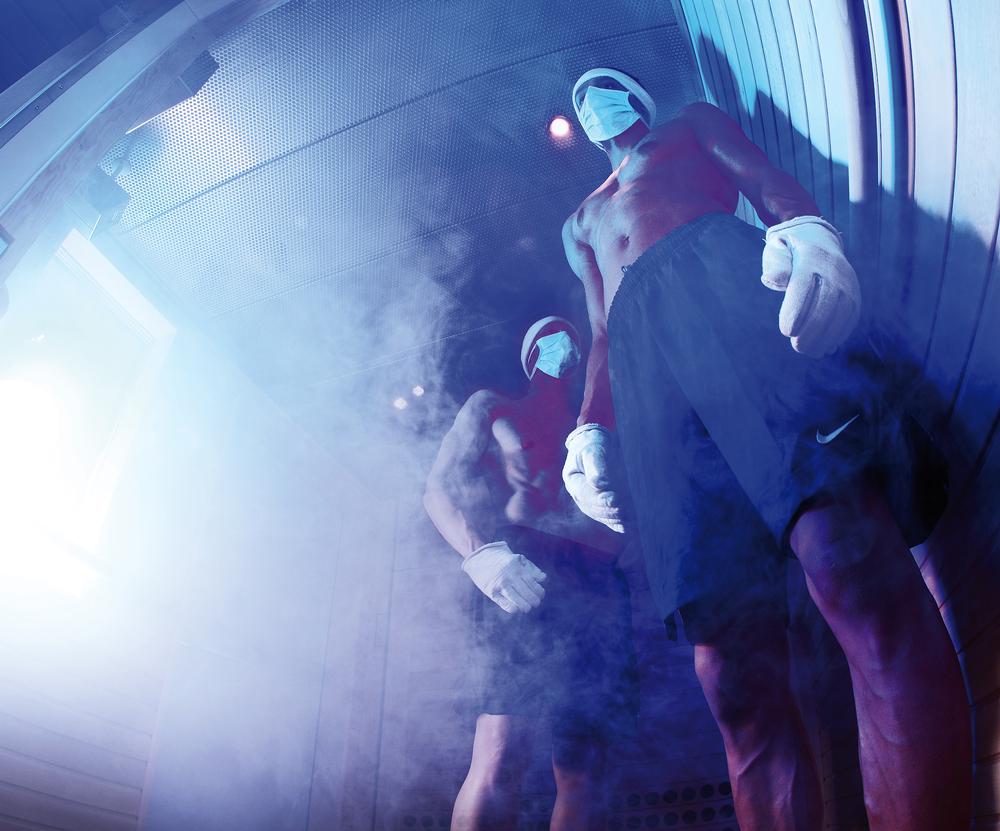
Standing for three minutes in a space cooled to minus 130°C may sound a tough sell to spa guests, but it’s a trend that’s becoming more mainstream as people warm to the health benefits of extreme cold.
The reported advantages of cryotherapy are many and varied, meaning it has a broad appeal: improved mood, fewer aches and pains for ageing joints, recovery after exercising and even a better appearance, with people emerging after treatments feeling more alert, upbeat and energised.
Cryotherapy works by forcing the body to send blood to the brain and the core in a process called vasoconstriction. Afterwards, vasodilation takes place, whereby blood that is now enriched with oxygen, nutrients and enzymes flows back into the peripheral tissues.
It’s commonly used in the sporting world as it increases power, performance and endurance, as well as clearing out lactate. It can boost recovery and reduce aches and pains – both from exercise and from chronic illnesses such as arthritis. Endorphins are also released and it’s even claimed to reduce wrinkles.
Its effect on overall wellbeing and beauty are being noted in spa circles. Rainer Bolsinger, sales manager of Zimmer MedizinSysteme – the German-based company behind Icelab cabins – likens cryotherapy to icing an injured knee, but the whole body and mind also benefit. He says: “It affects the nervous system, forcing our brain into a heightened state, which can give stress relief and clear the mind.”
Mecotec, another German-based company, supplies spas such as Lanserhof with the Cryoair chamber. Laurence White, MD of RP-X, its UK distributor, adds: “The body’s natural response to cold air provides total body and mind rejuvenation.
“It also helps the complexion and anti-ageing, as the cold temperatures stimulate the production of collagen, reducing fine lines and wrinkles and decreasing pore size. In addition, when combined with active cosmetic products, cryotherapy can increase the skin’s capacity to rejuvenate itself, regain elasticity, appear smoother and bring forth a youthful glow.”
Meanwhile, Wim Hof – also known as the ‘ice man’ – has created a method which combines exposure to sub-zero water (bathing or showering), breathing and mindset techniques alongside physical exercise. He reports profound effects including heightened focus and determination – he’s used the technique to climb Mount Everest in nothing but short runs and complete marathons in the desert with no water. He says: “The cold trains the vascular system and taps into deeper parts of the brain… A deep sense of control emerges from there.”
Spa Business interviewed Hof at the end of 2017 and in the same issue we asked a range of industry experts how spas can offer cold water therapy (see issue 4, 2017 p22 and p44).
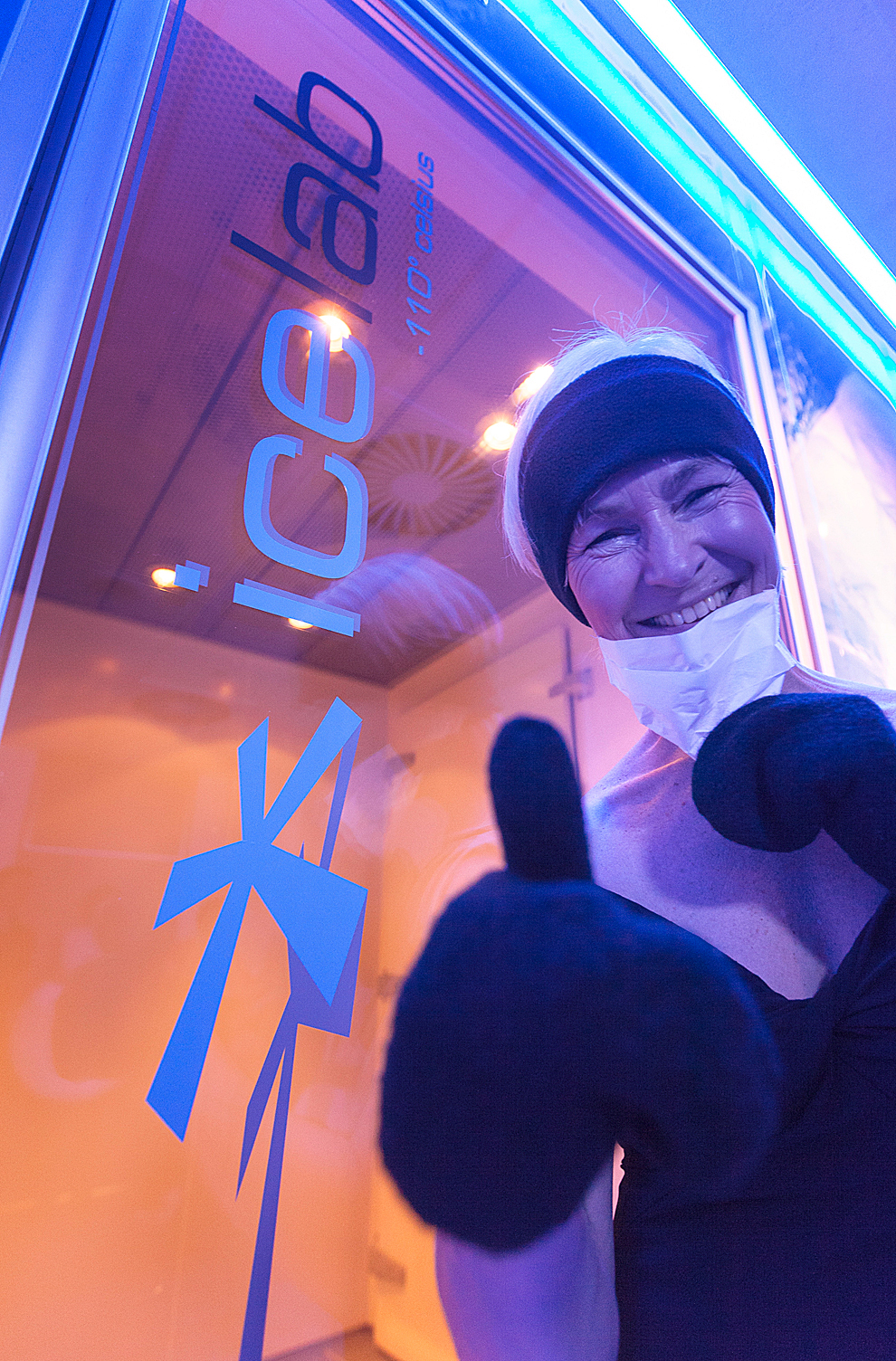
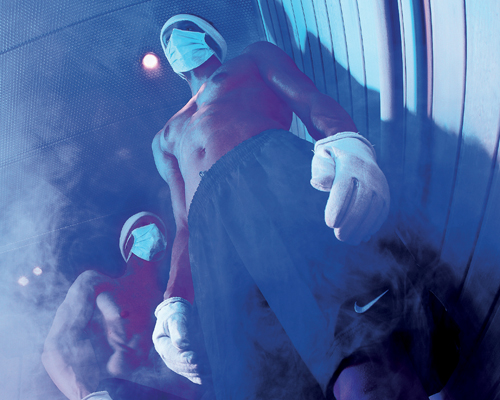
Roots in medicine The benefits might sound wonderful, but are they sufficient to warrant three minutes of extreme cold? According to Bolsinger, at this temperature, the air no longer contains moisture, so people don’t perceive the cold to be extreme. To protect their extremities, which are starved of blood during the treatment, users enter the chamber wearing protective masks, gloves, nipple protection and footwear. Music is often used to take their mind off the fact that they’re being chilled.
Cold therapy has a long history in medical treatments, first mentioned 400 years BC by Hippocrates as a method of treating pain. In the 19th century, Sebastian Kneipp popularised the Kneipp Method, which uses cold on the extremities – a method still used today in many spas and thermal baths (see SB16/4 p76).
“Whole-body cryostimulation at ultra-low temperatures was first applied by Professor T Yamauchi in Japan to treat rheumatoid arthritis. During the early 1980s several professors in Germany followed his approach and developed the treatment further,” says Bolsinger. “It’s been used in clinics and rehab centres as a method of treating pain, shortening rehabilitation and helping with stress and sleep. Now we’re seeing it move into the world of spas and fitness centres, where it’s used for preventative health, wellbeing, beauty and to optimise training and recovery.” Henri Chenot centres and the Bürgenstock resort are examples of spa operators which are tapping into the trend with Icelab.
UK-based company, CryoAction, says cryotherapy’s use in wellness is increasing and interest is growing across the board, from spas and health clubs to Premier League football clubs. “Cryotherapy is becoming increasingly popular across the health club sector and we’re installing new units all the time, driven by consumer demand, as clubs are seeking to respond to members who want to look and feel amazing,” says CryoAction CEO, Ian Saunders. “The chambers complement existing treatments and facilities and offer a new revenue opportunity.”
Icelab
Icelab uses environmentally-friendly compressor-based technology. Guests ease their way through one or two cool pre-chambers and finally reach the third which is set at -110°C and where they spend up to three minutes.
The rooms can accommodate up to four people at a time and music and video screens are installed as standard.
Guests can move around freely and the technicians speak to them through an intercom, suggesting different ways to move and stretch, to increase the effectiveness of the treatment. The Icelab system is distributed by Zimmer MedizinSysteme.
CryoAction
CryoAction designs, manufactures, installs and maintains its own products, which are certified for use as a medical device.
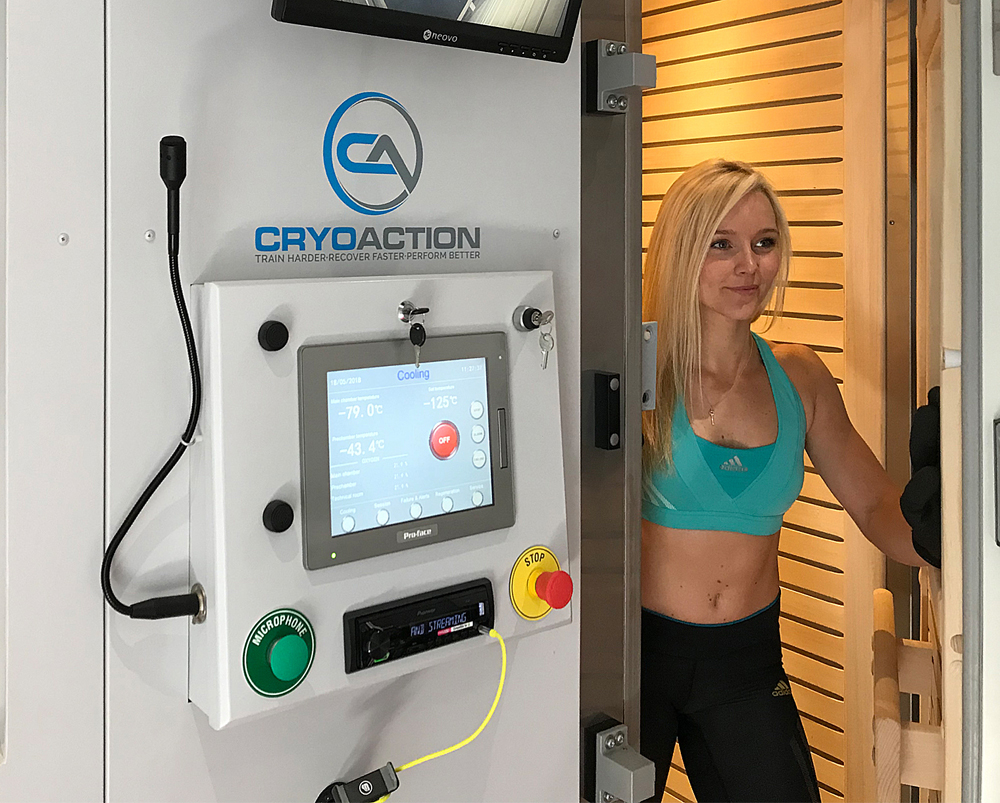
It has a portfolio that spans from single person chambers through to walk-in rooms, enabling up to 10 people to be treated simultaneously. Chambers can be standalone or integrated and are available in a wide selection of colours and materials to match a spa’s décor.
Larger bespoke chambers usually comprise two rooms linked by an interconnecting door. The first chamber is cooled to a temperature of around -60°C and the second to around -130°C.
Cryoair
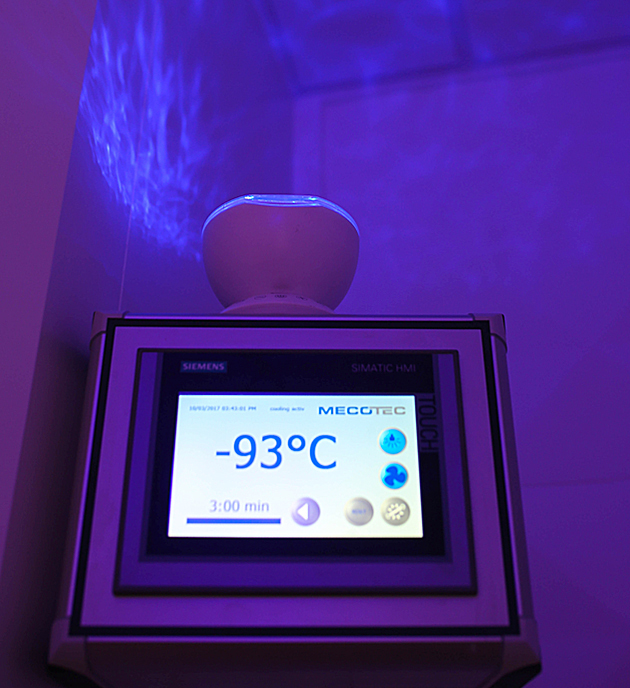
Cryoair offers two different sized chambers for commercial use. The Cryoair -85˚C has the capacity for one or two people. The Cryoair -110˚C is for high commercial use and can accommodate up to 30 users an hour.
People can use the chambers up to twice a day for three minutes.
The systems are made by Mecotec and distributed by RP-X in the UK.
Cold effects
•Research has proven that cryotherapy can
• Promote healing, wellbeing and quality of life
• Promote relaxation and deeper sleep
• Enhance lymph drainage and blood circulation
• Improve eczema
• Stimulate collagen production
• Increase energy levels
• Increase mobility
• Boost adrenaline and endorphins
• Reduce muscle soreness, pain and inflammation
• Speed up rehabilitation
• Improve fitness performance
Author
Kath-Hudson
Kath Hudson is a regular contributor to Spa Business magazine.
Spa Programmes: On the menu
Event saunas, sunlight therapy
and health and happiness retreats
feature in our programming series
Interview: Marc Cohen
Dr Marc Cohen is launching an extreme
bathing retreat and writing children’s
books. He talks to Jane Kitchen
Promotional feature: Vital Tech
Infrared technology is growing in popularity, Vital Tech’s Alexandra Gavsevitch
and Serge Parienti explain how it works
Focus on: Equine therapy
What is equine therapy and how
can spas tap into horsepower?
Kathleen Whyman finds out
Wellness: Chill out
Is going sub-zero the next big thing?
Kath Hudson takes a closer look
at the benefits of cryotherapy
Promotional feature: The Wellness
Noha Khalil of The Wellness discusses how
gym and spa elements are increasingly
coming together through design to
deliver outstanding fitness concepts
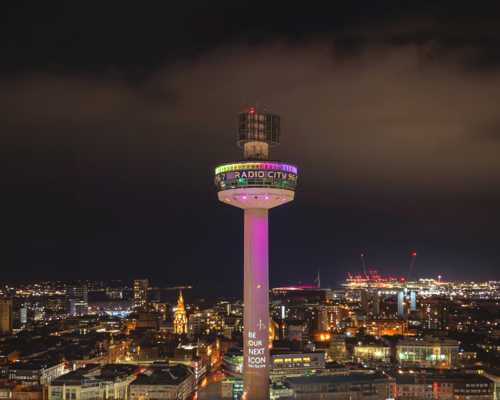
An opportunity to reimagine one of the UK’s most recognisable towers has been formally
opened by Rivington Hark, as St Johns Beacon invites operators and partners to shape its
next phase. [more...]
Is going sub-zero the next big thing? We take
a closer look at the benefits of extreme cold
exposure and cryotherapy, as well as some
of the options on offer for those thinking
of making the leap into the big chill
Cryotherapy is commonly used in the sporting world and now its overall effect on wellbeing and beauty is being noted by spas
Standing for three minutes in a space cooled to minus 130°C may sound a tough sell to spa guests, but it’s a trend that’s becoming more mainstream as people warm to the health benefits of extreme cold.
The reported advantages of cryotherapy are many and varied, meaning it has a broad appeal: improved mood, fewer aches and pains for ageing joints, recovery after exercising and even a better appearance, with people emerging after treatments feeling more alert, upbeat and energised.
Cryotherapy works by forcing the body to send blood to the brain and the core in a process called vasoconstriction. Afterwards, vasodilation takes place, whereby blood that is now enriched with oxygen, nutrients and enzymes flows back into the peripheral tissues.
It’s commonly used in the sporting world as it increases power, performance and endurance, as well as clearing out lactate. It can boost recovery and reduce aches and pains – both from exercise and from chronic illnesses such as arthritis. Endorphins are also released and it’s even claimed to reduce wrinkles.
Its effect on overall wellbeing and beauty are being noted in spa circles. Rainer Bolsinger, sales manager of Zimmer MedizinSysteme – the German-based company behind Icelab cabins – likens cryotherapy to icing an injured knee, but the whole body and mind also benefit. He says: “It affects the nervous system, forcing our brain into a heightened state, which can give stress relief and clear the mind.”
Mecotec, another German-based company, supplies spas such as Lanserhof with the Cryoair chamber. Laurence White, MD of RP-X, its UK distributor, adds: “The body’s natural response to cold air provides total body and mind rejuvenation.
“It also helps the complexion and anti-ageing, as the cold temperatures stimulate the production of collagen, reducing fine lines and wrinkles and decreasing pore size. In addition, when combined with active cosmetic products, cryotherapy can increase the skin’s capacity to rejuvenate itself, regain elasticity, appear smoother and bring forth a youthful glow.”
Meanwhile, Wim Hof – also known as the ‘ice man’ – has created a method which combines exposure to sub-zero water (bathing or showering), breathing and mindset techniques alongside physical exercise. He reports profound effects including heightened focus and determination – he’s used the technique to climb Mount Everest in nothing but short runs and complete marathons in the desert with no water. He says: “The cold trains the vascular system and taps into deeper parts of the brain… A deep sense of control emerges from there.”
Spa Business interviewed Hof at the end of 2017 and in the same issue we asked a range of industry experts how spas can offer cold water therapy (see issue 4, 2017 p22 and p44).
Roots in medicine The benefits might sound wonderful, but are they sufficient to warrant three minutes of extreme cold? According to Bolsinger, at this temperature, the air no longer contains moisture, so people don’t perceive the cold to be extreme. To protect their extremities, which are starved of blood during the treatment, users enter the chamber wearing protective masks, gloves, nipple protection and footwear. Music is often used to take their mind off the fact that they’re being chilled.
Cold therapy has a long history in medical treatments, first mentioned 400 years BC by Hippocrates as a method of treating pain. In the 19th century, Sebastian Kneipp popularised the Kneipp Method, which uses cold on the extremities – a method still used today in many spas and thermal baths (see SB16/4 p76).
“Whole-body cryostimulation at ultra-low temperatures was first applied by Professor T Yamauchi in Japan to treat rheumatoid arthritis. During the early 1980s several professors in Germany followed his approach and developed the treatment further,” says Bolsinger. “It’s been used in clinics and rehab centres as a method of treating pain, shortening rehabilitation and helping with stress and sleep. Now we’re seeing it move into the world of spas and fitness centres, where it’s used for preventative health, wellbeing, beauty and to optimise training and recovery.” Henri Chenot centres and the Bürgenstock resort are examples of spa operators which are tapping into the trend with Icelab.
UK-based company, CryoAction, says cryotherapy’s use in wellness is increasing and interest is growing across the board, from spas and health clubs to Premier League football clubs. “Cryotherapy is becoming increasingly popular across the health club sector and we’re installing new units all the time, driven by consumer demand, as clubs are seeking to respond to members who want to look and feel amazing,” says CryoAction CEO, Ian Saunders. “The chambers complement existing treatments and facilities and offer a new revenue opportunity.”
Icelab
Icelab uses environmentally-friendly compressor-based technology. Guests ease their way through one or two cool pre-chambers and finally reach the third which is set at -110°C and where they spend up to three minutes.
The rooms can accommodate up to four people at a time and music and video screens are installed as standard.
Guests can move around freely and the technicians speak to them through an intercom, suggesting different ways to move and stretch, to increase the effectiveness of the treatment. The Icelab system is distributed by Zimmer MedizinSysteme.
CryoAction
CryoAction designs, manufactures, installs and maintains its own products, which are certified for use as a medical device.
It has a portfolio that spans from single person chambers through to walk-in rooms, enabling up to 10 people to be treated simultaneously. Chambers can be standalone or integrated and are available in a wide selection of colours and materials to match a spa’s décor.
Larger bespoke chambers usually comprise two rooms linked by an interconnecting door. The first chamber is cooled to a temperature of around -60°C and the second to around -130°C.
Cryoair
Cryoair offers two different sized chambers for commercial use. The Cryoair -85˚C has the capacity for one or two people. The Cryoair -110˚C is for high commercial use and can accommodate up to 30 users an hour.
People can use the chambers up to twice a day for three minutes.
The systems are made by Mecotec and distributed by RP-X in the UK.
Cold effects
•Research has proven that cryotherapy can
• Promote healing, wellbeing and quality of life
• Promote relaxation and deeper sleep
• Enhance lymph drainage and blood circulation
• Improve eczema
• Stimulate collagen production
• Increase energy levels
• Increase mobility
• Boost adrenaline and endorphins
• Reduce muscle soreness, pain and inflammation
• Speed up rehabilitation
• Improve fitness performance
Author
Kath-Hudson
Kath Hudson is a regular contributor to Spa Business magazine.
Spa Programmes: On the menu
Event saunas, sunlight therapy
and health and happiness retreats
feature in our programming series
Interview: Marc Cohen
Dr Marc Cohen is launching an extreme
bathing retreat and writing children’s
books. He talks to Jane Kitchen
Promotional feature: Vital Tech
Infrared technology is growing in popularity, Vital Tech’s Alexandra Gavsevitch
and Serge Parienti explain how it works
Focus on: Equine therapy
What is equine therapy and how
can spas tap into horsepower?
Kathleen Whyman finds out
Wellness: Chill out
Is going sub-zero the next big thing?
Kath Hudson takes a closer look
at the benefits of cryotherapy
Promotional feature: The Wellness
Noha Khalil of The Wellness discusses how
gym and spa elements are increasingly
coming together through design to
deliver outstanding fitness concepts
Hotel de France, located on the British Isle of Jersey, has created a wellness retreat package
that includes a hot yoga session that will take place in Jersey Zoo’s butterfly sanctuary.
A new immersive attraction designed to transport visitors into the final hours of ancient Pompeii
is preparing to open near the world-famous archaeological site in southern Italy.
Experience design company, BRC Imagination Arts, has completed a transition that sees founder
Bob Rogers pass ownership of the business to four long-serving senior executives, while
remaining actively involved with the company.
Movie Park Germany has opened a new Paramount Pictures-themed attraction as part of its 30th
anniversary celebrations, using immersive storytelling and adaptive reuse to reinforce the park’s
longstanding “Hollywood in Germany” positioning.
Therme Manchester’s 28-acre development, which will include interconnected glass pavilions
that measure 65,000sq m, will be the largest bathing and wellbeing attraction in the world once
complete, according to prof David Russell, CEO of Therme UK.
Efteling has opened Hooghmoed, a new family drop tower designed to broaden the appeal of its
recently launched Sirene Island themed area and introduce younger visitors to thrill attractions.
A proposed Puy du Fou development near Bicester and Universal Destinations and Experiences’
planned resort in Bedford are emerging as part of a wider transformation of the Oxford–
Cambridge Growth Corridor into a major centre for UK leisure and tourism inv
Shedd Aquarium has opened the Immersion Theater developed in partnership with SimEx-
Iwerks, as part of a wider strategy to enhance the guest experience and create additional
revenue opportunities.
The UK government has announced a temporary reduction in VAT on visitor attractions and
children’s meals as part of a summer cost-of-living support package designed to stimulate the
visitor economy and encourage family days out.
As designer Yinka Ilori prepares for his first solo gallery show in London, he speaks exclusively
to CLADmag about his mission to spread joy, the power of play, and his bold approach to using
colour (including the colours you won’t see in his work).
The government of Thailand is exploring plans for a THB300bn (£6.3bn, US$8.3bn)
entertainment complex in the country’s Eastern Economic Corridor (EEC), with officials
proposing a large-scale theme park and sports destination as part of a broader tourism and
economic development strategy.
+ More news
COMPANY PROFILES
TechnoAlpin Indoor TechnoAlpin is the world leader for snowmaking systems. With the Indoor snow division, TechnoAlpin c [more...]
Sally Corporation Our services include: Dark ride design & build; Redevelopment of existing attractions; High-quality [more...]
Holovis Holovis is a privately owned company
established in 2004 by CEO Stuart
Hetherington. [more...]
instantprint We’re a Yorkshire-based online printer, founded
in 2009 by Adam Carnell and James Kinsella. [more...]
An opportunity to reimagine one of the UK’s most recognisable towers has been formally
opened by Rivington Hark, as St Johns Beacon invites operators and partners to shape its
next phase. [more...]