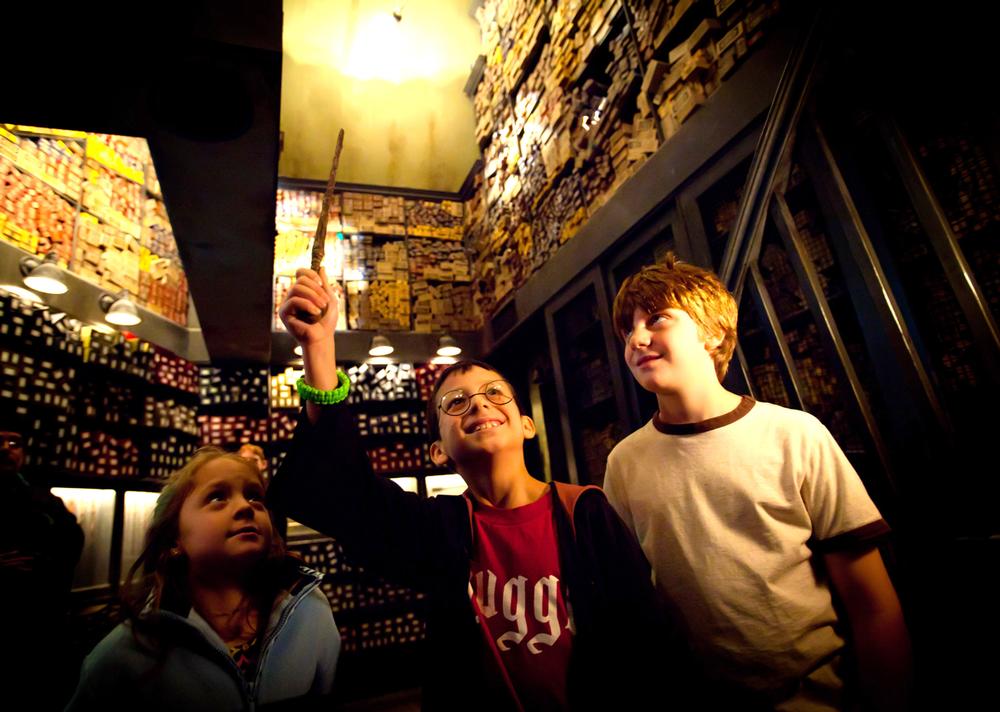
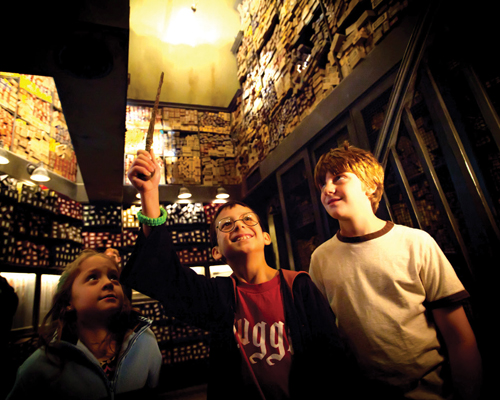
Ollivanders Wand Shop is a clever merchandise offering at Universal
The evaluation of potential revenues at attractions is critical, yet this is often over-estimated by people planning new attractions as there is little published information. In this article we discuss attraction revenue streams.
The most important revenue source for visitor attractions is admissions. Ticket revenues typically account for more than half the income from visitors and the measure of this income is as an admission per capita, also known as per cap.
Admission per caps are influenced by ticket prices, discounts, season pass sales and visitor mix. They are compared to the full adult admission price in a measure known as admission yield. Strong performing attractions that offer limited discounts can achieve admission yields of 80 per cent or more. Visitor attractions that operate in competitive markets with deep discounts can struggle to achieve yields of 50 per cent.
Per caps and yield measurement exclude the impact of VAT, which must also be allowed for. While a few countries do not charge VAT and US attractions typically add sales tax to tickets, most operators need to absorb the 20 per cent or so VAT rates that are common around the world.
Thus, an attraction that has a full adult admission ticket of £20 including VAT and achieves a 60 per cent yield would only achieve an admission per cap of £10 once VAT and discounts are factored in. Changes in VAT rates – as experienced in Spain in 2012 when VAT increased from a reduced rate of 8 per cent to the full rate of 21 per cent – are hard to pass on to customers. Spanish operators had to absorb this increase which directly impacted profits.
Setting the right price The importance of admission revenue means that setting ticket prices appropriately is critical. While visitors commonly complain about prices, they do have a feel for an appropriate value per hour of entertainment. Typically, adult admission to attractions in the UK are equivalent to between £5 and £7.50 per hour although there are exceptions for unique or short stay attractions. For example, the Shard and London Eye charge the equivalent of more than £30 per hour while a visit to the Harry Potter Studio Tour costs £13 per hour.
Once prices are established, it is difficult to make significant increases without a major investment in the attraction product. This price pressure has led to a surge in the number of upcharge activities such as VIP or fast passes, behind the scenes tours and animal encounters offered in recent years. These can be expensive, and while the appeal lies in a limited number being available, they can serve to increase admissions income by up to 10 per cent.
Secondary spends Food and beverage is an important secondary income stream. F&B spending is related to the visitor length of stay and the availability of alternative offers. Attractions where guests spend up to two hours typically generate spending on a drink and/or snack on-site, unless the attraction is located in an urban area with a range of alternative branded F&B offers. At larger attractions, with a dwell time of four hours or more, guests often have a meal on site.
Merchandise is also an important source of income. While retail outlets need to provide a variety of offers from small pocket money items to more expensive gifts, the range should be of a manageable size to avoid excess stock.
Most attractions look to create a visitor flow that exits guests through a retail outlet. This is a sound business decision. Back in 1997, we worked with the Royal Armouries Museum in Leeds, UK. Initially, the guests exited past the shop but not directly through it. We suggested altering the flow so that all guests exited through the shop and retail turnover increased by 25 per cent as a result.
Other visitor-related income can include parking fees, games, photos and videos.
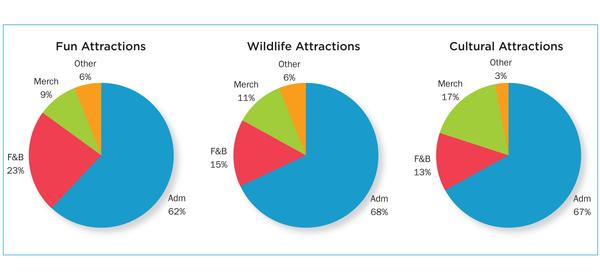
Revenue mix In terms of the mix of revenues across different types of attractions, the pie charts (below) show the typical split for theme parks, wildlife attractions and gated cultural attractions. As shown, the greater length of stay at theme parks leads to stronger F&B spending than at other attractions while cultural attractions are able to generate a greater proportion from merchandise. In general, a strong performing attraction can look to achieve a total per capita revenue equivalent to the full adult admission price. So using the earlier example where the £20 adult admission ticket yielded an average admission per cap of £10, adding on F&B, merchandise and other visitor revenue could lead to a total per cap of around £20.
As with admissions, VAT is applicable across most of these secondary income streams and importantly there is the cost of goods to take into account. These costs have similar ratios across attractions and are generally 20-40 per cent for F&B and 30-50 per cent for merchandise.
The ever-increasing use of credit and debit cards also has an impact on revenues as attractions have to pay credit card fees to the card issuers. While these have been capped in recent years, they can still have an impact on the business, particularly those with strong online ticket sales.
The goods sold generally equate to 10 to 20 per cent of total visitor revenues, depending on the guest spending mix.
Other forms of income There are several other non-visitor income streams. The most common is grants. Many museums that offer free entry rely almost entirely on grant aid from national, regional or local governments, as do most national and regional parks. A number of gated cultural and natural attractions also benefit from substantial grant income.
Donations, friends and memberships can also be important sources of income, particularly to cultural and wildlife attractions. For groups such as English Heritage in the UK, Fondo Ambiente Italiano in Italy, and National Trusts in Australia, Canada and the UK, memberships provide a vital source of income to support the maintenance and restoration of the large numbers of properties entrusted to them.
Attracting significant income from sponsorship is challenging. While landmark attractions such as the Coca Cola London Eye and British Airways i360 in Brighton, UK, have been able to attract naming rights sponsorship, and KidZania generates strong sponsorship income from its activity partners, these are exceptions. Most sponsorship income achieved by attractions is of a modest value or via in-kind sponsorship from beverage, technology or other suppliers.
Events and accommodation Hosting events and activities is another source of income. These can include conferences, exhibitions, concerts, parties, corporate events and sleepovers.
While most attractions look to operate their own F&B and merchandise outlets, some rent out these activities to third-party operators, receiving an annual rental stream. Although this generally leads to a lesser income than would be achieved by the attraction running the facilities directly, as the catering/retail company needs to make a profit from the business, it does make life simpler for the operator.
A number of large theme parks and other attractions have developed on-site hotels and other accommodation to create resorts and extend the length of stay of their guests. While these are typically operated as separate business units, they obviously have a significant impact on the total resort incomes.
Typically, commercial attractions generate in excess of 80 per cent of their income directly from visitors. At wildlife and cultural attractions non-visitor income often represents more than 50 per cent of total revenues. As we have shown, assessing revenues at attractions is a complex area with lots of income streams to consider. It is therefore critical to obtain experienced advice and input when undertaking business planning in this area.
Read more from this issue of Attractions Management magazine
View contents of Attractions Management 2017 issue 1
People profile: Nolan Bushnell
Nolan Bushnell, father of the video game industry, on his new VR business and the future of technology
People profile: Ron Magill
Zoo Miami’s Ron Magill gives the lowdown on the attraction’s new Florida: Mission Everglades zone
People profile: Kim Gladstone Herlev
Denmark’s Experimentarium has reopened after a major renovation. CEO Kim Gladstone Herlev shares his vision for the future
People profile: Jimmy Fallon
Hold on tight! US TV star Jimmy Fallon is the subject of a brand new ride at Universal Orlando
Interview: Matthias Li
Matthias Li, chief executive at Hong Kong’s
Ocean Park, on his response to a changing
visitor profile and rising competition
Pipeline: Opening Doors
There’s an array of attractions set to launch.
We anticipate the hot debuts of the year
Tourism: A Plan for Oman
The Ministry of Tourism’s Maitha Al Mahrouqi
on Oman’s status as a budding destination
This eight-part series outlines the patterns and dynamics that define every attraction – from visitor behaviour and guest spending to operating costs and profitability
CONTENTS 1. An overview 2. How are you perceived? 3. Benchmarking 4. Planning a new attraction 5. Driving revenues 6. Controlling costs 7. Is it worth it? 8. Benefits and impacts
Different types of attractions have a different revenue split. For example, fun attractions make more from F&B
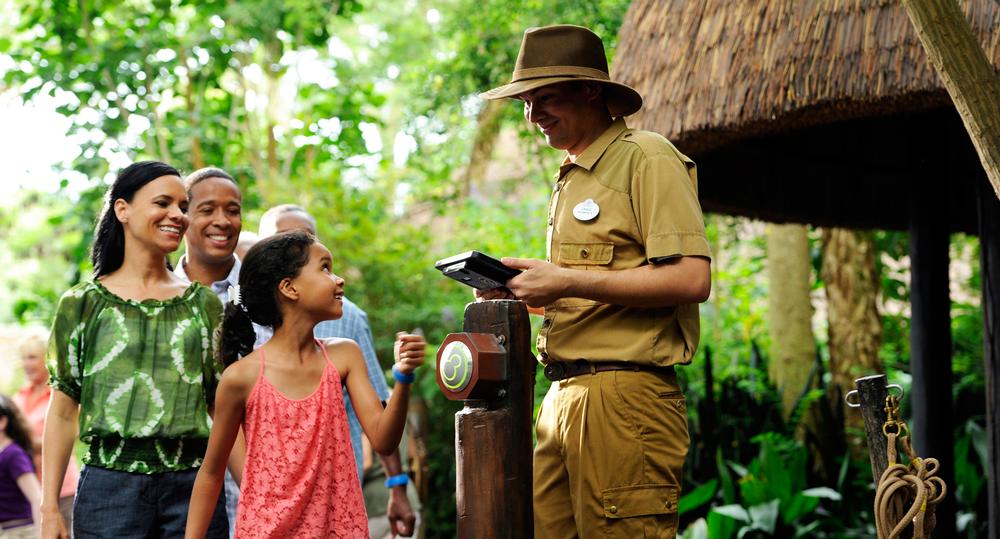
Upcharge activities such as fast passes can boost admissions income by 10 per cent
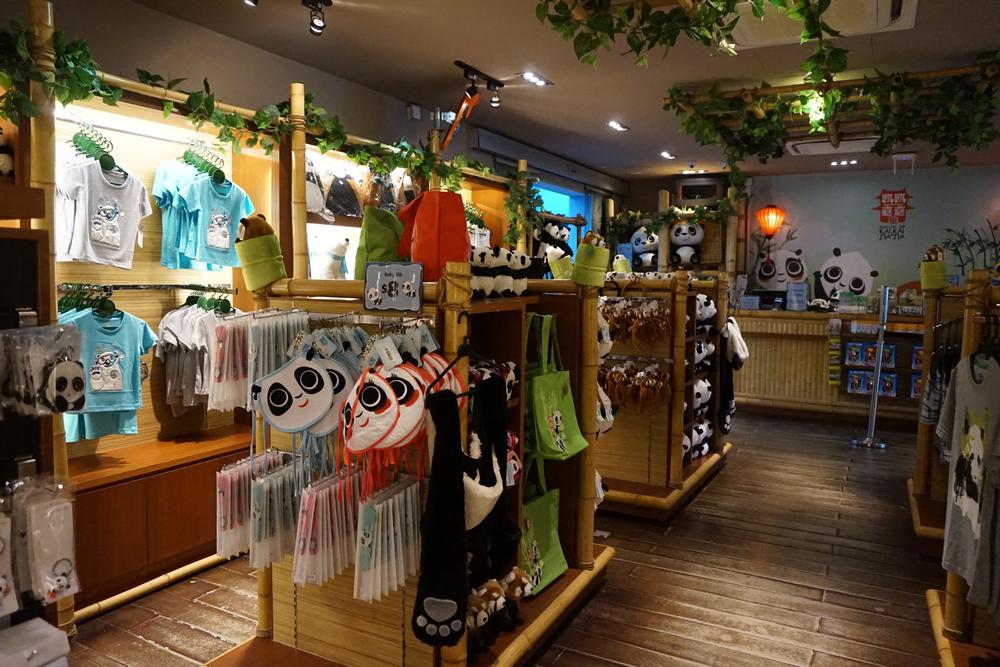
Singapore’s River Safari capitalises on its popular Giant Panda Forest exhibit with the House of Kai Kai and Jia Jia shop and Mama Panda Kitchen / PHOTO: Wildlife Reserves Singapore
Singapore’s River Safari capitalises on its popular Giant Panda Forest exhibit with the House of Kai Kai and Jia Jia shop and Mama Panda Kitchen / PHOTO: Wildlife Reserves Singapore
Membership is a vital income source for Italy’s Fondo Ambiente
COMPANY PROFILES
IAAPA EMEA
IAAPA Expo Europe was established in 2006 and has grown to the largest international conference and [more...]
Alterface
Alterface’s Creative Division team is
seasoned in concept and ride development,
as well as storyte [more...]
Holovis
Holovis is a privately owned company
established in 2004 by CEO Stuart
Hetherington. [more...]
Simworx Ltd
The company was initially established
in 1997. Terry Monkton and Andrew
Roberts are the key stakeh [more...]
Ollivanders Wand Shop is a clever merchandise offering at Universal
The evaluation of potential revenues at attractions is critical, yet this is often over-estimated by people planning new attractions as there is little published information. In this article we discuss attraction revenue streams.
The most important revenue source for visitor attractions is admissions. Ticket revenues typically account for more than half the income from visitors and the measure of this income is as an admission per capita, also known as per cap.
Admission per caps are influenced by ticket prices, discounts, season pass sales and visitor mix. They are compared to the full adult admission price in a measure known as admission yield. Strong performing attractions that offer limited discounts can achieve admission yields of 80 per cent or more. Visitor attractions that operate in competitive markets with deep discounts can struggle to achieve yields of 50 per cent.
Per caps and yield measurement exclude the impact of VAT, which must also be allowed for. While a few countries do not charge VAT and US attractions typically add sales tax to tickets, most operators need to absorb the 20 per cent or so VAT rates that are common around the world.
Thus, an attraction that has a full adult admission ticket of £20 including VAT and achieves a 60 per cent yield would only achieve an admission per cap of £10 once VAT and discounts are factored in. Changes in VAT rates – as experienced in Spain in 2012 when VAT increased from a reduced rate of 8 per cent to the full rate of 21 per cent – are hard to pass on to customers. Spanish operators had to absorb this increase which directly impacted profits.
Setting the right price The importance of admission revenue means that setting ticket prices appropriately is critical. While visitors commonly complain about prices, they do have a feel for an appropriate value per hour of entertainment. Typically, adult admission to attractions in the UK are equivalent to between £5 and £7.50 per hour although there are exceptions for unique or short stay attractions. For example, the Shard and London Eye charge the equivalent of more than £30 per hour while a visit to the Harry Potter Studio Tour costs £13 per hour.
Once prices are established, it is difficult to make significant increases without a major investment in the attraction product. This price pressure has led to a surge in the number of upcharge activities such as VIP or fast passes, behind the scenes tours and animal encounters offered in recent years. These can be expensive, and while the appeal lies in a limited number being available, they can serve to increase admissions income by up to 10 per cent.
Secondary spends Food and beverage is an important secondary income stream. F&B spending is related to the visitor length of stay and the availability of alternative offers. Attractions where guests spend up to two hours typically generate spending on a drink and/or snack on-site, unless the attraction is located in an urban area with a range of alternative branded F&B offers. At larger attractions, with a dwell time of four hours or more, guests often have a meal on site.
Merchandise is also an important source of income. While retail outlets need to provide a variety of offers from small pocket money items to more expensive gifts, the range should be of a manageable size to avoid excess stock.
Most attractions look to create a visitor flow that exits guests through a retail outlet. This is a sound business decision. Back in 1997, we worked with the Royal Armouries Museum in Leeds, UK. Initially, the guests exited past the shop but not directly through it. We suggested altering the flow so that all guests exited through the shop and retail turnover increased by 25 per cent as a result.
Other visitor-related income can include parking fees, games, photos and videos.
Revenue mix In terms of the mix of revenues across different types of attractions, the pie charts (below) show the typical split for theme parks, wildlife attractions and gated cultural attractions. As shown, the greater length of stay at theme parks leads to stronger F&B spending than at other attractions while cultural attractions are able to generate a greater proportion from merchandise. In general, a strong performing attraction can look to achieve a total per capita revenue equivalent to the full adult admission price. So using the earlier example where the £20 adult admission ticket yielded an average admission per cap of £10, adding on F&B, merchandise and other visitor revenue could lead to a total per cap of around £20.
As with admissions, VAT is applicable across most of these secondary income streams and importantly there is the cost of goods to take into account. These costs have similar ratios across attractions and are generally 20-40 per cent for F&B and 30-50 per cent for merchandise.
The ever-increasing use of credit and debit cards also has an impact on revenues as attractions have to pay credit card fees to the card issuers. While these have been capped in recent years, they can still have an impact on the business, particularly those with strong online ticket sales.
The goods sold generally equate to 10 to 20 per cent of total visitor revenues, depending on the guest spending mix.
Other forms of income There are several other non-visitor income streams. The most common is grants. Many museums that offer free entry rely almost entirely on grant aid from national, regional or local governments, as do most national and regional parks. A number of gated cultural and natural attractions also benefit from substantial grant income.
Donations, friends and memberships can also be important sources of income, particularly to cultural and wildlife attractions. For groups such as English Heritage in the UK, Fondo Ambiente Italiano in Italy, and National Trusts in Australia, Canada and the UK, memberships provide a vital source of income to support the maintenance and restoration of the large numbers of properties entrusted to them.
Attracting significant income from sponsorship is challenging. While landmark attractions such as the Coca Cola London Eye and British Airways i360 in Brighton, UK, have been able to attract naming rights sponsorship, and KidZania generates strong sponsorship income from its activity partners, these are exceptions. Most sponsorship income achieved by attractions is of a modest value or via in-kind sponsorship from beverage, technology or other suppliers.
Events and accommodation Hosting events and activities is another source of income. These can include conferences, exhibitions, concerts, parties, corporate events and sleepovers.
While most attractions look to operate their own F&B and merchandise outlets, some rent out these activities to third-party operators, receiving an annual rental stream. Although this generally leads to a lesser income than would be achieved by the attraction running the facilities directly, as the catering/retail company needs to make a profit from the business, it does make life simpler for the operator.
A number of large theme parks and other attractions have developed on-site hotels and other accommodation to create resorts and extend the length of stay of their guests. While these are typically operated as separate business units, they obviously have a significant impact on the total resort incomes.
Typically, commercial attractions generate in excess of 80 per cent of their income directly from visitors. At wildlife and cultural attractions non-visitor income often represents more than 50 per cent of total revenues. As we have shown, assessing revenues at attractions is a complex area with lots of income streams to consider. It is therefore critical to obtain experienced advice and input when undertaking business planning in this area.
Read more from this issue of Attractions Management magazine
View contents of Attractions Management 2017 issue 1
People profile: Nolan Bushnell
Nolan Bushnell, father of the video game industry, on his new VR business and the future of technology
People profile: Ron Magill
Zoo Miami’s Ron Magill gives the lowdown on the attraction’s new Florida: Mission Everglades zone
People profile: Kim Gladstone Herlev
Denmark’s Experimentarium has reopened after a major renovation. CEO Kim Gladstone Herlev shares his vision for the future
People profile: Jimmy Fallon
Hold on tight! US TV star Jimmy Fallon is the subject of a brand new ride at Universal Orlando
Interview: Matthias Li
Matthias Li, chief executive at Hong Kong’s
Ocean Park, on his response to a changing
visitor profile and rising competition
Pipeline: Opening Doors
There’s an array of attractions set to launch.
We anticipate the hot debuts of the year
Tourism: A Plan for Oman
The Ministry of Tourism’s Maitha Al Mahrouqi
on Oman’s status as a budding destination
This eight-part series outlines the patterns and dynamics that define every attraction – from visitor behaviour and guest spending to operating costs and profitability
CONTENTS 1. An overview 2. How are you perceived? 3. Benchmarking 4. Planning a new attraction 5. Driving revenues 6. Controlling costs 7. Is it worth it? 8. Benefits and impacts
Different types of attractions have a different revenue split. For example, fun attractions make more from F&B
Upcharge activities such as fast passes can boost admissions income by 10 per cent
Singapore’s River Safari capitalises on its popular Giant Panda Forest exhibit with the House of Kai Kai and Jia Jia shop and Mama Panda Kitchen / PHOTO: Wildlife Reserves Singapore
Singapore’s River Safari capitalises on its popular Giant Panda Forest exhibit with the House of Kai Kai and Jia Jia shop and Mama Panda Kitchen / PHOTO: Wildlife Reserves Singapore
Membership is a vital income source for Italy’s Fondo Ambiente
London Museum will open four new food and drink destinations when it launches its new home
at Smithfield on 28 November, making hospitality a central part of the visitor experience at one
of the capital's biggest cultural openings of the year.
OMA has completed a major transformation of New York's New Museum, creating a larger
cultural campus that combines expanded exhibition spaces with learning, performance,
hospitality and public programming.
A US$50 million (£44.2 million, €51.2 million) transformation of Chicago's historic McCormick
Mansion has created a new destination that combines live magic, immersive theatre, dining and
private membership under one roof.
The Montana Historical Society has officially celebrated the opening of its new Montana
Heritage
Center, a US$107 million (£79 million, €92 million) destination that combines immersive
storytelling with cutting-edge audiovisual technology to bring the sta
San Antonio Zoo has reported a US$283 million economic impact for 2025, following a decade-
long transformation programme that has seen almost US$200 million invested into the Texas
attraction.
Plans for the AU$180 million redevelopment of Reef HQ Aquarium in Townsville, Australia, are
progressing, with the project set to transform the attraction into a global centre for reef
education and conservation.
Abu Dhabi-based investment firm Mubadala Capital has made a binding, fully financed
€1 billion
offer to acquire Pierre and Vacances SA, the European holiday resort operator behind the
continental European Center Parcs business.
Disney has reaffirmed its commitment to investing US$30 billion in its US parks and cruise
business by 2033, using new America250 celebrations to underline the role its attractions play
in supporting jobs, tourism and economic growth.
Expo 2030 Riyadh is being planned as a permanent visitor destination, with organisers
confirming the six-million-square-metre site will become a Global Village after the event closes.
The owner of one of Australia's best-known waterparks has acquired a major competitor,
creating a new attractions business spanning two of the country's largest visitor destinations.