In his latest in a series of columns, FaulknerBrowns Architects' Mike Hall explores the importance of sustainable, carefully considered sports facilities and how they can contribute to healthy, active cities
By Mike Hall | Published in Sports Management 2014 issue 4
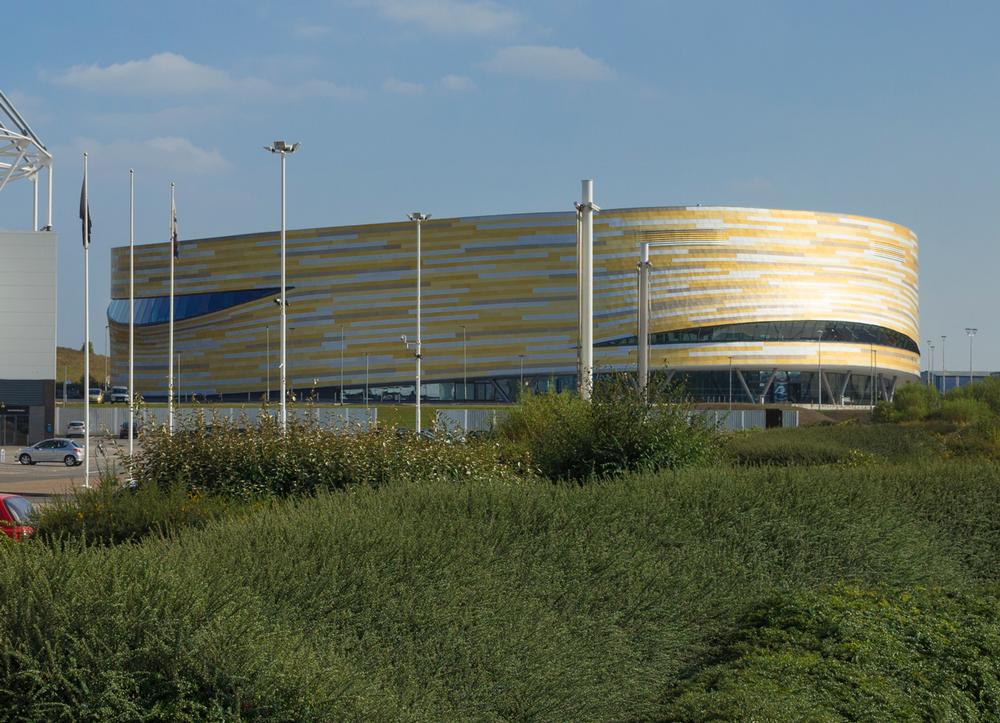
The Derby Arena – playing a part in plans to make Derby the most active city in the UK
You may have blinked and missed it, but 6 October 2014 was World Architecture Day. This year's theme was Healthy Cities – Happy Cities and underlining it was the role good design can play in creating health and happy environments for people.
In terms of activity and participation, there are a number of cities in England which may rightly lay claim to the top participation honours. Sheffield frequently comes out as one of the top performing cities. Major landmark facilities such as Ponds Forge International Sports Centre and the English Institute for Sport have played a key role in contributing to community participation and elite training.
Manchester, UK can also boast its place as one of the highest performing cities, especially when the efficient cost of delivering these services is factored in. Manchester Aquatics, built to host all of the water-based disciplines for the 2002 Commonwealth Games, is still one of the world’s most flexible pool complexes. Its central arterial location on Oxford Road also means that it is at the heart of one of the most sought after student locations in the country. This contributes to a healthy balance of community, student and high performance usage with a staggering 750,000 users through the turnstiles each year. Manchester City Council has consistently targeted a number of key sports development programs through to national and international events.
Manchester’s National Cycling Centre has just celebrated its twentieth birthday and is still the world’s most well used indoor cycling facility, having provided the bedrock for Britain’s cycling success on the track for the last three Olympic Games.
There is, however, a new kid on the block. Derby City Council has a vision to be ‘the most active city in the UK’. FaulknerBrowns were involved in the early stages of implementing Derby's leisure strategy, which included a technical review of wet and dry hub facilities as well as a series of satellite locations.
Building on lessons learnt from projects in Sheffield and Manchester, the recently completed Derby Arena – which incorporates a cycle track – is one of the most innovative facilities of its type in the world. Designed by FaulknerBrowns to break down barriers, the internal 250m track was lifted up one storey in height to create a stronger, more active connection to the Arena’s interior.
These connections are expressed on the outside of the building, literally lifting the skin of the building to define a clear entrance sequence, welcoming all members of the community into the building. This approach has driven improved access to a range of activities, including court sports and health and fitness, in addition to cycling. Importantly, the building is also flexible enough to accommodate revenue producing concerts and non-sports events.
In line with the aspiration of World Architecture Day, we share a strong belief in the role which carefully considered, sustainable and quality sports facilities play in contributing to healthy, active cities.
In his latest in a series of columns, FaulknerBrowns Architects' Mike Hall explores the importance of sustainable, carefully considered sports facilities and how they can contribute to healthy, active cities
By Mike Hall | Published in Sports Management 2014 issue 4
The Derby Arena – playing a part in plans to make Derby the most active city in the UK
You may have blinked and missed it, but 6 October 2014 was World Architecture Day. This year's theme was Healthy Cities – Happy Cities and underlining it was the role good design can play in creating health and happy environments for people.
In terms of activity and participation, there are a number of cities in England which may rightly lay claim to the top participation honours. Sheffield frequently comes out as one of the top performing cities. Major landmark facilities such as Ponds Forge International Sports Centre and the English Institute for Sport have played a key role in contributing to community participation and elite training.
Manchester, UK can also boast its place as one of the highest performing cities, especially when the efficient cost of delivering these services is factored in. Manchester Aquatics, built to host all of the water-based disciplines for the 2002 Commonwealth Games, is still one of the world’s most flexible pool complexes. Its central arterial location on Oxford Road also means that it is at the heart of one of the most sought after student locations in the country. This contributes to a healthy balance of community, student and high performance usage with a staggering 750,000 users through the turnstiles each year. Manchester City Council has consistently targeted a number of key sports development programs through to national and international events.
Manchester’s National Cycling Centre has just celebrated its twentieth birthday and is still the world’s most well used indoor cycling facility, having provided the bedrock for Britain’s cycling success on the track for the last three Olympic Games.
There is, however, a new kid on the block. Derby City Council has a vision to be ‘the most active city in the UK’. FaulknerBrowns were involved in the early stages of implementing Derby's leisure strategy, which included a technical review of wet and dry hub facilities as well as a series of satellite locations.
Building on lessons learnt from projects in Sheffield and Manchester, the recently completed Derby Arena – which incorporates a cycle track – is one of the most innovative facilities of its type in the world. Designed by FaulknerBrowns to break down barriers, the internal 250m track was lifted up one storey in height to create a stronger, more active connection to the Arena’s interior.
These connections are expressed on the outside of the building, literally lifting the skin of the building to define a clear entrance sequence, welcoming all members of the community into the building. This approach has driven improved access to a range of activities, including court sports and health and fitness, in addition to cycling. Importantly, the building is also flexible enough to accommodate revenue producing concerts and non-sports events.
In line with the aspiration of World Architecture Day, we share a strong belief in the role which carefully considered, sustainable and quality sports facilities play in contributing to healthy, active cities.
OMA has completed a major transformation of New York's New Museum, creating a larger
cultural campus that combines expanded exhibition spaces with learning, performance,
hospitality and public programming.
A US$50 million (£44.2 million, €51.2 million) transformation of Chicago's historic McCormick
Mansion has created a new destination that combines live magic, immersive theatre, dining and
private membership under one roof.
The Montana Historical Society has officially celebrated the opening of its new Montana
Heritage
Center, a US$107 million (£79 million, €92 million) destination that combines immersive
storytelling with cutting-edge audiovisual technology to bring the sta
San Antonio Zoo has reported a US$283 million economic impact for 2025, following a decade-
long transformation programme that has seen almost US$200 million invested into the Texas
attraction.
Plans for the AU$180 million redevelopment of Reef HQ Aquarium in Townsville, Australia, are
progressing, with the project set to transform the attraction into a global centre for reef
education and conservation.
Abu Dhabi-based investment firm Mubadala Capital has made a binding, fully financed
€1 billion
offer to acquire Pierre and Vacances SA, the European holiday resort operator behind the
continental European Center Parcs business.
Disney has reaffirmed its commitment to investing US$30 billion in its US parks and cruise
business by 2033, using new America250 celebrations to underline the role its attractions play
in supporting jobs, tourism and economic growth.
Expo 2030 Riyadh is being planned as a permanent visitor destination, with organisers
confirming the six-million-square-metre site will become a Global Village after the event closes.
The owner of one of Australia's best-known waterparks has acquired a major competitor,
creating a new attractions business spanning two of the country's largest visitor destinations.
The Toverland theme park in the Netherlands has announced a €98m expansion programme
that will add a resort, new attractions and staff facilities as it pursues plans to become a multi-
day destination.
+ More news
COMPANY PROFILES
Clip 'n Climb Clip ‘n Climb currently offers facility owners and
investors more than 40 colourful and unique
Cha [more...]
Simworx Ltd The company was initially established
in 1997. Terry Monkton and Andrew
Roberts are the key stakeh [more...]
TechnoAlpin Indoor TechnoAlpin is the world leader for snowmaking systems. With the Indoor snow division, TechnoAlpin c [more...]
Holovis Holovis is a privately owned company
established in 2004 by CEO Stuart
Hetherington. [more...]