There’s been a surge in interest in short, but intense exercise regimes –
known as high-intensity interval training – in the fitness sector.
We investigate the background and benefits of this protocol for spas
By Kate Cracknell | Published in Spa Business 2012 issue 4
HIT training principles have been used by athletes the world over since the 1930s
In the last few years, the health and fitness industry has seen the emergence of a number of shorter, results-driven workout concepts for ‘time poor’ consumers. Women-only franchises Curves and Vivafit have offered a 30-minute, circuit-based workout for some time, but are now being joined by the likes of Fit n Fast in Australia, where Quickie workouts are available in activities such as cycling, boxing and circuits – and where the intensity is being ramped up to challenge a younger demographic.
From a fitness equipment supplier perspective, milon’s eccentric and concentric resistance equipment has been designed to maximise results via a circuit workout that takes around 30 minutes. Power Plate also recently demonstrated a 20-minute concept which combines its vibration training platform with its new powerBIKE with vibrating pedals. Classes are getting shorter.
An elite heritage They’re also getting tougher. Because what this is all leading to is the emergence of HIT (high-intensity interval training). Or should we say re-emergence? After all, in essence HIT is a training method that’s been around for many years in the elite sports arena.
Interval training in its modern form dates back to the 1930s, when Woldemar Gerschler (Germany) and Gosta Holmer (Sweden) used it to enhance the performance of their national teams. And in Finland, Lauri Pikhala was creating interval training programmes for runner Paavo Nurmi back in 1910.
Holmer dubbed the approach fartlek – Swedish for ‘speed play’ – thanks to the use of ‘faster than race’ pace. Concentrating on simultaneous speed/endurance training, the training protocol puts stress on both aerobic and anaerobic energy systems due to the alternating pace and intensity of the exercise. It’s now used the world over to offer variation in an elite athlete’s preparation throughout the year. And now it’s coming to fitness centres and gyms in the form of HIT. So how do we define HIT?
Defining HIT Len Kravitz and Lance Dalleck – researchers at the University of New Mexico, in the US – define interval training as “high-intensity, short duration training sessions performed at workloads above the lactate threshold, marked by an abrupt increase in blood lactate that forces the muscle to revert from aerobic to anaerobic metabolism”.
Clearly this is hard to measure within a gym environment. However, in a review paper undertaken in February by New Zealand’s AUT University (see the Literature Review panel), HIT is defined as either working at over 75 per cent of heart rate maximum (HR max) or 75 per cent of maximum oxygen uptake (VO2 max), followed by rest periods.
Intervals vary from 1:1 (work:rest) ratios, to 2:1 or other variations depending on fitness levels. The rest phase can either be complete rest or dropping back to a moderate intensity to enable recovery.
“However, 75 per cent HR max and 75 per cent VO2 max are very different intensities and not to be confused as being the same,” stresses Randy Huntington, global director of marketing, performance, education and research at fitness equipment specialist Keiser. So there are no clear-cut guidelines as yet, other than that the work phases should be ‘hard’ or ‘very hard’.
Huntington, meanwhile, categorises HIT as a form of circuit training. “In 1953, RE Morgan and GT Anderson at the University of Leeds [UK] created circuit training – of which interval training is a subset – with Manfred Scholich going on to write the bible on interval/circuit training in 1986,” he explains. “There are many ways to do circuits and Scholich has already labelled them quite well, setting a series of criteria: sets, repetitions, load, type of exercise, order of exercises, number of exercises, rest interval, work interval and density.
“It’s important that a common vocabulary be established within the fitness industry, otherwise we’ll end up with fancy marketing names for programmes that have actually existed for over 40 years – and in some cases, where the roots are over 100 years old.”
Benefits of HIT But if precise terminology and parameters are still to be decided, there does seem to be broad agreement on the benefits of HIT.
“Research shows that HIT delivers results that surpass conventional, steady-state training,” says Bryce Hastings, technical consultant for group exercise company Les Mills International (see sb08/3 p100). “These include accelerated aerobic conditioning, getting you fitter faster; an improved anaerobic threshold, letting you go harder for longer; improved insulin resistance and growth hormone changes, with enhanced hormonal responses; and the generation of athletic, powerful muscle, giving you the tone you dream about.”
Huntington adds: “Interval training has the potential to burn more calories than conventional aerobic/strength training and is an effective means of improving strength/muscular endurance. In addition, it has always delivered faster results. However, all this is at the potential expense of injury and endocrine burnout. It takes a while to adapt to such workouts, and in most cases adherence is less time than the required time to adaptation. If we’re to bring it into the gym, we need to make it fun so people will continue to do it, thereby gaining a cumulative effect.”
There’s also an argument that a HIT circuit may not deliver optimum results. Huntington continues: “In the late 80s and early 90s, Keiser developed the XPress Circuit for time-conscious, non-elite members. This was done in the full knowledge that circuit training will always compromise the true effectiveness of the five S’s – strength, speed, skill, stamina, suppleness – when they’re not done as discreet parts of a programme. Does this make HIT or circuit training bad? Absolutely not. It just means that the best results you can get will be less than the best result you could achieve by focusing on any one of the five S’s individually.”
For non-elite athletes, however, the benefits will already be very compelling. Not only that, but the AUT University/Les Mills review paper highlights benefits for a far more diverse range of exercisers than might have been expected. Gym-based use of HIT could, it seems, have a broad appeal.
Read more from this issue of Attractions Management magazine
View contents of Attractions Management 2012 issue 4
Interview: Laurent Houel
Evian's global brand development
director tells Katie Barnes about the
group's new evianSpa licence concept
that's set for a strategic global rollout
Promotional feature: Value Proposition
If you're thinking of investing in a spa development bigger than 300sq m,
a feasibility study – at a cost of only US$10k-US$18k – can reveal the
business model most likely to succeed.
Research: Work it out
Katherine Johnston reveals key
recommendations following a
much-needed study on global spa
management training
Top team: Miraval
The team that created the new spa at
Miraval shared a bold vision as Liz
Terry discovered on her visit
Family matters: The Brepohls
Natural medicine is the focus at
Lapinha: one of Brazil's original
medical spas. Neena Dhillon talks to
the founding family
The making of...: A massage table
Up to 18 million parts are needed for
a year's production of massage tables.
Lisa Starr takes an ‘undercover' look
at just what goes into making this
industry staple
Research: The cold war
Meditation and exercise can
significantly reduce sick days taken
due to colds and flu
Research papers A 2005 study of 38 elite cyclists, published in the Journal of Strength & Conditioning Research, showed that interval training leads to improved respiratory function, including better blood flow through the lungs and oxygen-carbon dioxide exchange. In the study, HIT increased performance by improving ventilatory threshold and VO2 max, boosting the body’s ability to use oxygen to generate energy.
Another study, published in the Journal of Physiology in July 2006, found improved adaptations in muscle cells after interval training in contrast to traditional steady-state endurance training. The study compared two groups of active young men over two weeks. One group engaged in traditional long-duration training for 90–120 minutes, while the other did four to six sets of sprint intervals (30 seconds all-out and four-minute rest intervals). It revealed superior adaptations in muscle tissue of the HIT group.
HIT led to improved respiratory function
Literature review
AUT University’s review of 45 published journal articles, carried out on behalf of Les Mills, focused on 24 papers that compared HIT with steady-state moderate intensity exercise. The authors focused on moderately trained recreational athletes through to those with general metabolic syndrome (including obesity and hypertension) as more representative of the general population. The training studies ranged from two to 20 weeks, with typically three to five sessions a week.
Some studies used supra-maximal intensity (up to a reported 170 per cent of VO2 max). But most used ‘work’ phases of around 90 per cent VO2 max – also described as 15-17 out of 20 on a self-rating scale of perceived exertion (hard to very hard). Sessions generally lasted around 40 minutes, including work and recovery phases: work phases were typically 30 seconds to two minutes; with recovery mostly one to four minutes of light to moderate exercise (70 per cent HR max).
In several studies HIT produced 5-10 per cent greater increases in VO2 max, often in less time. In some cases even greater differences were observed. Where the steady state group did experience significantly greater increases in VO2 max “it was patently owing to very big differences in training volume”.
In all cases, HIT produced greater improvements in anaerobic fitness, insulin sensitivity, endothelin function and body fat levels, with significantly greater reductions also observed in systolic and diastolic pressure in several studies.
Although often anecdotally quoted as a benefit of HIT, only one study specifically examined EPOC (excess post-exercise oxygen consumption) and found no significant difference compared with steady-state moderate intensity exercise.
Several of the papers commented anecdotally that subjects typically reported their enjoyment of interval-style training more than steady-state training, leading to good adherence.
The authors of the review found no evidence that repeat high intensity exercise bouts had a harmful effect on any of the populations. They also found no evidence that exercise intensity alone has a negative effect on resting hormone levels (testosterone, cortisol etc).
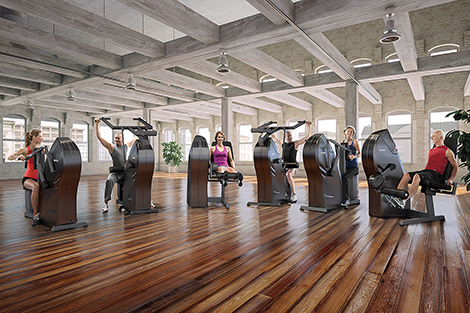
The milon circuit uses traffic lights to take exercisers through a 30 minute workout
HIT has been proven to help generate powerful, athletic muscle
In several studies, HIT produced 5-10 per cent greater increases in VO2 max
COMPANY PROFILES
RMA Ltd
RMA Ltd is a one-stop global company
that can design, build and produce from a
greenfield site upw [more...]
Taylor Made Designs
Founded in 1993, Taylor Made
Designs supply corporate clothing
and brand-enhancing merchandise
to [more...]
Alterface
Alterface’s Creative Division team is
seasoned in concept and ride development,
as well as storyte [more...]
QubicaAMF UK
QubicaAMF is the largest and most
innovative bowling equipment provider with
600 employees worldwi [more...]
There’s been a surge in interest in short, but intense exercise regimes –
known as high-intensity interval training – in the fitness sector.
We investigate the background and benefits of this protocol for spas
By Kate Cracknell | Published in Spa Business 2012 issue 4
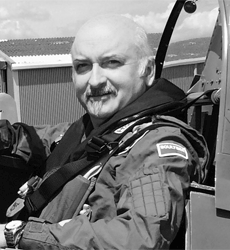
HIT training principles have been used by athletes the world over since the 1930s
In the last few years, the health and fitness industry has seen the emergence of a number of shorter, results-driven workout concepts for ‘time poor’ consumers. Women-only franchises Curves and Vivafit have offered a 30-minute, circuit-based workout for some time, but are now being joined by the likes of Fit n Fast in Australia, where Quickie workouts are available in activities such as cycling, boxing and circuits – and where the intensity is being ramped up to challenge a younger demographic.
From a fitness equipment supplier perspective, milon’s eccentric and concentric resistance equipment has been designed to maximise results via a circuit workout that takes around 30 minutes. Power Plate also recently demonstrated a 20-minute concept which combines its vibration training platform with its new powerBIKE with vibrating pedals. Classes are getting shorter.
An elite heritage They’re also getting tougher. Because what this is all leading to is the emergence of HIT (high-intensity interval training). Or should we say re-emergence? After all, in essence HIT is a training method that’s been around for many years in the elite sports arena.
Interval training in its modern form dates back to the 1930s, when Woldemar Gerschler (Germany) and Gosta Holmer (Sweden) used it to enhance the performance of their national teams. And in Finland, Lauri Pikhala was creating interval training programmes for runner Paavo Nurmi back in 1910.
Holmer dubbed the approach fartlek – Swedish for ‘speed play’ – thanks to the use of ‘faster than race’ pace. Concentrating on simultaneous speed/endurance training, the training protocol puts stress on both aerobic and anaerobic energy systems due to the alternating pace and intensity of the exercise. It’s now used the world over to offer variation in an elite athlete’s preparation throughout the year. And now it’s coming to fitness centres and gyms in the form of HIT. So how do we define HIT?
Defining HIT Len Kravitz and Lance Dalleck – researchers at the University of New Mexico, in the US – define interval training as “high-intensity, short duration training sessions performed at workloads above the lactate threshold, marked by an abrupt increase in blood lactate that forces the muscle to revert from aerobic to anaerobic metabolism”.
Clearly this is hard to measure within a gym environment. However, in a review paper undertaken in February by New Zealand’s AUT University (see the Literature Review panel), HIT is defined as either working at over 75 per cent of heart rate maximum (HR max) or 75 per cent of maximum oxygen uptake (VO2 max), followed by rest periods.
Intervals vary from 1:1 (work:rest) ratios, to 2:1 or other variations depending on fitness levels. The rest phase can either be complete rest or dropping back to a moderate intensity to enable recovery.
“However, 75 per cent HR max and 75 per cent VO2 max are very different intensities and not to be confused as being the same,” stresses Randy Huntington, global director of marketing, performance, education and research at fitness equipment specialist Keiser. So there are no clear-cut guidelines as yet, other than that the work phases should be ‘hard’ or ‘very hard’.
Huntington, meanwhile, categorises HIT as a form of circuit training. “In 1953, RE Morgan and GT Anderson at the University of Leeds [UK] created circuit training – of which interval training is a subset – with Manfred Scholich going on to write the bible on interval/circuit training in 1986,” he explains. “There are many ways to do circuits and Scholich has already labelled them quite well, setting a series of criteria: sets, repetitions, load, type of exercise, order of exercises, number of exercises, rest interval, work interval and density.
“It’s important that a common vocabulary be established within the fitness industry, otherwise we’ll end up with fancy marketing names for programmes that have actually existed for over 40 years – and in some cases, where the roots are over 100 years old.”
Benefits of HIT But if precise terminology and parameters are still to be decided, there does seem to be broad agreement on the benefits of HIT.
“Research shows that HIT delivers results that surpass conventional, steady-state training,” says Bryce Hastings, technical consultant for group exercise company Les Mills International (see sb08/3 p100). “These include accelerated aerobic conditioning, getting you fitter faster; an improved anaerobic threshold, letting you go harder for longer; improved insulin resistance and growth hormone changes, with enhanced hormonal responses; and the generation of athletic, powerful muscle, giving you the tone you dream about.”
Huntington adds: “Interval training has the potential to burn more calories than conventional aerobic/strength training and is an effective means of improving strength/muscular endurance. In addition, it has always delivered faster results. However, all this is at the potential expense of injury and endocrine burnout. It takes a while to adapt to such workouts, and in most cases adherence is less time than the required time to adaptation. If we’re to bring it into the gym, we need to make it fun so people will continue to do it, thereby gaining a cumulative effect.”
There’s also an argument that a HIT circuit may not deliver optimum results. Huntington continues: “In the late 80s and early 90s, Keiser developed the XPress Circuit for time-conscious, non-elite members. This was done in the full knowledge that circuit training will always compromise the true effectiveness of the five S’s – strength, speed, skill, stamina, suppleness – when they’re not done as discreet parts of a programme. Does this make HIT or circuit training bad? Absolutely not. It just means that the best results you can get will be less than the best result you could achieve by focusing on any one of the five S’s individually.”
For non-elite athletes, however, the benefits will already be very compelling. Not only that, but the AUT University/Les Mills review paper highlights benefits for a far more diverse range of exercisers than might have been expected. Gym-based use of HIT could, it seems, have a broad appeal.
Read more from this issue of Attractions Management magazine
View contents of Attractions Management 2012 issue 4
Interview: Laurent Houel
Evian's global brand development
director tells Katie Barnes about the
group's new evianSpa licence concept
that's set for a strategic global rollout
Promotional feature: Value Proposition
If you're thinking of investing in a spa development bigger than 300sq m,
a feasibility study – at a cost of only US$10k-US$18k – can reveal the
business model most likely to succeed.
Research: Work it out
Katherine Johnston reveals key
recommendations following a
much-needed study on global spa
management training
Top team: Miraval
The team that created the new spa at
Miraval shared a bold vision as Liz
Terry discovered on her visit
Family matters: The Brepohls
Natural medicine is the focus at
Lapinha: one of Brazil's original
medical spas. Neena Dhillon talks to
the founding family
The making of...: A massage table
Up to 18 million parts are needed for
a year's production of massage tables.
Lisa Starr takes an ‘undercover' look
at just what goes into making this
industry staple
Research: The cold war
Meditation and exercise can
significantly reduce sick days taken
due to colds and flu
Research papers A 2005 study of 38 elite cyclists, published in the Journal of Strength & Conditioning Research, showed that interval training leads to improved respiratory function, including better blood flow through the lungs and oxygen-carbon dioxide exchange. In the study, HIT increased performance by improving ventilatory threshold and VO2 max, boosting the body’s ability to use oxygen to generate energy.
Another study, published in the Journal of Physiology in July 2006, found improved adaptations in muscle cells after interval training in contrast to traditional steady-state endurance training. The study compared two groups of active young men over two weeks. One group engaged in traditional long-duration training for 90–120 minutes, while the other did four to six sets of sprint intervals (30 seconds all-out and four-minute rest intervals). It revealed superior adaptations in muscle tissue of the HIT group.
HIT led to improved respiratory function
Literature review
AUT University’s review of 45 published journal articles, carried out on behalf of Les Mills, focused on 24 papers that compared HIT with steady-state moderate intensity exercise. The authors focused on moderately trained recreational athletes through to those with general metabolic syndrome (including obesity and hypertension) as more representative of the general population. The training studies ranged from two to 20 weeks, with typically three to five sessions a week.
Some studies used supra-maximal intensity (up to a reported 170 per cent of VO2 max). But most used ‘work’ phases of around 90 per cent VO2 max – also described as 15-17 out of 20 on a self-rating scale of perceived exertion (hard to very hard). Sessions generally lasted around 40 minutes, including work and recovery phases: work phases were typically 30 seconds to two minutes; with recovery mostly one to four minutes of light to moderate exercise (70 per cent HR max).
In several studies HIT produced 5-10 per cent greater increases in VO2 max, often in less time. In some cases even greater differences were observed. Where the steady state group did experience significantly greater increases in VO2 max “it was patently owing to very big differences in training volume”.
In all cases, HIT produced greater improvements in anaerobic fitness, insulin sensitivity, endothelin function and body fat levels, with significantly greater reductions also observed in systolic and diastolic pressure in several studies.
Although often anecdotally quoted as a benefit of HIT, only one study specifically examined EPOC (excess post-exercise oxygen consumption) and found no significant difference compared with steady-state moderate intensity exercise.
Several of the papers commented anecdotally that subjects typically reported their enjoyment of interval-style training more than steady-state training, leading to good adherence.
The authors of the review found no evidence that repeat high intensity exercise bouts had a harmful effect on any of the populations. They also found no evidence that exercise intensity alone has a negative effect on resting hormone levels (testosterone, cortisol etc).
The milon circuit uses traffic lights to take exercisers through a 30 minute workout
HIT has been proven to help generate powerful, athletic muscle
In several studies, HIT produced 5-10 per cent greater increases in VO2 max
OMA has completed a major transformation of New York's New Museum, creating a larger
cultural campus that combines expanded exhibition spaces with learning, performance,
hospitality and public programming.
A US$50 million (£44.2 million, €51.2 million) transformation of Chicago's historic McCormick
Mansion has created a new destination that combines live magic, immersive theatre, dining and
private membership under one roof.
The Montana Historical Society has officially celebrated the opening of its new Montana
Heritage
Center, a US$107 million (£79 million, €92 million) destination that combines immersive
storytelling with cutting-edge audiovisual technology to bring the sta
San Antonio Zoo has reported a US$283 million economic impact for 2025, following a decade-
long transformation programme that has seen almost US$200 million invested into the Texas
attraction.
Plans for the AU$180 million redevelopment of Reef HQ Aquarium in Townsville, Australia, are
progressing, with the project set to transform the attraction into a global centre for reef
education and conservation.
Abu Dhabi-based investment firm Mubadala Capital has made a binding, fully financed
€1 billion
offer to acquire Pierre and Vacances SA, the European holiday resort operator behind the
continental European Center Parcs business.
Disney has reaffirmed its commitment to investing US$30 billion in its US parks and cruise
business by 2033, using new America250 celebrations to underline the role its attractions play
in supporting jobs, tourism and economic growth.
Expo 2030 Riyadh is being planned as a permanent visitor destination, with organisers
confirming the six-million-square-metre site will become a Global Village after the event closes.
The owner of one of Australia's best-known waterparks has acquired a major competitor,
creating a new attractions business spanning two of the country's largest visitor destinations.
The Toverland theme park in the Netherlands has announced a €98m expansion programme
that will add a resort, new attractions and staff facilities as it pursues plans to become a multi-
day destination.
+ More news
COMPANY PROFILES
RMA Ltd RMA Ltd is a one-stop global company
that can design, build and produce from a
greenfield site upw [more...]
Taylor Made Designs Founded in 1993, Taylor Made
Designs supply corporate clothing
and brand-enhancing merchandise
to [more...]
Alterface Alterface’s Creative Division team is
seasoned in concept and ride development,
as well as storyte [more...]
QubicaAMF UK QubicaAMF is the largest and most
innovative bowling equipment provider with
600 employees worldwi [more...]