Meditators had fewer days off sick and less severe symptoms
While the common cold is a mild illness, it costs society billions every year – especially in terms of lack of workplace productivity due to days off sick.
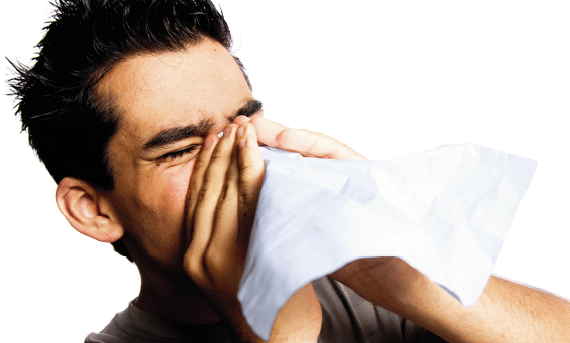
Previous scientific studies have highlighted the fact that people who workout more or have low stress levels aren’t as likely to get ill. But now research published by the Annals of Family Medicine in July* has also suggested that positive thinking – via mindfulness meditation – as well as exercise leads to less severe symptoms of acute respiratory illnesses (ARI), such as colds and influenza, or may even prevent them altogether.
A mindful study Dr Bruce Barrett, an associate professor at the University of Wisconsin-Madison, and colleagues randomly assigned 149 participants aged 50 years and over to three groups.
One group took part in an eight-week meditation programme of two-and-a-half hour group sessions a week and 45-minutes of at-home practice on a daily basis. The programme was based on mindfulness meditation which works on the idea that an increased awareness of your own body, thoughts and emotions may lead to a healthier mind-body response to stress.
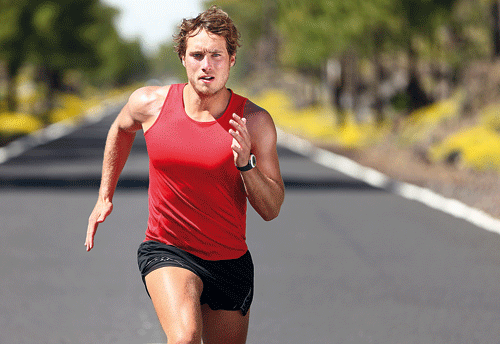
The second group underwent a matching eight-week exercise programme of one two-and-a-half-hour group session a week and 45 minutes of physical activity a day. The exercise was of moderate intensity and mostly consisted of stationary bike, treadmill and equipment workouts in the group sessions, and brisk walking or jogging at home.
The third group was simply included for control purposes.
The researchers then observed participants from September to May – considered the US cold and influenza season. Via bi-weekly calls, they kept track of when people reported having a cold/flu, the severity of symptoms, the number of days missed off work and the number of visits to a doctor.
Healthy results During observation, 40 bouts of ARI were reported in the control group, compared to only 27 cases in those who had meditated and 26 in the exercise group.
Meditators also reported less severe symptoms. The symptoms were measured using the Wisconsin Upper Respiratory Symptom Survey which rates 24 ailments – from a runny nose, sneezing and sore throat to headache/congestion, body ache and fever – on a scale of 0–7 for severity. The symptoms weren’t singled out, but overall the average score in the meditation group was only 144, compared to 248 for exercise participants and 358 in the control group.
People in the exercise and meditation groups felt sick for five days on average, while those in the control group felt sick for an average of nine days.
“I suspect this is because they [the meditators] are better able to cope with the symptoms,” independent mindfulness researcher James Carmody told Reuters press agency. “[With mindfulness] people learn to redirect their attention so they don’t stay stuck on unpleasant thoughts.”
Notably, people in the meditation and exercise groups also took less ARI-related sick days from work during the study. Meditators missed 16 days of work due to ARI in total; while those who exercised took 32 days off work for ARI. In contrast, people in the control group took 67 days off work.
There wasn’t much difference in the number of times people visited the doctor because of ARI.
*Barrett, Bruce et al. Meditation or Exercise for Preventing Acute Respiratory Infection: A Randomized Controlled Trial, The Annals of Family Medicine, July/August 2012
Read more from this issue of Attractions Management magazine
View contents of Attractions Management 2012 issue 4
Interview: Laurent Houel
Evian's global brand development
director tells Katie Barnes about the
group's new evianSpa licence concept
that's set for a strategic global rollout
Promotional feature: Value Proposition
If you're thinking of investing in a spa development bigger than 300sq m,
a feasibility study – at a cost of only US$10k-US$18k – can reveal the
business model most likely to succeed.
Research: Work it out
Katherine Johnston reveals key
recommendations following a
much-needed study on global spa
management training
Top team: Miraval
The team that created the new spa at
Miraval shared a bold vision as Liz
Terry discovered on her visit
Family matters: The Brepohls
Natural medicine is the focus at
Lapinha: one of Brazil's original
medical spas. Neena Dhillon talks to
the founding family
The making of...: A massage table
Up to 18 million parts are needed for
a year's production of massage tables.
Lisa Starr takes an ‘undercover' look
at just what goes into making this
industry staple
Research: The cold war
Meditation and exercise can
significantly reduce sick days taken
due to colds and flu
Meditators had fewer days off sick and less severe symptoms
While the common cold is a mild illness, it costs society billions every year – especially in terms of lack of workplace productivity due to days off sick.
Previous scientific studies have highlighted the fact that people who workout more or have low stress levels aren’t as likely to get ill. But now research published by the Annals of Family Medicine in July* has also suggested that positive thinking – via mindfulness meditation – as well as exercise leads to less severe symptoms of acute respiratory illnesses (ARI), such as colds and influenza, or may even prevent them altogether.
A mindful study Dr Bruce Barrett, an associate professor at the University of Wisconsin-Madison, and colleagues randomly assigned 149 participants aged 50 years and over to three groups.
One group took part in an eight-week meditation programme of two-and-a-half hour group sessions a week and 45-minutes of at-home practice on a daily basis. The programme was based on mindfulness meditation which works on the idea that an increased awareness of your own body, thoughts and emotions may lead to a healthier mind-body response to stress.
The second group underwent a matching eight-week exercise programme of one two-and-a-half-hour group session a week and 45 minutes of physical activity a day. The exercise was of moderate intensity and mostly consisted of stationary bike, treadmill and equipment workouts in the group sessions, and brisk walking or jogging at home.
The third group was simply included for control purposes.
The researchers then observed participants from September to May – considered the US cold and influenza season. Via bi-weekly calls, they kept track of when people reported having a cold/flu, the severity of symptoms, the number of days missed off work and the number of visits to a doctor.
Healthy results During observation, 40 bouts of ARI were reported in the control group, compared to only 27 cases in those who had meditated and 26 in the exercise group.
Meditators also reported less severe symptoms. The symptoms were measured using the Wisconsin Upper Respiratory Symptom Survey which rates 24 ailments – from a runny nose, sneezing and sore throat to headache/congestion, body ache and fever – on a scale of 0–7 for severity. The symptoms weren’t singled out, but overall the average score in the meditation group was only 144, compared to 248 for exercise participants and 358 in the control group.
People in the exercise and meditation groups felt sick for five days on average, while those in the control group felt sick for an average of nine days.
“I suspect this is because they [the meditators] are better able to cope with the symptoms,” independent mindfulness researcher James Carmody told Reuters press agency. “[With mindfulness] people learn to redirect their attention so they don’t stay stuck on unpleasant thoughts.”
Notably, people in the meditation and exercise groups also took less ARI-related sick days from work during the study. Meditators missed 16 days of work due to ARI in total; while those who exercised took 32 days off work for ARI. In contrast, people in the control group took 67 days off work.
There wasn’t much difference in the number of times people visited the doctor because of ARI.
*Barrett, Bruce et al. Meditation or Exercise for Preventing Acute Respiratory Infection: A Randomized Controlled Trial, The Annals of Family Medicine, July/August 2012
Read more from this issue of Attractions Management magazine
View contents of Attractions Management 2012 issue 4
Interview: Laurent Houel
Evian's global brand development
director tells Katie Barnes about the
group's new evianSpa licence concept
that's set for a strategic global rollout
Promotional feature: Value Proposition
If you're thinking of investing in a spa development bigger than 300sq m,
a feasibility study – at a cost of only US$10k-US$18k – can reveal the
business model most likely to succeed.
Research: Work it out
Katherine Johnston reveals key
recommendations following a
much-needed study on global spa
management training
Top team: Miraval
The team that created the new spa at
Miraval shared a bold vision as Liz
Terry discovered on her visit
Family matters: The Brepohls
Natural medicine is the focus at
Lapinha: one of Brazil's original
medical spas. Neena Dhillon talks to
the founding family
The making of...: A massage table
Up to 18 million parts are needed for
a year's production of massage tables.
Lisa Starr takes an ‘undercover' look
at just what goes into making this
industry staple
Research: The cold war
Meditation and exercise can
significantly reduce sick days taken
due to colds and flu
OMA has completed a major transformation of New York's New Museum, creating a larger
cultural campus that combines expanded exhibition spaces with learning, performance,
hospitality and public programming.
A US$50 million (£44.2 million, €51.2 million) transformation of Chicago's historic McCormick
Mansion has created a new destination that combines live magic, immersive theatre, dining and
private membership under one roof.
The Montana Historical Society has officially celebrated the opening of its new Montana
Heritage
Center, a US$107 million (£79 million, €92 million) destination that combines immersive
storytelling with cutting-edge audiovisual technology to bring the sta
San Antonio Zoo has reported a US$283 million economic impact for 2025, following a decade-
long transformation programme that has seen almost US$200 million invested into the Texas
attraction.
Plans for the AU$180 million redevelopment of Reef HQ Aquarium in Townsville, Australia, are
progressing, with the project set to transform the attraction into a global centre for reef
education and conservation.
Abu Dhabi-based investment firm Mubadala Capital has made a binding, fully financed
€1 billion
offer to acquire Pierre and Vacances SA, the European holiday resort operator behind the
continental European Center Parcs business.
Disney has reaffirmed its commitment to investing US$30 billion in its US parks and cruise
business by 2033, using new America250 celebrations to underline the role its attractions play
in supporting jobs, tourism and economic growth.
Expo 2030 Riyadh is being planned as a permanent visitor destination, with organisers
confirming the six-million-square-metre site will become a Global Village after the event closes.
The owner of one of Australia's best-known waterparks has acquired a major competitor,
creating a new attractions business spanning two of the country's largest visitor destinations.
The Toverland theme park in the Netherlands has announced a €98m expansion programme
that will add a resort, new attractions and staff facilities as it pursues plans to become a multi-
day destination.
+ More news
COMPANY PROFILES
Alterface Alterface’s Creative Division team is
seasoned in concept and ride development,
as well as storyte [more...]