Results from the ISPA 2012 US Spa Industry Study show that
the country’s operators are making further, positive progress.
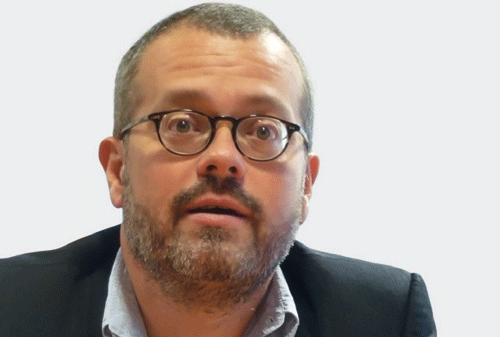
PwC’s Colin McIlHeney analyses the findings and the challenges ahead
By Colin McIlheney | Published in Spa Business 2012 issue 4
Total spa revenue for 2011 rose to US$13.4bn – a 4.5 per cent increase on 2012 and a figure which has now surpassed the pre-recession peak of US$12.8bn in 2008. This is an important milestone
The 2012 US Spa Industry Study by the International Spa Association (ISPA) provides a profile of the spa industry in the US throughout 2011 and also into the first half of 2012. Its findings are based on a survey of 807 spa operators across the US, including day spas, hotel/resort spas, medical spas, club spas, destination spas and mineral springs spas. Criteria analysed include the regional distribution of spas, their type, ownership structure, number of client visits and service/product offerings.
This year’s study focused on the industry’s performance as it kept pace with an economy still in gradual emergence from the recession, and as spas adapted to an increasingly competitive marketplace where cost-conscious consumers are shopping around.
The report gauged the extent to which the industry has stabilised and experienced growth. This was measured by examining the change across five key factors: revenues, spa visits, number of locations, floor space and staffing levels.
To gain insight into more recent and emerging trends, spa operators were also asked about their experiences during the period of September 2011 to March 2012. Their answers reveal that the steady upward trajectory has continued from 2011.
Survey questions also identified the key challenges facing spas as they regain ground and the changes operators have made to ensure they stay competitive and deliver value and professionalism to clients.
GraduAL progress During 2011, the spa industry in the US continued to build on the moderate growth experienced in 2010 when business gradually picked up after the downturn and customer visits increased (see sb11/4 p38).
All five key performance factors for the spa industry either grew or held steady compared to their 2010 performance. Total spa revenue for 2011 rose to us$13.4bn (€10.2bn, £8.3bn) – a 4.5 per cent increase on 2010 and a figure which has now surpassed the pre-recession peak of us$12.8bn (€9.8bn, £8bn) achieved in 2008. This is an important milestone as the industry recovers.
The performance mirrors the overall recovery rate across the US economy. In 2011, total consumer spending on services in the nation grew by 3.7 per cent. While, for the second year in a row, average revenues per spa expanded, rising by 4.9 per cent in 2011 to us$673,000 (€513,350, £417,000). This increase in spa revenues is driven largely by a boost in visits, up by 4.1 per cent in 2012 to 156 million. But while visits were up, revenue per visit stayed virtually unchanged at us$86 (€66, £53), with a slight lift of 0.4 per cent compared to 2010. Nonetheless the notable increase in visits is a positive sign.
Across the US, the total number of spa locations now stands at 19,850, largely unchanged from 19,900 in 2010. After declines in both 2009 and 2010, this is welcome news. In those years, spa locations fell by 1,400. Day spas are still by far the largest category, representing 78.9 per cent of all spas in the US, followed by medical spas at 8.8 per cent, resort/hotel spas at 8.7 per cent, club spas at 2.9 per cent, destination spas at 0.4 per cent and mineral springs spas at 0.3 per cent .
Total employment held steady, with a 0.2 per cent increase between May 2011 and May 2012. Yet there’s been a marked shift towards full-time employees, up by 9.3 per cent; a further sign that the industry’s back on track. Total square footage also held steady, with an expansion of less than 1 per cent.
More recent trends The survey of spa operators covering from September 2011 to March 2012 revealed a continuation of the upward trend. The majority of spa operators reported a lift in demand compared to the same period one year ago. Almost six in 10 said visits were up and 55 per cent reported increased client spending per visit, across all types of spas. Sixty per cent of operators saw a growth in revenues. Staffing levels stayed evenly balanced.
These are positive developments, showing an improvement on the 2011 survey results when a minority of 45 per cent reported a growing spend per visit.
Rising profit margins Driven by increasing demand, profitability is on the upswing. Fifty-five per cent of spas reported a 2011 profit percentage topping 10 per cent, up from 49 per cent in 2010. Most also said that profitability had improved between September 2011 and March 2012 compared to 12 months previously. But almost one in five spas, reported a net loss in 2011, virtually unchanged from 2010 (18 per cent). Together, these results show an industry that has stabilised in terms of staffing and location numbers and is experiencing a modest but broadly-based recovery.
Stimulating demand Spas have been adopting a range of strategies to stimulate demand and increase visits in an arena which is highly competitive, and where consumers are now more price conscious than before the recession.
Operators are keeping prices steady to maintain competitiveness against a backdrop of rising consumer prices. Average price per spa service – us$80 (€61, £50) – remained unchanged in 2011 compared with both 2010 and 2009. This is likely to reflect the moderate pace of consumer spending and the use of discounts and rewards to encourage visits and loyalty. However, holding prices steady also means that improving profitability is likely to remain challenging for many spas for the time being.
At the same time spas across the board are expanding their portfolio of services, offers and products, to provide more choice and flexibility to busy customers. Over 83 per cent reported making one or more changes over the past 12 months in response to recent economic conditions. Nearly one in four added additional health and wellness programmes such as individual wellness consultations, nutritional programmes and group wellness packages. In addition, 28 per cent introduced shorter treatment offerings of 30 minutes or less to bring greater value and efficiency to time-pressed clients. Almost one in three operators expanded their spa treatment menu and 55 per cent have added new retail products. On average spas have made 2.5 changes to their operations in the past year.
Ninety-six per cent of spas have their own website and are stepping up the use of online social media, up from 82 per cent in 2011 to 88 per cent in 2012. Three in four spas offered one or more gift card promotions.
Confident overall As the industry makes further progress along the road to recovery, spa operators we questioned noted there were a range of challenges the industry still faces. These included:
* The economy and consumer spending; * Pricing, inflation and profitability. In a competitive environment, with consumers shopping around for the best deals, spas are seeking to maintain quality but without raising prices. Against a backdrop of rising costs, margins are being squeezed; *Shortages of qualified staff and rising payroll costs; and, * Perceptions and the need for education. Spas continue to tackle a public perception of luxury and pampering. There remains a need to educate consumers about the health benefits of the spa experience and to position spas as places which promote wellbeing.
Overall, however, an overwhelming 78 per cent of all spa operators are confident or very confident that revenues will continue to increase in the next six months.
Read more from this issue of Attractions Management magazine
View contents of Attractions Management 2012 issue 4
Interview: Laurent Houel
Evian's global brand development
director tells Katie Barnes about the
group's new evianSpa licence concept
that's set for a strategic global rollout
Promotional feature: Value Proposition
If you're thinking of investing in a spa development bigger than 300sq m,
a feasibility study – at a cost of only US$10k-US$18k – can reveal the
business model most likely to succeed.
Research: Work it out
Katherine Johnston reveals key
recommendations following a
much-needed study on global spa
management training
Top team: Miraval
The team that created the new spa at
Miraval shared a bold vision as Liz
Terry discovered on her visit
Family matters: The Brepohls
Natural medicine is the focus at
Lapinha: one of Brazil's original
medical spas. Neena Dhillon talks to
the founding family
The making of...: A massage table
Up to 18 million parts are needed for
a year's production of massage tables.
Lisa Starr takes an ‘undercover' look
at just what goes into making this
industry staple
Research: The cold war
Meditation and exercise can
significantly reduce sick days taken
due to colds and flu
ISPA is recognised worldwide as one of the voices of the spa industry, representing providers in more than 70 countries. It has been publishing in-depth studies of the spa industry in the US since 2000.
Topics covered in detail in the full ISPA 2012 US Spa Industry Study, prepared by PricewaterhouseCoopers, include: industry size and continued modest growth; an industry profile looking at size and geography by type of spa; facilities, including elements of indoor square footage; services and products offered; prices and the composition of revenue; and visitor and employee numbers.
The full report is available at experienceispa.com. ISPA members can download a copy and non-members can purchase the report via this site.
Fifty-five per cent of spas in the US added new retail products
Guest numbers are up by 4.1 per cent which has boosted revenues
COMPANY PROFILES
Painting With Light
By combining lighting, video, scenic and architectural elements, sound and special effects we tell s [more...]
Sally Corporation
Our services include: Dark ride design & build; Redevelopment of existing attractions; High-quality [more...]
RMA Ltd
RMA Ltd is a one-stop global company
that can design, build and produce from a
greenfield site upw [more...]
Alterface
Alterface’s Creative Division team is
seasoned in concept and ride development,
as well as storyte [more...]
Results from the ISPA 2012 US Spa Industry Study show that
the country’s operators are making further, positive progress.
PwC’s Colin McIlHeney analyses the findings and the challenges ahead
By Colin McIlheney | Published in Spa Business 2012 issue 4
Total spa revenue for 2011 rose to US$13.4bn – a 4.5 per cent increase on 2012 and a figure which has now surpassed the pre-recession peak of US$12.8bn in 2008. This is an important milestone
The 2012 US Spa Industry Study by the International Spa Association (ISPA) provides a profile of the spa industry in the US throughout 2011 and also into the first half of 2012. Its findings are based on a survey of 807 spa operators across the US, including day spas, hotel/resort spas, medical spas, club spas, destination spas and mineral springs spas. Criteria analysed include the regional distribution of spas, their type, ownership structure, number of client visits and service/product offerings.
This year’s study focused on the industry’s performance as it kept pace with an economy still in gradual emergence from the recession, and as spas adapted to an increasingly competitive marketplace where cost-conscious consumers are shopping around.
The report gauged the extent to which the industry has stabilised and experienced growth. This was measured by examining the change across five key factors: revenues, spa visits, number of locations, floor space and staffing levels.
To gain insight into more recent and emerging trends, spa operators were also asked about their experiences during the period of September 2011 to March 2012. Their answers reveal that the steady upward trajectory has continued from 2011.
Survey questions also identified the key challenges facing spas as they regain ground and the changes operators have made to ensure they stay competitive and deliver value and professionalism to clients.
GraduAL progress During 2011, the spa industry in the US continued to build on the moderate growth experienced in 2010 when business gradually picked up after the downturn and customer visits increased (see sb11/4 p38).
All five key performance factors for the spa industry either grew or held steady compared to their 2010 performance. Total spa revenue for 2011 rose to us$13.4bn (€10.2bn, £8.3bn) – a 4.5 per cent increase on 2010 and a figure which has now surpassed the pre-recession peak of us$12.8bn (€9.8bn, £8bn) achieved in 2008. This is an important milestone as the industry recovers.
The performance mirrors the overall recovery rate across the US economy. In 2011, total consumer spending on services in the nation grew by 3.7 per cent. While, for the second year in a row, average revenues per spa expanded, rising by 4.9 per cent in 2011 to us$673,000 (€513,350, £417,000). This increase in spa revenues is driven largely by a boost in visits, up by 4.1 per cent in 2012 to 156 million. But while visits were up, revenue per visit stayed virtually unchanged at us$86 (€66, £53), with a slight lift of 0.4 per cent compared to 2010. Nonetheless the notable increase in visits is a positive sign.
Across the US, the total number of spa locations now stands at 19,850, largely unchanged from 19,900 in 2010. After declines in both 2009 and 2010, this is welcome news. In those years, spa locations fell by 1,400. Day spas are still by far the largest category, representing 78.9 per cent of all spas in the US, followed by medical spas at 8.8 per cent, resort/hotel spas at 8.7 per cent, club spas at 2.9 per cent, destination spas at 0.4 per cent and mineral springs spas at 0.3 per cent .
Total employment held steady, with a 0.2 per cent increase between May 2011 and May 2012. Yet there’s been a marked shift towards full-time employees, up by 9.3 per cent; a further sign that the industry’s back on track. Total square footage also held steady, with an expansion of less than 1 per cent.
More recent trends The survey of spa operators covering from September 2011 to March 2012 revealed a continuation of the upward trend. The majority of spa operators reported a lift in demand compared to the same period one year ago. Almost six in 10 said visits were up and 55 per cent reported increased client spending per visit, across all types of spas. Sixty per cent of operators saw a growth in revenues. Staffing levels stayed evenly balanced.
These are positive developments, showing an improvement on the 2011 survey results when a minority of 45 per cent reported a growing spend per visit.
Rising profit margins Driven by increasing demand, profitability is on the upswing. Fifty-five per cent of spas reported a 2011 profit percentage topping 10 per cent, up from 49 per cent in 2010. Most also said that profitability had improved between September 2011 and March 2012 compared to 12 months previously. But almost one in five spas, reported a net loss in 2011, virtually unchanged from 2010 (18 per cent). Together, these results show an industry that has stabilised in terms of staffing and location numbers and is experiencing a modest but broadly-based recovery.
Stimulating demand Spas have been adopting a range of strategies to stimulate demand and increase visits in an arena which is highly competitive, and where consumers are now more price conscious than before the recession.
Operators are keeping prices steady to maintain competitiveness against a backdrop of rising consumer prices. Average price per spa service – us$80 (€61, £50) – remained unchanged in 2011 compared with both 2010 and 2009. This is likely to reflect the moderate pace of consumer spending and the use of discounts and rewards to encourage visits and loyalty. However, holding prices steady also means that improving profitability is likely to remain challenging for many spas for the time being.
At the same time spas across the board are expanding their portfolio of services, offers and products, to provide more choice and flexibility to busy customers. Over 83 per cent reported making one or more changes over the past 12 months in response to recent economic conditions. Nearly one in four added additional health and wellness programmes such as individual wellness consultations, nutritional programmes and group wellness packages. In addition, 28 per cent introduced shorter treatment offerings of 30 minutes or less to bring greater value and efficiency to time-pressed clients. Almost one in three operators expanded their spa treatment menu and 55 per cent have added new retail products. On average spas have made 2.5 changes to their operations in the past year.
Ninety-six per cent of spas have their own website and are stepping up the use of online social media, up from 82 per cent in 2011 to 88 per cent in 2012. Three in four spas offered one or more gift card promotions.
Confident overall As the industry makes further progress along the road to recovery, spa operators we questioned noted there were a range of challenges the industry still faces. These included:
* The economy and consumer spending; * Pricing, inflation and profitability. In a competitive environment, with consumers shopping around for the best deals, spas are seeking to maintain quality but without raising prices. Against a backdrop of rising costs, margins are being squeezed; *Shortages of qualified staff and rising payroll costs; and, * Perceptions and the need for education. Spas continue to tackle a public perception of luxury and pampering. There remains a need to educate consumers about the health benefits of the spa experience and to position spas as places which promote wellbeing.
Overall, however, an overwhelming 78 per cent of all spa operators are confident or very confident that revenues will continue to increase in the next six months.
Read more from this issue of Attractions Management magazine
View contents of Attractions Management 2012 issue 4
Interview: Laurent Houel
Evian's global brand development
director tells Katie Barnes about the
group's new evianSpa licence concept
that's set for a strategic global rollout
Promotional feature: Value Proposition
If you're thinking of investing in a spa development bigger than 300sq m,
a feasibility study – at a cost of only US$10k-US$18k – can reveal the
business model most likely to succeed.
Research: Work it out
Katherine Johnston reveals key
recommendations following a
much-needed study on global spa
management training
Top team: Miraval
The team that created the new spa at
Miraval shared a bold vision as Liz
Terry discovered on her visit
Family matters: The Brepohls
Natural medicine is the focus at
Lapinha: one of Brazil's original
medical spas. Neena Dhillon talks to
the founding family
The making of...: A massage table
Up to 18 million parts are needed for
a year's production of massage tables.
Lisa Starr takes an ‘undercover' look
at just what goes into making this
industry staple
Research: The cold war
Meditation and exercise can
significantly reduce sick days taken
due to colds and flu
ISPA is recognised worldwide as one of the voices of the spa industry, representing providers in more than 70 countries. It has been publishing in-depth studies of the spa industry in the US since 2000.
Topics covered in detail in the full ISPA 2012 US Spa Industry Study, prepared by PricewaterhouseCoopers, include: industry size and continued modest growth; an industry profile looking at size and geography by type of spa; facilities, including elements of indoor square footage; services and products offered; prices and the composition of revenue; and visitor and employee numbers.
The full report is available at experienceispa.com. ISPA members can download a copy and non-members can purchase the report via this site.
Fifty-five per cent of spas in the US added new retail products
Guest numbers are up by 4.1 per cent which has boosted revenues
Abu Dhabi-based investment firm Mubadala Capital has made a binding, fully financed
€1 billion
offer to acquire Pierre and Vacances SA, the European holiday resort operator behind the
continental European Center Parcs business.
Disney has reaffirmed its commitment to investing US$30 billion in its US parks and cruise
business by 2033, using new America250 celebrations to underline the role its attractions play
in supporting jobs, tourism and economic growth.
Expo 2030 Riyadh is being planned as a permanent visitor destination, with organisers
confirming the six-million-square-metre site will become a Global Village after the event closes.
The owner of one of Australia's best-known waterparks has acquired a major competitor,
creating a new attractions business spanning two of the country's largest visitor destinations.
The Toverland theme park in the Netherlands has announced a €98m expansion programme
that will add a resort, new attractions and staff facilities as it pursues plans to become a multi-
day destination.
Hotel de France, located on the British Isle of Jersey, has created a wellness retreat package
that includes a hot yoga session that will take place in Jersey Zoo’s butterfly sanctuary.
A new immersive attraction designed to transport visitors into the final hours of ancient Pompeii
is preparing to open near the world-famous archaeological site in southern Italy.
Experience design company, BRC Imagination Arts, has completed a transition that sees founder
Bob Rogers pass ownership of the business to four long-serving senior executives, while
remaining actively involved with the company.
Movie Park Germany has opened a new Paramount Pictures-themed attraction as part of its 30th
anniversary celebrations, using immersive storytelling and adaptive reuse to reinforce the park’s
longstanding “Hollywood in Germany” positioning.
Therme Manchester’s 28-acre development, which will include interconnected glass pavilions
that measure 65,000sq m, will be the largest bathing and wellbeing attraction in the world once
complete, according to prof David Russell, CEO of Therme UK.
+ More news
COMPANY PROFILES
Painting With Light By combining lighting, video, scenic and architectural elements, sound and special effects we tell s [more...]
Sally Corporation Our services include: Dark ride design & build; Redevelopment of existing attractions; High-quality [more...]
RMA Ltd RMA Ltd is a one-stop global company
that can design, build and produce from a
greenfield site upw [more...]
Alterface Alterface’s Creative Division team is
seasoned in concept and ride development,
as well as storyte [more...]