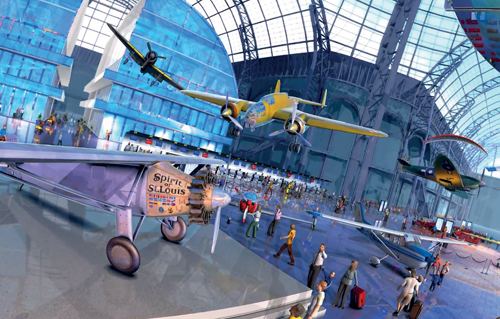
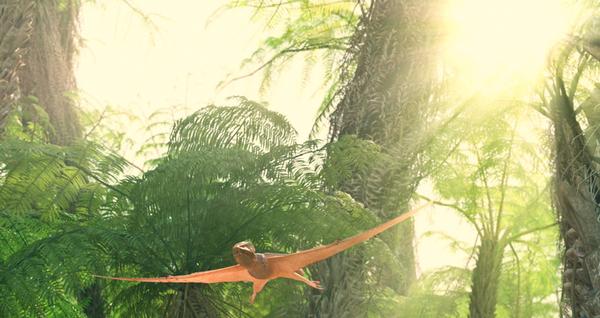
Dream to Fly presents the development of aviation through the ages with a poetic narration
In a world of ever-increasing specialisation, it’s refreshing that an organisation exists to serve a wide variety of interests, from educational to experimental to cultural to commercial, and everything in between. IMERSA (Immersive Media Entertainment, Research, Science & Arts) started with a small group of individuals whose activities in existing vehicles, such as IPS and International Planetarium Society, was deemed restrictive in terms of innovation in a rapidly evolving digital age. The common element among the people who first gathered under the IMERSA umbrella was that almost everyone was involved in designing and producing programmes for audiences to experience and enjoy under domes or other immersive environments.
Conference agenda In March, the fifth IMERSA conference was held – once again at the Denver Museum of Nature and Science (DMNS) – under the watchful eye and guiding hand of Dan Neafus, operations manager at DMNS’s Gates Planetarium. Neafus likes to say the real purpose of these annual gatherings is to bring a bunch of his good friends together, but that belies a significantly more ambitious agenda – namely to advance the cause of promoting widespread use of dome and other immersive spaces in a variety of institutional, artistic and commercial environments. IMERSA has positioned itself as a group not only to promote that idea, but to foster educational opportunities for people to learn from each other, and to establish a culture of best practices. It’s striking how many of the sessions involved codifying best practices, as well as providing common language and other base-line nomenclature and standards by which delegates can go back to their home domes with greater abilities and greater confidence. A prime example is Neafus’s comprehensive paper The Language of Immersive Cinema, which he authored in anticipation of the IMERSA conference and which will doubtlessly be widely circulated.
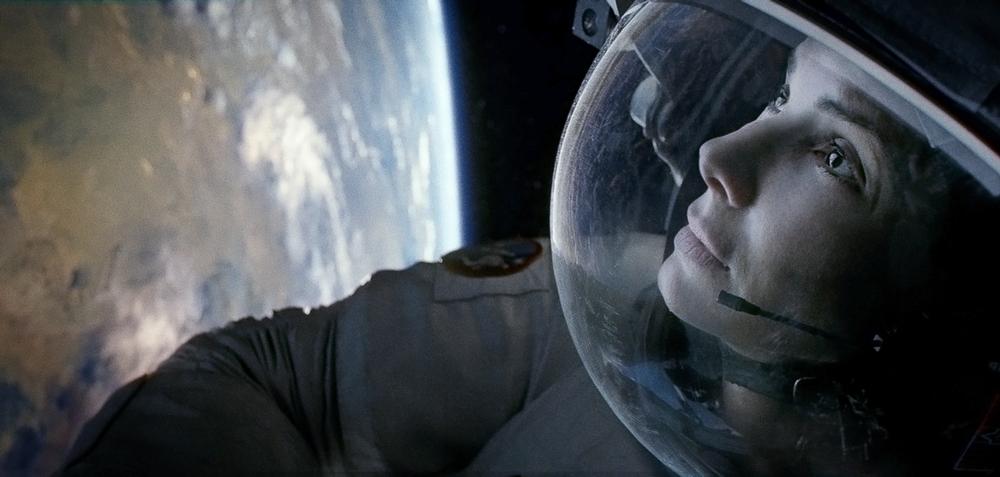
Increased attendance One of the best indicators of the niche IMERSA is filling is the attendance, which this year topped 200 people from six continents. Some delegates grappled with the challenge of multiple, portable domes as arty, yet commercial, operations in urban settings. Other attendees pondered the dilemma of creating fulldome productions on a relatively epic scale, but without the budget of blockbuster films like Gravity, which get seared into the mass audience consciousness every once in a while (this happens often enough to beg the perennial question as to whether we’re collectively pushing a rope uphill or are we actually making a difference out there in the educational and cultural world?).
That dilemma was highlighted when an ambitious new production by a talented, enthusiastic and determined filmmaker, Robin Sip, was premiered. Dinosaurs at Dusk was shown to an appreciative, but naturally critical audience. No one could be anything but impressed by the level of detail involved in creating this live-action educational fantasy and Sip was exceedingly generous in sharing many of the behind-the-scenes production details.
To me, there was a problem with the way English dialogue was structured, as well as with some of the stilted acting. To my taste, the same effort and refined production intensity might have resulted in an end-product that was less forced, and therefore more comfortable and natural. To be fair, some of my Japanese colleagues found the dialogue and acting “very cute” and they thought it would be quite marketable in their domes. So, what do I know?
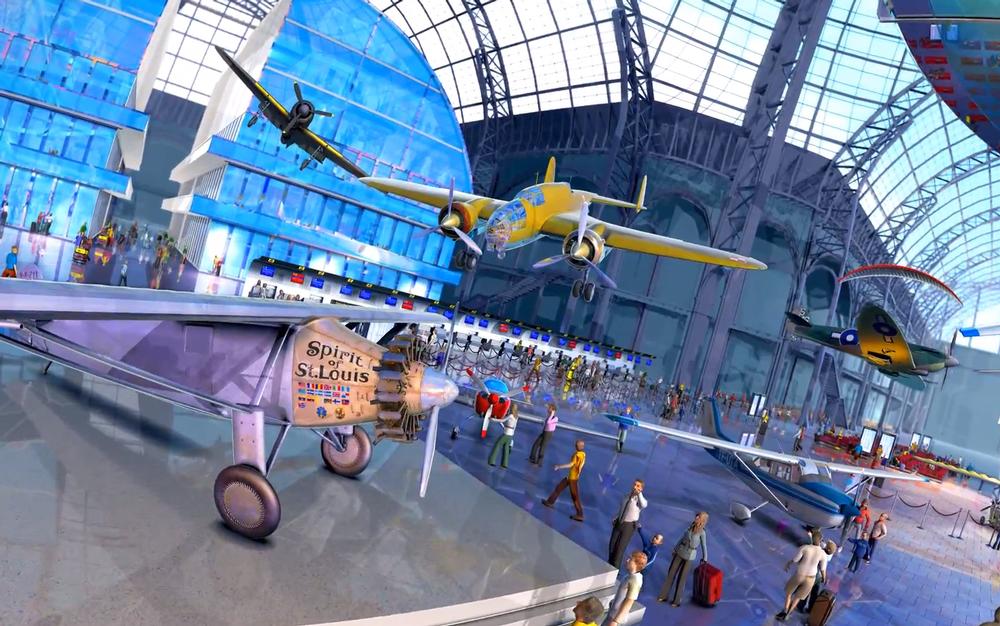
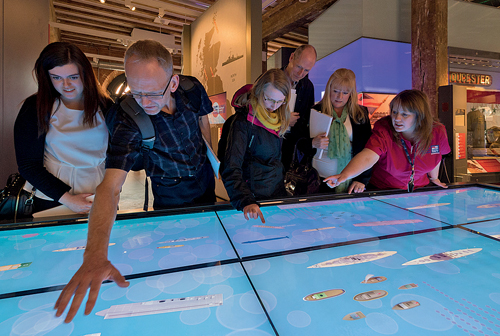
Another ambitious production aired, though not shown for the first time, was Dream to Fly by Copernicus Science Centre, Warsaw. The film has stunning visual effects, but suffers from a few curious content choices – specifically, graphically horrifying scenes of war planes dive-bombing ships at sea. Not the regular planetarium fare, but the producers are no doubt attempting to do away with stodgy programming often associated with “boring” planetariums.
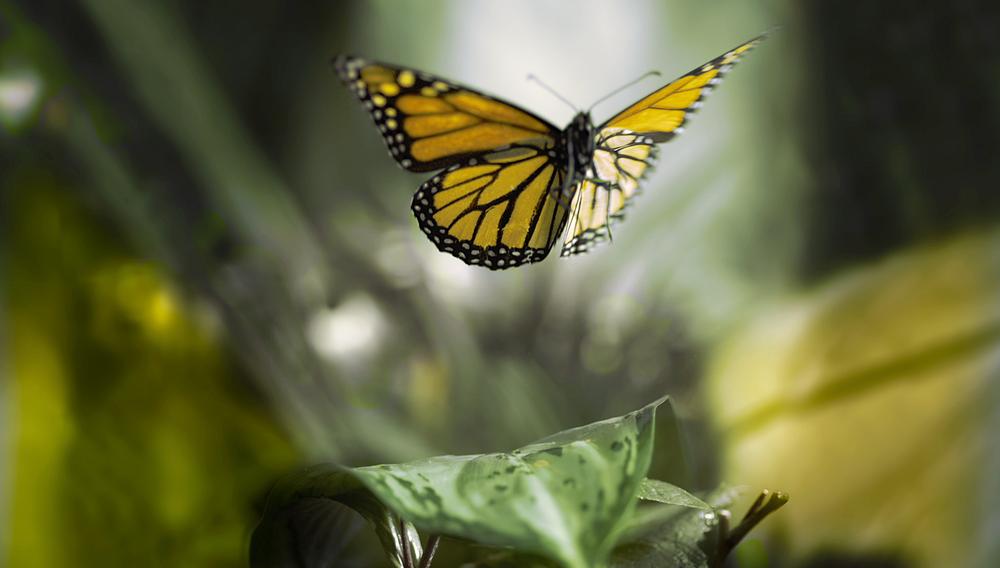
No place like dome One interesting experiment was the transferring of a large format (Imax-style) production Flight of the Butterflies into the dome environment. This is a lovely human drama with a compelling storyline, super photography and pretty good acting.
Canadian producer Jonathan Barker attended IMERSA and talked about how he and his team at SK Films had re-rendered the large-format film specifically for the dome environment – making a plea for others to proactively do the same. This is one of the rare times I’ve seen a tender human-scale story well told and presented in a planetarium-like environment. It’s commercial success has led to the production of a range of themed shower curtains. When was the last time a planetarium or dome show achieved something like that?
One of the common elements in this new style of immersive presentation is rapidly expanding access to science visualisation databases. These can be adapted, modified and integrated into complete productions, or (as I’d prefer to see in terms of taking advantage of a unique medium) presented with well delivered, authoritative, live commentary for immediacy, relevance to audiences and timeliness.
Dr Donna Cox, a leading luminary in computational science – especially astrophysics, earth sciences, engineering and related data domains, continued this theme with her keynote speech. She held us all spell-bound – as she and her colleagues have with audiences worldwide with Hubble 3D and other significant contributions to public understanding of the universe.
Mark C Petersen walked us all through the Loch Ness Productions database of worldwide dome theatres. Available online, it’s a valuable resource, not only as a snapshot in time, but for spotting trends in the medium. Dario Tiverton from Italy has also compiled a fulldome data base.
It’s a truism that there’s no higher honour than to be recognised and celebrated by one’s peers. This was true for Jeri Panek, long time representative of Evans and Sutherland Corp, who received a lifetime achievement award. At least a dozen speakers paraded in front of the open mike at the closing banquet to express appreciation for Jeri’s indomitable spirit, for the many contributions she has made in the field, and for her legendary ability to make and keep friends, even among fierce commercial competitors. Jeri told some priceless stories and needless to say, she received a prolonged, standing ovation at the closing banquet.
I have it on good authority that the next summit IMERSA will again be held at Denver Museum of Nature and Science in 2015. IMERSA’s board is actively involved in collaborative agreements with several like-minded, parallel organisations (including IPS, GSCA, ASTC and Ecsite) and recognises that the time has come to expand the board to take into account age, gender, geographic, topical and other currently under-represented areas.
Read more from this issue of Attractions Management magazine
View contents of Attractions Management 2014 issue 2
Editor's letter: The New Philanthropists
Tech is hot and as the growing number of tech millionaires
turn their thoughts to philanthropy, tech-related
attactions will prosper
Profile: Mario Mamon
The current chair of IAAPA talks about
his role with the organisation, doubling
the size of family theme park Enchanted
Kingdom in the Philippines and the
devastation of Super Typhoon Haiyan
Museums: MOHAI
MOHAI's executive director,
Leonard Garfield, talks about
the Seattle museum's new Bezos
Center for Innovation, named after
Amazon founder Jeff Bezos
Science centres: Appliance of science
Andreas Waschk and Mike Boris
explain how they made Blueprint
Entertainment into Europe's largest
private science centre operator
Museums: Olympic Movement
Director Francis Gabet describes how
The Olympic Museum's extensive
refurbishment reflects the excitement
and diveristy of the modern Games
Planetariums: Starry skies
The newly upgraded Fiske Planetarium in
Boulder, Colorado now boasts the highest
specification full dome theatre in the US.
Director Douglas Duncan tells us more
Museums: Beautiful minds
The founders of MoMath, the New York
Museum of Mathematics, tell us how
they're on a mission to get ordinary
people to fall in love with maths
World expos: Brave new world
Christian Lachel considers how world
expos can raise global awareness
about what matters for the planet
3D/4D/5D: IMERSA
A review of the fifth annual IMERSA
conference held in Denver, Colorado
Advertisement feature: EAS 2014
The exhibitors reveal what they’ll be showcasing at EAS in
September and what the hot topics of conversation will be
Waterparks: Wet'n'Wild
Wet'n'Wild Sydney has welcomed
a million visitors through its gates
since opening in December. Managing
director Chris Warhurst tells us why
Ticketing: Convenience store
Gateway's Liesel Tarquini explains
how mobile web stores can help
generate additional revenue
for attractions operators
Visit to Fiske Planetarium During the conference, delegates visited the newly refurbished and upgraded Fiske Planetarium in Boulder, Colorado for an event hosted by Dr Douglas Duncan, planetarium director (see interview on page 44).
The old Zeiss Mark 6 projector has quaintly taken its place among old-style displays that adorn the exhibition area of the planetarium. Now, inside the planetarium’s 20m (66ft)-diameter dome theatre, there’s a technological transformation with a brand new Megastar II star-ball projector, capable of projecting some 22 million stars. This is complemented by a state-of-the-art Sky-Skan 8K (8,000 X 8,000 pixels resolution) digital video system, with added SCISS astronomical data sets.
The 8K system produced some dazzling, crisp, clear, and bright images, although some (not all) were dogged by the persistent dome cross-reflection problem that tends to wash some scenes out.
It’s difficult to fathom why some scenes are more susceptible to that phenomenon than others that appear to be similar in content. Well, it’s an art as much as a science.
Annette Sotheran-Barnett was able to see her own production To Space and Back for the first time in an 8K projection dome, and was moved to see the production as she imagined it should be seen, under ideal conditions.
After a brief retro-laser show in the new theatre, there was a panel talk with Chris Maytag (Fiske Planetarium), Mark Webb and Patrick McPike (Adler Planetarium), Andrew Johnston (Smithsonian Institution), Steve Savage (Sky-Skan), Michael Daut (E&S) and Staffan Klashed (SCISS).
Ian C McLennan, Ian McLennan Consulting Tel: +1-604-681-4790 Email: [email protected]
An opportunity to reimagine one of the UK’s most recognisable towers has been formally
opened by Rivington Hark, as St Johns Beacon invites operators and partners to shape its
next phase. [more...]
Dream to Fly presents the development of aviation through the ages with a poetic narration
In a world of ever-increasing specialisation, it’s refreshing that an organisation exists to serve a wide variety of interests, from educational to experimental to cultural to commercial, and everything in between. IMERSA (Immersive Media Entertainment, Research, Science & Arts) started with a small group of individuals whose activities in existing vehicles, such as IPS and International Planetarium Society, was deemed restrictive in terms of innovation in a rapidly evolving digital age. The common element among the people who first gathered under the IMERSA umbrella was that almost everyone was involved in designing and producing programmes for audiences to experience and enjoy under domes or other immersive environments.
Conference agenda In March, the fifth IMERSA conference was held – once again at the Denver Museum of Nature and Science (DMNS) – under the watchful eye and guiding hand of Dan Neafus, operations manager at DMNS’s Gates Planetarium. Neafus likes to say the real purpose of these annual gatherings is to bring a bunch of his good friends together, but that belies a significantly more ambitious agenda – namely to advance the cause of promoting widespread use of dome and other immersive spaces in a variety of institutional, artistic and commercial environments. IMERSA has positioned itself as a group not only to promote that idea, but to foster educational opportunities for people to learn from each other, and to establish a culture of best practices. It’s striking how many of the sessions involved codifying best practices, as well as providing common language and other base-line nomenclature and standards by which delegates can go back to their home domes with greater abilities and greater confidence. A prime example is Neafus’s comprehensive paper The Language of Immersive Cinema, which he authored in anticipation of the IMERSA conference and which will doubtlessly be widely circulated.
Increased attendance One of the best indicators of the niche IMERSA is filling is the attendance, which this year topped 200 people from six continents. Some delegates grappled with the challenge of multiple, portable domes as arty, yet commercial, operations in urban settings. Other attendees pondered the dilemma of creating fulldome productions on a relatively epic scale, but without the budget of blockbuster films like Gravity, which get seared into the mass audience consciousness every once in a while (this happens often enough to beg the perennial question as to whether we’re collectively pushing a rope uphill or are we actually making a difference out there in the educational and cultural world?).
That dilemma was highlighted when an ambitious new production by a talented, enthusiastic and determined filmmaker, Robin Sip, was premiered. Dinosaurs at Dusk was shown to an appreciative, but naturally critical audience. No one could be anything but impressed by the level of detail involved in creating this live-action educational fantasy and Sip was exceedingly generous in sharing many of the behind-the-scenes production details.
To me, there was a problem with the way English dialogue was structured, as well as with some of the stilted acting. To my taste, the same effort and refined production intensity might have resulted in an end-product that was less forced, and therefore more comfortable and natural. To be fair, some of my Japanese colleagues found the dialogue and acting “very cute” and they thought it would be quite marketable in their domes. So, what do I know?
Another ambitious production aired, though not shown for the first time, was Dream to Fly by Copernicus Science Centre, Warsaw. The film has stunning visual effects, but suffers from a few curious content choices – specifically, graphically horrifying scenes of war planes dive-bombing ships at sea. Not the regular planetarium fare, but the producers are no doubt attempting to do away with stodgy programming often associated with “boring” planetariums.
No place like dome One interesting experiment was the transferring of a large format (Imax-style) production Flight of the Butterflies into the dome environment. This is a lovely human drama with a compelling storyline, super photography and pretty good acting.
Canadian producer Jonathan Barker attended IMERSA and talked about how he and his team at SK Films had re-rendered the large-format film specifically for the dome environment – making a plea for others to proactively do the same. This is one of the rare times I’ve seen a tender human-scale story well told and presented in a planetarium-like environment. It’s commercial success has led to the production of a range of themed shower curtains. When was the last time a planetarium or dome show achieved something like that?
One of the common elements in this new style of immersive presentation is rapidly expanding access to science visualisation databases. These can be adapted, modified and integrated into complete productions, or (as I’d prefer to see in terms of taking advantage of a unique medium) presented with well delivered, authoritative, live commentary for immediacy, relevance to audiences and timeliness.
Dr Donna Cox, a leading luminary in computational science – especially astrophysics, earth sciences, engineering and related data domains, continued this theme with her keynote speech. She held us all spell-bound – as she and her colleagues have with audiences worldwide with Hubble 3D and other significant contributions to public understanding of the universe.
Mark C Petersen walked us all through the Loch Ness Productions database of worldwide dome theatres. Available online, it’s a valuable resource, not only as a snapshot in time, but for spotting trends in the medium. Dario Tiverton from Italy has also compiled a fulldome data base.
It’s a truism that there’s no higher honour than to be recognised and celebrated by one’s peers. This was true for Jeri Panek, long time representative of Evans and Sutherland Corp, who received a lifetime achievement award. At least a dozen speakers paraded in front of the open mike at the closing banquet to express appreciation for Jeri’s indomitable spirit, for the many contributions she has made in the field, and for her legendary ability to make and keep friends, even among fierce commercial competitors. Jeri told some priceless stories and needless to say, she received a prolonged, standing ovation at the closing banquet.
I have it on good authority that the next summit IMERSA will again be held at Denver Museum of Nature and Science in 2015. IMERSA’s board is actively involved in collaborative agreements with several like-minded, parallel organisations (including IPS, GSCA, ASTC and Ecsite) and recognises that the time has come to expand the board to take into account age, gender, geographic, topical and other currently under-represented areas.
Read more from this issue of Attractions Management magazine
View contents of Attractions Management 2014 issue 2
Editor's letter: The New Philanthropists
Tech is hot and as the growing number of tech millionaires
turn their thoughts to philanthropy, tech-related
attactions will prosper
Profile: Mario Mamon
The current chair of IAAPA talks about
his role with the organisation, doubling
the size of family theme park Enchanted
Kingdom in the Philippines and the
devastation of Super Typhoon Haiyan
Museums: MOHAI
MOHAI's executive director,
Leonard Garfield, talks about
the Seattle museum's new Bezos
Center for Innovation, named after
Amazon founder Jeff Bezos
Science centres: Appliance of science
Andreas Waschk and Mike Boris
explain how they made Blueprint
Entertainment into Europe's largest
private science centre operator
Museums: Olympic Movement
Director Francis Gabet describes how
The Olympic Museum's extensive
refurbishment reflects the excitement
and diveristy of the modern Games
Planetariums: Starry skies
The newly upgraded Fiske Planetarium in
Boulder, Colorado now boasts the highest
specification full dome theatre in the US.
Director Douglas Duncan tells us more
Museums: Beautiful minds
The founders of MoMath, the New York
Museum of Mathematics, tell us how
they're on a mission to get ordinary
people to fall in love with maths
World expos: Brave new world
Christian Lachel considers how world
expos can raise global awareness
about what matters for the planet
3D/4D/5D: IMERSA
A review of the fifth annual IMERSA
conference held in Denver, Colorado
Advertisement feature: EAS 2014
The exhibitors reveal what they’ll be showcasing at EAS in
September and what the hot topics of conversation will be
Waterparks: Wet'n'Wild
Wet'n'Wild Sydney has welcomed
a million visitors through its gates
since opening in December. Managing
director Chris Warhurst tells us why
Ticketing: Convenience store
Gateway's Liesel Tarquini explains
how mobile web stores can help
generate additional revenue
for attractions operators
Visit to Fiske Planetarium During the conference, delegates visited the newly refurbished and upgraded Fiske Planetarium in Boulder, Colorado for an event hosted by Dr Douglas Duncan, planetarium director (see interview on page 44).
The old Zeiss Mark 6 projector has quaintly taken its place among old-style displays that adorn the exhibition area of the planetarium. Now, inside the planetarium’s 20m (66ft)-diameter dome theatre, there’s a technological transformation with a brand new Megastar II star-ball projector, capable of projecting some 22 million stars. This is complemented by a state-of-the-art Sky-Skan 8K (8,000 X 8,000 pixels resolution) digital video system, with added SCISS astronomical data sets.
The 8K system produced some dazzling, crisp, clear, and bright images, although some (not all) were dogged by the persistent dome cross-reflection problem that tends to wash some scenes out.
It’s difficult to fathom why some scenes are more susceptible to that phenomenon than others that appear to be similar in content. Well, it’s an art as much as a science.
Annette Sotheran-Barnett was able to see her own production To Space and Back for the first time in an 8K projection dome, and was moved to see the production as she imagined it should be seen, under ideal conditions.
After a brief retro-laser show in the new theatre, there was a panel talk with Chris Maytag (Fiske Planetarium), Mark Webb and Patrick McPike (Adler Planetarium), Andrew Johnston (Smithsonian Institution), Steve Savage (Sky-Skan), Michael Daut (E&S) and Staffan Klashed (SCISS).
Ian C McLennan, Ian McLennan Consulting Tel: +1-604-681-4790 Email: [email protected]
Movie Park Germany has opened a new Paramount Pictures-themed attraction as part of its 30th
anniversary celebrations, using immersive storytelling and adaptive reuse to reinforce the park’s
longstanding “Hollywood in Germany” positioning.
Therme Manchester’s 28-acre development, which will include interconnected glass pavilions
that measure 65,000sq m, will be the largest bathing and wellbeing attraction in the world once
complete, according to prof David Russell, CEO of Therme UK.
Efteling has opened Hooghmoed, a new family drop tower designed to broaden the appeal of its
recently launched Sirene Island themed area and introduce younger visitors to thrill attractions.
A proposed Puy du Fou development near Bicester and Universal Destinations and Experiences’
planned resort in Bedford are emerging as part of a wider transformation of the Oxford–
Cambridge Growth Corridor into a major centre for UK leisure and tourism inv
Shedd Aquarium has opened the Immersion Theater developed in partnership with SimEx-
Iwerks, as part of a wider strategy to enhance the guest experience and create additional
revenue opportunities.
The UK government has announced a temporary reduction in VAT on visitor attractions and
children’s meals as part of a summer cost-of-living support package designed to stimulate the
visitor economy and encourage family days out.
As designer Yinka Ilori prepares for his first solo gallery show in London, he speaks exclusively
to CLADmag about his mission to spread joy, the power of play, and his bold approach to using
colour (including the colours you won’t see in his work).
The government of Thailand is exploring plans for a THB300bn (£6.3bn, US$8.3bn)
entertainment complex in the country’s Eastern Economic Corridor (EEC), with officials
proposing a large-scale theme park and sports destination as part of a broader tourism and
economic development strategy.
Royal Caribbean has revealed its Hero of the Seas cruise ship, home to the most pools at sea
(nine), and a record-breaking 28 dining venues, as well as attractions including a waterpark
with two new family raft slides.
An opportunity to reimagine one of the UK’s most recognisable towers has been formally
opened by Rivington Hark, as St Johns Beacon invites operators and partners to shape its
next phase. [more...]