Latin America’s health club industry is robust, according to the latest statistics in the 2017 IHRSA Latin American Report. Sponsored by Hoist Fitness and produced in collaboration with Mercado Fitness (Argentina), with support from trade body Fitness Brasil, this second edition of the inaugural 2012 publication offers even more up-to-date groundbreaking research.
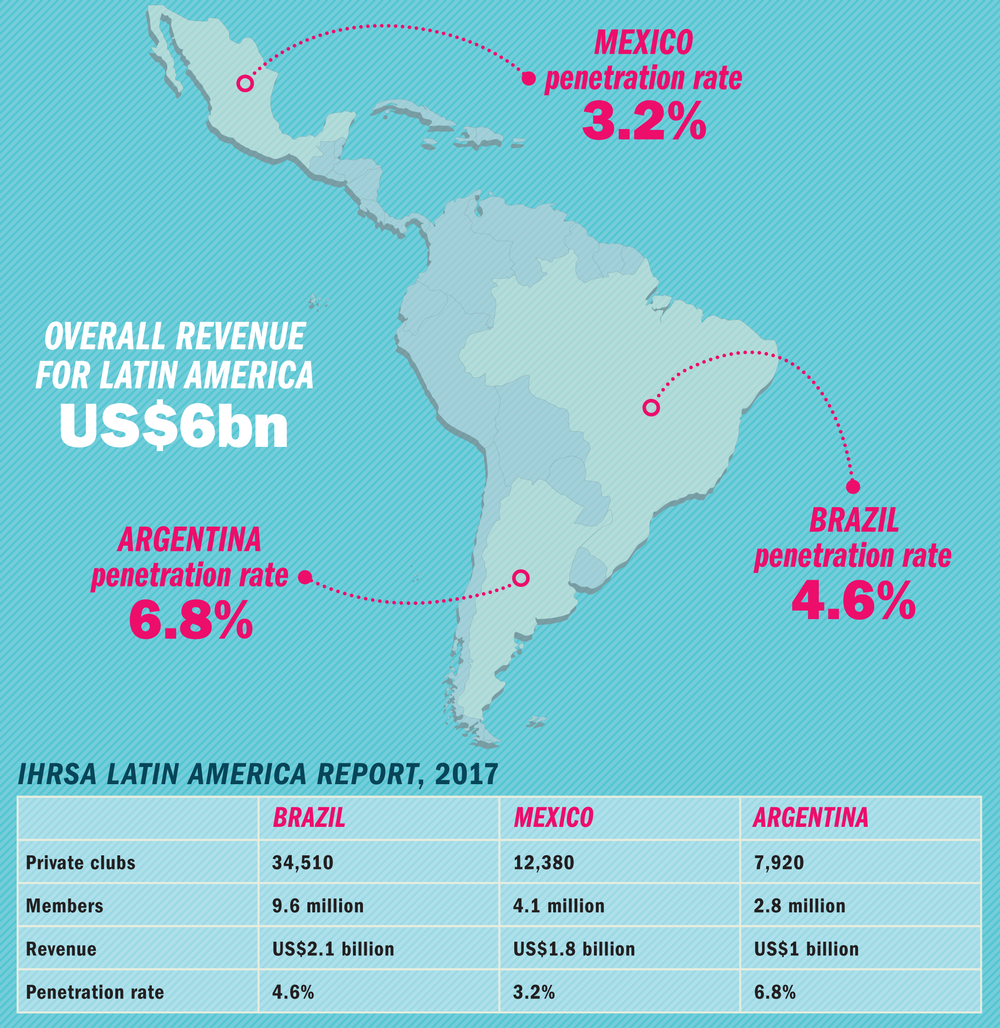
A healthy industry The 18 Latin American markets analysed generate US$6bn in revenue from more than 65,000 clubs. Nearly 20 million Latin Americans are members of a health club. Brazil alone accounts for more than half of the health clubs in Latin America with 34,509 facilities. Argentina has the highest penetration rate among all the markets, with 6.8 per cent of Argentinians currently belonging to a health club.
“The health club landscape in Latin America is dynamic and has undergone significant developments since 2012,” said Guillermo Velez, editor of the report and director of Mercado Fitness. “In addition to the growth of the low cost segment, other developments, including economic indicators, increasingly savvy consumers, technology, the boutique phenomenon and professionalisation have all impacted and shaped the industry in Latin America.”
Opportunity knocks While club operators and industry experts have observed growth amidst market developments in the region, opportunities abound in Latin America. The 2017 report shows an average penetration rate of 2.15 per cent, signifying potential for growth. Along with Argentina’s 6.8 per cent, Brazil and Mexico both have member penetration rates exceeding 3 per cent, at 4.6 per cent and 3.2 per cent, respectively.
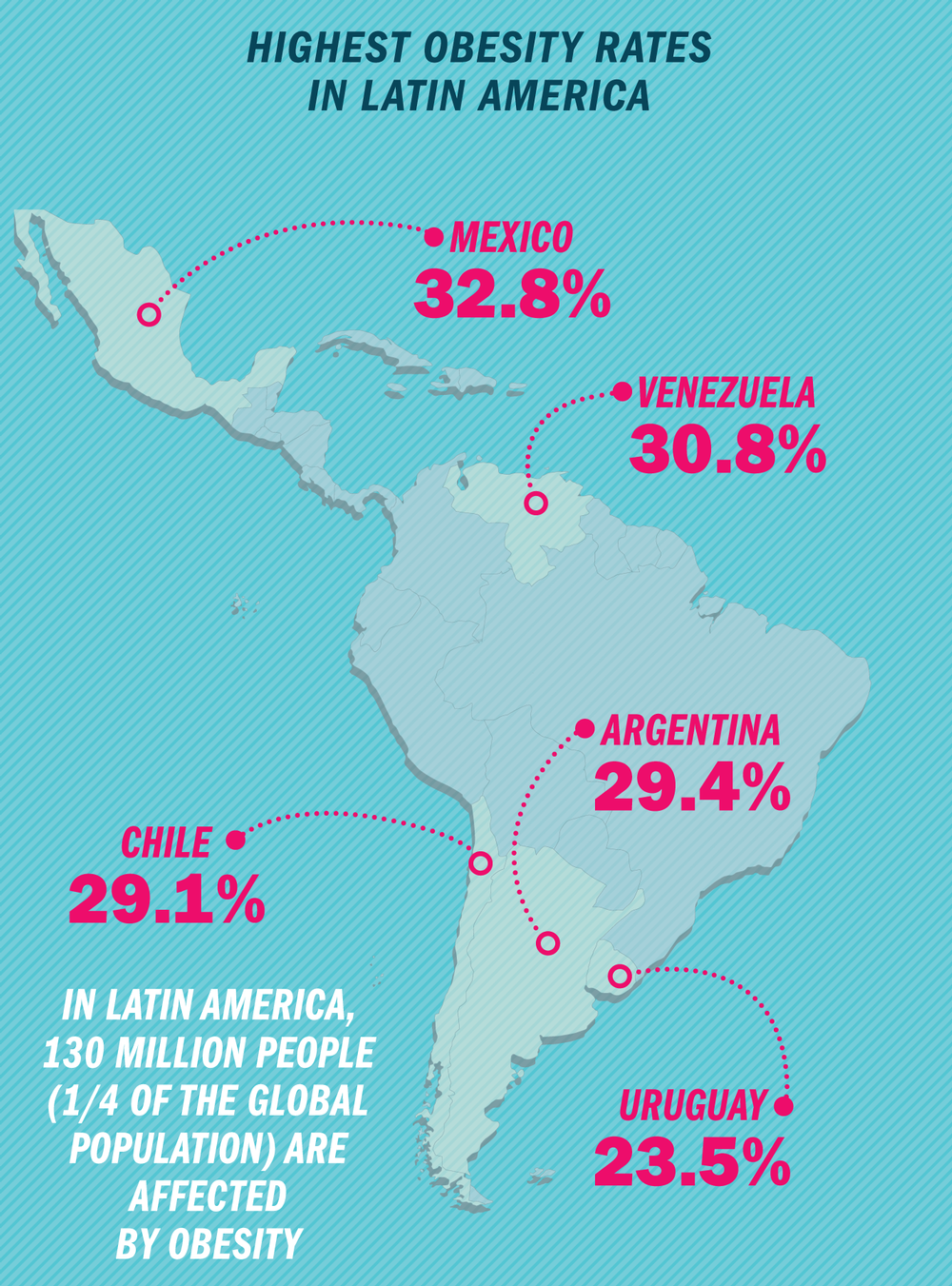
Inactive and obese In Latin America, 130 million people (one quarter of the global population) are affected by obesity. These figures could reach 191 million by 2030. The countries with the highest rates of obesity are Mexico (32.8 per cent), Venezuela (30.8 per cent), Argentina (29.4 per cent), Chile (29.1 per cent) and Uruguay (23.5 per cent). Obesity is a global pandemic: a person with obesity lives 10 years less than someone with a healthy weight. World Bank reports indicate that if this continues, by 2030 the number of people in Latin America with obesity will reach 30 per cent of the population.
Children are not exempt. According to the World Health Organization, 20 to 25 per cent of children and adolescents in Latin America are overweight or obese. Chile ranks sixth place in child obesity on a global scale and tops the list for the region. UNICEF produces its own statistics which are just as dismal for Latin America: 7 per cent of children under the age of 5 are overweight, as are 19 per cent of children between the ages of 5 and 11, and 17 per cent aged 12 to 19. Obesity affects 37 per cent of children between the ages of 5 and 11, and 36 per cent of those aged 12 to 19.
Sedentary lifestyles World Health Organization data also shows that 60 per cent of the population in Latin America is sedentary. This same agency indicates that in this region physical inactivity causes 1 in 10 deaths; almost the same impact that smoking has on the population, according to scientists.
According to a study conducted by the Valencian International University, the highest levels are observed in Chile where 88.8 per cent of the male population and 93.3 per cent of the female population are sedentary. In Argentina, 67 per cent of the population aged 25 to 70 is sedentary.
In Brazil, only 30 per cent of the population is physically active and barely 2-5 per cent exercises the optimal amount. “In this country, 300,000 people die every year from diseases caused by and related to a sedentary lifestyle. Meaning, one person every two minutes,” claims D. Victor Matsudo, coordinator for the Latin America Physical Activity Network.
Low cost chains When the last regional IHRSA report was published in 2012, there were only two low cost chains in two countries in Latin America. Today, five years later, there are at least 23 different brands with a total of 448 gyms (340 of these belong to SmartFit) in 12 countries throughout the region.
Undeniably, this phenomenon has only just begun. As consultant Ray Algar explains: “It’s not only a matter of pricing, but more an all-embracing organisational philosophy.” As far as consumers are concerned “they know that high costs do not necessarily guarantee quality service and they’re less obsessed with paying more just to prove status – they value their money and are convinced that paying less is more savvy.”
Several specialists agree that the low cost offer stimulates a new demand and does not necessarily encourage less spending. However, they also remark that this model’s growth will affect mid market health clubs.
Traditional gyms – full service in theory – must review their value propositions in order to validate higher pricing. “Those who don’t will be less valued and become irrelevant,” claims Algar. The market tends to polarise itself and in between the poles there’ll be nothing left.
Diversify and digitalise In competitive scenarios, with consumers eager for an enhanced experience, the fitness industry is undergoing a substantial diversification process. While premium health clubs and low cost gyms consolidate opposite poles within the market, boutique fitness studios, i.e. Micro Gyms, thrive in Latin America, just as they do globally.
Digital platforms marketing gym passes have also grown notoriously throughout the whole region. Regardless of future projections concerning these companies, it’s clear that the fitness industry is slowly learning to function effectively in light of the new consumer preferences.
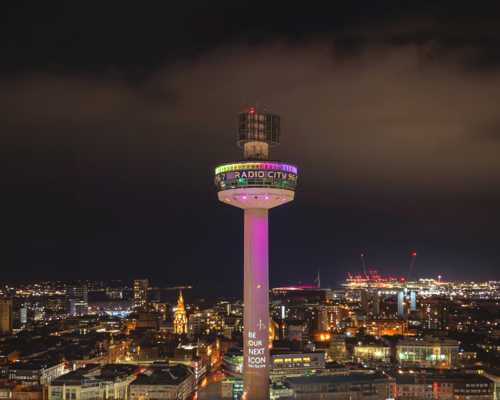
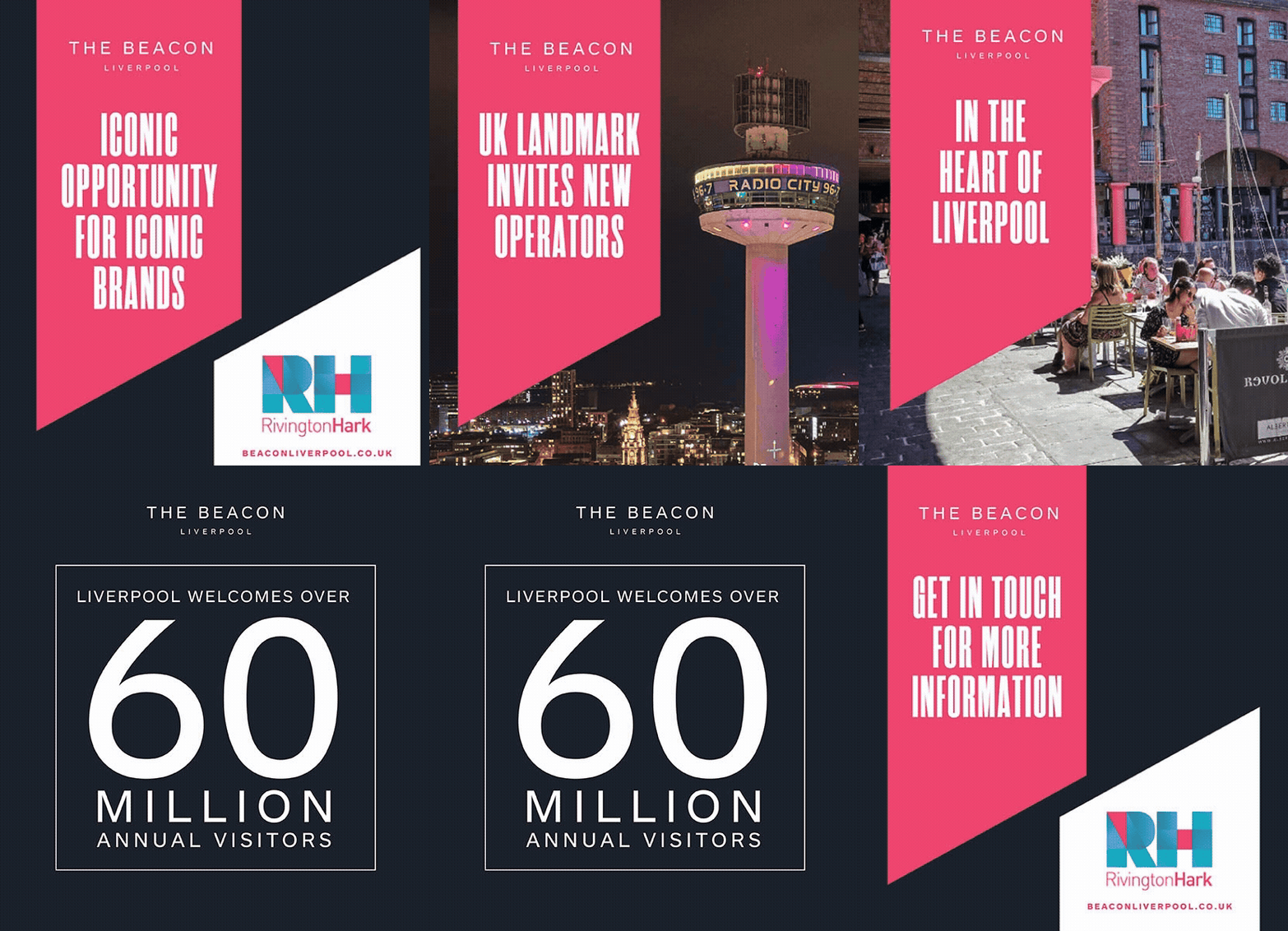
An opportunity to reimagine one of the UK’s most recognisable towers has been formally
opened by Rivington Hark, as St Johns Beacon invites operators and partners to shape its
next phase. [more...]
Latin America’s health club industry is robust, according to the latest statistics in the 2017 IHRSA Latin American Report. Sponsored by Hoist Fitness and produced in collaboration with Mercado Fitness (Argentina), with support from trade body Fitness Brasil, this second edition of the inaugural 2012 publication offers even more up-to-date groundbreaking research.
A healthy industry The 18 Latin American markets analysed generate US$6bn in revenue from more than 65,000 clubs. Nearly 20 million Latin Americans are members of a health club. Brazil alone accounts for more than half of the health clubs in Latin America with 34,509 facilities. Argentina has the highest penetration rate among all the markets, with 6.8 per cent of Argentinians currently belonging to a health club.
“The health club landscape in Latin America is dynamic and has undergone significant developments since 2012,” said Guillermo Velez, editor of the report and director of Mercado Fitness. “In addition to the growth of the low cost segment, other developments, including economic indicators, increasingly savvy consumers, technology, the boutique phenomenon and professionalisation have all impacted and shaped the industry in Latin America.”
Opportunity knocks While club operators and industry experts have observed growth amidst market developments in the region, opportunities abound in Latin America. The 2017 report shows an average penetration rate of 2.15 per cent, signifying potential for growth. Along with Argentina’s 6.8 per cent, Brazil and Mexico both have member penetration rates exceeding 3 per cent, at 4.6 per cent and 3.2 per cent, respectively.
Inactive and obese In Latin America, 130 million people (one quarter of the global population) are affected by obesity. These figures could reach 191 million by 2030. The countries with the highest rates of obesity are Mexico (32.8 per cent), Venezuela (30.8 per cent), Argentina (29.4 per cent), Chile (29.1 per cent) and Uruguay (23.5 per cent). Obesity is a global pandemic: a person with obesity lives 10 years less than someone with a healthy weight. World Bank reports indicate that if this continues, by 2030 the number of people in Latin America with obesity will reach 30 per cent of the population.
Children are not exempt. According to the World Health Organization, 20 to 25 per cent of children and adolescents in Latin America are overweight or obese. Chile ranks sixth place in child obesity on a global scale and tops the list for the region. UNICEF produces its own statistics which are just as dismal for Latin America: 7 per cent of children under the age of 5 are overweight, as are 19 per cent of children between the ages of 5 and 11, and 17 per cent aged 12 to 19. Obesity affects 37 per cent of children between the ages of 5 and 11, and 36 per cent of those aged 12 to 19.
Sedentary lifestyles World Health Organization data also shows that 60 per cent of the population in Latin America is sedentary. This same agency indicates that in this region physical inactivity causes 1 in 10 deaths; almost the same impact that smoking has on the population, according to scientists.
According to a study conducted by the Valencian International University, the highest levels are observed in Chile where 88.8 per cent of the male population and 93.3 per cent of the female population are sedentary. In Argentina, 67 per cent of the population aged 25 to 70 is sedentary.
In Brazil, only 30 per cent of the population is physically active and barely 2-5 per cent exercises the optimal amount. “In this country, 300,000 people die every year from diseases caused by and related to a sedentary lifestyle. Meaning, one person every two minutes,” claims D. Victor Matsudo, coordinator for the Latin America Physical Activity Network.
Low cost chains When the last regional IHRSA report was published in 2012, there were only two low cost chains in two countries in Latin America. Today, five years later, there are at least 23 different brands with a total of 448 gyms (340 of these belong to SmartFit) in 12 countries throughout the region.
Undeniably, this phenomenon has only just begun. As consultant Ray Algar explains: “It’s not only a matter of pricing, but more an all-embracing organisational philosophy.” As far as consumers are concerned “they know that high costs do not necessarily guarantee quality service and they’re less obsessed with paying more just to prove status – they value their money and are convinced that paying less is more savvy.”
Several specialists agree that the low cost offer stimulates a new demand and does not necessarily encourage less spending. However, they also remark that this model’s growth will affect mid market health clubs.
Traditional gyms – full service in theory – must review their value propositions in order to validate higher pricing. “Those who don’t will be less valued and become irrelevant,” claims Algar. The market tends to polarise itself and in between the poles there’ll be nothing left.
Diversify and digitalise In competitive scenarios, with consumers eager for an enhanced experience, the fitness industry is undergoing a substantial diversification process. While premium health clubs and low cost gyms consolidate opposite poles within the market, boutique fitness studios, i.e. Micro Gyms, thrive in Latin America, just as they do globally.
Digital platforms marketing gym passes have also grown notoriously throughout the whole region. Regardless of future projections concerning these companies, it’s clear that the fitness industry is slowly learning to function effectively in light of the new consumer preferences.
Hotel de France, located on the British Isle of Jersey, has created a wellness retreat package
that includes a hot yoga session that will take place in Jersey Zoo’s butterfly sanctuary.
A new immersive attraction designed to transport visitors into the final hours of ancient Pompeii
is preparing to open near the world-famous archaeological site in southern Italy.
Experience design company, BRC Imagination Arts, has completed a transition that sees founder
Bob Rogers pass ownership of the business to four long-serving senior executives, while
remaining actively involved with the company.
Movie Park Germany has opened a new Paramount Pictures-themed attraction as part of its 30th
anniversary celebrations, using immersive storytelling and adaptive reuse to reinforce the park’s
longstanding “Hollywood in Germany” positioning.
Therme Manchester’s 28-acre development, which will include interconnected glass pavilions
that measure 65,000sq m, will be the largest bathing and wellbeing attraction in the world once
complete, according to prof David Russell, CEO of Therme UK.
Efteling has opened Hooghmoed, a new family drop tower designed to broaden the appeal of its
recently launched Sirene Island themed area and introduce younger visitors to thrill attractions.
A proposed Puy du Fou development near Bicester and Universal Destinations and Experiences’
planned resort in Bedford are emerging as part of a wider transformation of the Oxford–
Cambridge Growth Corridor into a major centre for UK leisure and tourism inv
Shedd Aquarium has opened the Immersion Theater developed in partnership with SimEx-
Iwerks, as part of a wider strategy to enhance the guest experience and create additional
revenue opportunities.
The UK government has announced a temporary reduction in VAT on visitor attractions and
children’s meals as part of a summer cost-of-living support package designed to stimulate the
visitor economy and encourage family days out.
As designer Yinka Ilori prepares for his first solo gallery show in London, he speaks exclusively
to CLADmag about his mission to spread joy, the power of play, and his bold approach to using
colour (including the colours you won’t see in his work).
The government of Thailand is exploring plans for a THB300bn (£6.3bn, US$8.3bn)
entertainment complex in the country’s Eastern Economic Corridor (EEC), with officials
proposing a large-scale theme park and sports destination as part of a broader tourism and
economic development strategy.
+ More news
COMPANY PROFILES
IAAPA EMEA IAAPA Expo Europe was established in 2006 and has grown to the largest international conference and [more...]
Holovis Holovis is a privately owned company
established in 2004 by CEO Stuart
Hetherington. [more...]
IDEATTACK IDEATTACK is a full-service planning and
design company with headquarters in
Los Angeles. [more...]
Alterface Alterface’s Creative Division team is
seasoned in concept and ride development,
as well as storyte [more...]
An opportunity to reimagine one of the UK’s most recognisable towers has been formally
opened by Rivington Hark, as St Johns Beacon invites operators and partners to shape its
next phase. [more...]