Beacons are changing the face of retail and providing less intrusive ways of interacting with our devices, our surroundings and the Internet of Things. We look into the potential applications for attractions
By Alice Davis | Published in Attractions Management 2016 issue 1
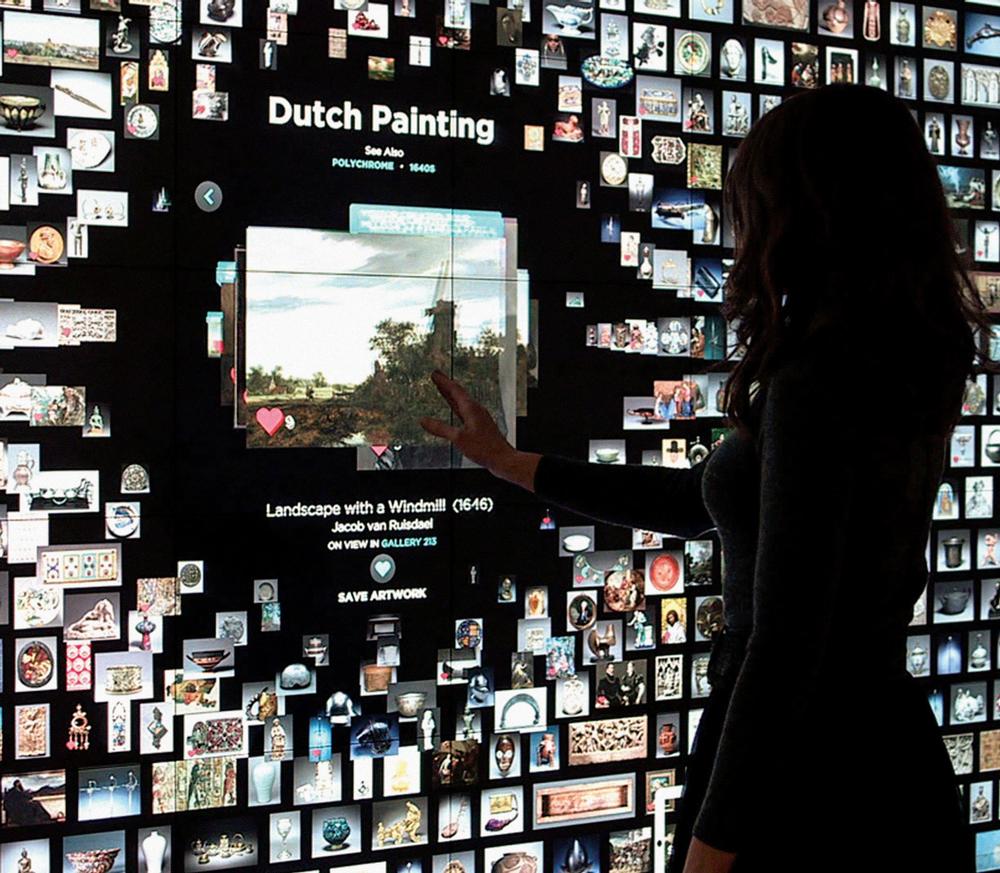
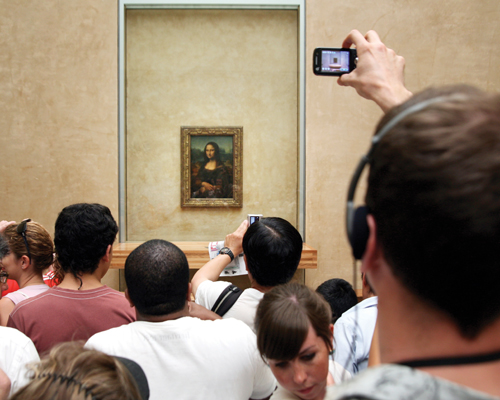
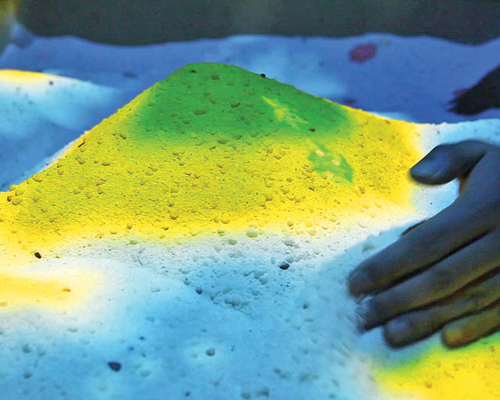
Up to 16 visitors at a time can explore Cleveland museum’s 4,200 artworks on Gallery One’s huge multi-touch screen / PHOTOS: COURTESY OF CLEVELAND MUSEUM OF ART
What are beacons? Simply put, they are small pieces of Bluetooth-enabled hardware that can be planted in different locations around a site. These beacons (iBeacons in Apple’s case) communicate pre-programmed information to receivers – your phone or tablet – when you come close enough to trigger the device.
You may have already encountered beacon technology in stores, where retailers can, for example, push coupons to shoppers’ mobile devices depending on the department they are browsing, or send information or a discount code about a product they have stopped to admire.
Beacon technology can have practical uses, too. Airports and airlines are using it to communicate with passengers, sending them travel details like gate numbers, flight times and even special offers on duty free. Airlines can see if a passenger is stuck in security and know that they are on the way.
Beacons are in use already at certain sports stadiums, attractions venues and restaurants. They can be used to track deliveries or help people find their way around and, as we get used to the technology, software designers will come up with many more creative applications.
But could beacons benefit your attraction? We asked Jane Alexander of the Cleveland Museum of Art in Cleveland, Ohio, to tell us about her experience of using indoor location awareness systems in the galleries. We also asked Floris Boekel from the Dutch agency LabWerk what beacons can do for attractions.
Read more from this issue of Attractions Management magazine
View contents of Attractions Management 2016 issue 1
Interview: Tony Butler
Tony Butler, executive director of Derby
Museums Trust, on how museums can
be a force for good in their communities
Attractions: Perfect Brew
At 15 years old, the Guinness Storehouse
has been voted Europe’s best-loved
attraction. Manager Paul Carty reveals
the secrets of the Dublin brandland
Profile: John McReynolds
IAAPA’s new chairman reveals his aims
for the year ahead, his vision for a
global association and how his role at
Universal Orlando informs his goals
Analysis: The Attractions Business
Business planning consultant
David Camp starts an exclusive eight-part
series, delving into the fine art of attractions
operation from a business perspective
Science Centres: How to Future-Proof a Science Centre
Peter Slavenburg of design agency
NorthernLight describes how invisible
technology, serious play, co-creation
and the digital experience will inform
the science centre of tomorrow
Promotional feature: Simworx Ventures
Simworx Ventures is bringing its expertise in cutting-edge media-based attractions
to a new audience of museums, heritage sites, zoos and aquariums
Technology: Beacons on the Horizon
Beacons have countless applications in
the world of attractions. A case study
from the Cleveland Museum of Art
illustrates the technology’s potential
Museums & Galleries: Art Attack
Some of the most exciting attractions
design is happening in new and
upcoming galleries around the world,
from firms like Kengo Kuma and BIG
Promotional feature: IDEA
2016 is shaping up to be an interesting year for the attractions industry.
IDEA looks at what it takes to win audiences and command attention
Mystery Shopper: Spring in Your Step
We disappear down the rabbit hole as we
pay a mystery shopper visit to Bounce
Below, a unique underground trampolining
attraction in Snowdonia, north Wales
Rides: The Ride Makers
Our ride makers series continues with
water rides, a firm favourite with park
guests. Three leading companies reveal
the latest trends in flumes and chutes
Technology: Tech Check
The industry technology unveiled at
IAAPA 2015: from VR to interactives, and
digital puppets to 20-storey LED giants
The evolution of location tracking at the Cleveland Museum of Art
Jane Alexander
Jane AlexanderChief Information OfficerCleveland Museum of Art (CMA) in Cleveland, Ohio
Gallery One opened on 21 January 2013 at the Cleveland Museum of Art (CMA). The gallery boasts interactive, multi-touch screens that interpret selected art installations through facial recognition, and motion-sensing input devices allowing visitors to actively engage with the art.
Gallery One’s 40-foot (12-metre) Collection Wall, one of the largest multi-touch MicroTile screens in the US, allows visitors to discover the full breadth of the collections on view and to shape their own tours of the museum.
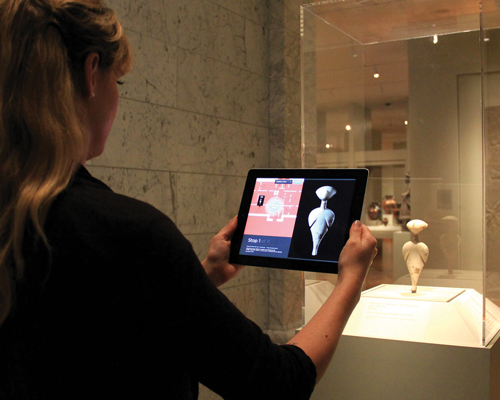
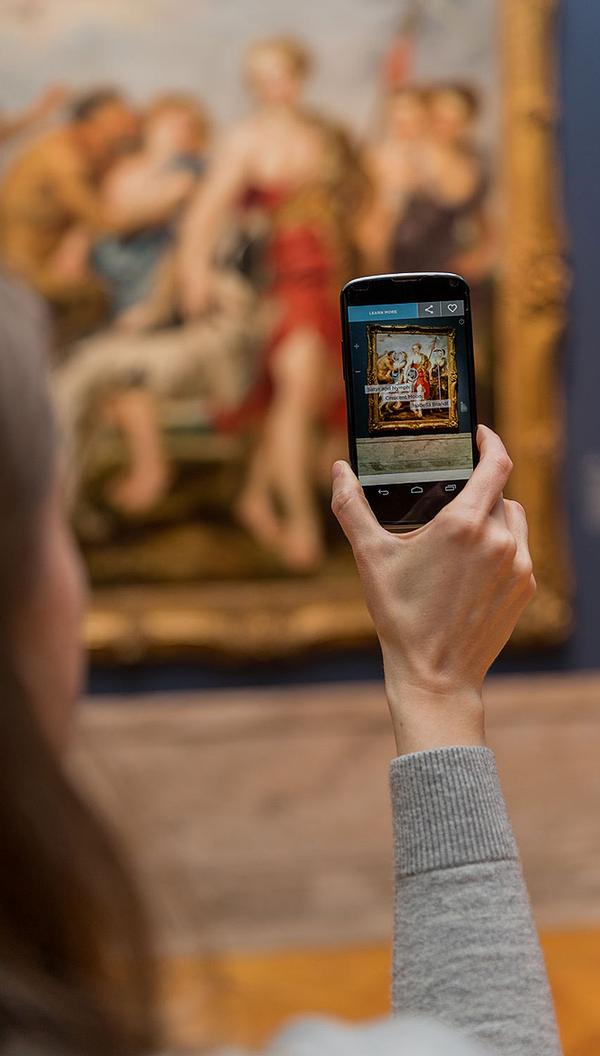
Gallery One was further transformed beyond its four walls by the ArtLens app, which enabled visitors to connect to the Collection Wall and to create their own tours through the entire museum via their mobile device. The app provides many other opportunities for customising the visitor’s experience at the CMA. For example, using the app’s innovative image recognition software, visitors can request additional content about specific pieces of art.
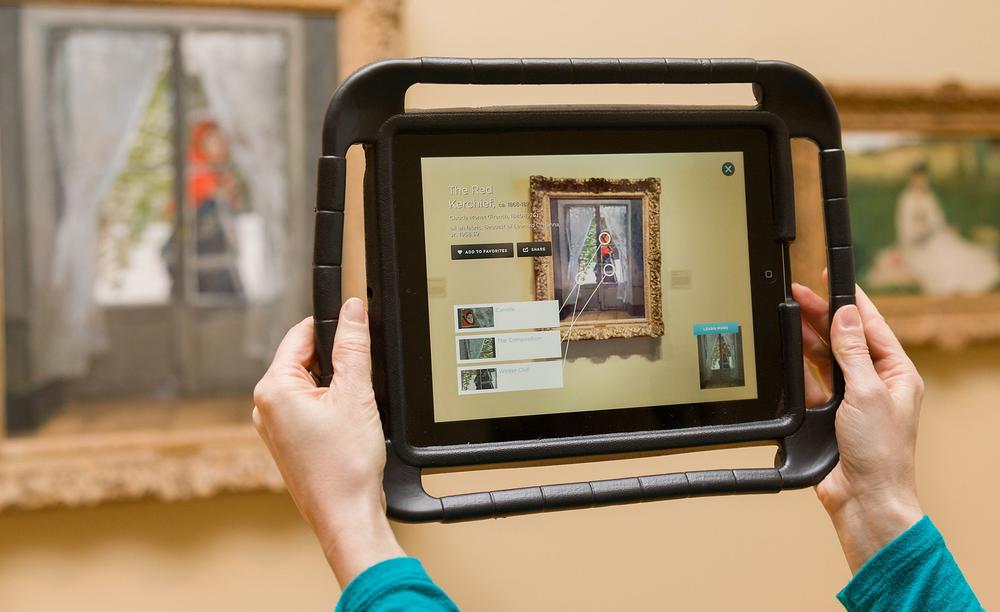
One of the most cutting-edge features of ArtLens is the app’s ability to track the visitor’s location in the museum. As a visitor enters any space in the museum, a tray appears on the screen of the device identifying the surrounding artwork and offering a variety of expanded interpretive content about it. By clicking on the artwork the visitor wants to learn about, more information will be provided.
An accurate and robust indoor location awareness system is a critical component of the ArtLens app. Because indoor location awareness is relatively new as a technological concept, methods of implementation are constantly evolving.
The CMA’s original system relied solely on WiFi triangulation, which was the standard at the time. However, initial implementations were highly inefficient from a bandwidth standpoint causing network congestion both upstream and down. Furthermore, signal saturation through existing WiFi hotspots proved elusive. While the system, for the most part, functioned well, reliability and deployment issues drove the CMA to search for a better solution.
The CMA then partnered with location-based services provider Navizon (now Accuware) and its SDK to improve location awareness. After approximately 250 Bluetooth beacons were placed throughout the museum, ArtLens was able to triangulate a user’s position within a few metres. Every few seconds, a collection of sensors from the user’s device (compass, accelerometer, gyroscope, etc.) smooths the path between beacon updates.
This iteration is significantly more accurate, uses less battery life and has almost no impact on the museum’s technological infrastructure.
There are still some challenges. The CMA’s magnetic profile causes significant interference with compass orientation. The sheer size and openness of the atrium as well as the unusual shape of certain galleries have also posed challenges. The “blue dot” – which shows the user where he or she is in the gallery – occasionally jumps around displaying an incorrect location.
However, despite these small hiccups, the beacon system has been a great success. As location technology evolves, we are exploring a host of new solutions to further improve the digital experience.
With improved WiFi technologies, WiFi triangulation is re-emerging as a potential solution. Using the CMA’s own magnetic footprint to aid triangulation is another possibility for improvement. As technology evolves, the CMA will continue to reiterate its location awareness infrastructure in order to provide a seamless digital experience for its visitors. So stay tuned!
"After 250 Bluetooth beacons were placed throughout the galleries, ArtLens was able to triangulate a user’s position within a few metres ...with almost no impact on the museum’s technological infrastructure"
PHOTOS: COURTESY OF CLEVELAND MUSEUM OF ART
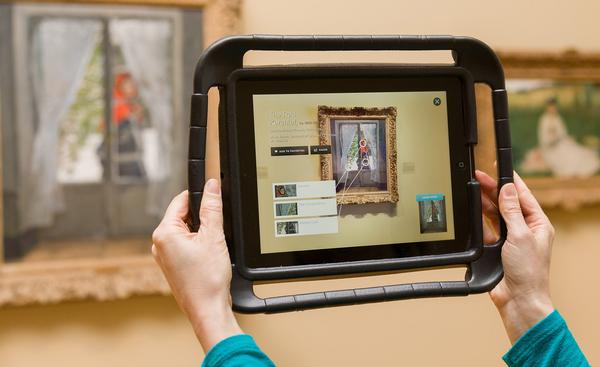
ArtLens recognises selected objects, providing information about specific details of the artwork
Jane Alexander is the chief information officer for the Cleveland Museum of Art (CMA) in Cleveland, Ohio. Jane is responsible for the creation, ongoing iteration and advocacy of a vision for innovation, technology implementation and digital strategies best applied to the art museum’s mission. In 2013, CMA completed Gallery One and the revolutionary ArtLens mobile app, which transformed the museum into one of the most technologically advanced art destinations in the world.
Beacon technology brings sense of place to visitor experience
Floris Boekel
Floris BoekelCo-founder and CEOLabWerk
What does LabWerk do? We create innovative mobile applications which utilise beacon technology. Through beacon technology, we can enhance user experiences through localised content delivery, accurate indoor navigation and a contactless payment option, while providing insight and analytics on foot traffic track density and on-site customer behaviour analytics to the business.
How are attractions able to use beacon technology? Attractions can use beacon technology to:
• unlock and deliver specific content based on a user’s location
• trigger push notifications on mobile devices when a mobile device detects a beacon’s signal
• deliver an accurate indoor navigation solution to visitors
• gain insights into traffic flow and density
• increase visitor engagement with exhibitions through gamification; for example, visiting each section of the exhibition to unlock all available content to earn a prize or coupon
• offer a wider range of content types
Unlike audioguides, where numbers need to be entered or transmitters scanned, beacon technology makes all information available on a user’s device without needing to take any additional action other than walk into a beacon’s transmitting range.
Because all the content is delivered through a user’s mobile device, there are few restrictions to the types, formats and length of content available. This content is still available in the app on a visitor’s mobile device after their visit, meaning that they can access any and all information again at a later time.
What attractions have you worked with? Our attractions clients include Zoom Torino zoo in Italy, the Harvard Collection of Historical Scientific Instruments in the US, the Motor Transport Museum in the UK, the Slottsfjellsmuseet museum in Norway and Tulpenland in the Netherlands.
What are the benefits of beacon technology? LabWerk’s museum platform, mApp, is an all-in-one app for anyone who wants to offer their visitors a unique, personalised experience. Using beacon technology, it offers visitors a range of features, including location-aware content delivery, indoor navigation, gamification and engagement, Passbook integration for coupons and rewards, multilingual content, Facebook and Twitter integration and custom branding to suit your museum.
This technology allows clients to manage, update and add content and languages, access analytics on content, usage and traffic configure beacons signal range and the action they trigger within the app and style the app to suit their brand. Clients can add text, video, photos and audio to their visitor’s edutainment experience.
How is the visitor experience enhanced by beacon technology? Beacon technology allows the proactive delivery of content. Content and notifications are triggered without the visitor needing to take action, coupons are automatically awarded based on set usage requirements and interactive maps show visitors their current location.
Are there any pitfalls or challenges with this type of technology? You need an internet connection for users to download the required app before beginning their visit if they have not already done so. Users must also have Bluetooth enabled on their mobile device.
How much does an attraction usually need to invest to develop and install beacon technology?
At LabWerk, the starter version of mApp costs about €4,000 ($4,580, £2,960) per year with a contract period of three years, and €12,000 ($13,730, £8,870) per year for the professional version. Custom development projects are available and price is based on individual requirements.
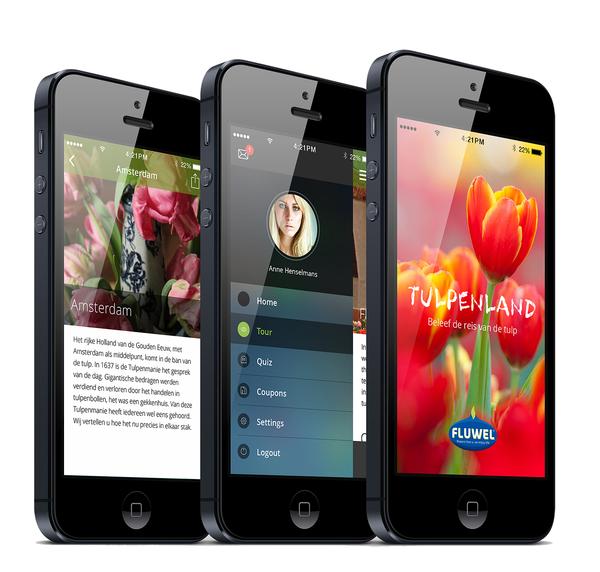
Can you describe an attractions project you have done? The Tulpenland app launched in 2014 and we believe it was the first European theme park to use beacon technology. A number of beacons were placed around each zone of their tulip-themed park. As a visitor progresses through each zone discovering the history of the tulip, they are presented with a notification on their mobile device informing them when more interactive content is available for viewing. The beacons provide an enhanced and personalised experience to visitors at the park by offering location-triggered content. The beacons placed throughout the Amsterdam attraction allow users of the app to see their exact on-site location and which pieces of content they are yet to discover and unlock on a map.
The app also engages visitors with a number of quiz questions. By answering those correctly, the visitor earns a discount coupon to use at the park’s gift shop.
LabWerk has designed beacon-led apps for a range of attractions
Floris Boekel is the co-founder and CEO of LabWerk, an Amsterdam, Netherlands-based agency creating innovative applications using beacon technology. LabWerk works with clients on hyperlocal content, indoor navigation, location tracking and mobile payments. Boekel defines the strategy and vision for LabWerk’s growth and culture.
The ArtLens app, developed by the Cleveland Museum of Art, uses image recognition and location tracking software / PHOTOS: COURTESY OF CLEVELAND MUSEUM OF ART
ArtLens benefits from the evolution
of location awareness technology
COMPANY PROFILES
Clip 'n Climb
Clip ‘n Climb currently offers facility owners and
investors more than 40 colourful and unique
Cha [more...]
IAAPA EMEA
IAAPA Expo Europe was established in 2006 and has grown to the largest international conference and [more...]
RMA Ltd
RMA Ltd is a one-stop global company
that can design, build and produce from a
greenfield site upw [more...]
Beacons are changing the face of retail and providing less intrusive ways of interacting with our devices, our surroundings and the Internet of Things. We look into the potential applications for attractions
By Alice Davis | Published in Attractions Management 2016 issue 1
Up to 16 visitors at a time can explore Cleveland museum’s 4,200 artworks on Gallery One’s huge multi-touch screen / PHOTOS: COURTESY OF CLEVELAND MUSEUM OF ART
What are beacons? Simply put, they are small pieces of Bluetooth-enabled hardware that can be planted in different locations around a site. These beacons (iBeacons in Apple’s case) communicate pre-programmed information to receivers – your phone or tablet – when you come close enough to trigger the device.
You may have already encountered beacon technology in stores, where retailers can, for example, push coupons to shoppers’ mobile devices depending on the department they are browsing, or send information or a discount code about a product they have stopped to admire.
Beacon technology can have practical uses, too. Airports and airlines are using it to communicate with passengers, sending them travel details like gate numbers, flight times and even special offers on duty free. Airlines can see if a passenger is stuck in security and know that they are on the way.
Beacons are in use already at certain sports stadiums, attractions venues and restaurants. They can be used to track deliveries or help people find their way around and, as we get used to the technology, software designers will come up with many more creative applications.
But could beacons benefit your attraction? We asked Jane Alexander of the Cleveland Museum of Art in Cleveland, Ohio, to tell us about her experience of using indoor location awareness systems in the galleries. We also asked Floris Boekel from the Dutch agency LabWerk what beacons can do for attractions.
Read more from this issue of Attractions Management magazine
View contents of Attractions Management 2016 issue 1
Interview: Tony Butler
Tony Butler, executive director of Derby
Museums Trust, on how museums can
be a force for good in their communities
Attractions: Perfect Brew
At 15 years old, the Guinness Storehouse
has been voted Europe’s best-loved
attraction. Manager Paul Carty reveals
the secrets of the Dublin brandland
Profile: John McReynolds
IAAPA’s new chairman reveals his aims
for the year ahead, his vision for a
global association and how his role at
Universal Orlando informs his goals
Analysis: The Attractions Business
Business planning consultant
David Camp starts an exclusive eight-part
series, delving into the fine art of attractions
operation from a business perspective
Science Centres: How to Future-Proof a Science Centre
Peter Slavenburg of design agency
NorthernLight describes how invisible
technology, serious play, co-creation
and the digital experience will inform
the science centre of tomorrow
Promotional feature: Simworx Ventures
Simworx Ventures is bringing its expertise in cutting-edge media-based attractions
to a new audience of museums, heritage sites, zoos and aquariums
Technology: Beacons on the Horizon
Beacons have countless applications in
the world of attractions. A case study
from the Cleveland Museum of Art
illustrates the technology’s potential
Museums & Galleries: Art Attack
Some of the most exciting attractions
design is happening in new and
upcoming galleries around the world,
from firms like Kengo Kuma and BIG
Promotional feature: IDEA
2016 is shaping up to be an interesting year for the attractions industry.
IDEA looks at what it takes to win audiences and command attention
Mystery Shopper: Spring in Your Step
We disappear down the rabbit hole as we
pay a mystery shopper visit to Bounce
Below, a unique underground trampolining
attraction in Snowdonia, north Wales
Rides: The Ride Makers
Our ride makers series continues with
water rides, a firm favourite with park
guests. Three leading companies reveal
the latest trends in flumes and chutes
Technology: Tech Check
The industry technology unveiled at
IAAPA 2015: from VR to interactives, and
digital puppets to 20-storey LED giants
The evolution of location tracking at the Cleveland Museum of Art
Jane Alexander
Jane AlexanderChief Information OfficerCleveland Museum of Art (CMA) in Cleveland, Ohio
Gallery One opened on 21 January 2013 at the Cleveland Museum of Art (CMA). The gallery boasts interactive, multi-touch screens that interpret selected art installations through facial recognition, and motion-sensing input devices allowing visitors to actively engage with the art.
Gallery One’s 40-foot (12-metre) Collection Wall, one of the largest multi-touch MicroTile screens in the US, allows visitors to discover the full breadth of the collections on view and to shape their own tours of the museum.
Gallery One was further transformed beyond its four walls by the ArtLens app, which enabled visitors to connect to the Collection Wall and to create their own tours through the entire museum via their mobile device. The app provides many other opportunities for customising the visitor’s experience at the CMA. For example, using the app’s innovative image recognition software, visitors can request additional content about specific pieces of art.
One of the most cutting-edge features of ArtLens is the app’s ability to track the visitor’s location in the museum. As a visitor enters any space in the museum, a tray appears on the screen of the device identifying the surrounding artwork and offering a variety of expanded interpretive content about it. By clicking on the artwork the visitor wants to learn about, more information will be provided.
An accurate and robust indoor location awareness system is a critical component of the ArtLens app. Because indoor location awareness is relatively new as a technological concept, methods of implementation are constantly evolving.
The CMA’s original system relied solely on WiFi triangulation, which was the standard at the time. However, initial implementations were highly inefficient from a bandwidth standpoint causing network congestion both upstream and down. Furthermore, signal saturation through existing WiFi hotspots proved elusive. While the system, for the most part, functioned well, reliability and deployment issues drove the CMA to search for a better solution.
The CMA then partnered with location-based services provider Navizon (now Accuware) and its SDK to improve location awareness. After approximately 250 Bluetooth beacons were placed throughout the museum, ArtLens was able to triangulate a user’s position within a few metres. Every few seconds, a collection of sensors from the user’s device (compass, accelerometer, gyroscope, etc.) smooths the path between beacon updates.
This iteration is significantly more accurate, uses less battery life and has almost no impact on the museum’s technological infrastructure.
There are still some challenges. The CMA’s magnetic profile causes significant interference with compass orientation. The sheer size and openness of the atrium as well as the unusual shape of certain galleries have also posed challenges. The “blue dot” – which shows the user where he or she is in the gallery – occasionally jumps around displaying an incorrect location.
However, despite these small hiccups, the beacon system has been a great success. As location technology evolves, we are exploring a host of new solutions to further improve the digital experience.
With improved WiFi technologies, WiFi triangulation is re-emerging as a potential solution. Using the CMA’s own magnetic footprint to aid triangulation is another possibility for improvement. As technology evolves, the CMA will continue to reiterate its location awareness infrastructure in order to provide a seamless digital experience for its visitors. So stay tuned!
"After 250 Bluetooth beacons were placed throughout the galleries, ArtLens was able to triangulate a user’s position within a few metres ...with almost no impact on the museum’s technological infrastructure"
PHOTOS: COURTESY OF CLEVELAND MUSEUM OF ART
ArtLens recognises selected objects, providing information about specific details of the artwork
Jane Alexander is the chief information officer for the Cleveland Museum of Art (CMA) in Cleveland, Ohio. Jane is responsible for the creation, ongoing iteration and advocacy of a vision for innovation, technology implementation and digital strategies best applied to the art museum’s mission. In 2013, CMA completed Gallery One and the revolutionary ArtLens mobile app, which transformed the museum into one of the most technologically advanced art destinations in the world.
Beacon technology brings sense of place to visitor experience
Floris Boekel
Floris BoekelCo-founder and CEOLabWerk
What does LabWerk do? We create innovative mobile applications which utilise beacon technology. Through beacon technology, we can enhance user experiences through localised content delivery, accurate indoor navigation and a contactless payment option, while providing insight and analytics on foot traffic track density and on-site customer behaviour analytics to the business.
How are attractions able to use beacon technology? Attractions can use beacon technology to:
• unlock and deliver specific content based on a user’s location
• trigger push notifications on mobile devices when a mobile device detects a beacon’s signal
• deliver an accurate indoor navigation solution to visitors
• gain insights into traffic flow and density
• increase visitor engagement with exhibitions through gamification; for example, visiting each section of the exhibition to unlock all available content to earn a prize or coupon
• offer a wider range of content types
Unlike audioguides, where numbers need to be entered or transmitters scanned, beacon technology makes all information available on a user’s device without needing to take any additional action other than walk into a beacon’s transmitting range.
Because all the content is delivered through a user’s mobile device, there are few restrictions to the types, formats and length of content available. This content is still available in the app on a visitor’s mobile device after their visit, meaning that they can access any and all information again at a later time.
What attractions have you worked with? Our attractions clients include Zoom Torino zoo in Italy, the Harvard Collection of Historical Scientific Instruments in the US, the Motor Transport Museum in the UK, the Slottsfjellsmuseet museum in Norway and Tulpenland in the Netherlands.
What are the benefits of beacon technology? LabWerk’s museum platform, mApp, is an all-in-one app for anyone who wants to offer their visitors a unique, personalised experience. Using beacon technology, it offers visitors a range of features, including location-aware content delivery, indoor navigation, gamification and engagement, Passbook integration for coupons and rewards, multilingual content, Facebook and Twitter integration and custom branding to suit your museum.
This technology allows clients to manage, update and add content and languages, access analytics on content, usage and traffic configure beacons signal range and the action they trigger within the app and style the app to suit their brand. Clients can add text, video, photos and audio to their visitor’s edutainment experience.
How is the visitor experience enhanced by beacon technology? Beacon technology allows the proactive delivery of content. Content and notifications are triggered without the visitor needing to take action, coupons are automatically awarded based on set usage requirements and interactive maps show visitors their current location.
Are there any pitfalls or challenges with this type of technology? You need an internet connection for users to download the required app before beginning their visit if they have not already done so. Users must also have Bluetooth enabled on their mobile device.
How much does an attraction usually need to invest to develop and install beacon technology?
At LabWerk, the starter version of mApp costs about €4,000 ($4,580, £2,960) per year with a contract period of three years, and €12,000 ($13,730, £8,870) per year for the professional version. Custom development projects are available and price is based on individual requirements.
Can you describe an attractions project you have done? The Tulpenland app launched in 2014 and we believe it was the first European theme park to use beacon technology. A number of beacons were placed around each zone of their tulip-themed park. As a visitor progresses through each zone discovering the history of the tulip, they are presented with a notification on their mobile device informing them when more interactive content is available for viewing. The beacons provide an enhanced and personalised experience to visitors at the park by offering location-triggered content. The beacons placed throughout the Amsterdam attraction allow users of the app to see their exact on-site location and which pieces of content they are yet to discover and unlock on a map.
The app also engages visitors with a number of quiz questions. By answering those correctly, the visitor earns a discount coupon to use at the park’s gift shop.
LabWerk has designed beacon-led apps for a range of attractions
Floris Boekel is the co-founder and CEO of LabWerk, an Amsterdam, Netherlands-based agency creating innovative applications using beacon technology. LabWerk works with clients on hyperlocal content, indoor navigation, location tracking and mobile payments. Boekel defines the strategy and vision for LabWerk’s growth and culture.
The ArtLens app, developed by the Cleveland Museum of Art, uses image recognition and location tracking software / PHOTOS: COURTESY OF CLEVELAND MUSEUM OF ART
ArtLens benefits from the evolution
of location awareness technology
Abu Dhabi-based investment firm Mubadala Capital has made a binding, fully financed
€1 billion
offer to acquire Pierre and Vacances SA, the European holiday resort operator behind the
continental European Center Parcs business.
Expo 2030 Riyadh is being planned as a permanent visitor destination, with organisers
confirming the six-million-square-metre site will become a Global Village after the event closes.
The owner of one of Australia's best-known waterparks has acquired a major competitor,
creating a new attractions business spanning two of the country's largest visitor destinations.
The Toverland theme park in the Netherlands has announced a €98m expansion programme
that will add a resort, new attractions and staff facilities as it pursues plans to become a multi-
day destination.
Hotel de France, located on the British Isle of Jersey, has created a wellness retreat package
that includes a hot yoga session that will take place in Jersey Zoo’s butterfly sanctuary.
A new immersive attraction designed to transport visitors into the final hours of ancient Pompeii
is preparing to open near the world-famous archaeological site in southern Italy.
Experience design company, BRC Imagination Arts, has completed a transition that sees founder
Bob Rogers pass ownership of the business to four long-serving senior executives, while
remaining actively involved with the company.
Movie Park Germany has opened a new Paramount Pictures-themed attraction as part of its 30th
anniversary celebrations, using immersive storytelling and adaptive reuse to reinforce the park’s
longstanding “Hollywood in Germany” positioning.
Therme Manchester’s 28-acre development, which will include interconnected glass pavilions
that measure 65,000sq m, will be the largest bathing and wellbeing attraction in the world once
complete, according to prof David Russell, CEO of Therme UK.
Efteling has opened Hooghmoed, a new family drop tower designed to broaden the appeal of its
recently launched Sirene Island themed area and introduce younger visitors to thrill attractions.
+ More news
COMPANY PROFILES
Clip 'n Climb Clip ‘n Climb currently offers facility owners and
investors more than 40 colourful and unique
Cha [more...]
IAAPA EMEA IAAPA Expo Europe was established in 2006 and has grown to the largest international conference and [more...]
RMA Ltd RMA Ltd is a one-stop global company
that can design, build and produce from a
greenfield site upw [more...]