When the first science centres appeared more than 40 years ago, they were well ahead of their time. Being able to interact with exhibits was a completely new experience for people. It was “please touch” instead of “don’t touch”. However, times have changed, people have evolved and technology has advanced at an incredible speed. Although some science centres have been able to anticipate these changes successfully, many of them need to do more to adopt innovations and stay relevant for the general public.
In this article we suggest six action points which could make science centres ready for the future.
Read more from this issue of Attractions Management magazine
View contents of Attractions Management 2016 issue 1
Interview: Tony Butler
Tony Butler, executive director of Derby
Museums Trust, on how museums can
be a force for good in their communities
Attractions: Perfect Brew
At 15 years old, the Guinness Storehouse
has been voted Europe’s best-loved
attraction. Manager Paul Carty reveals
the secrets of the Dublin brandland
Profile: John McReynolds
IAAPA’s new chairman reveals his aims
for the year ahead, his vision for a
global association and how his role at
Universal Orlando informs his goals
Analysis: The Attractions Business
Business planning consultant
David Camp starts an exclusive eight-part
series, delving into the fine art of attractions
operation from a business perspective
Science Centres: How to Future-Proof a Science Centre
Peter Slavenburg of design agency
NorthernLight describes how invisible
technology, serious play, co-creation
and the digital experience will inform
the science centre of tomorrow
Promotional feature: Simworx Ventures
Simworx Ventures is bringing its expertise in cutting-edge media-based attractions
to a new audience of museums, heritage sites, zoos and aquariums
Technology: Beacons on the Horizon
Beacons have countless applications in
the world of attractions. A case study
from the Cleveland Museum of Art
illustrates the technology’s potential
Museums & Galleries: Art Attack
Some of the most exciting attractions
design is happening in new and
upcoming galleries around the world,
from firms like Kengo Kuma and BIG
Promotional feature: IDEA
2016 is shaping up to be an interesting year for the attractions industry.
IDEA looks at what it takes to win audiences and command attention
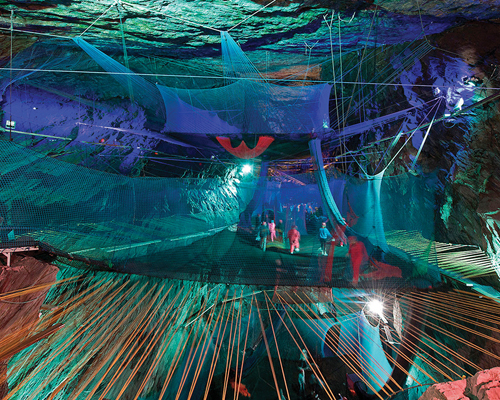
Mystery Shopper: Spring in Your Step
We disappear down the rabbit hole as we
pay a mystery shopper visit to Bounce
Below, a unique underground trampolining
attraction in Snowdonia, north Wales
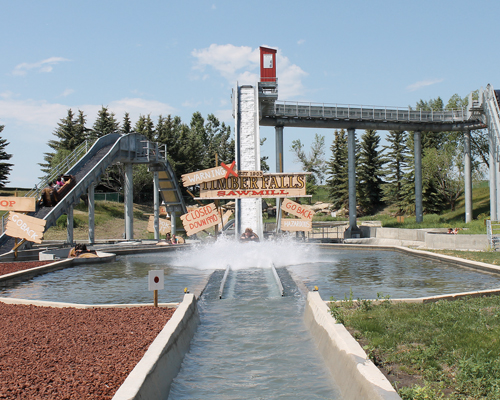
Rides: The Ride Makers
Our ride makers series continues with
water rides, a firm favourite with park
guests. Three leading companies reveal
the latest trends in flumes and chutes
Technology: Tech Check
The industry technology unveiled at
IAAPA 2015: from VR to interactives, and
digital puppets to 20-storey LED giants
1. Apply technology in an intuitive and elegant way With all the digital and technological innovations that have emerged, the challenge is to make technology elegant or even invisible. We have moved from a 20th-century world where technology was visible all around us, to a world where technology has become intuitive, omnipresent and invisible. If you walk through the new Rijksmuseum in Amsterdam, the Netherlands, you’ll see no technology whatsoever. No screens or panels – the place looks completely clean. That’s what people want technology to be like. Tesla is another example of elegant technology. One touchscreen display controls most of the car’s functions.
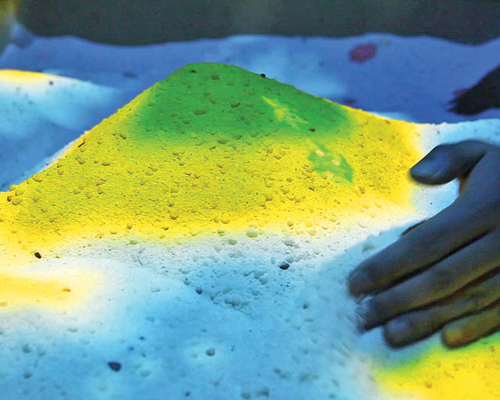
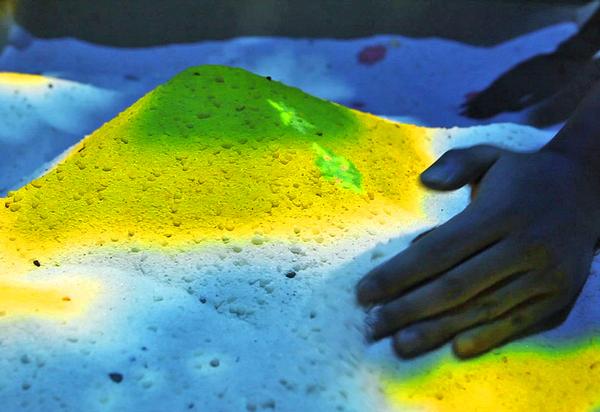
So technology is advancing, but the presence of technology is diminishing. This is the way science centres should move as well. The iSandBOX (an interactive sandbox) is a great example of invisible technology. With this exhibit one can learn about geology without having to touch buttons or screens. By playing with the sand you can create valleys, mountains, lakes, oceans and can even have lava coming out of volcanoes. People don’t feel as though they’re interacting with technology because the technology that’s used (sensors and a projector) is elegantly integrated.
iSandBOX is an interactive, augmented-
reality sandbox
2. Co-create and share Communication between organisations and their customers used to be one-way, but today it’s all about sharing and exchanging ideas, goods and information. Examples of this sharing philosophy are abundant; from social media, to crowdsourcing and second-screen applications that enable people to interact with television shows.
Many science centres seem to have missed this development and still primarily focus on one-way communication. A typical example is an exhibit that shows a science principle. Every time you press a button you get the proof that a certain scientific phenomenon is true. Why not show different scientific philosophies that contradict each other and offer opportunities to share or discuss them?
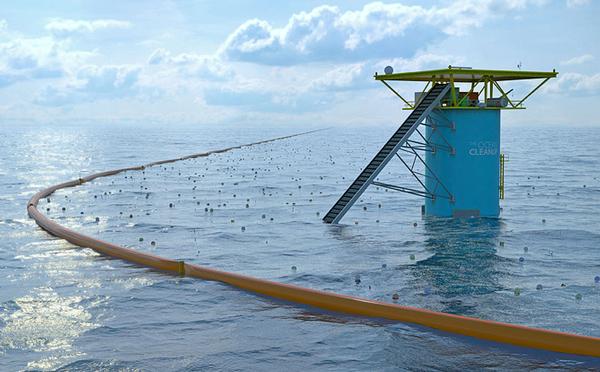
Science centres play a vital role in their communities and are ideally placed to get citizens involved in world-changing projects. The Ocean Cleanup project is a good example of a project where science centres could be a forum for a crowdsourcing initiative to get people involved. Instead of offering a game that teaches visitors about the pollution of the oceans, you could cooperate with a real project, crowdsource ideas and co-create solutions with visitors.
To really create impact and make projects like this happen, science centres can build partnerships with the organisations and institutes around them. Most science centres have ties with science departments of universities, but they could extend their partnerships to companies that focus on innovation or start-ups with high-tech ideas.
It’s about having shared goals to create a win-win situation. Companies can contribute knowledge and resources to science centres, while science centres can offer companies a great testing ground for new ideas. Why not showcase a company’s latest innovation in a science centre and have visitors test and respond to the idea?
Projects like Ocean Cleanup can be partners
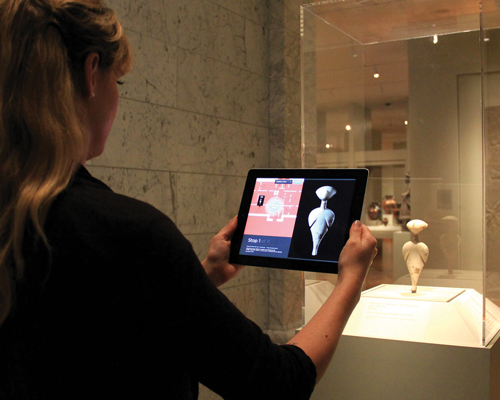
3. Integrate online and offline experiences Over 50 per cent of museum visitors use their smart phone to prepare for a visit. This number will continue to rise. Whether you like it or not, a visit to a science centre will start with a pre-visit in the digital domain. Once visitors arrive, their phone will continue to guide them during their visit and science centres have to be prepared for this.
Science centres can learn a lot from seemingly more traditional places like the Rijksmuseum, where visitors can create a personal museum collection online and the visit is guided by a context-aware app. Digital experiences are necessary for every attraction: it’s simply what your visitors expect.
As a science centre is already an interactive experience, an app’s main function is to guide the visit. With beacons, an app can record what visitors do, store results and stimulate repeat visits. The phone can stay in your pocket, but the app will be used before and after the visit.
At NorthernLight we’ve been experimenting with these context-aware apps in museums, stadiums and retail. In January, the highest density beacons project was launched at Volkenkunde Museum in the Netherlands, with 100 iBeacons used throughout the museum.
At the Rijksmuseum, visitors can create a personalised digital collection on their mobile phones
4. Make it playful Serious games are an important educational tool in the 21st century. Science centres were one of the first places in the world to introduce applied and serious gaming. In a way, they invented the idea of using gameplay and interaction for education. But it now seems that online and business-to-business serious games – to teach engineers or educate surgeons or train pilots – are getting ahead.
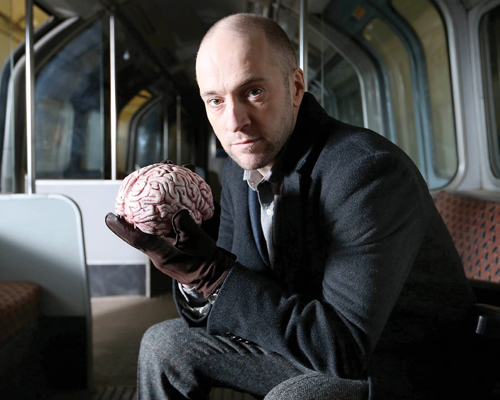
Science centres need to catch up and learn lessons from these types of serious games. Science-based attractions could integrate serious games and real training software into their exhibitions. Take for example the brain surgeon’s game that is used to teach medical students. It would be fantastic to make this game available to science centres. The same goes for flight simulators and car mechanic’s augmented-reality devices.
Often large investments were made to develop these games and although they are used to teach serious, real-life skills, they are more challenging and at the same time more fun than the average science centre game that was developed with a limited budget 10 years ago.
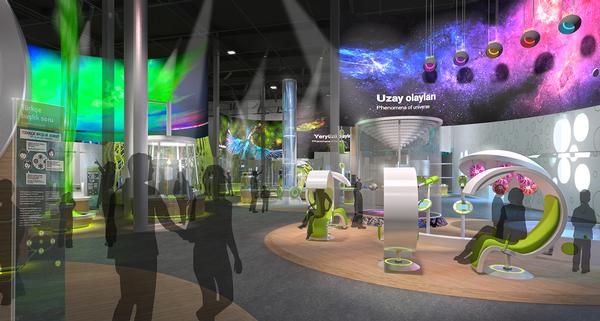
The Inventions for Life area at Kayseri Science Centre in Turkey will feature serious games
5. Make it physical Nothing beats being close to the “real thing”. Science centres have always been experts in creating experiences that are hands-on and tactile. In this sense they have been examples for traditional museums. However, in recent years, some science centres have fallen into the trap of creating mostly touchscreen-type experiences, thinking everyone likes digital. But it remains important to stimulate interactivity with real objects, tactile materials and physical interactives.
In order to add a level of physicality and authenticity a few science centres have started to acquire an object collection. NEMO in Amsterdam, for example, has a special heritage collection consisting of 17,000 artefacts that tell the story of humankind and energy in its broadest sense, from the parlograph to the MP3 player and from the Humphry Davy lamp to LED lighting.
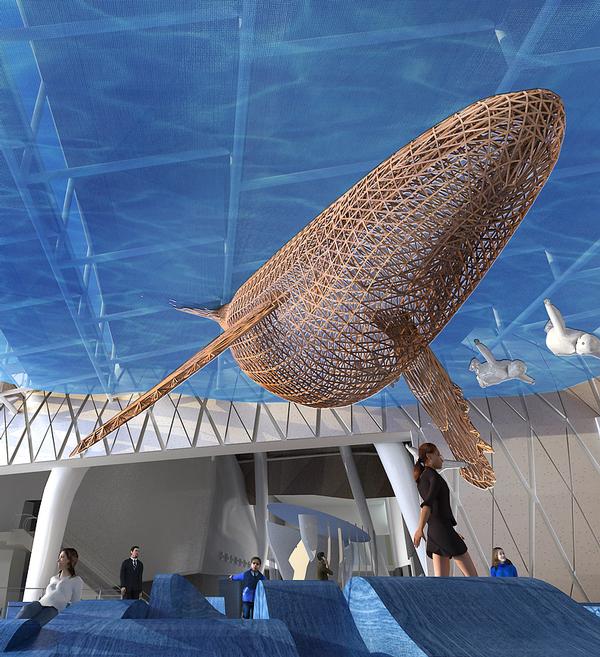
The National Maritime Museum China has authentic collection objects
6. Create the unexpected People are exposed to a lot of media nowadays. Brands try to get people’s attention in all sorts of unexpected ways in order to promote and sell their products. The main aim of most brand activation campaigns is to surprise people and create a buzz. Samsung Turkey is a great example. They launched a website with a video call centre for the hearing impaired. As part of the launch they created a video in which they followed a hearing-impaired man named Muharrem through his morning routine. A month of preparation (including sign language training) and many cameras later, Muharrem goes through the city and is greeted by people who can communicate just like he does. The video went viral and has been viewed almost 8 million times.
Science centres can learn from this example, in which a company uses the unexpected to attract attention. They should make a bigger effort to surprise their visitors and make impact, building better, more challenging interactive exhibits. Once you create the unexpected, you will create a buzz, both offline (word-of-mouth) and online on social media.
Another way to create the unexpected is to expose people to interactive exhibits in unexpected places like airports or shopping areas. Here they have a much bigger impact. In Bergen in Norway a science centre was built in a shopping mall, and the Dutch science centre NEMO built a free mini science centre at Amsterdam’s Schiphol airport, resulting in a lot of positive feedback from travellers.
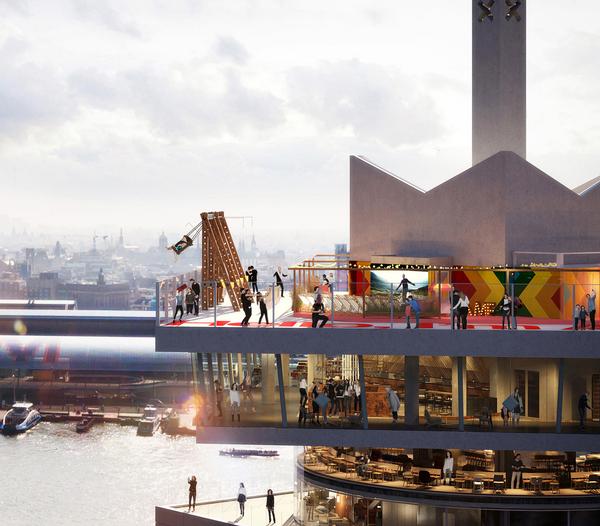
Amsterdam’s A’DAM Tower: surprising visitors with the unique Over The Edge vertigo swing
IN CONCLUSION
These six characteristics of a futureproof science centre are based on the important role science centres have in society. A science centre is about experiences that connect people through sharing ideas and insights. It’s about changing perceptions and attitudes and experiences that cut across boundaries between art and culture, history and science. It’s about lifelong learning. Science centres can only continue to keep playing this role if they continuously adapt and keep up with current trends and innovations.
Peter SlavenburgCo-founder and Director NorthernLight
Peter Slavenburg
Peter Slavenburg is co-founder and director of NorthernLight. NorthernLight develops and designs physical and digital experience platforms for brands, museums and public spaces. By using the latest digital technologies and media innovations NorthernLight changes physical locations into places where learning, discovery and entertainment go hand in hand.
When the first science centres appeared more than 40 years ago, they were well ahead of their time. Being able to interact with exhibits was a completely new experience for people. It was “please touch” instead of “don’t touch”. However, times have changed, people have evolved and technology has advanced at an incredible speed. Although some science centres have been able to anticipate these changes successfully, many of them need to do more to adopt innovations and stay relevant for the general public.
In this article we suggest six action points which could make science centres ready for the future.
Read more from this issue of Attractions Management magazine
View contents of Attractions Management 2016 issue 1
Interview: Tony Butler
Tony Butler, executive director of Derby
Museums Trust, on how museums can
be a force for good in their communities
Attractions: Perfect Brew
At 15 years old, the Guinness Storehouse
has been voted Europe’s best-loved
attraction. Manager Paul Carty reveals
the secrets of the Dublin brandland
Profile: John McReynolds
IAAPA’s new chairman reveals his aims
for the year ahead, his vision for a
global association and how his role at
Universal Orlando informs his goals
Analysis: The Attractions Business
Business planning consultant
David Camp starts an exclusive eight-part
series, delving into the fine art of attractions
operation from a business perspective
Science Centres: How to Future-Proof a Science Centre
Peter Slavenburg of design agency
NorthernLight describes how invisible
technology, serious play, co-creation
and the digital experience will inform
the science centre of tomorrow
Promotional feature: Simworx Ventures
Simworx Ventures is bringing its expertise in cutting-edge media-based attractions
to a new audience of museums, heritage sites, zoos and aquariums
Technology: Beacons on the Horizon
Beacons have countless applications in
the world of attractions. A case study
from the Cleveland Museum of Art
illustrates the technology’s potential
Museums & Galleries: Art Attack
Some of the most exciting attractions
design is happening in new and
upcoming galleries around the world,
from firms like Kengo Kuma and BIG
Promotional feature: IDEA
2016 is shaping up to be an interesting year for the attractions industry.
IDEA looks at what it takes to win audiences and command attention
Mystery Shopper: Spring in Your Step
We disappear down the rabbit hole as we
pay a mystery shopper visit to Bounce
Below, a unique underground trampolining
attraction in Snowdonia, north Wales
Rides: The Ride Makers
Our ride makers series continues with
water rides, a firm favourite with park
guests. Three leading companies reveal
the latest trends in flumes and chutes
Technology: Tech Check
The industry technology unveiled at
IAAPA 2015: from VR to interactives, and
digital puppets to 20-storey LED giants
1. Apply technology in an intuitive and elegant way With all the digital and technological innovations that have emerged, the challenge is to make technology elegant or even invisible. We have moved from a 20th-century world where technology was visible all around us, to a world where technology has become intuitive, omnipresent and invisible. If you walk through the new Rijksmuseum in Amsterdam, the Netherlands, you’ll see no technology whatsoever. No screens or panels – the place looks completely clean. That’s what people want technology to be like. Tesla is another example of elegant technology. One touchscreen display controls most of the car’s functions.
So technology is advancing, but the presence of technology is diminishing. This is the way science centres should move as well. The iSandBOX (an interactive sandbox) is a great example of invisible technology. With this exhibit one can learn about geology without having to touch buttons or screens. By playing with the sand you can create valleys, mountains, lakes, oceans and can even have lava coming out of volcanoes. People don’t feel as though they’re interacting with technology because the technology that’s used (sensors and a projector) is elegantly integrated.
iSandBOX is an interactive, augmented-
reality sandbox
2. Co-create and share Communication between organisations and their customers used to be one-way, but today it’s all about sharing and exchanging ideas, goods and information. Examples of this sharing philosophy are abundant; from social media, to crowdsourcing and second-screen applications that enable people to interact with television shows.
Many science centres seem to have missed this development and still primarily focus on one-way communication. A typical example is an exhibit that shows a science principle. Every time you press a button you get the proof that a certain scientific phenomenon is true. Why not show different scientific philosophies that contradict each other and offer opportunities to share or discuss them?
Science centres play a vital role in their communities and are ideally placed to get citizens involved in world-changing projects. The Ocean Cleanup project is a good example of a project where science centres could be a forum for a crowdsourcing initiative to get people involved. Instead of offering a game that teaches visitors about the pollution of the oceans, you could cooperate with a real project, crowdsource ideas and co-create solutions with visitors.
To really create impact and make projects like this happen, science centres can build partnerships with the organisations and institutes around them. Most science centres have ties with science departments of universities, but they could extend their partnerships to companies that focus on innovation or start-ups with high-tech ideas.
It’s about having shared goals to create a win-win situation. Companies can contribute knowledge and resources to science centres, while science centres can offer companies a great testing ground for new ideas. Why not showcase a company’s latest innovation in a science centre and have visitors test and respond to the idea?
Projects like Ocean Cleanup can be partners
3. Integrate online and offline experiences Over 50 per cent of museum visitors use their smart phone to prepare for a visit. This number will continue to rise. Whether you like it or not, a visit to a science centre will start with a pre-visit in the digital domain. Once visitors arrive, their phone will continue to guide them during their visit and science centres have to be prepared for this.
Science centres can learn a lot from seemingly more traditional places like the Rijksmuseum, where visitors can create a personal museum collection online and the visit is guided by a context-aware app. Digital experiences are necessary for every attraction: it’s simply what your visitors expect.
As a science centre is already an interactive experience, an app’s main function is to guide the visit. With beacons, an app can record what visitors do, store results and stimulate repeat visits. The phone can stay in your pocket, but the app will be used before and after the visit.
At NorthernLight we’ve been experimenting with these context-aware apps in museums, stadiums and retail. In January, the highest density beacons project was launched at Volkenkunde Museum in the Netherlands, with 100 iBeacons used throughout the museum.
At the Rijksmuseum, visitors can create a personalised digital collection on their mobile phones
4. Make it playful Serious games are an important educational tool in the 21st century. Science centres were one of the first places in the world to introduce applied and serious gaming. In a way, they invented the idea of using gameplay and interaction for education. But it now seems that online and business-to-business serious games – to teach engineers or educate surgeons or train pilots – are getting ahead.
Science centres need to catch up and learn lessons from these types of serious games. Science-based attractions could integrate serious games and real training software into their exhibitions. Take for example the brain surgeon’s game that is used to teach medical students. It would be fantastic to make this game available to science centres. The same goes for flight simulators and car mechanic’s augmented-reality devices.
Often large investments were made to develop these games and although they are used to teach serious, real-life skills, they are more challenging and at the same time more fun than the average science centre game that was developed with a limited budget 10 years ago.
The Inventions for Life area at Kayseri Science Centre in Turkey will feature serious games
5. Make it physical Nothing beats being close to the “real thing”. Science centres have always been experts in creating experiences that are hands-on and tactile. In this sense they have been examples for traditional museums. However, in recent years, some science centres have fallen into the trap of creating mostly touchscreen-type experiences, thinking everyone likes digital. But it remains important to stimulate interactivity with real objects, tactile materials and physical interactives.
In order to add a level of physicality and authenticity a few science centres have started to acquire an object collection. NEMO in Amsterdam, for example, has a special heritage collection consisting of 17,000 artefacts that tell the story of humankind and energy in its broadest sense, from the parlograph to the MP3 player and from the Humphry Davy lamp to LED lighting.
The National Maritime Museum China has authentic collection objects
6. Create the unexpected People are exposed to a lot of media nowadays. Brands try to get people’s attention in all sorts of unexpected ways in order to promote and sell their products. The main aim of most brand activation campaigns is to surprise people and create a buzz. Samsung Turkey is a great example. They launched a website with a video call centre for the hearing impaired. As part of the launch they created a video in which they followed a hearing-impaired man named Muharrem through his morning routine. A month of preparation (including sign language training) and many cameras later, Muharrem goes through the city and is greeted by people who can communicate just like he does. The video went viral and has been viewed almost 8 million times.
Science centres can learn from this example, in which a company uses the unexpected to attract attention. They should make a bigger effort to surprise their visitors and make impact, building better, more challenging interactive exhibits. Once you create the unexpected, you will create a buzz, both offline (word-of-mouth) and online on social media.
Another way to create the unexpected is to expose people to interactive exhibits in unexpected places like airports or shopping areas. Here they have a much bigger impact. In Bergen in Norway a science centre was built in a shopping mall, and the Dutch science centre NEMO built a free mini science centre at Amsterdam’s Schiphol airport, resulting in a lot of positive feedback from travellers.
Amsterdam’s A’DAM Tower: surprising visitors with the unique Over The Edge vertigo swing
IN CONCLUSION
These six characteristics of a futureproof science centre are based on the important role science centres have in society. A science centre is about experiences that connect people through sharing ideas and insights. It’s about changing perceptions and attitudes and experiences that cut across boundaries between art and culture, history and science. It’s about lifelong learning. Science centres can only continue to keep playing this role if they continuously adapt and keep up with current trends and innovations.
Peter SlavenburgCo-founder and Director NorthernLight
Peter Slavenburg
Peter Slavenburg is co-founder and director of NorthernLight. NorthernLight develops and designs physical and digital experience platforms for brands, museums and public spaces. By using the latest digital technologies and media innovations NorthernLight changes physical locations into places where learning, discovery and entertainment go hand in hand.
OMA has completed a major transformation of New York's New Museum, creating a larger
cultural campus that combines expanded exhibition spaces with learning, performance,
hospitality and public programming.
A US$50 million (£44.2 million, €51.2 million) transformation of Chicago's historic McCormick
Mansion has created a new destination that combines live magic, immersive theatre, dining and
private membership under one roof.
The Montana Historical Society has officially celebrated the opening of its new Montana
Heritage
Center, a US$107 million (£79 million, €92 million) destination that combines immersive
storytelling with cutting-edge audiovisual technology to bring the sta
San Antonio Zoo has reported a US$283 million economic impact for 2025, following a decade-
long transformation programme that has seen almost US$200 million invested into the Texas
attraction.
Plans for the AU$180 million redevelopment of Reef HQ Aquarium in Townsville, Australia, are
progressing, with the project set to transform the attraction into a global centre for reef
education and conservation.
Abu Dhabi-based investment firm Mubadala Capital has made a binding, fully financed
€1 billion
offer to acquire Pierre and Vacances SA, the European holiday resort operator behind the
continental European Center Parcs business.
Disney has reaffirmed its commitment to investing US$30 billion in its US parks and cruise
business by 2033, using new America250 celebrations to underline the role its attractions play
in supporting jobs, tourism and economic growth.
Expo 2030 Riyadh is being planned as a permanent visitor destination, with organisers
confirming the six-million-square-metre site will become a Global Village after the event closes.
The owner of one of Australia's best-known waterparks has acquired a major competitor,
creating a new attractions business spanning two of the country's largest visitor destinations.
The Toverland theme park in the Netherlands has announced a €98m expansion programme
that will add a resort, new attractions and staff facilities as it pursues plans to become a multi-
day destination.
+ More news
COMPANY PROFILES
DJW David & Lynn Willrich started the Company
over thirty years ago, from the Audio Visual
Department [more...]