The terrorist attacks of September 11 2001 left many scars that will never heal. Commemorating the events of that day in a memorial and museum was always going to be a huge challenge, demanding nuanced thinking, sensitivity and incredible staying power from all involved
By Liz Terry | Published in Attractions Management 2015 issue 1
Rarely has one moment in time so defined an age and a place as Ground Zero, New York City on September 11, 2001. It’s almost impossible to imagine how daunting the task appeared when the first meeting was called to discuss the development of a lasting memorial on the site.
Apart from negotiating the many and varied political and financial hurdles, the challenge for those creating the 9/11 Memorial and Museum was to evoke emotion but not to traumatise, to record contemporary events, while putting them in a historical context and to look at the big picture, while still sensitively commemorating the individuals who died.
Most importantly, they needed to find positive messages among the tragedy and to give hope.
All this has been achieved by a combination of excellent design, storytelling, placemaking and good judgement.
At the opening, Michael Bloomberg, 9/11 memorial chair and former New York mayor, said: “The museum tells heartbreaking stories of unimaginable loss, but also inspiring stories of courage and compassion. Its opening honours the commitment we made to 9/11 family members and to all future generations: That we would never forget those we lost or the terrible lessons we learned that day.”
In our feature on page 64 we talk to the people behind the project about how they made it. Their approach was to enable visitors to opt-in to the level of information they choose, so they can view the exhibits on their own terms.
The museum is deep underground – built among the foundations of the Twin Towers – with its entrance at surface level within the 9/11 Memorial Park at Ground Zero.
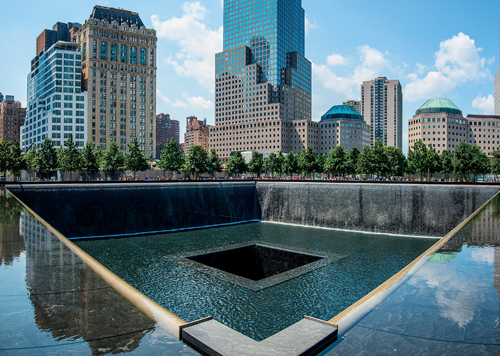
The Memorial Park has two reflecting pools which fill the footprints of the towers and are edged with the names of the dead. Their mesmerising falling curtains of water run away to darkness and create a focus for contemplation.
The museum is housed in vast, cathedral-like spaces which are beautifully lit, with dark floors, restful acoustics and the best air you’ll breathe in New York City.
I felt an intensity of concentration from visitors which I’ve never experienced in a museum before – things seemed heightened and people respectfully engaged with everything around them.
In addition to the excellent, well-documented main exhibits, there are unexpected gems, such as one explaining the vision behind the World Trade Centre, which was conceived as a global community. This has extra resonance, as people from 90 countries lost their lives on 9/11.
In the US, opinions are divided over everything from the presence of a museum shop, to the keeping of human remains on the site, but there’s also an acceptance that controversy was always part of the project’s DNA. When it comes down to it, the designers and architects have created exquisite work in the most challenging circumstances and for that, we owe them our respect and admiration.
Liz Terry, editor, twitter: @elizterry
Read more from this issue of Attractions Management magazine
View contents of Attractions Management 2015 issue 1
Interview: Dominique Cocquet
Euro Disney’s Villages Nature is
a next-generation approach to
park accommodation with leading
eco credentials. Resort manager
Dominque Cocquet tells all
Rides: The Ride Makers
In the second part of our series,
industry-leading manufacturers tell us
about the latest trends in family-friendly
coasters and child-friendly rides
Workplace Apps: Work Mates
Apps that manage an attraction’s
workforce make life easier for operators.
Could this software help you?
3D/4D/5D: New Dimensions
From zombie-themed dark rides to
3D films about supersonic cars, its the
latest news, products and launches
from the world of 3D/4D/5D
The terrorist attacks of September 11 2001 left many scars that will never heal. Commemorating the events of that day in a memorial and museum was always going to be a huge challenge, demanding nuanced thinking, sensitivity and incredible staying power from all involved
By Liz Terry | Published in Attractions Management 2015 issue 1
Rarely has one moment in time so defined an age and a place as Ground Zero, New York City on September 11, 2001. It’s almost impossible to imagine how daunting the task appeared when the first meeting was called to discuss the development of a lasting memorial on the site.
Apart from negotiating the many and varied political and financial hurdles, the challenge for those creating the 9/11 Memorial and Museum was to evoke emotion but not to traumatise, to record contemporary events, while putting them in a historical context and to look at the big picture, while still sensitively commemorating the individuals who died.
Most importantly, they needed to find positive messages among the tragedy and to give hope.
All this has been achieved by a combination of excellent design, storytelling, placemaking and good judgement.
At the opening, Michael Bloomberg, 9/11 memorial chair and former New York mayor, said: “The museum tells heartbreaking stories of unimaginable loss, but also inspiring stories of courage and compassion. Its opening honours the commitment we made to 9/11 family members and to all future generations: That we would never forget those we lost or the terrible lessons we learned that day.”
In our feature on page 64 we talk to the people behind the project about how they made it. Their approach was to enable visitors to opt-in to the level of information they choose, so they can view the exhibits on their own terms.
The museum is deep underground – built among the foundations of the Twin Towers – with its entrance at surface level within the 9/11 Memorial Park at Ground Zero.
The Memorial Park has two reflecting pools which fill the footprints of the towers and are edged with the names of the dead. Their mesmerising falling curtains of water run away to darkness and create a focus for contemplation.
The museum is housed in vast, cathedral-like spaces which are beautifully lit, with dark floors, restful acoustics and the best air you’ll breathe in New York City.
I felt an intensity of concentration from visitors which I’ve never experienced in a museum before – things seemed heightened and people respectfully engaged with everything around them.
In addition to the excellent, well-documented main exhibits, there are unexpected gems, such as one explaining the vision behind the World Trade Centre, which was conceived as a global community. This has extra resonance, as people from 90 countries lost their lives on 9/11.
In the US, opinions are divided over everything from the presence of a museum shop, to the keeping of human remains on the site, but there’s also an acceptance that controversy was always part of the project’s DNA. When it comes down to it, the designers and architects have created exquisite work in the most challenging circumstances and for that, we owe them our respect and admiration.
Liz Terry, editor, twitter: @elizterry
Read more from this issue of Attractions Management magazine
View contents of Attractions Management 2015 issue 1
Interview: Dominique Cocquet
Euro Disney’s Villages Nature is
a next-generation approach to
park accommodation with leading
eco credentials. Resort manager
Dominque Cocquet tells all
Rides: The Ride Makers
In the second part of our series,
industry-leading manufacturers tell us
about the latest trends in family-friendly
coasters and child-friendly rides
Workplace Apps: Work Mates
Apps that manage an attraction’s
workforce make life easier for operators.
Could this software help you?
3D/4D/5D: New Dimensions
From zombie-themed dark rides to
3D films about supersonic cars, its the
latest news, products and launches
from the world of 3D/4D/5D
OMA has completed a major transformation of New York's New Museum, creating a larger
cultural campus that combines expanded exhibition spaces with learning, performance,
hospitality and public programming.
A US$50 million (£44.2 million, €51.2 million) transformation of Chicago's historic McCormick
Mansion has created a new destination that combines live magic, immersive theatre, dining and
private membership under one roof.
The Montana Historical Society has officially celebrated the opening of its new Montana
Heritage
Center, a US$107 million (£79 million, €92 million) destination that combines immersive
storytelling with cutting-edge audiovisual technology to bring the sta
San Antonio Zoo has reported a US$283 million economic impact for 2025, following a decade-
long transformation programme that has seen almost US$200 million invested into the Texas
attraction.
Plans for the AU$180 million redevelopment of Reef HQ Aquarium in Townsville, Australia, are
progressing, with the project set to transform the attraction into a global centre for reef
education and conservation.
Abu Dhabi-based investment firm Mubadala Capital has made a binding, fully financed
€1 billion
offer to acquire Pierre and Vacances SA, the European holiday resort operator behind the
continental European Center Parcs business.
Disney has reaffirmed its commitment to investing US$30 billion in its US parks and cruise
business by 2033, using new America250 celebrations to underline the role its attractions play
in supporting jobs, tourism and economic growth.
Expo 2030 Riyadh is being planned as a permanent visitor destination, with organisers
confirming the six-million-square-metre site will become a Global Village after the event closes.
The owner of one of Australia's best-known waterparks has acquired a major competitor,
creating a new attractions business spanning two of the country's largest visitor destinations.
The Toverland theme park in the Netherlands has announced a €98m expansion programme
that will add a resort, new attractions and staff facilities as it pursues plans to become a multi-
day destination.