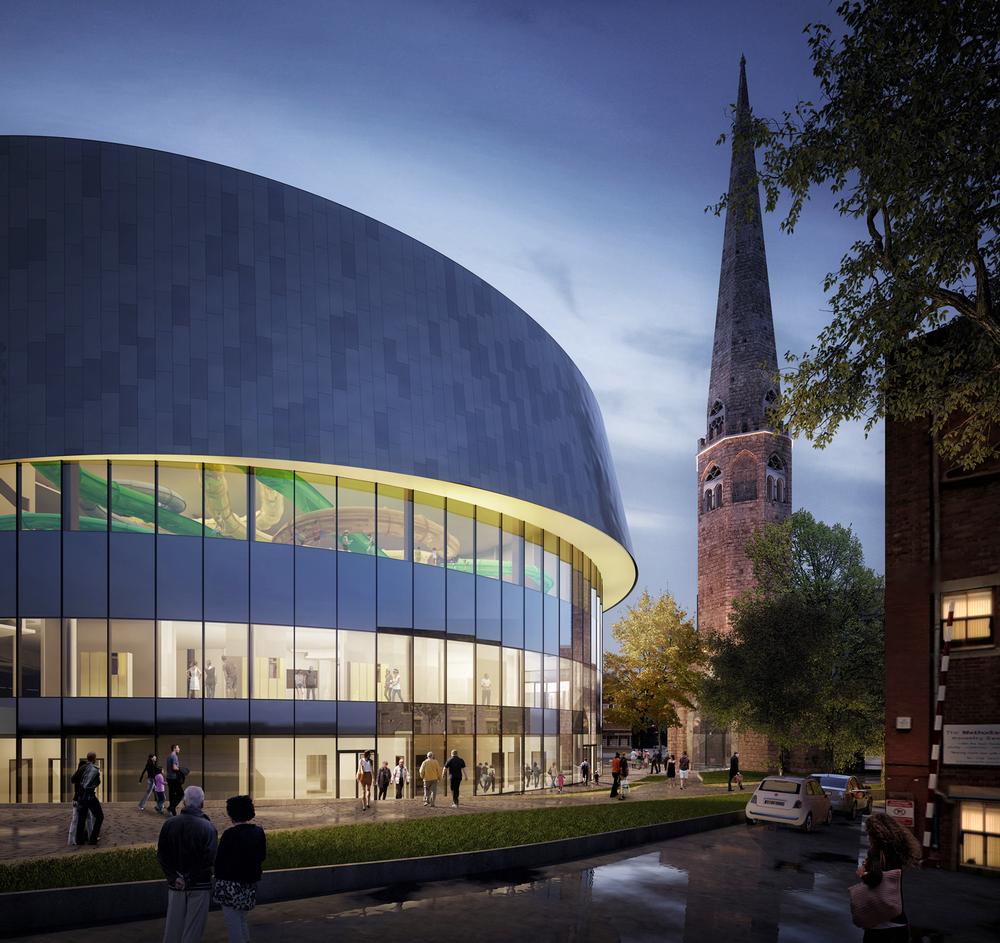
FaulknerBrowns recently submitted plans for an exciting new, high octane waterpark for the city of Coventry. During the process, I couldn’t help but reflect on the parallels between this bold move by the local council and the debate surrounding the remit of the BBC as a public broadcaster in contrast to competing providers in the private sector.
Of the few waterparks built in the UK in the last few years almost all have been investments by the private sector, with holiday destinations such as Center Parcs dominating the landscape. This has raised the question of why a publicly funded local authority would invest in a city centre waterpark and – like the BBC – how will it be able to demonstrate value for money.
Public Benefits Firstly, it’s important to consider the wider regeneration benefits that a destination leisure facility can bring to a city centre. We know that through increased footfall and inspirational placemaking, similar schemes have acted as catalysts for private sector investment, bringing a welcome boost to the economy.
For the last 20 years, much sporting policy and funding in aquatics facilities has been driven by lane swimming, but the reality is that participation covers a wide spectrum of activity, ranging from supervised play through to developing water confidence, swimming for recreation and fitness and competition swimming. The ideal aquatics centre would contain facilities to provide for all these activities.
As well as the characteristic flume rides, the Coventry waterpark proposals contain toddler areas, leisure water to a range of depths and also lane swimming.
From both a social perspective and – in particular – a health standpoint, it’s interesting to examine the concept behind this new waterpark through the viewpoint of changing government policy, because the Sporting Futures strategy places much greater emphasis on a wider, more holistic health and leisure offer which is in tune with this type of facility development.
Health Benefits There’s also a strong argument to suggest that significant ‘incidental’ (non-swimming related) health benefits arise from the leisure water experience, both in terms of the physical movement up and down the levels of the facility and also from the associated feel-good factor.
In our Coventry proposal this vertical movement up through the building is exaggerated by the tight city centre site, which has led us to stack the facilities on top of each other: the main pools and the ride hall are stacked three stories above the 25m pool, the wet changing and the spa, with access provided by a generous spiral ramp up through the building.
Strong Public Sector Role Like the BBC, there is a strong role that the public sector can play, alongside the private sector, in providing high quality entertainment. In this case the added public value is provided through strong health and wellbeing benefits, in much the same way the BBC focuses on providing an educational offer.
In the post-Olympic landscape, schemes to promote health and wellbeing need to be conceived and delivered through innovative delivery mechanisms. As in the case of the BBC, change is needed, but the public sector is capable of championing innovative thinking.
See more on sport in Coventry on page 34
Read about the ASA’s initiative to prove the health benefits of swimming on page 8
FaulknerBrowns recently submitted plans for an exciting new, high octane waterpark for the city of Coventry. During the process, I couldn’t help but reflect on the parallels between this bold move by the local council and the debate surrounding the remit of the BBC as a public broadcaster in contrast to competing providers in the private sector.
Of the few waterparks built in the UK in the last few years almost all have been investments by the private sector, with holiday destinations such as Center Parcs dominating the landscape. This has raised the question of why a publicly funded local authority would invest in a city centre waterpark and – like the BBC – how will it be able to demonstrate value for money.
Public Benefits Firstly, it’s important to consider the wider regeneration benefits that a destination leisure facility can bring to a city centre. We know that through increased footfall and inspirational placemaking, similar schemes have acted as catalysts for private sector investment, bringing a welcome boost to the economy.
For the last 20 years, much sporting policy and funding in aquatics facilities has been driven by lane swimming, but the reality is that participation covers a wide spectrum of activity, ranging from supervised play through to developing water confidence, swimming for recreation and fitness and competition swimming. The ideal aquatics centre would contain facilities to provide for all these activities.
As well as the characteristic flume rides, the Coventry waterpark proposals contain toddler areas, leisure water to a range of depths and also lane swimming.
From both a social perspective and – in particular – a health standpoint, it’s interesting to examine the concept behind this new waterpark through the viewpoint of changing government policy, because the Sporting Futures strategy places much greater emphasis on a wider, more holistic health and leisure offer which is in tune with this type of facility development.
Health Benefits There’s also a strong argument to suggest that significant ‘incidental’ (non-swimming related) health benefits arise from the leisure water experience, both in terms of the physical movement up and down the levels of the facility and also from the associated feel-good factor.
In our Coventry proposal this vertical movement up through the building is exaggerated by the tight city centre site, which has led us to stack the facilities on top of each other: the main pools and the ride hall are stacked three stories above the 25m pool, the wet changing and the spa, with access provided by a generous spiral ramp up through the building.
Strong Public Sector Role Like the BBC, there is a strong role that the public sector can play, alongside the private sector, in providing high quality entertainment. In this case the added public value is provided through strong health and wellbeing benefits, in much the same way the BBC focuses on providing an educational offer.
In the post-Olympic landscape, schemes to promote health and wellbeing need to be conceived and delivered through innovative delivery mechanisms. As in the case of the BBC, change is needed, but the public sector is capable of championing innovative thinking.
See more on sport in Coventry on page 34
Read about the ASA’s initiative to prove the health benefits of swimming on page 8
OMA has completed a major transformation of New York's New Museum, creating a larger
cultural campus that combines expanded exhibition spaces with learning, performance,
hospitality and public programming.
A US$50 million (£44.2 million, €51.2 million) transformation of Chicago's historic McCormick
Mansion has created a new destination that combines live magic, immersive theatre, dining and
private membership under one roof.
The Montana Historical Society has officially celebrated the opening of its new Montana
Heritage
Center, a US$107 million (£79 million, €92 million) destination that combines immersive
storytelling with cutting-edge audiovisual technology to bring the sta
San Antonio Zoo has reported a US$283 million economic impact for 2025, following a decade-
long transformation programme that has seen almost US$200 million invested into the Texas
attraction.
Plans for the AU$180 million redevelopment of Reef HQ Aquarium in Townsville, Australia, are
progressing, with the project set to transform the attraction into a global centre for reef
education and conservation.
Abu Dhabi-based investment firm Mubadala Capital has made a binding, fully financed
€1 billion
offer to acquire Pierre and Vacances SA, the European holiday resort operator behind the
continental European Center Parcs business.
Disney has reaffirmed its commitment to investing US$30 billion in its US parks and cruise
business by 2033, using new America250 celebrations to underline the role its attractions play
in supporting jobs, tourism and economic growth.
Expo 2030 Riyadh is being planned as a permanent visitor destination, with organisers
confirming the six-million-square-metre site will become a Global Village after the event closes.
The owner of one of Australia's best-known waterparks has acquired a major competitor,
creating a new attractions business spanning two of the country's largest visitor destinations.
The Toverland theme park in the Netherlands has announced a €98m expansion programme
that will add a resort, new attractions and staff facilities as it pursues plans to become a multi-
day destination.
+ More news
COMPANY PROFILES
IDEATTACK IDEATTACK is a full-service planning and
design company with headquarters in
Los Angeles. [more...]
Painting With Light By combining lighting, video, scenic and architectural elements, sound and special effects we tell s [more...]
QubicaAMF UK QubicaAMF is the largest and most
innovative bowling equipment provider with
600 employees worldwi [more...]
Taylor Made Designs Founded in 1993, Taylor Made
Designs supply corporate clothing
and brand-enhancing merchandise
to [more...]