The physical demands of a racing driver requires specialist training programmes
The latest fitness trends suggest that functional training areas and rigs are increasingly being added to accompany traditional resistance equipment on the gym floor.
Fixed strength equipment, however, still plays a key role in many facilities – and it’s powering some of the world’s top professional sports people to success, from tennis stars to Premier League football teams.
Incorporating fixed strength equipment into sport-specific training programmes isn’t exclusive to professional athletes either; it’s accessible to players of all ages and abilities. Rob Thurston, commercial director at fitness equipment manufacturer Cybex, says: “Fixed strength equipment is still central to many sports gym floor layouts.
“There are many examples of sports people at all levels using strength equipment in their training programmes – it’s all about using the right kit to develop the attributes applicable to your sport.”
We look at ways in which resistance kit is being used by elite athletes, and how amateur sports enthusiasts can benefit from similar techniques.
Resisting the force Sport: Formula 1 Client: Lotus Formula 1 Junior Team, UK Supplier: Matrix Being a racing driver is extremely challenging both physically and mentally; you need to be in the best condition possible to cope with the demands,” explains Marlon Stöckinger, Lotus F1 Junior Team driver.
Consequently, physical fitness is one of the eight key areas of development identified by the Lotus F1 Junior Team, which has been established by Gravity Sports Management and the Lotus F1 team to uncover motor sport’s stars of the future.
Aside from a resilient cardiovascular system required to maintain an average heart rate of 140–160bpm, strength training is essential to combat the physical demands of the sport. Drivers must focus on building neck strength to withstand cornering at speed and high G-forces; core strength to manage tight movements at extremely high speeds; strong and reactive glutes and legs to apply correct pressure and speed to the brake; and accelerator and grip strength to maintain maximum control of the car at all times.
Based at the Lotus F1 Team factory in Enstone, Oxfordshire, the team’s Human Performance Centre is equipped by Matrix Fitness. Products from its commercial strength series, Ultra and Aura, are incorporated into the bespoke training programmes of the drivers to focus on key muscle groups. Specifically, drivers use the rotary torso, seated leg curl, leg press, leg extension and Matrix’s functional trainer.
“The equipment helps me train the specific muscle groups that are crucial for racing at a high level,” concludes Stöckinger.
Marlon Stöckinger
FUNCTIONAL POWER Sport: Football Client: Tottenham Hotspur Football Club, UK Supplier: Keiser The physical wellbeing of professional footballers can be the difference between a trophy-winning season or one to forget; with 38 Premier League fixtures, FA Cup and League Cup competitions and spells in the UEFA Champions League and Europa League for the last four seasons, fitness levels of the players at Tottenham Hotspur FC are crucial to the club’s success.
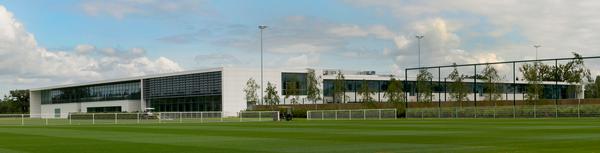
In September 2012, the Premier League side opened its new training centre in Bulls Cross, Enfield. A 77-acre facility, the training centre comprises 15 grass pitches, a covered artificial pitch, pool and hydrotherapy complex, altitude room, sports rehabilitation suites and a large-scale gym equipped by Keiser.
“We used Keiser equipment at our old training centre and our players were extremely satisfied with it,” says Wayne Diesel, head of medical services at Tottenham. “As part of our commitment to research into football-specific training, we needed equipment that would allow functional power development, creating a greater spectrum to progress exercises.”
Strength equipment from Keiser’s Air range is incorporated into the football-specific strength and conditioning programmes used by the players. Unlike most fixed resistance equipment with weight stacks, Keiser’s range uses air pressure to provide resistance.
The range targets upper body, lower body and core strength, as well as offering a detailed information display. “Keiser’s Air resistance equipment delivers ease of regulation of power output as a percentage of the player’s maximum; the ability to spot asymmetries between opposite limbs,” explains Diesel.
Tottenham Hotspur’s new training centre in Enfield opened in 2012
Wayne Diesel, head of medical services at Tottenham Hotspur
Rehab & performance Sport: Cricket Client: Warwickshire County Cricket Club, UK Supplier: Technogym The physical demands of cricketers are unique to each player’s specialism: from tall, strong and powerful fast bowlers to shorter wicket keepers who place a large amount of pressure on their hamstrings during long days in the field. Building and maintaining peak physical fitness enables batsmen to score more runs, bowlers to maintain their desired pace and accuracy for longer, and fielders to sustain high levels of concentration and faster reaction speeds.
While teams train year-round, the intended outcome of their strength and conditioning programmes will also change depending on where they are in a season, explains Armstrong: “Resistance training takes priority pre-season, throughout November and December, as the players focus on building up their baseline strength; in January the programme switches to developing power and speed; and then, when the season starts in April, strength training is again incorporated to maintain high performance levels.”
In 2013, Technogym installed resistance equipment in the on-site gym at Edgbaston Stadium, home to Warwickshire County Cricket Club.
“The equipment we chose allows for a wide variety of exercises, uses and loads, and its flexibility meets the needs of the players’ unique specialisms,” adds Armstrong. The gym incorporates Technogym’s Multipower, a lifting rack that allows for assisted lower and upper limb exercises. This was used as part of a comprehensive rehabilitation programme for three of the club’s bowlers who suffered back stress fractures last year.
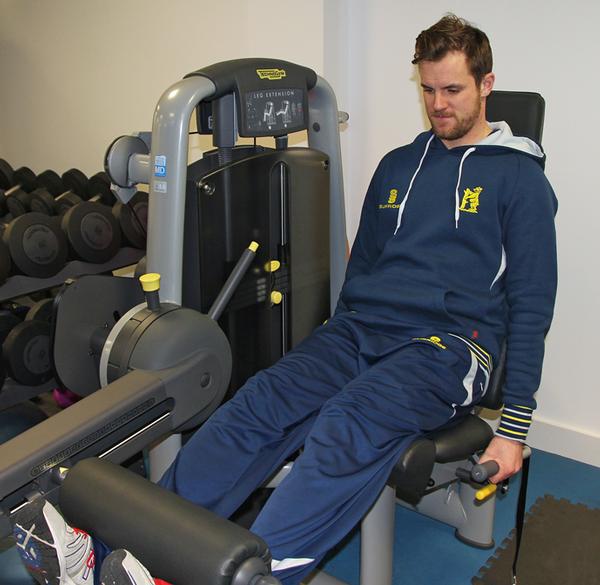
Products from Technogym’s Selection MED line were also installed, including the leg extension and leg press, which are designed specifically to support rehabilitation and users with various physical conditions during exercise.
The equipment also allows the team to quickly bring new players up to the required strength and fitness levels. “The adjustable head rest and handles of the leg press ensure players are seated in a safe and uncompromised position, allowing them to put significant loads on their legs without compromising their back,” explains Armstrong.
Strength and conditioning coach Chris Armstrong on the kit
Aceing it Sport: Tennis Client: ATP World Tour Finals, UK Supplier: Cybex International UK Power, strength, agility, endurance, flexibility and speed are all vital abilities for tennis players at any level of the sport and, while time spent on-court is essential, time spent in the gym is often where a competitive edge is gained.
In November 2013, as the climax to the men’s professional tennis season, the Barclays ATP World Tour Finals returned to London’s O2 arena. Continuing a partnership that dates back to 2009, Cybex International UK was chosen to equip the tournament’s on-site gym. “Having a gym within the venue opens up a lot of opportunities,” says ATP World Tour medical director Clay Sniteman.
“Players can run their own functional warm-up sessions, cool down after matches or even rehabilitate injuries they pick up during the tournament.”
Alongside CV equipment, the gym housed the Bravo Pull and Bravo Press, two pieces from Cybex’s cable-based Bravo Functional Training system. “Cable-based training is perfect for tennis players, as it allows for the multi-directional movement required for the sport,” explains Sniteman. “By using the Cybex Bravo, players benefit hugely from the range of motion, angles and stability work, being able to isolate parts of the body during their workouts and target the weaker areas from abdominals to core, back to shoulders and even lower body.”
The Bravo functional training system is one of Cybex’s key strength pieces and is used at a number of elite training centres.
“The Bravo system combines the features of selectorised and cable-based strength training equipment to deliver endless possibilities,” says Thurston.
Novak Djokovic successfully defended his ATP World Tour Finals title at London’s O2
COMPANY PROFILES
instantprint
We’re a Yorkshire-based online printer, founded
in 2009 by Adam Carnell and James Kinsella. [more...]
IDEATTACK
IDEATTACK is a full-service planning and
design company with headquarters in
Los Angeles. [more...]
The physical demands of a racing driver requires specialist training programmes
The latest fitness trends suggest that functional training areas and rigs are increasingly being added to accompany traditional resistance equipment on the gym floor.
Fixed strength equipment, however, still plays a key role in many facilities – and it’s powering some of the world’s top professional sports people to success, from tennis stars to Premier League football teams.
Incorporating fixed strength equipment into sport-specific training programmes isn’t exclusive to professional athletes either; it’s accessible to players of all ages and abilities. Rob Thurston, commercial director at fitness equipment manufacturer Cybex, says: “Fixed strength equipment is still central to many sports gym floor layouts.
“There are many examples of sports people at all levels using strength equipment in their training programmes – it’s all about using the right kit to develop the attributes applicable to your sport.”
We look at ways in which resistance kit is being used by elite athletes, and how amateur sports enthusiasts can benefit from similar techniques.
Resisting the force Sport: Formula 1 Client: Lotus Formula 1 Junior Team, UK Supplier: Matrix Being a racing driver is extremely challenging both physically and mentally; you need to be in the best condition possible to cope with the demands,” explains Marlon Stöckinger, Lotus F1 Junior Team driver.
Consequently, physical fitness is one of the eight key areas of development identified by the Lotus F1 Junior Team, which has been established by Gravity Sports Management and the Lotus F1 team to uncover motor sport’s stars of the future.
Aside from a resilient cardiovascular system required to maintain an average heart rate of 140–160bpm, strength training is essential to combat the physical demands of the sport. Drivers must focus on building neck strength to withstand cornering at speed and high G-forces; core strength to manage tight movements at extremely high speeds; strong and reactive glutes and legs to apply correct pressure and speed to the brake; and accelerator and grip strength to maintain maximum control of the car at all times.
Based at the Lotus F1 Team factory in Enstone, Oxfordshire, the team’s Human Performance Centre is equipped by Matrix Fitness. Products from its commercial strength series, Ultra and Aura, are incorporated into the bespoke training programmes of the drivers to focus on key muscle groups. Specifically, drivers use the rotary torso, seated leg curl, leg press, leg extension and Matrix’s functional trainer.
“The equipment helps me train the specific muscle groups that are crucial for racing at a high level,” concludes Stöckinger.
Marlon Stöckinger
FUNCTIONAL POWER Sport: Football Client: Tottenham Hotspur Football Club, UK Supplier: Keiser The physical wellbeing of professional footballers can be the difference between a trophy-winning season or one to forget; with 38 Premier League fixtures, FA Cup and League Cup competitions and spells in the UEFA Champions League and Europa League for the last four seasons, fitness levels of the players at Tottenham Hotspur FC are crucial to the club’s success.
In September 2012, the Premier League side opened its new training centre in Bulls Cross, Enfield. A 77-acre facility, the training centre comprises 15 grass pitches, a covered artificial pitch, pool and hydrotherapy complex, altitude room, sports rehabilitation suites and a large-scale gym equipped by Keiser.
“We used Keiser equipment at our old training centre and our players were extremely satisfied with it,” says Wayne Diesel, head of medical services at Tottenham. “As part of our commitment to research into football-specific training, we needed equipment that would allow functional power development, creating a greater spectrum to progress exercises.”
Strength equipment from Keiser’s Air range is incorporated into the football-specific strength and conditioning programmes used by the players. Unlike most fixed resistance equipment with weight stacks, Keiser’s range uses air pressure to provide resistance.
The range targets upper body, lower body and core strength, as well as offering a detailed information display. “Keiser’s Air resistance equipment delivers ease of regulation of power output as a percentage of the player’s maximum; the ability to spot asymmetries between opposite limbs,” explains Diesel.
Tottenham Hotspur’s new training centre in Enfield opened in 2012
Wayne Diesel, head of medical services at Tottenham Hotspur
Rehab & performance Sport: Cricket Client: Warwickshire County Cricket Club, UK Supplier: Technogym The physical demands of cricketers are unique to each player’s specialism: from tall, strong and powerful fast bowlers to shorter wicket keepers who place a large amount of pressure on their hamstrings during long days in the field. Building and maintaining peak physical fitness enables batsmen to score more runs, bowlers to maintain their desired pace and accuracy for longer, and fielders to sustain high levels of concentration and faster reaction speeds.
While teams train year-round, the intended outcome of their strength and conditioning programmes will also change depending on where they are in a season, explains Armstrong: “Resistance training takes priority pre-season, throughout November and December, as the players focus on building up their baseline strength; in January the programme switches to developing power and speed; and then, when the season starts in April, strength training is again incorporated to maintain high performance levels.”
In 2013, Technogym installed resistance equipment in the on-site gym at Edgbaston Stadium, home to Warwickshire County Cricket Club.
“The equipment we chose allows for a wide variety of exercises, uses and loads, and its flexibility meets the needs of the players’ unique specialisms,” adds Armstrong. The gym incorporates Technogym’s Multipower, a lifting rack that allows for assisted lower and upper limb exercises. This was used as part of a comprehensive rehabilitation programme for three of the club’s bowlers who suffered back stress fractures last year.
Products from Technogym’s Selection MED line were also installed, including the leg extension and leg press, which are designed specifically to support rehabilitation and users with various physical conditions during exercise.
The equipment also allows the team to quickly bring new players up to the required strength and fitness levels. “The adjustable head rest and handles of the leg press ensure players are seated in a safe and uncompromised position, allowing them to put significant loads on their legs without compromising their back,” explains Armstrong.
Strength and conditioning coach Chris Armstrong on the kit
Aceing it Sport: Tennis Client: ATP World Tour Finals, UK Supplier: Cybex International UK Power, strength, agility, endurance, flexibility and speed are all vital abilities for tennis players at any level of the sport and, while time spent on-court is essential, time spent in the gym is often where a competitive edge is gained.
In November 2013, as the climax to the men’s professional tennis season, the Barclays ATP World Tour Finals returned to London’s O2 arena. Continuing a partnership that dates back to 2009, Cybex International UK was chosen to equip the tournament’s on-site gym. “Having a gym within the venue opens up a lot of opportunities,” says ATP World Tour medical director Clay Sniteman.
“Players can run their own functional warm-up sessions, cool down after matches or even rehabilitate injuries they pick up during the tournament.”
Alongside CV equipment, the gym housed the Bravo Pull and Bravo Press, two pieces from Cybex’s cable-based Bravo Functional Training system. “Cable-based training is perfect for tennis players, as it allows for the multi-directional movement required for the sport,” explains Sniteman. “By using the Cybex Bravo, players benefit hugely from the range of motion, angles and stability work, being able to isolate parts of the body during their workouts and target the weaker areas from abdominals to core, back to shoulders and even lower body.”
The Bravo functional training system is one of Cybex’s key strength pieces and is used at a number of elite training centres.
“The Bravo system combines the features of selectorised and cable-based strength training equipment to deliver endless possibilities,” says Thurston.
Novak Djokovic successfully defended his ATP World Tour Finals title at London’s O2
A US$50 million (£44.2 million, €51.2 million) transformation of Chicago's historic McCormick
Mansion has created a new destination that combines live magic, immersive theatre, dining and
private membership under one roof.
The Montana Historical Society has officially celebrated the opening of its new Montana
Heritage
Center, a US$107 million (£79 million, €92 million) destination that combines immersive
storytelling with cutting-edge audiovisual technology to bring the sta
San Antonio Zoo has reported a US$283 million economic impact for 2025, following a decade-
long transformation programme that has seen almost US$200 million invested into the Texas
attraction.
Plans for the AU$180 million redevelopment of Reef HQ Aquarium in Townsville, Australia, are
progressing, with the project set to transform the attraction into a global centre for reef
education and conservation.
Abu Dhabi-based investment firm Mubadala Capital has made a binding, fully financed
€1 billion
offer to acquire Pierre and Vacances SA, the European holiday resort operator behind the
continental European Center Parcs business.
Disney has reaffirmed its commitment to investing US$30 billion in its US parks and cruise
business by 2033, using new America250 celebrations to underline the role its attractions play
in supporting jobs, tourism and economic growth.
Expo 2030 Riyadh is being planned as a permanent visitor destination, with organisers
confirming the six-million-square-metre site will become a Global Village after the event closes.
The owner of one of Australia's best-known waterparks has acquired a major competitor,
creating a new attractions business spanning two of the country's largest visitor destinations.
The Toverland theme park in the Netherlands has announced a €98m expansion programme
that will add a resort, new attractions and staff facilities as it pursues plans to become a multi-
day destination.
Hotel de France, located on the British Isle of Jersey, has created a wellness retreat package
that includes a hot yoga session that will take place in Jersey Zoo’s butterfly sanctuary.
+ More news
COMPANY PROFILES
instantprint We’re a Yorkshire-based online printer, founded
in 2009 by Adam Carnell and James Kinsella. [more...]
IDEATTACK IDEATTACK is a full-service planning and
design company with headquarters in
Los Angeles. [more...]