In these strange times, we have a chance to engage more
people in fitness and wellbeing, but it will require great flexibility
and creativity. Francesco Arlotti, Technogym’s global head of sales
for digital solutions, talks to Kate Cracknell
By Kate Cracknell | Published in Fit Tech 2020 issue 2
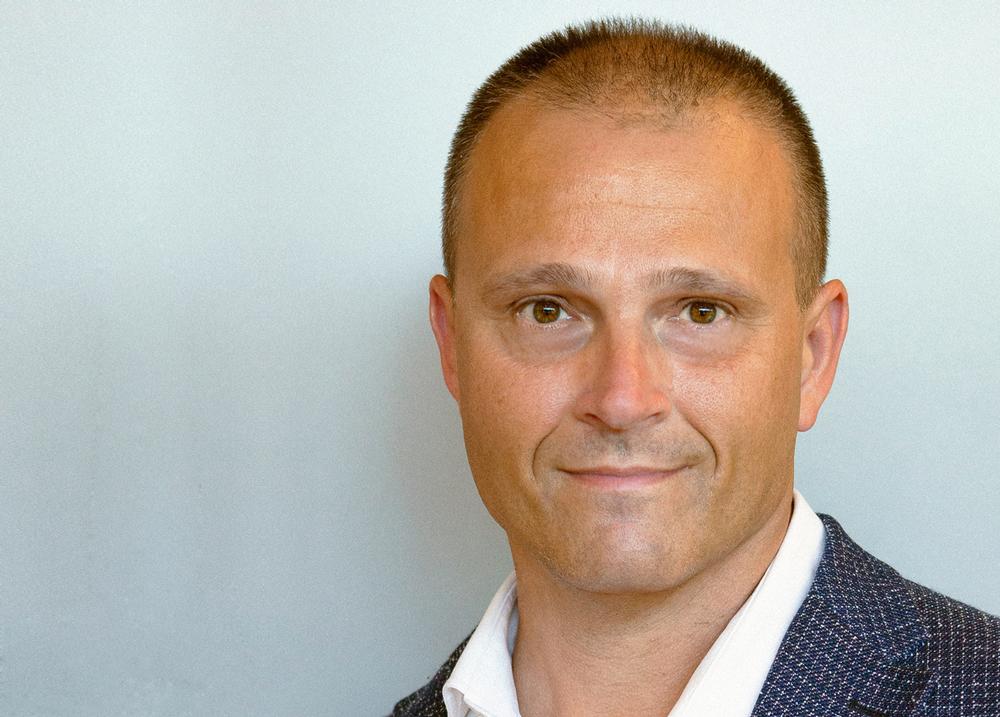
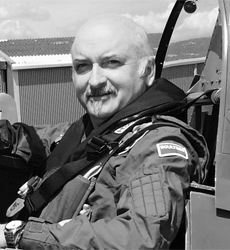
Francesco Arlotti, Technogym’s global head of sales
for digital solutions
How do you feel the pandemic has impacted our sector? The first thing to say is this: What’s happened over recent months, in terms of the digitisation of the fitness sector, hasn’t only happened because of COVID-19. It was going to happen anyway. The crisis has simply accelerated the sector’s digital transformation.
I sometimes make myself unpopular saying this – it’s hard when a lot of operators are still struggling – but I, therefore, see this crisis as an opportunity. It has thrown a spotlight on why our penetration rates were stagnating. It has forced us to think out of the box and be more creative in meeting customers’ needs.
It has confirmed what was already true: that an exclusively offline model is not a good option. Neither is exclusively online: people want community and other people. But there does need to be a blend, because consumers are already digitally addicted. They’re already there, waiting for us to catch up, and we needed to respond or risk them seeking out a pure consumer solution.
That’s why I see COVID-19 as an opportunity. It has accelerated us towards a destination we needed to reach anyway. It has given us a boost and a chance to reinvent this fantastic industry. And as a huge added bonus, it has given consumers a far greater appreciation of good physical and mental health – and with it, handed us a far more receptive audience.
However, it will only be an opportunity if we understand what consumers want – if we focus on their needs rather than ours – and if we steer away from commoditising our product.
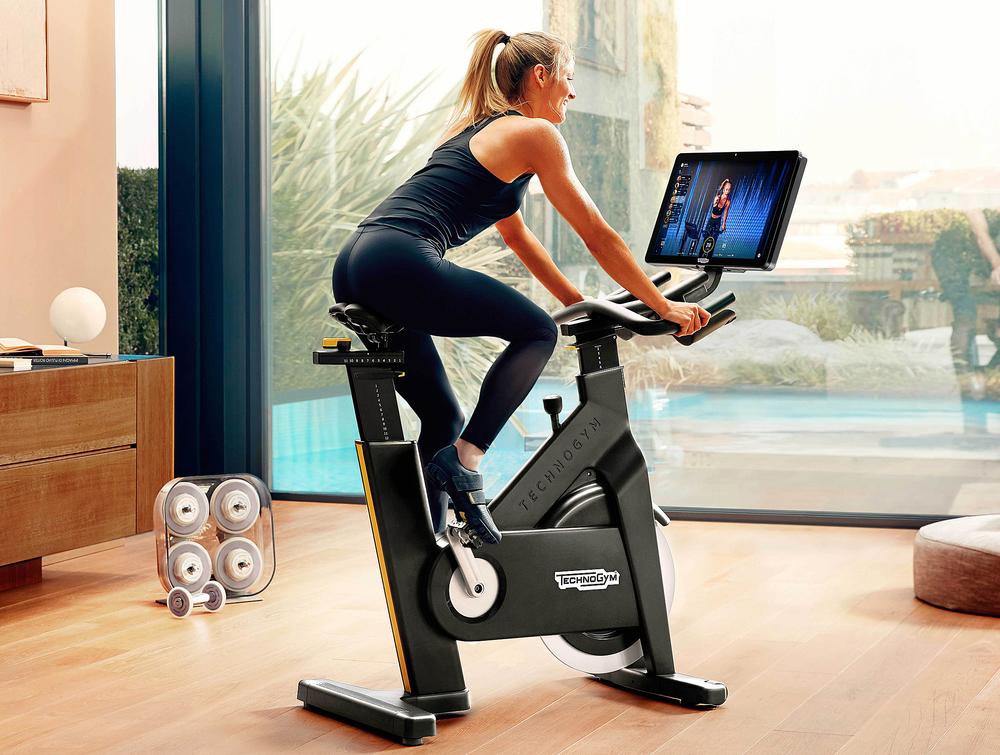
How have you been supporting customers through the COVID crisis? We’ve adopted a phased approach. Phase one was about helping our clients support their customers in training at home, with online solutions people could use during lockdown.
Phase two has been focusing on building confidence among members, by allowing them to book absolutely everything online – not just classes but everything in the club – based on strict capacity limits. We’ve been working hard on this recently, helping operators map out all their spaces, so members feel safe.
Phase three is business model evolution, helping operators build on what they’ve done during lockdown to develop a seamless online/offline offering.
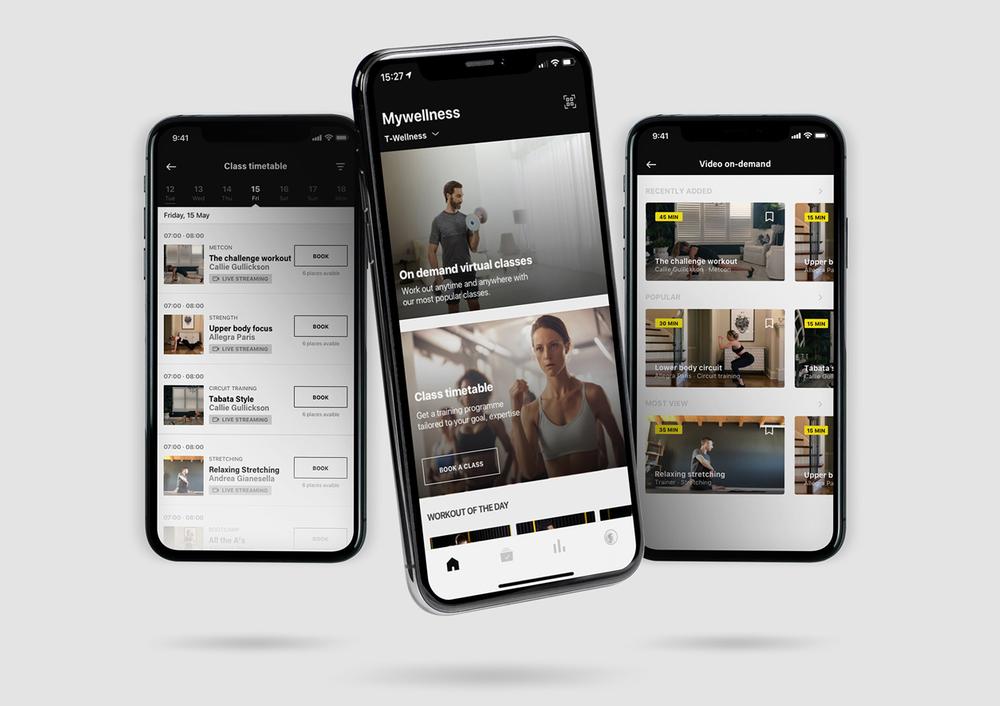
We’ve also launched new upgrades for Mywellness, designed to help operators move into phase three. Firstly, we’ve introduced a library of virtual on-demand classes created by Technogym; if operators also want to upload their own signature classes for their members, they can do that too. Also launching is Coach Live video chat: live streaming of classes where instructors can also see the people training at home, allowing them to feed back on technique and so on.
All of this is alongside the existing functionality on Mywellness, from exercise prescription and body assessment to challenges, communication and class booking and rating. The new modules are there to complement all of this and ensure operators have the right software platform to thrive in the new normal.
What is your advice for operators as we begin to emerge from lockdown? Firstly, fitness clubs and home fitness are not competitors. People are getting accustomed to training both at home and in clubs.
Recent UK research found that 12 per cent of respondents plan to work out from home after lockdown, while 50 per cent said they would work out both from home and in their club or fitness centre.
Home is a safe space for people: those with safety concerns around COVID-19, as well as those who haven’t used a gym before. Don’t fight the safe space, rather, be in alliance with it. The new model is a blend of offline (clubs) and online (digital) – a model we call ‘phygital’.
Second, help rebuild people’s confidence. Make your members feel secure and ready to come back to your facilities.
Third, don’t go back to your old ways. Don’t see what you’ve done during lockdown as a temporary solution. Build on it. Evolve it. I like to give the example of my favourite fish restaurant. During lockdown, it started to do home deliveries – a wonderful alternative to the usual junk food options. It has now re-opened, but it continues to offer home deliveries as an additional revenue stream.
Four, remember that a digital proposition can only be effectively monetised if it’s seamless.
What do you mean by seamless? Let me take a step back and explain that, at Technogym, we aim to provide solutions that on the one hand help operators overcome the challenges of adopting digital, and on the other allow them to provide members with personalised solutions.
There are two common scenarios we help operators avoid: trying to create a proprietary system, generally witnessed among the bigger club groups, which involves huge investment and lower ROI than they tend to expect; and cherry-picking a number of different platforms based on particular features you want, which results in a digital proposition that’s full of friction-points and hard for staff and members to handle.
We don’t sell features. Features in themselves don’t guarantee a seamless experience; we believe they’re consistently over-rated. Meanwhile, the journey tends to be under-rated when in fact this is what matters.
Let’s take the example of an iPhone compared to another cheaper phone that, in a feature-by-feature comparison, seems very similar. Why are people still willing to spend four times more to have an iPhone? It’s because of the experience once the phone is in people’s hands: the design, the fluency of the user experience, the seamlessness.
It’s why we sell a full proposition as a service: product, content, consultancy and activation support to ensure everyone – from the operator to every member of staff – understands the full journey, their role within it, and how to communicate it to members. Without this, operators will not achieve the successes they should from their digital investment.
How do you see membership structures working in this new world? We need to move our members away from free fitness content on Facebook and Instagram. Sharing for free on these platforms commoditises the service being offered by clubs – something from which it’s hard to come back. Operators need to work now on re-establishing a more regular relationship with members.
I believe if we put consumers at the centre and allow our creativity to spark, we will come up with brand new propositions.
We’ve already had customers, like Virgin Active, who’ve successfully used Mywellness to offer programmes and ‘Workouts of the Day’ during lockdown; there’s no reason why these operators might not now start to charge for content, as everything is already being delivered on their own platform.
We just need to be more flexible in the way we think about things. If we see the home as a class studio or workout space that just happens to be in a different location – a space into which clubs can extend their expertise via digital channels – then we can reach out to far more people, offering at-home and blended memberships, alongside more traditional packages.
What are Technogym’s digital plans and ambitions? Everything digital is accelerating so fast. As I said before, what’s happening isn’t because of COVID-19, but the virus has certainly accelerated things. What might otherwise have taken three to five years has happened in the space of a few months.
Our digital teams worked round the clock to create new solutions that work immediately. Tomorrow. Today even! And we’re still moving at this rapid pace to keep supporting operators through these difficult times. That’s the short-term view.
Looking at the mid- to long-term, our goal is to leverage the huge ecosystem we’ve created over the years across equipment, technology and activation in order to offer people relevant training experiences in line with their goals, personality and passions.
Today, 15 million people across 15,000 clubs globally are registered on Mywellness. It’s about helping operators stay connected to members, not only for the couple of hours a week they spend at the club but through an enduring relationship, 24/7.
Clubs have the real possibility to become wellness hubs – not only to incrementally improve their day-to-day business, but also to innovate their business model – for example, by interacting with insurance companies, medical organisations and the corporate world.
Technogym is continuing to invest in digital innovation – including digital training content, artificial intelligence functionality and mobile applications – with the goal of being a strategic partner creating real value for fitness operators in the long-term.
Innovation with a vision
Arlotti explains: “Technogym has a software development team of around 50 people, and about the same number again who are focused purely on equipment connectivity: with external membership software systems, with bioimpedance analysis platforms, with the most popular consumer fitness apps and devices to ensure we’re embracing overall wellbeing.
“It’s a complex process that takes in data from a wide range of sources. For the new mywellness platform release in April this year, for example, we analysed billions of anonymous clicks and data to gain insights into member behaviour. We assessed trends and market research, conducted by ourselves and by others, to understand how those behaviours might change. We listened to feedback; we’re in the privileged position of working with over 80,000 wellness centres across 100+ countries, so we can secure a lot of valuable input.
15 million people across 15,000 clubs globally are registered on Technogym’s Mywellness system. It’s about helping operators stay connected to their members 24/7
“But layered on top of all this, you still need a vision to which your R&D is linked; responding solely to requests could lead you to develop a product that’s obsolete even by the time it’s launched.
“At Technogym, our overarching vision is this: We want to take wellness to the highest possible number of people, creating a healthier world by supporting those who live in it to become healthier themselves.
“In digital terms, that translates into technology that takes wellness beyond the gym. It’s about supporting industry evolution so it isn’t just about gym membership any more, but also about taking the programmes, services and expertise of gyms out to people wherever they are.”
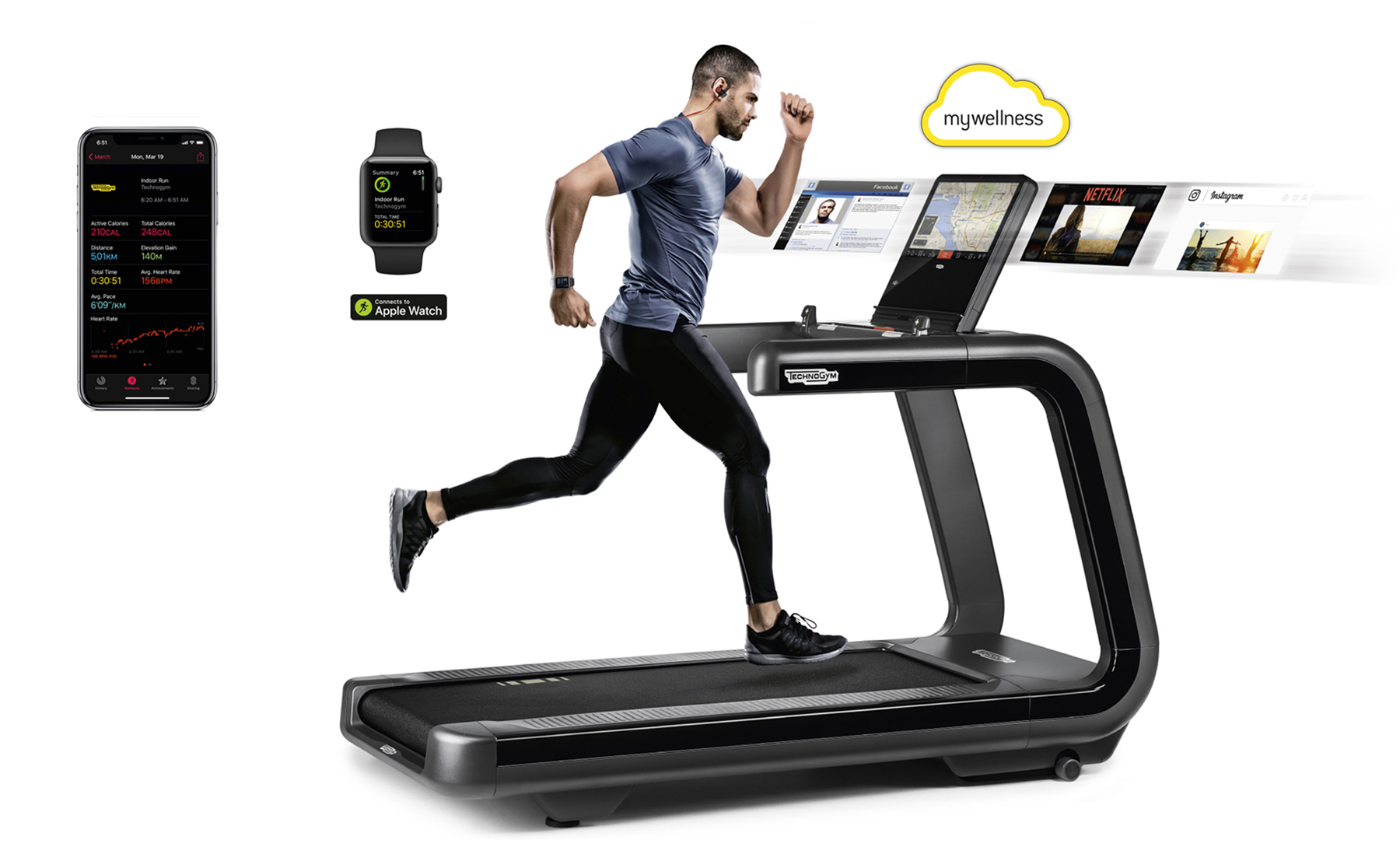
Mywellness connects workouts and analytics across multiple platforms
Blazing a digital trail
“After roles at Accenture and P&G, I joined Technogym in July 2006 as international trade marketing manager,” Arlotti explains. “I later became solutions manager for the health club sector, and it was in this role that digital emerged as a passion, ultimately leading to my appointment as head of digital solutions in 2012.
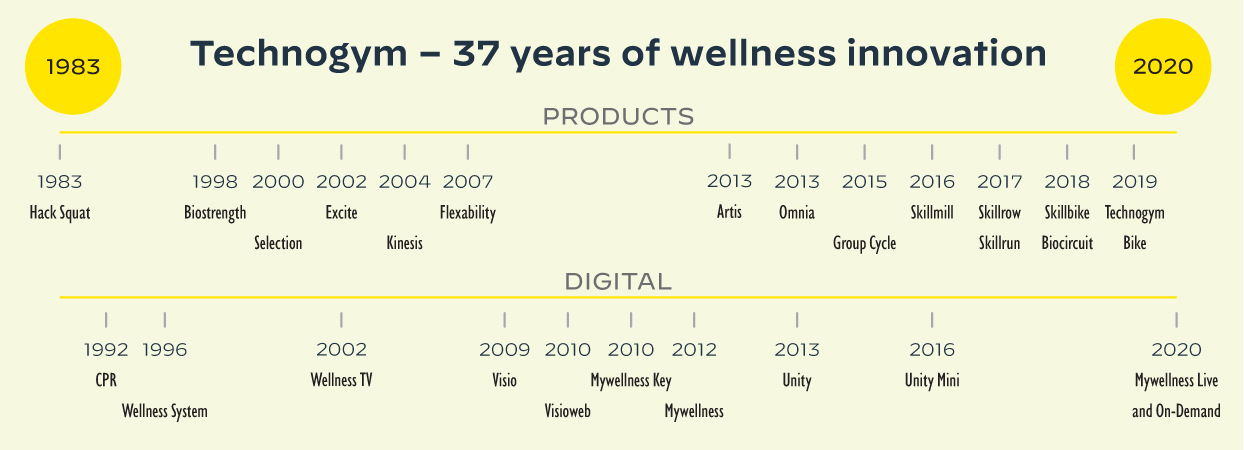
“It’s important to recognise Technogym’s history in this field: it was 1996 when the company founded a team in Seattle and launched Wellness System. Trainers could design and upload personalised programmes onto Wellness Keys; the equipment would automatically set the appropriate speed, load and/or reps when a key was inserted; and results could be downloaded at the end of the workout.
This doesn’t sound ground-breaking now, but back in 1996 nobody had yet asked for this. It was a true innovation.
“The market has changed since then, with digital becoming more important. But just because you’re market leader for phase one, doesn’t mean you’ll still be market leader through the second, third and subsequent phases.
Nokia is an example. It was market leader, but as the market moved on, it failed to understand the point was having your apps with you all the time.
“Technogym didn’t fall into this trap. We realised the world was changing and needed a new digital proposition that followed people wherever they were, embracing movement in the gym, at home, at work and on the way to work. In 2012, we therefore launched our ‘Wellness on the Go’ mywellness cloud solution.
“But with digital, nothing stands still. We continually evolve and develop mywellness cloud. In April 2020, for example, we introduced real-time analytics, so you can see what your members – and even sub-sets of your members – are doing, when, what equipment they’re using, even what they like.”
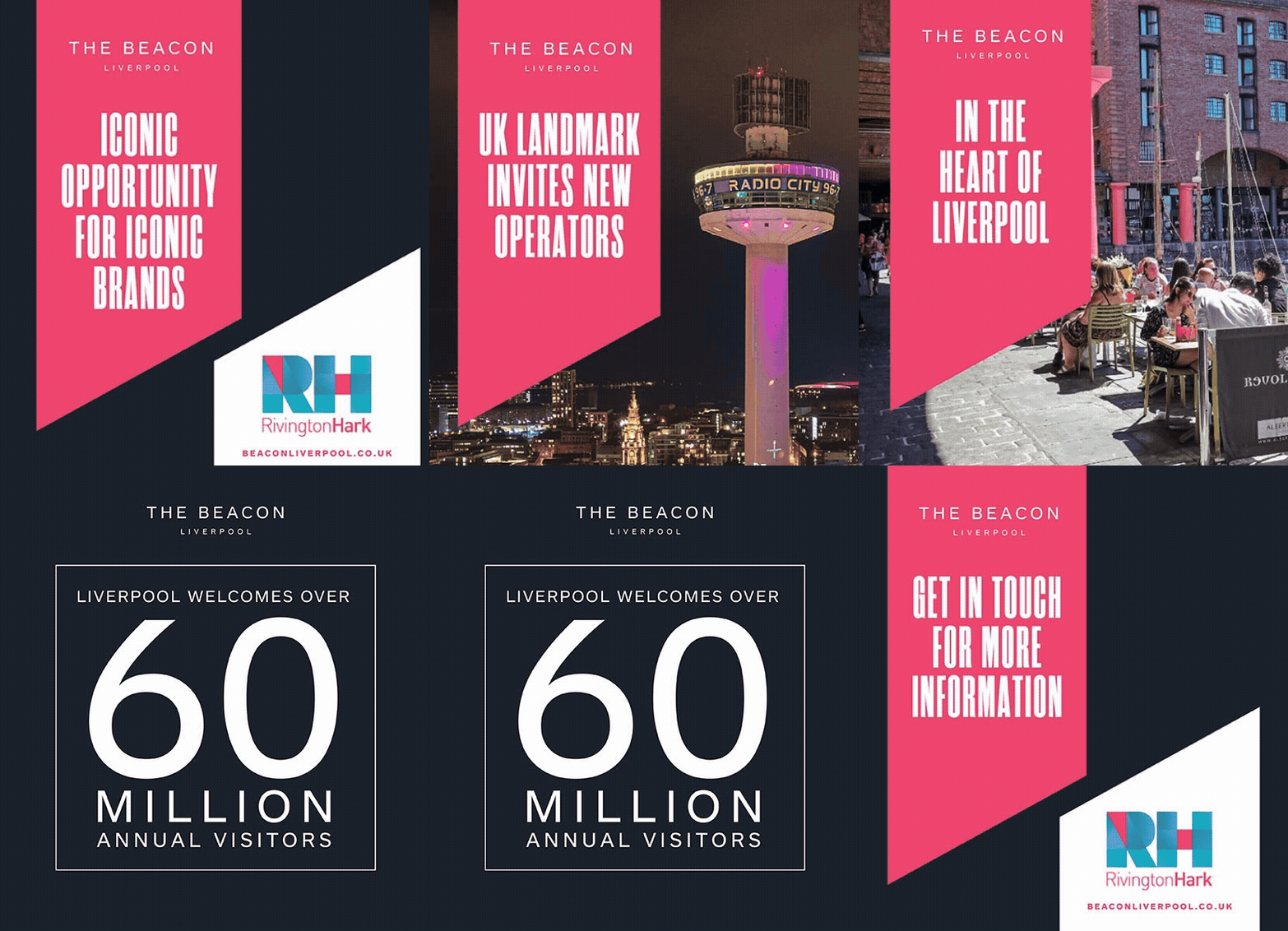
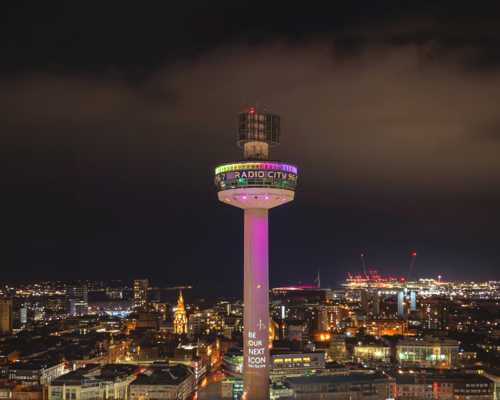
An opportunity to reimagine one of the UK’s most recognisable towers has been formally
opened by Rivington Hark, as St Johns Beacon invites operators and partners to shape its
next phase. [more...]
In these strange times, we have a chance to engage more
people in fitness and wellbeing, but it will require great flexibility
and creativity. Francesco Arlotti, Technogym’s global head of sales
for digital solutions, talks to Kate Cracknell
By Kate Cracknell | Published in Fit Tech 2020 issue 2
Francesco Arlotti, Technogym’s global head of sales
for digital solutions
How do you feel the pandemic has impacted our sector? The first thing to say is this: What’s happened over recent months, in terms of the digitisation of the fitness sector, hasn’t only happened because of COVID-19. It was going to happen anyway. The crisis has simply accelerated the sector’s digital transformation.
I sometimes make myself unpopular saying this – it’s hard when a lot of operators are still struggling – but I, therefore, see this crisis as an opportunity. It has thrown a spotlight on why our penetration rates were stagnating. It has forced us to think out of the box and be more creative in meeting customers’ needs.
It has confirmed what was already true: that an exclusively offline model is not a good option. Neither is exclusively online: people want community and other people. But there does need to be a blend, because consumers are already digitally addicted. They’re already there, waiting for us to catch up, and we needed to respond or risk them seeking out a pure consumer solution.
That’s why I see COVID-19 as an opportunity. It has accelerated us towards a destination we needed to reach anyway. It has given us a boost and a chance to reinvent this fantastic industry. And as a huge added bonus, it has given consumers a far greater appreciation of good physical and mental health – and with it, handed us a far more receptive audience.
However, it will only be an opportunity if we understand what consumers want – if we focus on their needs rather than ours – and if we steer away from commoditising our product.
How have you been supporting customers through the COVID crisis? We’ve adopted a phased approach. Phase one was about helping our clients support their customers in training at home, with online solutions people could use during lockdown.
Phase two has been focusing on building confidence among members, by allowing them to book absolutely everything online – not just classes but everything in the club – based on strict capacity limits. We’ve been working hard on this recently, helping operators map out all their spaces, so members feel safe.
Phase three is business model evolution, helping operators build on what they’ve done during lockdown to develop a seamless online/offline offering.
We’ve also launched new upgrades for Mywellness, designed to help operators move into phase three. Firstly, we’ve introduced a library of virtual on-demand classes created by Technogym; if operators also want to upload their own signature classes for their members, they can do that too. Also launching is Coach Live video chat: live streaming of classes where instructors can also see the people training at home, allowing them to feed back on technique and so on.
All of this is alongside the existing functionality on Mywellness, from exercise prescription and body assessment to challenges, communication and class booking and rating. The new modules are there to complement all of this and ensure operators have the right software platform to thrive in the new normal.
What is your advice for operators as we begin to emerge from lockdown? Firstly, fitness clubs and home fitness are not competitors. People are getting accustomed to training both at home and in clubs.
Recent UK research found that 12 per cent of respondents plan to work out from home after lockdown, while 50 per cent said they would work out both from home and in their club or fitness centre.
Home is a safe space for people: those with safety concerns around COVID-19, as well as those who haven’t used a gym before. Don’t fight the safe space, rather, be in alliance with it. The new model is a blend of offline (clubs) and online (digital) – a model we call ‘phygital’.
Second, help rebuild people’s confidence. Make your members feel secure and ready to come back to your facilities.
Third, don’t go back to your old ways. Don’t see what you’ve done during lockdown as a temporary solution. Build on it. Evolve it. I like to give the example of my favourite fish restaurant. During lockdown, it started to do home deliveries – a wonderful alternative to the usual junk food options. It has now re-opened, but it continues to offer home deliveries as an additional revenue stream.
Four, remember that a digital proposition can only be effectively monetised if it’s seamless.
What do you mean by seamless? Let me take a step back and explain that, at Technogym, we aim to provide solutions that on the one hand help operators overcome the challenges of adopting digital, and on the other allow them to provide members with personalised solutions.
There are two common scenarios we help operators avoid: trying to create a proprietary system, generally witnessed among the bigger club groups, which involves huge investment and lower ROI than they tend to expect; and cherry-picking a number of different platforms based on particular features you want, which results in a digital proposition that’s full of friction-points and hard for staff and members to handle.
We don’t sell features. Features in themselves don’t guarantee a seamless experience; we believe they’re consistently over-rated. Meanwhile, the journey tends to be under-rated when in fact this is what matters.
Let’s take the example of an iPhone compared to another cheaper phone that, in a feature-by-feature comparison, seems very similar. Why are people still willing to spend four times more to have an iPhone? It’s because of the experience once the phone is in people’s hands: the design, the fluency of the user experience, the seamlessness.
It’s why we sell a full proposition as a service: product, content, consultancy and activation support to ensure everyone – from the operator to every member of staff – understands the full journey, their role within it, and how to communicate it to members. Without this, operators will not achieve the successes they should from their digital investment.
How do you see membership structures working in this new world? We need to move our members away from free fitness content on Facebook and Instagram. Sharing for free on these platforms commoditises the service being offered by clubs – something from which it’s hard to come back. Operators need to work now on re-establishing a more regular relationship with members.
I believe if we put consumers at the centre and allow our creativity to spark, we will come up with brand new propositions.
We’ve already had customers, like Virgin Active, who’ve successfully used Mywellness to offer programmes and ‘Workouts of the Day’ during lockdown; there’s no reason why these operators might not now start to charge for content, as everything is already being delivered on their own platform.
We just need to be more flexible in the way we think about things. If we see the home as a class studio or workout space that just happens to be in a different location – a space into which clubs can extend their expertise via digital channels – then we can reach out to far more people, offering at-home and blended memberships, alongside more traditional packages.
What are Technogym’s digital plans and ambitions? Everything digital is accelerating so fast. As I said before, what’s happening isn’t because of COVID-19, but the virus has certainly accelerated things. What might otherwise have taken three to five years has happened in the space of a few months.
Our digital teams worked round the clock to create new solutions that work immediately. Tomorrow. Today even! And we’re still moving at this rapid pace to keep supporting operators through these difficult times. That’s the short-term view.
Looking at the mid- to long-term, our goal is to leverage the huge ecosystem we’ve created over the years across equipment, technology and activation in order to offer people relevant training experiences in line with their goals, personality and passions.
Today, 15 million people across 15,000 clubs globally are registered on Mywellness. It’s about helping operators stay connected to members, not only for the couple of hours a week they spend at the club but through an enduring relationship, 24/7.
Clubs have the real possibility to become wellness hubs – not only to incrementally improve their day-to-day business, but also to innovate their business model – for example, by interacting with insurance companies, medical organisations and the corporate world.
Technogym is continuing to invest in digital innovation – including digital training content, artificial intelligence functionality and mobile applications – with the goal of being a strategic partner creating real value for fitness operators in the long-term.
Innovation with a vision
Arlotti explains: “Technogym has a software development team of around 50 people, and about the same number again who are focused purely on equipment connectivity: with external membership software systems, with bioimpedance analysis platforms, with the most popular consumer fitness apps and devices to ensure we’re embracing overall wellbeing.
“It’s a complex process that takes in data from a wide range of sources. For the new mywellness platform release in April this year, for example, we analysed billions of anonymous clicks and data to gain insights into member behaviour. We assessed trends and market research, conducted by ourselves and by others, to understand how those behaviours might change. We listened to feedback; we’re in the privileged position of working with over 80,000 wellness centres across 100+ countries, so we can secure a lot of valuable input.
15 million people across 15,000 clubs globally are registered on Technogym’s Mywellness system. It’s about helping operators stay connected to their members 24/7
“But layered on top of all this, you still need a vision to which your R&D is linked; responding solely to requests could lead you to develop a product that’s obsolete even by the time it’s launched.
“At Technogym, our overarching vision is this: We want to take wellness to the highest possible number of people, creating a healthier world by supporting those who live in it to become healthier themselves.
“In digital terms, that translates into technology that takes wellness beyond the gym. It’s about supporting industry evolution so it isn’t just about gym membership any more, but also about taking the programmes, services and expertise of gyms out to people wherever they are.”
Mywellness connects workouts and analytics across multiple platforms
Blazing a digital trail
“After roles at Accenture and P&G, I joined Technogym in July 2006 as international trade marketing manager,” Arlotti explains. “I later became solutions manager for the health club sector, and it was in this role that digital emerged as a passion, ultimately leading to my appointment as head of digital solutions in 2012.
“It’s important to recognise Technogym’s history in this field: it was 1996 when the company founded a team in Seattle and launched Wellness System. Trainers could design and upload personalised programmes onto Wellness Keys; the equipment would automatically set the appropriate speed, load and/or reps when a key was inserted; and results could be downloaded at the end of the workout.
This doesn’t sound ground-breaking now, but back in 1996 nobody had yet asked for this. It was a true innovation.
“The market has changed since then, with digital becoming more important. But just because you’re market leader for phase one, doesn’t mean you’ll still be market leader through the second, third and subsequent phases.
Nokia is an example. It was market leader, but as the market moved on, it failed to understand the point was having your apps with you all the time.
“Technogym didn’t fall into this trap. We realised the world was changing and needed a new digital proposition that followed people wherever they were, embracing movement in the gym, at home, at work and on the way to work. In 2012, we therefore launched our ‘Wellness on the Go’ mywellness cloud solution.
“But with digital, nothing stands still. We continually evolve and develop mywellness cloud. In April 2020, for example, we introduced real-time analytics, so you can see what your members – and even sub-sets of your members – are doing, when, what equipment they’re using, even what they like.”
A new immersive attraction designed to transport visitors into the final hours of ancient Pompeii
is preparing to open near the world-famous archaeological site in southern Italy.
Experience design company, BRC Imagination Arts, has completed a transition that sees founder
Bob Rogers pass ownership of the business to four long-serving senior executives, while
remaining actively involved with the company.
Movie Park Germany has opened a new Paramount Pictures-themed attraction as part of its 30th
anniversary celebrations, using immersive storytelling and adaptive reuse to reinforce the park’s
longstanding “Hollywood in Germany” positioning.
Therme Manchester’s 28-acre development, which will include interconnected glass pavilions
that measure 65,000sq m, will be the largest bathing and wellbeing attraction in the world once
complete, according to prof David Russell, CEO of Therme UK.
Efteling has opened Hooghmoed, a new family drop tower designed to broaden the appeal of its
recently launched Sirene Island themed area and introduce younger visitors to thrill attractions.
A proposed Puy du Fou development near Bicester and Universal Destinations and Experiences’
planned resort in Bedford are emerging as part of a wider transformation of the Oxford–
Cambridge Growth Corridor into a major centre for UK leisure and tourism inv
Shedd Aquarium has opened the Immersion Theater developed in partnership with SimEx-
Iwerks, as part of a wider strategy to enhance the guest experience and create additional
revenue opportunities.
The UK government has announced a temporary reduction in VAT on visitor attractions and
children’s meals as part of a summer cost-of-living support package designed to stimulate the
visitor economy and encourage family days out.
As designer Yinka Ilori prepares for his first solo gallery show in London, he speaks exclusively
to CLADmag about his mission to spread joy, the power of play, and his bold approach to using
colour (including the colours you won’t see in his work).
The government of Thailand is exploring plans for a THB300bn (£6.3bn, US$8.3bn)
entertainment complex in the country’s Eastern Economic Corridor (EEC), with officials
proposing a large-scale theme park and sports destination as part of a broader tourism and
economic development strategy.
An opportunity to reimagine one of the UK’s most recognisable towers has been formally
opened by Rivington Hark, as St Johns Beacon invites operators and partners to shape its
next phase. [more...]