French-Brazilian architect Elizabeth de Portzamparc designed the museum
Musée de la Romanité has opened in a futuristic new building in Nîmes, France – in contrast to the Roman amphitheatre next door.
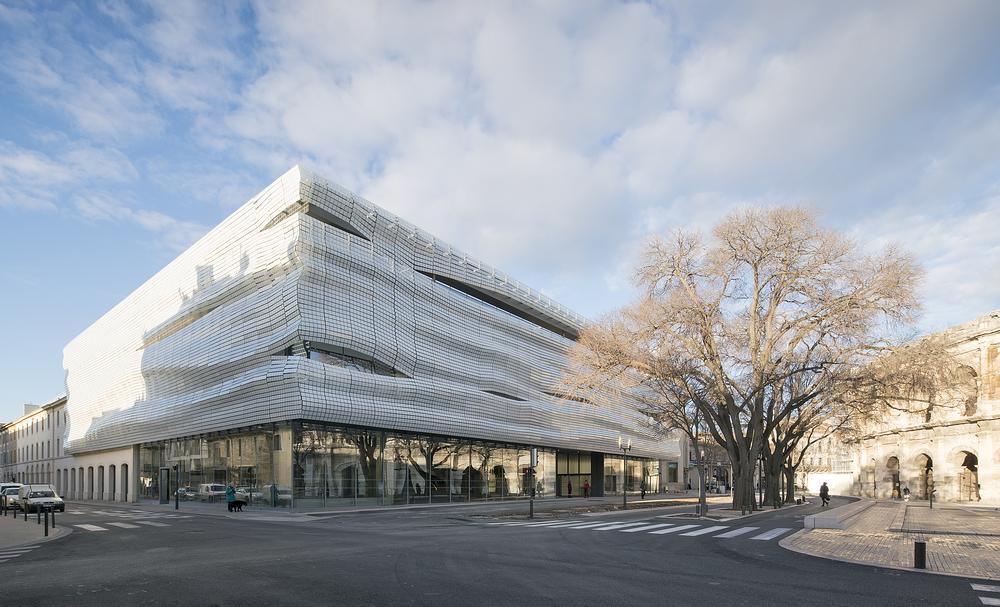
Architect Elizabeth de Portzamparc is behind the striking, fluid design, which seeks to contrast the ancient heritage of the Arena of Nîmes amphitheatre with contemporary architecture.
The museum has a transparent ground floor from which visitors can view the arena, topped by a shimmering glass façade. From a distance, the building appears to be hovering above the ground.
“The Musée de la Romanité is the smallest of the public facilities I’ve worked on or am working on. It is nonetheless the most symbolic one and concentrates a great number of reflections and concepts that have always guided my work,” de Portzamparc told CLAD.
“It’s a good example of urban and very open architecture, a building designed for a precise site, for the city and its inhabitants. It’s a symbol of what I call urban architecture.”
Describing the fluid, rippling façade, de Portzamparc said: “The soft and horizontal undulations, the predominance of glass, the transparency and the lightness contrast with the verticality of the arena’s stone arches and the imposing mass that has stood there for nearly two millennia.
“As a result, on one side of the site, there is a large cylindrical volume surrounded by the Roman arches; on the other, a large square volume, which seems to be floating and entirely draped in a toga of pleated glass.”
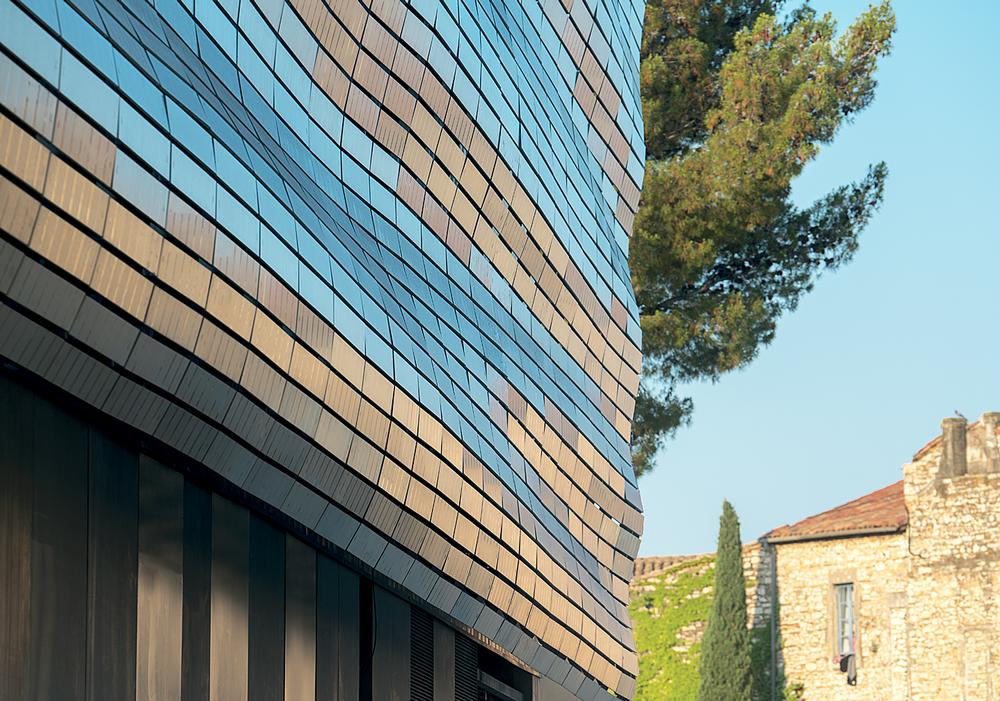
The distinctive exterior supports 6,708 glass strips across a surface of 2,500sq m (27,000sq ft). Each holds seven screen-printed square tiles, created to evoke the Roman mosaics exhibited inside the museum and to create a sense of movement through the changing reflections of light during the day.
Inside, slender columns are distributed to maximise exhibition spaces and to form a monolithic ensemble without expansion joints. The flat surfaces of the interior simplify the primary building structure, allowing for free expression of the curves in the glass panels on the exterior.
In addition to galleries dedicated to Roman history in the city, there is a 180-capacity auditorium, a bookshop, a documentation centre, a restaurant, a café and 3,400sq m (36,600sq ft) of gardens. A roof terrace offers visitors a panoramic view over the entire city, with the arena in the foreground.
The building is complete and the museum’s opening is scheduled for June. It will exhibit 5,000 works, out of a collection of around 25,000 pieces.
The museum has been built to anchor the city’s cultural expansion, attracting tourists from home and abroad. The metropolitan government has provided €35.8m (US$42m, £32m) of the project’s total €59.5m (US$70m, £53m) budget.
An opportunity to reimagine one of the UK’s most recognisable towers has been formally
opened by Rivington Hark, as St Johns Beacon invites operators and partners to shape its
next phase. [more...]
French-Brazilian architect Elizabeth de Portzamparc designed the museum
Musée de la Romanité has opened in a futuristic new building in Nîmes, France – in contrast to the Roman amphitheatre next door.
Architect Elizabeth de Portzamparc is behind the striking, fluid design, which seeks to contrast the ancient heritage of the Arena of Nîmes amphitheatre with contemporary architecture.
The museum has a transparent ground floor from which visitors can view the arena, topped by a shimmering glass façade. From a distance, the building appears to be hovering above the ground.
“The Musée de la Romanité is the smallest of the public facilities I’ve worked on or am working on. It is nonetheless the most symbolic one and concentrates a great number of reflections and concepts that have always guided my work,” de Portzamparc told CLAD.
“It’s a good example of urban and very open architecture, a building designed for a precise site, for the city and its inhabitants. It’s a symbol of what I call urban architecture.”
Describing the fluid, rippling façade, de Portzamparc said: “The soft and horizontal undulations, the predominance of glass, the transparency and the lightness contrast with the verticality of the arena’s stone arches and the imposing mass that has stood there for nearly two millennia.
“As a result, on one side of the site, there is a large cylindrical volume surrounded by the Roman arches; on the other, a large square volume, which seems to be floating and entirely draped in a toga of pleated glass.”
The distinctive exterior supports 6,708 glass strips across a surface of 2,500sq m (27,000sq ft). Each holds seven screen-printed square tiles, created to evoke the Roman mosaics exhibited inside the museum and to create a sense of movement through the changing reflections of light during the day.
Inside, slender columns are distributed to maximise exhibition spaces and to form a monolithic ensemble without expansion joints. The flat surfaces of the interior simplify the primary building structure, allowing for free expression of the curves in the glass panels on the exterior.
In addition to galleries dedicated to Roman history in the city, there is a 180-capacity auditorium, a bookshop, a documentation centre, a restaurant, a café and 3,400sq m (36,600sq ft) of gardens. A roof terrace offers visitors a panoramic view over the entire city, with the arena in the foreground.
The building is complete and the museum’s opening is scheduled for June. It will exhibit 5,000 works, out of a collection of around 25,000 pieces.
The museum has been built to anchor the city’s cultural expansion, attracting tourists from home and abroad. The metropolitan government has provided €35.8m (US$42m, £32m) of the project’s total €59.5m (US$70m, £53m) budget.
Hotel de France, located on the British Isle of Jersey, has created a wellness retreat package
that includes a hot yoga session that will take place in Jersey Zoo’s butterfly sanctuary.
A new immersive attraction designed to transport visitors into the final hours of ancient Pompeii
is preparing to open near the world-famous archaeological site in southern Italy.
Experience design company, BRC Imagination Arts, has completed a transition that sees founder
Bob Rogers pass ownership of the business to four long-serving senior executives, while
remaining actively involved with the company.
Movie Park Germany has opened a new Paramount Pictures-themed attraction as part of its 30th
anniversary celebrations, using immersive storytelling and adaptive reuse to reinforce the park’s
longstanding “Hollywood in Germany” positioning.
Therme Manchester’s 28-acre development, which will include interconnected glass pavilions
that measure 65,000sq m, will be the largest bathing and wellbeing attraction in the world once
complete, according to prof David Russell, CEO of Therme UK.
Efteling has opened Hooghmoed, a new family drop tower designed to broaden the appeal of its
recently launched Sirene Island themed area and introduce younger visitors to thrill attractions.
A proposed Puy du Fou development near Bicester and Universal Destinations and Experiences’
planned resort in Bedford are emerging as part of a wider transformation of the Oxford–
Cambridge Growth Corridor into a major centre for UK leisure and tourism inv
Shedd Aquarium has opened the Immersion Theater developed in partnership with SimEx-
Iwerks, as part of a wider strategy to enhance the guest experience and create additional
revenue opportunities.
The UK government has announced a temporary reduction in VAT on visitor attractions and
children’s meals as part of a summer cost-of-living support package designed to stimulate the
visitor economy and encourage family days out.
As designer Yinka Ilori prepares for his first solo gallery show in London, he speaks exclusively
to CLADmag about his mission to spread joy, the power of play, and his bold approach to using
colour (including the colours you won’t see in his work).
The government of Thailand is exploring plans for a THB300bn (£6.3bn, US$8.3bn)
entertainment complex in the country’s Eastern Economic Corridor (EEC), with officials
proposing a large-scale theme park and sports destination as part of a broader tourism and
economic development strategy.
+ More news
COMPANY PROFILES
IDEATTACK IDEATTACK is a full-service planning and
design company with headquarters in
Los Angeles. [more...]
An opportunity to reimagine one of the UK’s most recognisable towers has been formally
opened by Rivington Hark, as St Johns Beacon invites operators and partners to shape its
next phase. [more...]