Latest
issue
Get Attractions Management digital magazine FREE
Sign up here ▸
Jobs   News   Features   Products   Company profilesProfiles   Magazine   Handbook   Advertise    Subscribe  
NEWS
'Eurocentric' science centres hindering education in STEM for black youths
POSTED 15 Jun 2016 . BY Tom Anstey
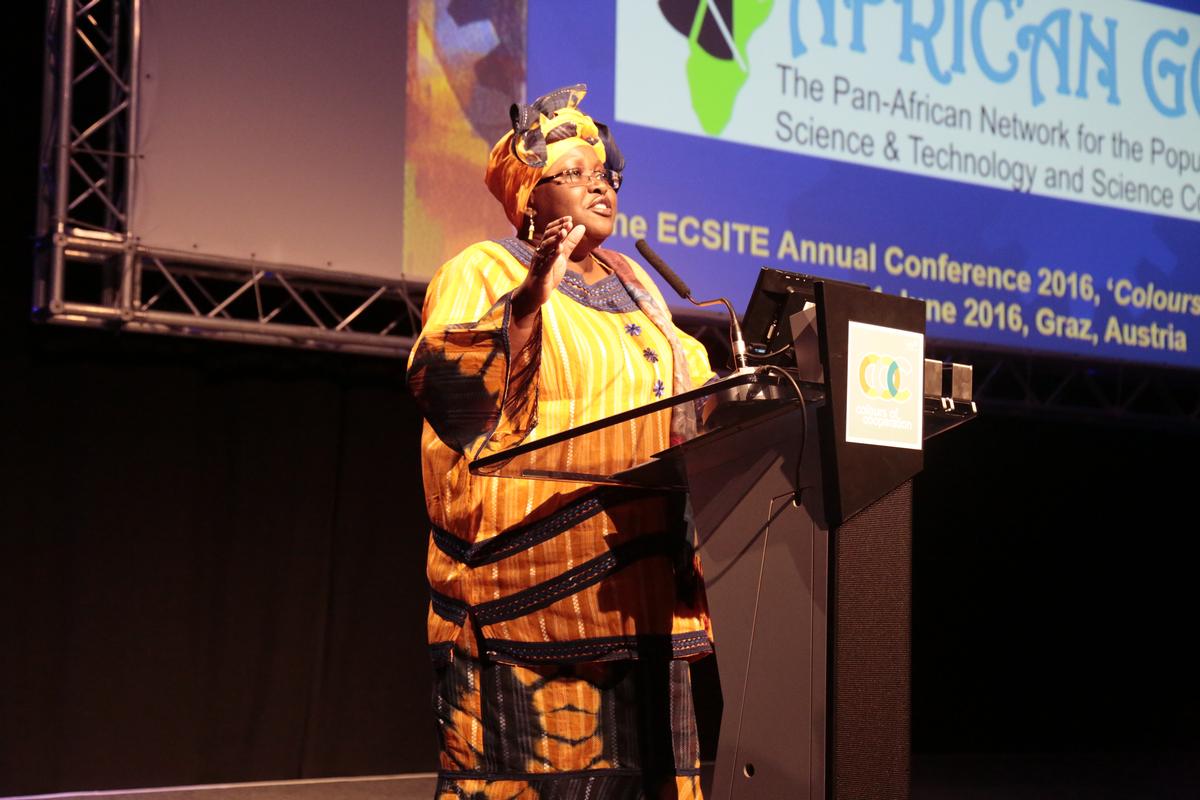
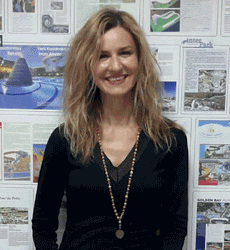
Rasekoala addressed 1,000 Ecsite members at the annual conference taking place this year in Graz, Austria Credit: Ecsite
One of Africa’s leading scientists has called for science centres across the world to address a Eurocentric model excluding many young black people from pursuing interest and potential careers in STEM subjects.

Delivering the keynote address at last week’s Ecsite conference in Graz, Austria, Dr Elizabeth Rasekoala, president of the Pan-African Network for the Popularisation of Science and Technology (Gong), recounted her first Ecsite in 1995 when just a handful of people attended the event.

“We barely filled a room in King’s College in London back then,” she said to the 1,000+ delegates in attendance. “Those were the days full of excitement. I remember that conference and I remember asking myself two questions. First I asked how long will it take before we have more women in the room and it is good to see that that has been question answered well. The second question was how long would it be before I am no longer the only black person in the room? That has still not been answered, that’s on your major to do list.”

Rasekoala went on to share global science centre and science museum visitor statistics, with one in every 1,900 people in Africa visiting such an institution compared to the UK where the figure was significantly lower at one in four. According to Rasekoala, the European education system tells a similar story.

“We see European STEM education welcoming graduates from developing countries, yet they cannot deliver the same progression for local students from those same backgrounds,” she said. “I found myself as a postgraduate African student dealing with a perverse dichotomy of a university department that supported me and my aspirations and yet at a children’s primary school, they are deemed to be underachieving black youths who can only excel in sports and music. You are living with this sort of schizophrenia in society. How do we explain that?”

Rasekoala said that science centres in Europe had failed to deliver a socially-inclusive model, something that was demonstrated by the upcoming UK/EU referendum.

“It’s not surprising that when you look at the UK/EU referendum debate that many ethnic minorities are backing the leave camp because they see the European narrative as toxic and disingenuous and they do not see how it’s going to improve their integration and advancement in the UK, they want out and I find that really sad because I am a great believer in the European project but we must have the courage to take it as far as it can go and not sit in the comfort zone. That’s the globalisation challenge.

“The future wellbeing of science centres and museums will greatly depend on the extent to which today’s institutions are willing to respond to key dynamics which are influencing people’s key decisions, including how and where they learn, whether they wish to learn science and technology or not, and how and when they enjoy their leisure time.”

Rasekoala added that the Eurocentric approach to science has had a trickledown effect in Africa, creating a vicious cycle of inequality that is being replicated worldwide.

“Within the African context we can see the global footprint of these inequalities,” she said. “Somewhat ironically, the contamination of this Eurocentric approach means that in Africa we have African scientists marginalised and so aware of being marginalised that when they go back home they perpetrate the same inequalities. It’s like children who’ve been abused who grow up and become abusers. That’s what we are creating, we are exporting Eurocentrism.

“The STEM and science sectors in Africa are no different. We still have the same inequalities of race, ethnicity, social class and gender, with a huge divide between where Africans are, where the ordinary people are and where the scientists are. This challenge is global and we must work together to address and create a global platform of transformation. This is an equal opportunity failure, we have all failed, period.

“Even in South Africa where we have the most science centres on the continent and where 90 per cent of the population are black Africans, you’ll be shocked to know that less than 5 per cent of visitors to science centres and science museums are black Africans – and that’s in 2016.”

Concluding her keynote, Rasekoala said the Ecsite and the network of global science centres should urgently address the issue, reshaping science to educate with a truly global approach that encourages all to take up science and STEM subjects.

“Science as it is taught, researched, practised and disseminated today is riddled with Eurocentric cultural perspectives and yet it was not always like this. We forget about the roots of science,” she said.

“I want to leave you with my humble recommendation that we move away from projects and look at the Ecsite leadership, the field adopting a transformational and dynamic, diversity, equity and inclusion framework to be endorsed by all science centres and museums as a good practice template for their operations and to be utilised as a practical toolkit for achieving social inclusion. What are the parameters that should be included? It’s up to you to work out but to me these are the key points. This is place where the dead bodies are buried and this is where we’re going to have to dig them up if we want to make change.”
RELATED STORIES
  Ecsite president urges members to fight fear with inclusion


Ecsite president Michiel Buchel has told the science network’s members to take a stand against fear and show all of Europe that inclusion can be far stronger a force than “looking for enemies that are often not really there.”
  Ecsite 2016: Use space to encourage future careers in STEM


Leading Danish scientist Tina Ibsen has called for planetariums and science museums to use a re-emerging popularity in space to draw young people into STEM careers.
  Ecsite 2016: UNESCO backs first world science centre day, coming in November


Ecsite and UNESCO are teaming up to introduce the first ever International Science Centre and Science Museum Day (ISCSMD), coming later this year.
  Austrian President Heinz Fischer opens Ecsite 2016


Austria’s President Heinz Fischer has officially launched this year’s Ecsite conference in Graz, addressing delegates ahead of three days of exploratory talks and session on science centres.
MORE NEWS
Warner Bros Discovery collaborates on upcoming Pompeii attraction
A new immersive attraction designed to transport visitors into the final hours of ancient Pompeii is preparing to open near the world-famous archaeological site in southern Italy.
Bob Rogers hands BRC to long-serving leadership team
Experience design company, BRC Imagination Arts, has completed a transition that sees founder Bob Rogers pass ownership of the business to four long-serving senior executives, while remaining actively involved with the company.
Rainer Maelzer joins Therme Group as chief entertainment officer
Rainer Maelzer, an experiential entertainment innovator, has been appointed chief entertainment officer by Therme Group.
Movie Park Germany reveals new Paramount attraction as part of its 30th anniversary celebrations
Movie Park Germany has opened a new Paramount Pictures-themed attraction as part of its 30th anniversary celebrations, using immersive storytelling and adaptive reuse to reinforce the park’s longstanding “Hollywood in Germany” positioning.
+ More news   

COMPANY PROFILES
IAAPA EMEA

IAAPA Expo Europe was established in 2006 and has grown to the largest international conference and [more...]
TechnoAlpin Indoor

TechnoAlpin is the world leader for snowmaking systems. With the Indoor snow division, TechnoAlpin c [more...]
Alterface

Alterface’s Creative Division team is seasoned in concept and ride development, as well as storyte [more...]
Polin Waterparks

Polin was founded in Istanbul in 1976. Polin has since grown into a leading company in the waterpa [more...]
+ More profiles  
FEATURED SUPPLIER

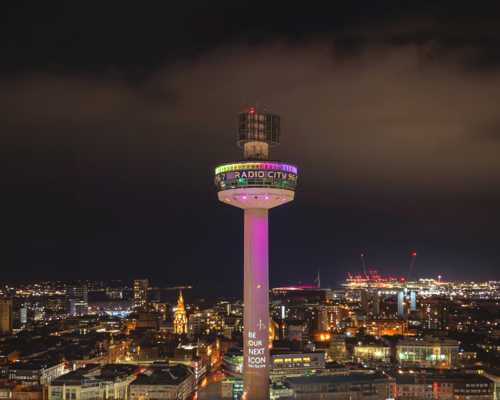
Iconic Liverpool attraction opens door to new operators
An opportunity to reimagine one of the UK’s most recognisable towers has been formally opened by Rivington Hark, as St Johns Beacon invites operators and partners to shape its next phase. [more...]
CATALOGUE GALLERY
 

+ More catalogues  
DIRECTORY
+ More directory  
DIARY


09-11 Jun 2026

World Sauna Forum 2026

Savutuvan Apaja, Haapaniemi, Finland
23-26 Aug 2026

Elevate Spa Riviera Maya Edition

The Riviera Maya Edition Kanai, Playa del Carmen, Mexico
+ More diary  
LATEST ISSUES
+ View Magazine Archive

Attractions Management

2026 issue 1


View issue contents
View on turning pages
Download PDF
FREE digital subscription
Print subscription

Attractions Management

2025 issue 2


View issue contents
View on turning pages
Download PDF
FREE digital subscription
Print subscription

Attractions Management

2025 issue 1


View issue contents
View on turning pages
Download PDF
FREE digital subscription
Print subscription

Attractions Management

2024 issue 4


View issue contents
View on turning pages
Download PDF
FREE digital subscription
Print subscription

Attractions Management News

06 Apr 2020 issue 153


View on turning pages
Download PDF
View archive
FREE digital subscription
Print subscription

Attractions Handbook

2019


View issue contents
View on turning pages
Download PDF
FREE digital subscription
Print subscription
 
ABOUT LEISURE MEDIA
LEISURE MEDIA MAGAZINES
LEISURE MEDIA HANDBOOKS
LEISURE MEDIA WEBSITES
LEISURE MEDIA PRODUCT SEARCH
 
ATTRACTIONS MANAGEMENT
ATTRACTIONS MANAGEMENT NEWS
ATTRACTIONS HANDBOOK
PRINT SUBSCRIPTIONS
FREE DIGITAL SUBSCRIPTIONS
ADVERTISE . CONTACT US

Leisure Media
Tel: +44 (0)1462 431385

©Cybertrek 2026
Get Attractions Management digital magazine FREE
Sign up here ▸
Jobs    News   Products   Magazine   Subscribe
NEWS
'Eurocentric' science centres hindering education in STEM for black youths
POSTED 15 Jun 2016 . BY Tom Anstey
Rasekoala addressed 1,000 Ecsite members at the annual conference taking place this year in Graz, Austria Credit: Ecsite
One of Africa’s leading scientists has called for science centres across the world to address a Eurocentric model excluding many young black people from pursuing interest and potential careers in STEM subjects.

Delivering the keynote address at last week’s Ecsite conference in Graz, Austria, Dr Elizabeth Rasekoala, president of the Pan-African Network for the Popularisation of Science and Technology (Gong), recounted her first Ecsite in 1995 when just a handful of people attended the event.

“We barely filled a room in King’s College in London back then,” she said to the 1,000+ delegates in attendance. “Those were the days full of excitement. I remember that conference and I remember asking myself two questions. First I asked how long will it take before we have more women in the room and it is good to see that that has been question answered well. The second question was how long would it be before I am no longer the only black person in the room? That has still not been answered, that’s on your major to do list.”

Rasekoala went on to share global science centre and science museum visitor statistics, with one in every 1,900 people in Africa visiting such an institution compared to the UK where the figure was significantly lower at one in four. According to Rasekoala, the European education system tells a similar story.

“We see European STEM education welcoming graduates from developing countries, yet they cannot deliver the same progression for local students from those same backgrounds,” she said. “I found myself as a postgraduate African student dealing with a perverse dichotomy of a university department that supported me and my aspirations and yet at a children’s primary school, they are deemed to be underachieving black youths who can only excel in sports and music. You are living with this sort of schizophrenia in society. How do we explain that?”

Rasekoala said that science centres in Europe had failed to deliver a socially-inclusive model, something that was demonstrated by the upcoming UK/EU referendum.

“It’s not surprising that when you look at the UK/EU referendum debate that many ethnic minorities are backing the leave camp because they see the European narrative as toxic and disingenuous and they do not see how it’s going to improve their integration and advancement in the UK, they want out and I find that really sad because I am a great believer in the European project but we must have the courage to take it as far as it can go and not sit in the comfort zone. That’s the globalisation challenge.

“The future wellbeing of science centres and museums will greatly depend on the extent to which today’s institutions are willing to respond to key dynamics which are influencing people’s key decisions, including how and where they learn, whether they wish to learn science and technology or not, and how and when they enjoy their leisure time.”

Rasekoala added that the Eurocentric approach to science has had a trickledown effect in Africa, creating a vicious cycle of inequality that is being replicated worldwide.

“Within the African context we can see the global footprint of these inequalities,” she said. “Somewhat ironically, the contamination of this Eurocentric approach means that in Africa we have African scientists marginalised and so aware of being marginalised that when they go back home they perpetrate the same inequalities. It’s like children who’ve been abused who grow up and become abusers. That’s what we are creating, we are exporting Eurocentrism.

“The STEM and science sectors in Africa are no different. We still have the same inequalities of race, ethnicity, social class and gender, with a huge divide between where Africans are, where the ordinary people are and where the scientists are. This challenge is global and we must work together to address and create a global platform of transformation. This is an equal opportunity failure, we have all failed, period.

“Even in South Africa where we have the most science centres on the continent and where 90 per cent of the population are black Africans, you’ll be shocked to know that less than 5 per cent of visitors to science centres and science museums are black Africans – and that’s in 2016.”

Concluding her keynote, Rasekoala said the Ecsite and the network of global science centres should urgently address the issue, reshaping science to educate with a truly global approach that encourages all to take up science and STEM subjects.

“Science as it is taught, researched, practised and disseminated today is riddled with Eurocentric cultural perspectives and yet it was not always like this. We forget about the roots of science,” she said.

“I want to leave you with my humble recommendation that we move away from projects and look at the Ecsite leadership, the field adopting a transformational and dynamic, diversity, equity and inclusion framework to be endorsed by all science centres and museums as a good practice template for their operations and to be utilised as a practical toolkit for achieving social inclusion. What are the parameters that should be included? It’s up to you to work out but to me these are the key points. This is place where the dead bodies are buried and this is where we’re going to have to dig them up if we want to make change.”

RELATED STORIES
Ecsite president urges members to fight fear with inclusion


Ecsite president Michiel Buchel has told the science network’s members to take a stand against fear and show all of Europe that inclusion can be far stronger a force than “looking for enemies that are often not really there.”

Ecsite 2016: Use space to encourage future careers in STEM


Leading Danish scientist Tina Ibsen has called for planetariums and science museums to use a re-emerging popularity in space to draw young people into STEM careers.
Ecsite 2016: UNESCO backs first world science centre day, coming in November


Ecsite and UNESCO are teaming up to introduce the first ever International Science Centre and Science Museum Day (ISCSMD), coming later this year.
Austrian President Heinz Fischer opens Ecsite 2016


Austria’s President Heinz Fischer has officially launched this year’s Ecsite conference in Graz, addressing delegates ahead of three days of exploratory talks and session on science centres.
MORE NEWS
Warner Bros Discovery collaborates on upcoming Pompeii attraction
A new immersive attraction designed to transport visitors into the final hours of ancient Pompeii is preparing to open near the world-famous archaeological site in southern Italy.
Bob Rogers hands BRC to long-serving leadership team
Experience design company, BRC Imagination Arts, has completed a transition that sees founder Bob Rogers pass ownership of the business to four long-serving senior executives, while remaining actively involved with the company.
Rainer Maelzer joins Therme Group as chief entertainment officer
Rainer Maelzer, an experiential entertainment innovator, has been appointed chief entertainment officer by Therme Group.
Movie Park Germany reveals new Paramount attraction as part of its 30th anniversary celebrations
Movie Park Germany has opened a new Paramount Pictures-themed attraction as part of its 30th anniversary celebrations, using immersive storytelling and adaptive reuse to reinforce the park’s longstanding “Hollywood in Germany” positioning.
Therme Manchester reveals 90:90 strategy – 90 per cent of the UK population within a 90-minute drive of a Therme
Therme Manchester’s 28-acre development, which will include interconnected glass pavilions that measure 65,000sq m, will be the largest bathing and wellbeing attraction in the world once complete, according to prof David Russell, CEO of Therme UK. 
Efteling expands family offer with new Hooghmoed drop tower
Efteling has opened Hooghmoed, a new family drop tower designed to broaden the appeal of its recently launched Sirene Island themed area and introduce younger visitors to thrill attractions.
+ More news   
 
COMPANY PROFILES
IAAPA EMEA

IAAPA Expo Europe was established in 2006 and has grown to the largest international conference and [more...]
TechnoAlpin Indoor

TechnoAlpin is the world leader for snowmaking systems. With the Indoor snow division, TechnoAlpin c [more...]
Alterface

Alterface’s Creative Division team is seasoned in concept and ride development, as well as storyte [more...]
Polin Waterparks

Polin was founded in Istanbul in 1976. Polin has since grown into a leading company in the waterpa [more...]
+ More profiles  
FEATURED SUPPLIER

Iconic Liverpool attraction opens door to new operators
An opportunity to reimagine one of the UK’s most recognisable towers has been formally opened by Rivington Hark, as St Johns Beacon invites operators and partners to shape its next phase. [more...]
CATALOGUE GALLERY
+ More catalogues  
DIRECTORY
+ More directory  
DIARY


09-11 Jun 2026

World Sauna Forum 2026

Savutuvan Apaja, Haapaniemi, Finland
23-26 Aug 2026

Elevate Spa Riviera Maya Edition

The Riviera Maya Edition Kanai, Playa del Carmen, Mexico
+ More diary  


ADVERTISE . CONTACT US

Leisure Media
Tel: +44 (0)1462 431385

©Cybertrek 2026

ABOUT LEISURE MEDIA
LEISURE MEDIA MAGAZINES
LEISURE MEDIA HANDBOOKS
LEISURE MEDIA WEBSITES
LEISURE MEDIA PRODUCT SEARCH
ATTRACTIONS MANAGEMENT NEWS
ATTRACTIONS HANDBOOK
PRINT SUBSCRIPTIONS
FREE DIGITAL SUBSCRIPTIONS