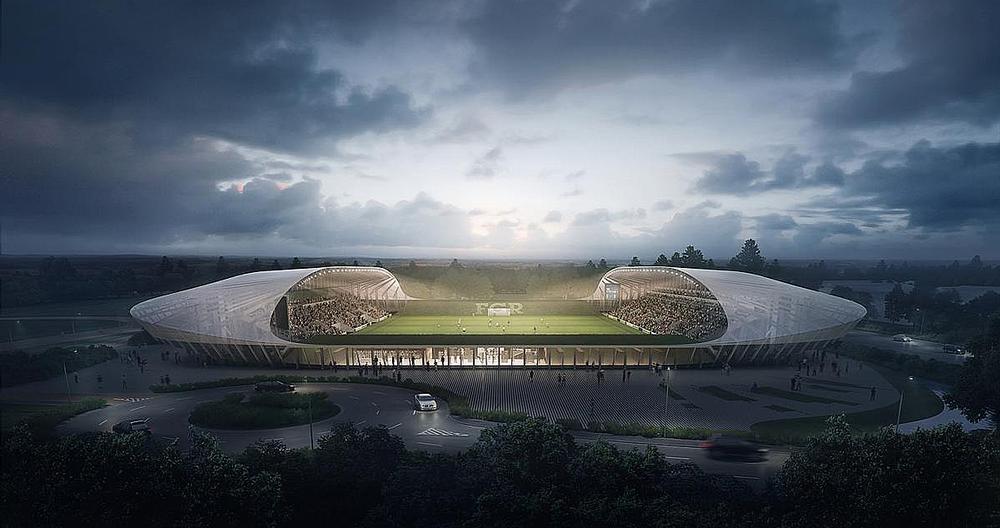
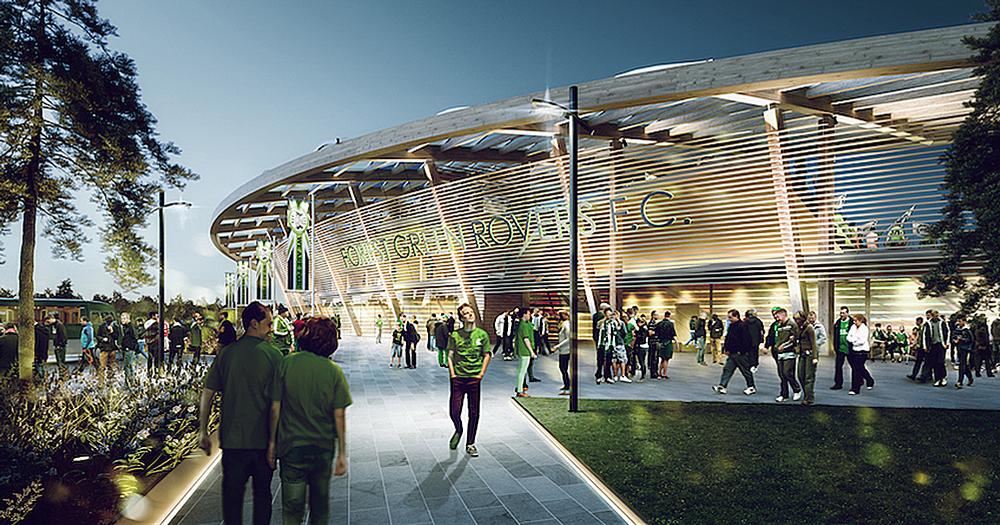
The owner of National League football team Forest Green Rovers hopes the club’s ambitious stadium plans will act as a catalyst for the development of more eco-friendly sports facilities.
After tending out a brief to design the stadium earlier this year, Dale Vince and the Forest Green board have whittled the competition down to two firms – Glenn Howells and Zaha Hadid – from an original pool of 60.
Talking to Sports Management, Vince credited both designs as being economically and environmentally sustainable and called the project the first of its kind in the world.
Both designs have eschewed the use of carbon-based substances and concrete materials in construction. Vince suggested that wood may be used as the main material for the stadium, while the arena will use solar power to create its own energy and rainwater for the pitch irrigation system.
Vince – who is also the founder and owner of alternative energy company Ecotricity – said he hoped the development would be a catalyst for change in the way stadiums are designed and that a number of football clubs had been in touch to garner advice on environmental matters.
“We’ve been in conversations with Liverpool FC about electricity supply,” he said. “In return they have helped us develop a capability in-house to analyse players and match day stats to use in recruitment and performance analysis, so it’s a bit of a two-way street.
“Our success has been the catalyst for other energy companies to come down our path, and we want to do the same in football.”
The ambitions stretches beyond eco credentials, and the owner is convinced that the stadium will be the “best outside the Championship” – a league he envisages Forest Green will occupy in the not-too-distant future.
“We see this as a fundamental ingredient in the success of the club as we seek to move up the leagues into the Championship,” he added. “The 5,000-capacity is expandable up to 10,000, and maybe a few more once we find ourselves in the upper part of League One.”
The stadium is part of a larger £100m (US$131.6m, €118.6m) development which will include a business park and sports facilities, expected to accommodate up to 4,000 new jobs. The club will work with the local college to train people in the discipline of sports medicine and science and “create a real hub for sporting science”.
Glenn Howells and Zaha Hadid will find out if they have been successful in late September, and both have been asked to “give a little bit of thought” about how much the stadium will cost to build.
Vince revealed that the club was expecting to receive outline planning consent by November, and then submit a detailed plan to the council.
An opportunity to reimagine one of the UK’s most recognisable towers has been formally
opened by Rivington Hark, as St Johns Beacon invites operators and partners to shape its
next phase. [more...]
The owner of National League football team Forest Green Rovers hopes the club’s ambitious stadium plans will act as a catalyst for the development of more eco-friendly sports facilities.
After tending out a brief to design the stadium earlier this year, Dale Vince and the Forest Green board have whittled the competition down to two firms – Glenn Howells and Zaha Hadid – from an original pool of 60.
Talking to Sports Management, Vince credited both designs as being economically and environmentally sustainable and called the project the first of its kind in the world.
Both designs have eschewed the use of carbon-based substances and concrete materials in construction. Vince suggested that wood may be used as the main material for the stadium, while the arena will use solar power to create its own energy and rainwater for the pitch irrigation system.
Vince – who is also the founder and owner of alternative energy company Ecotricity – said he hoped the development would be a catalyst for change in the way stadiums are designed and that a number of football clubs had been in touch to garner advice on environmental matters.
“We’ve been in conversations with Liverpool FC about electricity supply,” he said. “In return they have helped us develop a capability in-house to analyse players and match day stats to use in recruitment and performance analysis, so it’s a bit of a two-way street.
“Our success has been the catalyst for other energy companies to come down our path, and we want to do the same in football.”
The ambitions stretches beyond eco credentials, and the owner is convinced that the stadium will be the “best outside the Championship” – a league he envisages Forest Green will occupy in the not-too-distant future.
“We see this as a fundamental ingredient in the success of the club as we seek to move up the leagues into the Championship,” he added. “The 5,000-capacity is expandable up to 10,000, and maybe a few more once we find ourselves in the upper part of League One.”
The stadium is part of a larger £100m (US$131.6m, €118.6m) development which will include a business park and sports facilities, expected to accommodate up to 4,000 new jobs. The club will work with the local college to train people in the discipline of sports medicine and science and “create a real hub for sporting science”.
Glenn Howells and Zaha Hadid will find out if they have been successful in late September, and both have been asked to “give a little bit of thought” about how much the stadium will cost to build.
Vince revealed that the club was expecting to receive outline planning consent by November, and then submit a detailed plan to the council.
A new immersive attraction designed to transport visitors into the final hours of ancient Pompeii
is preparing to open near the world-famous archaeological site in southern Italy.
Experience design company, BRC Imagination Arts, has completed a transition that sees founder
Bob Rogers pass ownership of the business to four long-serving senior executives, while
remaining actively involved with the company.
Movie Park Germany has opened a new Paramount Pictures-themed attraction as part of its 30th
anniversary celebrations, using immersive storytelling and adaptive reuse to reinforce the park’s
longstanding “Hollywood in Germany” positioning.
Therme Manchester’s 28-acre development, which will include interconnected glass pavilions
that measure 65,000sq m, will be the largest bathing and wellbeing attraction in the world once
complete, according to prof David Russell, CEO of Therme UK.
Efteling has opened Hooghmoed, a new family drop tower designed to broaden the appeal of its
recently launched Sirene Island themed area and introduce younger visitors to thrill attractions.
A proposed Puy du Fou development near Bicester and Universal Destinations and Experiences’
planned resort in Bedford are emerging as part of a wider transformation of the Oxford–
Cambridge Growth Corridor into a major centre for UK leisure and tourism inv
Shedd Aquarium has opened the Immersion Theater developed in partnership with SimEx-
Iwerks, as part of a wider strategy to enhance the guest experience and create additional
revenue opportunities.
The UK government has announced a temporary reduction in VAT on visitor attractions and
children’s meals as part of a summer cost-of-living support package designed to stimulate the
visitor economy and encourage family days out.
As designer Yinka Ilori prepares for his first solo gallery show in London, he speaks exclusively
to CLADmag about his mission to spread joy, the power of play, and his bold approach to using
colour (including the colours you won’t see in his work).
The government of Thailand is exploring plans for a THB300bn (£6.3bn, US$8.3bn)
entertainment complex in the country’s Eastern Economic Corridor (EEC), with officials
proposing a large-scale theme park and sports destination as part of a broader tourism and
economic development strategy.
An opportunity to reimagine one of the UK’s most recognisable towers has been formally
opened by Rivington Hark, as St Johns Beacon invites operators and partners to shape its
next phase. [more...]