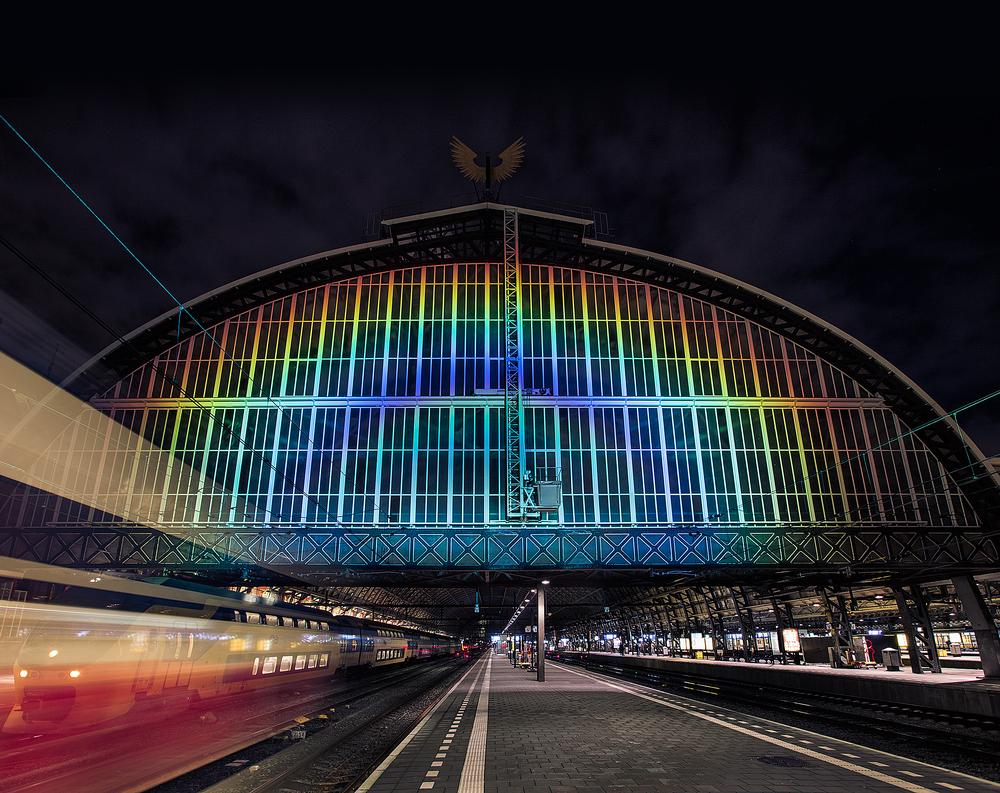
The installation uses new liquid crystal technology developed by researchers to create the rainbow / PHOTO: Studio Roosegaarde
Dutch designer Daan Roosegaarde’s latest light installation, Rainbow Station, can be seen every night in Amsterdam’s Central Station until the end of the year. As a celebration of the station 125th anniversary, and to mark UNESCO’s 2015 Year of Light, a rainbow lights up the station’s historic roof arch every evening after sunset.
“Although the station is beautiful, a lot of people consider it to be a bit dark and grey,” said Roosegaarde, speaking to CLADmag shortly after the artwork launched. “We wanted to add a layer of light. Because it’s a national monument, we couldn’t add anything physical to the station though, so that was a big challenge – to transform it, without adding to it.”
Studio Roosegaarde worked with astronomers at the University of Leiden to develop a lens filter that ‘unravels the light efficiently into a spectrum of a colours’ to create the rainbow.
“We worked with the astronomers to make an optical lens made of liquid crystal of 1,000mm thick, which breaks the light in a very efficient way. This is not a projection or a slide – it’s a real rainbow,” said Roosegaarde.
The rainbow will be visible every night at Amsterdam Central for the next year. After that it will tour different cities in Europe, including Berlin, Prague and London.
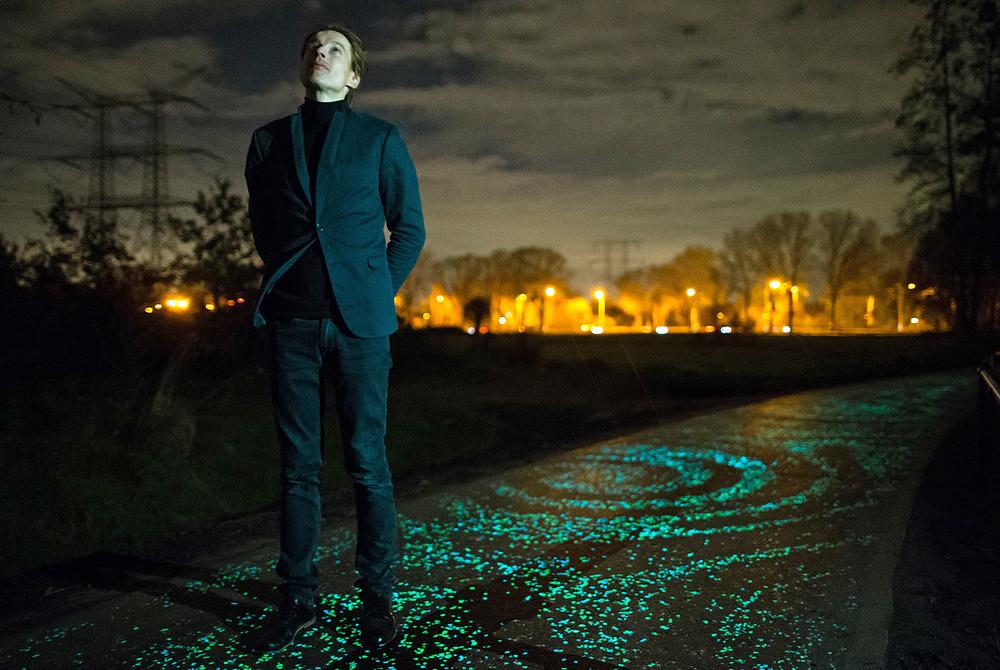
The launch of Rainbow Station came shortly after the unveiling of Roosegaarde’s Van Gogh-inspired cycle path in Nuenen, Netherlands. The 60m-long section of the path consists of thousands of solar powered glowing stones, arranged in patterns inspired by Van Gogh’s painting The Starry Night. It also features LED lights, so it will still be partially lit when there isn’t enough sun to charge the stones.
“My work relates to history – to the old world where we come from – but also to the future,” said Roosegaarde. “It’s about creating landscapes that are poetic and energy neutral.”
The cycle path is part of Daan Roosegaarde and developer Heijmans’ Smart Highways project, which aims to create safe, sustainable interactive roads using smart lighting, harvesting energy and creating signs that automatically adapt to the driving conditions.
The first Smart Highways project – called Glowing Lines – opened in the Netherlands in October. Solar powered, glow in the dark lines (created using photo-luminescent paint) have been installed on a stretch of the N329 road in Oss. The project is also developing Dynamic Paint, which will be triggered by different temperatures – so ice crystals could be painted on the road, which will light up when the temperature drops below a certain level, indicating that the surface could be slippery.
Roosegaarde’s work focuses on interactive landscapes that automatically respond to movement and function. In 2008, his practice, Studio Roosegaarde, created the Sustainable Dance Floor – an interactive dance floor which generates electricity as people dance on it – for the Sustainable Dance Club in Rotterdam. In addition to the ongoing Smart Highways project, he is also experimenting with ways that the bio-luminescent qualities of jellyfish could be used to light up trees at night, meaning they could be used in place of streetlights.
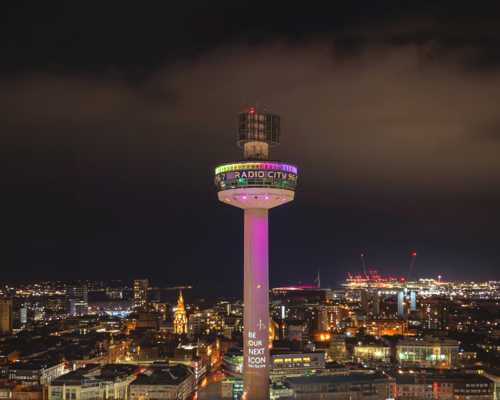
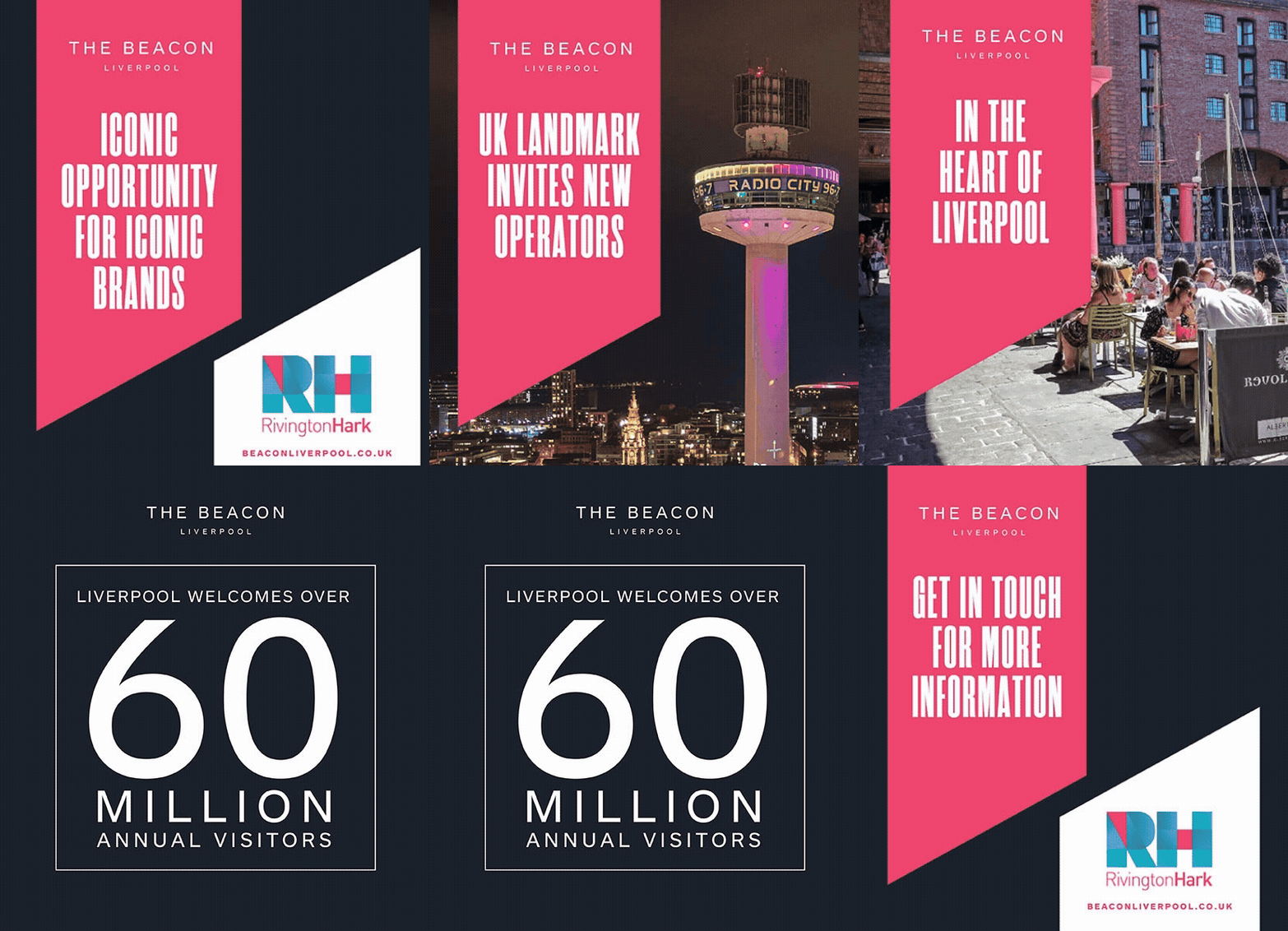
An opportunity to reimagine one of the UK’s most recognisable towers has been formally
opened by Rivington Hark, as St Johns Beacon invites operators and partners to shape its
next phase. [more...]
The installation uses new liquid crystal technology developed by researchers to create the rainbow / PHOTO: Studio Roosegaarde
Dutch designer Daan Roosegaarde’s latest light installation, Rainbow Station, can be seen every night in Amsterdam’s Central Station until the end of the year. As a celebration of the station 125th anniversary, and to mark UNESCO’s 2015 Year of Light, a rainbow lights up the station’s historic roof arch every evening after sunset.
“Although the station is beautiful, a lot of people consider it to be a bit dark and grey,” said Roosegaarde, speaking to CLADmag shortly after the artwork launched. “We wanted to add a layer of light. Because it’s a national monument, we couldn’t add anything physical to the station though, so that was a big challenge – to transform it, without adding to it.”
Studio Roosegaarde worked with astronomers at the University of Leiden to develop a lens filter that ‘unravels the light efficiently into a spectrum of a colours’ to create the rainbow.
“We worked with the astronomers to make an optical lens made of liquid crystal of 1,000mm thick, which breaks the light in a very efficient way. This is not a projection or a slide – it’s a real rainbow,” said Roosegaarde.
The rainbow will be visible every night at Amsterdam Central for the next year. After that it will tour different cities in Europe, including Berlin, Prague and London.
The launch of Rainbow Station came shortly after the unveiling of Roosegaarde’s Van Gogh-inspired cycle path in Nuenen, Netherlands. The 60m-long section of the path consists of thousands of solar powered glowing stones, arranged in patterns inspired by Van Gogh’s painting The Starry Night. It also features LED lights, so it will still be partially lit when there isn’t enough sun to charge the stones.
“My work relates to history – to the old world where we come from – but also to the future,” said Roosegaarde. “It’s about creating landscapes that are poetic and energy neutral.”
The cycle path is part of Daan Roosegaarde and developer Heijmans’ Smart Highways project, which aims to create safe, sustainable interactive roads using smart lighting, harvesting energy and creating signs that automatically adapt to the driving conditions.
The first Smart Highways project – called Glowing Lines – opened in the Netherlands in October. Solar powered, glow in the dark lines (created using photo-luminescent paint) have been installed on a stretch of the N329 road in Oss. The project is also developing Dynamic Paint, which will be triggered by different temperatures – so ice crystals could be painted on the road, which will light up when the temperature drops below a certain level, indicating that the surface could be slippery.
Roosegaarde’s work focuses on interactive landscapes that automatically respond to movement and function. In 2008, his practice, Studio Roosegaarde, created the Sustainable Dance Floor – an interactive dance floor which generates electricity as people dance on it – for the Sustainable Dance Club in Rotterdam. In addition to the ongoing Smart Highways project, he is also experimenting with ways that the bio-luminescent qualities of jellyfish could be used to light up trees at night, meaning they could be used in place of streetlights.
A new immersive attraction designed to transport visitors into the final hours of ancient Pompeii
is preparing to open near the world-famous archaeological site in southern Italy.
Experience design company, BRC Imagination Arts, has completed a transition that sees founder
Bob Rogers pass ownership of the business to four long-serving senior executives, while
remaining actively involved with the company.
Movie Park Germany has opened a new Paramount Pictures-themed attraction as part of its 30th
anniversary celebrations, using immersive storytelling and adaptive reuse to reinforce the park’s
longstanding “Hollywood in Germany” positioning.
Therme Manchester’s 28-acre development, which will include interconnected glass pavilions
that measure 65,000sq m, will be the largest bathing and wellbeing attraction in the world once
complete, according to prof David Russell, CEO of Therme UK.
Efteling has opened Hooghmoed, a new family drop tower designed to broaden the appeal of its
recently launched Sirene Island themed area and introduce younger visitors to thrill attractions.
A proposed Puy du Fou development near Bicester and Universal Destinations and Experiences’
planned resort in Bedford are emerging as part of a wider transformation of the Oxford–
Cambridge Growth Corridor into a major centre for UK leisure and tourism inv
Shedd Aquarium has opened the Immersion Theater developed in partnership with SimEx-
Iwerks, as part of a wider strategy to enhance the guest experience and create additional
revenue opportunities.
The UK government has announced a temporary reduction in VAT on visitor attractions and
children’s meals as part of a summer cost-of-living support package designed to stimulate the
visitor economy and encourage family days out.
As designer Yinka Ilori prepares for his first solo gallery show in London, he speaks exclusively
to CLADmag about his mission to spread joy, the power of play, and his bold approach to using
colour (including the colours you won’t see in his work).
The government of Thailand is exploring plans for a THB300bn (£6.3bn, US$8.3bn)
entertainment complex in the country’s Eastern Economic Corridor (EEC), with officials
proposing a large-scale theme park and sports destination as part of a broader tourism and
economic development strategy.
An opportunity to reimagine one of the UK’s most recognisable towers has been formally
opened by Rivington Hark, as St Johns Beacon invites operators and partners to shape its
next phase. [more...]