Apps are an important way for health and fitness
operators to keep members engaged and
motivated. Lucian Weston, head of business
development at Puregym, talks about developing
their app in-house to ensure it met member needs
New app upgrades include digital training support and body composition integration
Tell us about your background My previous role was a strategy consultant at PwC. I came to Pure Gym three and a half years ago.
In my current role I’m responsible for the development of new products and services to enhance member experience and deliver incremental revenue. Product management of the mobile app is an important component of this.
What were your main goals in developing the PureGym app? Ultimately, we believe the app should be central to the entire member experience and provide a point of competitive differentiation. It’s also a great way of engaging and motivating those who don’t use our physical facilities.
Who did the development work? We chose to develop it in-house. We see this as a real strength as it gives us complete ownership and allows us to continually add features and improve usability for members.
The first version was released in June 2018.
What functionality did you opt for and why? Initially, our aim was to develop a tool for class management. However, over time, we’ve added a wide range of other features to be relevant for a broader audience.
Did you consult members in relation to the app? Member feedback is one of the key principles of our development process. We always start with a member problem and think about how we can solve it.
Before starting development, we conduct research via a range of channels: online groups, in the gym, focus groups and one-on-one usability testing. We then develop and release a minimum viable product (MVP) of any feature before iterating based on usage data and feedback that we receive directly through our app.
Which features are most popular? Class management still accounts for about half of overall usage. However, it has been great how quickly we have diversified usage and the remaining features are all well used. We released a new version of training plans in January, which have got off to a flying start.
Are there any features that don’t get used so much? Honestly, there aren’t. The actual development is the costly, time consuming part of the process so we make sure we have as much confidence as possible before we start building. We do this through thinking strategically, conducting member research and analysing what works well in the market – as much in other industries as our own.
How do you measure success? We set ourselves ambitious targets across a range of metrics and track our performance rigorously. First and foremost, we record usage of the app. At the start of January, we were ranked number two on the App Store for Health and Fitness, second only to Fitbit. That month in total we had more than 700k members using the app.
Do you plan to update it? If so, how often and with what goals in mind? We release a new version of the app every two weeks, so it’s always evolving and improving over time. We’re committed to it as a long-term investment, with the goal of it being the centre of a member’s experience.
There are lots of exciting developments coming up this year, including digital training support, body composition integration, home workouts and intelligent messaging.
What advice do you have for other operators? Think carefully about your business goals and how an app will help you achieve them. Be clear on your return on investment model. Also bear in mind there are plenty of fit-for-purpose third-party apps that can be taken ‘off the shelf’.
How have you updated the app since COVID-19? After we closed our gyms on 20th March, we focused on expanding our home and outdoor workouts.
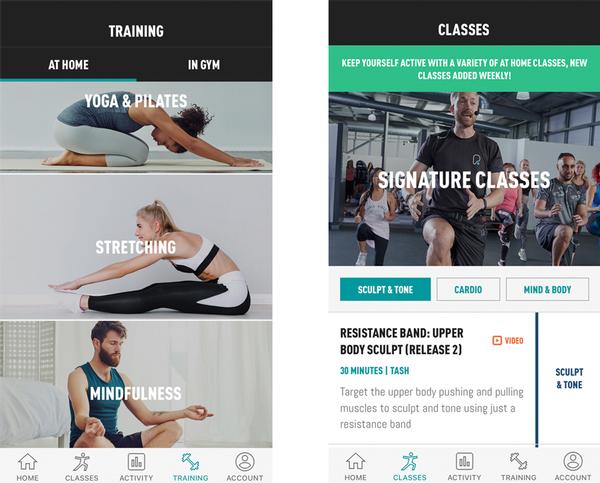
To continue supporting our members, we added tailored nutrition information, mindfulness and exercise guidance and made connecting with PTs for online training easier.
These were features of the app that we were already in the process of developing, however, the impact of COVID-19 has massively accelerated their rollout.
How has the app helped you to engage with members during this time? Alongside our social media channels, it has been our primary engagement tool with members.
Since our sites closed, more than 500,000 members and former members have used the app to support their mental and physical wellbeing. There are now more than 100 free workouts across cardio, strength, yoga, mindfulness and running, which have been highly popular and received great feedback.
How do you hope to use the app going forward? The app is central to our digital strategy. As we begin to re-open sites, members can use it to check how busy the gym is, and book a slot to visit safely. It’s also providing key information updates and being used to capture real-time feedback from members.
Meanwhile, tailored content is guiding members on getting back into their gym routine. The home and outdoor content will continue to be crucial for users in order to stay fit and healthy when they can’t make it to the gym.
About the Puregym app
The app currently has the following features and the PureGym team is adding to them all the time:
• Access: check how busy any gym is at any time
• Activity tracking: track gym visits and earn badges
• Training plans: workout plans tailored to fit members’ goals and experience levels
• Class management
• PIN entry reminder
• Manage your membership function
Lucian Weston is head of business
development at Puregym
An opportunity to reimagine one of the UK’s most recognisable towers has been formally
opened by Rivington Hark, as St Johns Beacon invites operators and partners to shape its
next phase. [more...]
Apps are an important way for health and fitness
operators to keep members engaged and
motivated. Lucian Weston, head of business
development at Puregym, talks about developing
their app in-house to ensure it met member needs
New app upgrades include digital training support and body composition integration
Tell us about your background My previous role was a strategy consultant at PwC. I came to Pure Gym three and a half years ago.
In my current role I’m responsible for the development of new products and services to enhance member experience and deliver incremental revenue. Product management of the mobile app is an important component of this.
What were your main goals in developing the PureGym app? Ultimately, we believe the app should be central to the entire member experience and provide a point of competitive differentiation. It’s also a great way of engaging and motivating those who don’t use our physical facilities.
Who did the development work? We chose to develop it in-house. We see this as a real strength as it gives us complete ownership and allows us to continually add features and improve usability for members.
The first version was released in June 2018.
What functionality did you opt for and why? Initially, our aim was to develop a tool for class management. However, over time, we’ve added a wide range of other features to be relevant for a broader audience.
Did you consult members in relation to the app? Member feedback is one of the key principles of our development process. We always start with a member problem and think about how we can solve it.
Before starting development, we conduct research via a range of channels: online groups, in the gym, focus groups and one-on-one usability testing. We then develop and release a minimum viable product (MVP) of any feature before iterating based on usage data and feedback that we receive directly through our app.
Which features are most popular? Class management still accounts for about half of overall usage. However, it has been great how quickly we have diversified usage and the remaining features are all well used. We released a new version of training plans in January, which have got off to a flying start.
Are there any features that don’t get used so much? Honestly, there aren’t. The actual development is the costly, time consuming part of the process so we make sure we have as much confidence as possible before we start building. We do this through thinking strategically, conducting member research and analysing what works well in the market – as much in other industries as our own.
How do you measure success? We set ourselves ambitious targets across a range of metrics and track our performance rigorously. First and foremost, we record usage of the app. At the start of January, we were ranked number two on the App Store for Health and Fitness, second only to Fitbit. That month in total we had more than 700k members using the app.
Do you plan to update it? If so, how often and with what goals in mind? We release a new version of the app every two weeks, so it’s always evolving and improving over time. We’re committed to it as a long-term investment, with the goal of it being the centre of a member’s experience.
There are lots of exciting developments coming up this year, including digital training support, body composition integration, home workouts and intelligent messaging.
What advice do you have for other operators? Think carefully about your business goals and how an app will help you achieve them. Be clear on your return on investment model. Also bear in mind there are plenty of fit-for-purpose third-party apps that can be taken ‘off the shelf’.
How have you updated the app since COVID-19? After we closed our gyms on 20th March, we focused on expanding our home and outdoor workouts.
To continue supporting our members, we added tailored nutrition information, mindfulness and exercise guidance and made connecting with PTs for online training easier.
These were features of the app that we were already in the process of developing, however, the impact of COVID-19 has massively accelerated their rollout.
How has the app helped you to engage with members during this time? Alongside our social media channels, it has been our primary engagement tool with members.
Since our sites closed, more than 500,000 members and former members have used the app to support their mental and physical wellbeing. There are now more than 100 free workouts across cardio, strength, yoga, mindfulness and running, which have been highly popular and received great feedback.
How do you hope to use the app going forward? The app is central to our digital strategy. As we begin to re-open sites, members can use it to check how busy the gym is, and book a slot to visit safely. It’s also providing key information updates and being used to capture real-time feedback from members.
Meanwhile, tailored content is guiding members on getting back into their gym routine. The home and outdoor content will continue to be crucial for users in order to stay fit and healthy when they can’t make it to the gym.
About the Puregym app
The app currently has the following features and the PureGym team is adding to them all the time:
• Access: check how busy any gym is at any time
• Activity tracking: track gym visits and earn badges
• Training plans: workout plans tailored to fit members’ goals and experience levels
• Class management
• PIN entry reminder
• Manage your membership function
Lucian Weston is head of business
development at Puregym
Hotel de France, located on the British Isle of Jersey, has created a wellness retreat package
that includes a hot yoga session that will take place in Jersey Zoo’s butterfly sanctuary.
A new immersive attraction designed to transport visitors into the final hours of ancient Pompeii
is preparing to open near the world-famous archaeological site in southern Italy.
Experience design company, BRC Imagination Arts, has completed a transition that sees founder
Bob Rogers pass ownership of the business to four long-serving senior executives, while
remaining actively involved with the company.
Movie Park Germany has opened a new Paramount Pictures-themed attraction as part of its 30th
anniversary celebrations, using immersive storytelling and adaptive reuse to reinforce the park’s
longstanding “Hollywood in Germany” positioning.
Therme Manchester’s 28-acre development, which will include interconnected glass pavilions
that measure 65,000sq m, will be the largest bathing and wellbeing attraction in the world once
complete, according to prof David Russell, CEO of Therme UK.
Efteling has opened Hooghmoed, a new family drop tower designed to broaden the appeal of its
recently launched Sirene Island themed area and introduce younger visitors to thrill attractions.
A proposed Puy du Fou development near Bicester and Universal Destinations and Experiences’
planned resort in Bedford are emerging as part of a wider transformation of the Oxford–
Cambridge Growth Corridor into a major centre for UK leisure and tourism inv
Shedd Aquarium has opened the Immersion Theater developed in partnership with SimEx-
Iwerks, as part of a wider strategy to enhance the guest experience and create additional
revenue opportunities.
The UK government has announced a temporary reduction in VAT on visitor attractions and
children’s meals as part of a summer cost-of-living support package designed to stimulate the
visitor economy and encourage family days out.
As designer Yinka Ilori prepares for his first solo gallery show in London, he speaks exclusively
to CLADmag about his mission to spread joy, the power of play, and his bold approach to using
colour (including the colours you won’t see in his work).
The government of Thailand is exploring plans for a THB300bn (£6.3bn, US$8.3bn)
entertainment complex in the country’s Eastern Economic Corridor (EEC), with officials
proposing a large-scale theme park and sports destination as part of a broader tourism and
economic development strategy.
+ More news
COMPANY PROFILES
Polin Waterparks Polin was founded in Istanbul in 1976. Polin
has since grown into a leading company in
the waterpa [more...]
An opportunity to reimagine one of the UK’s most recognisable towers has been formally
opened by Rivington Hark, as St Johns Beacon invites operators and partners to shape its
next phase. [more...]