Therme Group and Mamou-Mani Architects' joint venture Fab.Pub will use circular 3D printing technology to create architectural features at Therme Manchester
The system can fabricate partitions, walls and cladding using a blend of bioplastics
It will also be possible to reprocess items into new products and features at the end of their useful life
Therme Manchester has signed up to the Circularity in Practice pledge, which is a UK-wide sustainable manufacturing initiative to make 'reuse' the default construction method, with the initiative inspired by King Charles.
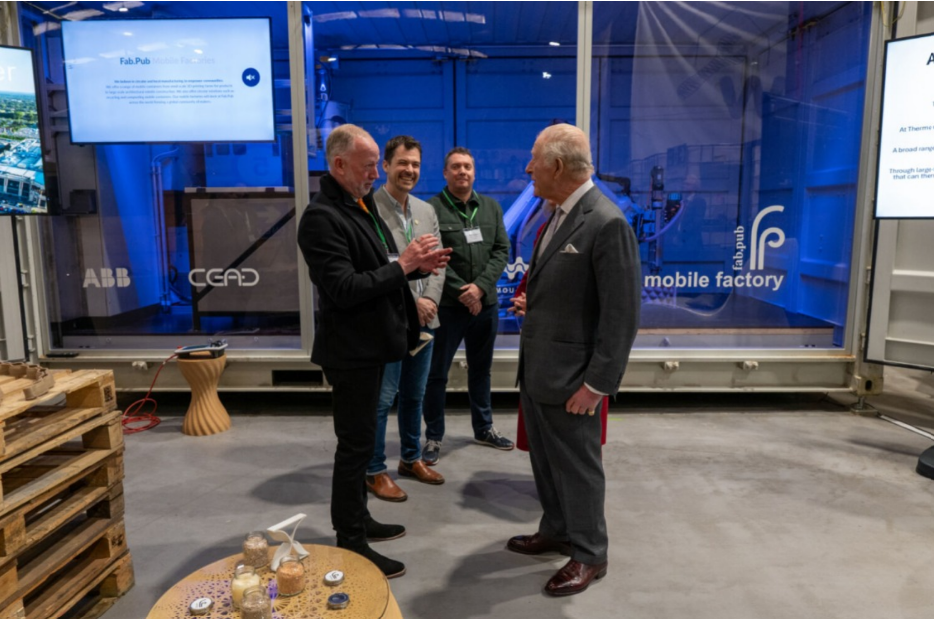
Professor David Russell and Rob Creber of Therme Manchester demonstrated a new large-scale 3D printer that will be used to reduce waste and keep materials in circulation at the £450 million (US$609 million, €519 million) development that's due to open in late 2028.
The printer will be operated by Fab.Pub, a specialist in 3D fabrication for architectural features, products and bespoke products. The 3D design process uses a blend of bio-plastics and UV-resistant additives or ceramic panels to create architectural partitions, walls, cladding, staircase balustrades, acoustic panels, planted vertical walls and canopies.
Fab.Pub, which stands for Fabrication Public, was founded in 2014 in London, UK, by Arthur Mamou-Mani of Mamou-Mani Architects. The company is a joint venture between Therme Group and Mamou-Mani Architects. Read more about Arther Manou Mani in an article on the Therme Group website here.
At Therme Manchester, repurposed materials will be recycled using the 3D printer to produce furniture, plant pots and recreational features. It will also be possible to reprocess these materials at the end of their useful life to create new products.
Prof Russell, CEO of Therme Group UK, said: “Circularity has to move beyond theory and into delivery. We are demonstrating how waste materials can be transformed, reused and kept in continuous circulation at scale – supporting UK manufacturing while reducing emissions and resource demand.”
At the launch of the Circularity in Practice pledge at the SUEZ Renew Hub in Greater Manchester, Fab.Pub demonstrated one of its robotic Mobile Factories.
The mobile nature of this factory, housed within a shipping container, means the system reduces emissions, waste, supports regional manufacturing capability and limits demand for virgin resources.
Pub operates a franchise model for these mobile factories to give local communities access to advanced 3D printing and robotics technology.