Raad Studio-designed Lowline project to create ‘world’s first underground park’ in New York
POSTED 30 Jun 2015 . BY Jak Phillips
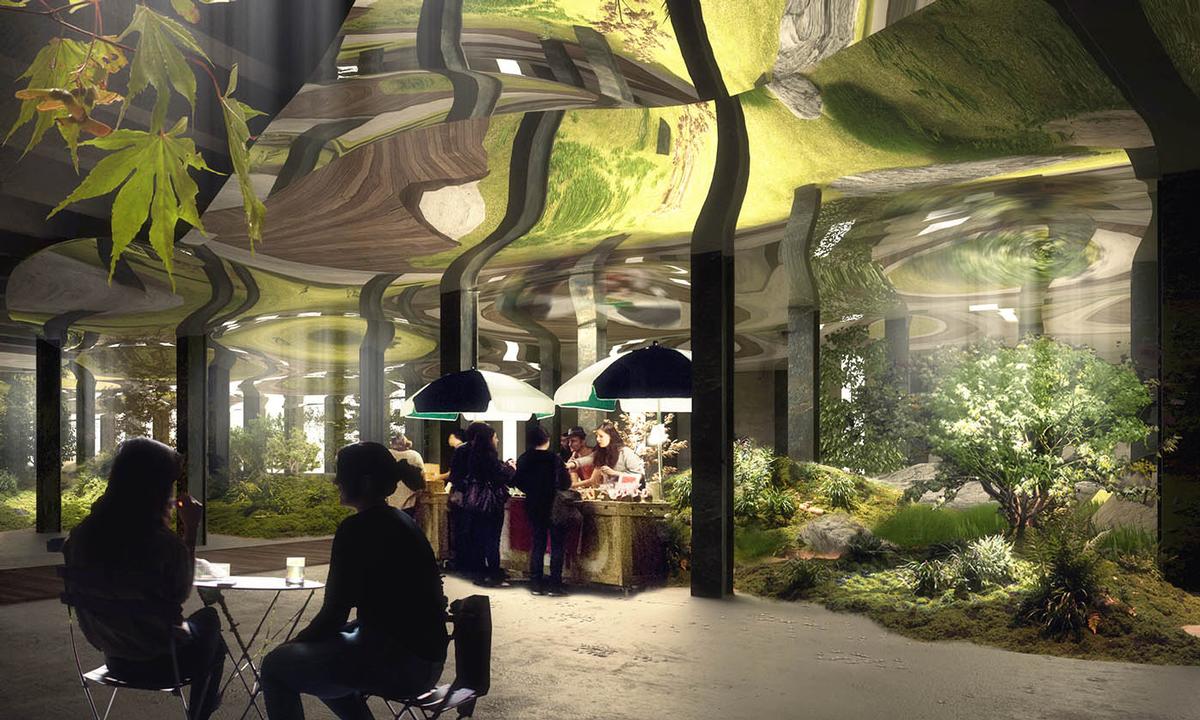
The project would see light reflectors placed on surrounding buildings and rooftops to channel sunlight into the park Credit: Raad Studio
The team behind an ambitious New York design project to create the ‘world's first underground park’ have turned to Kickstarter to raise US$200,000 (€179,000, £127,000) for technical development for the complex scheme.
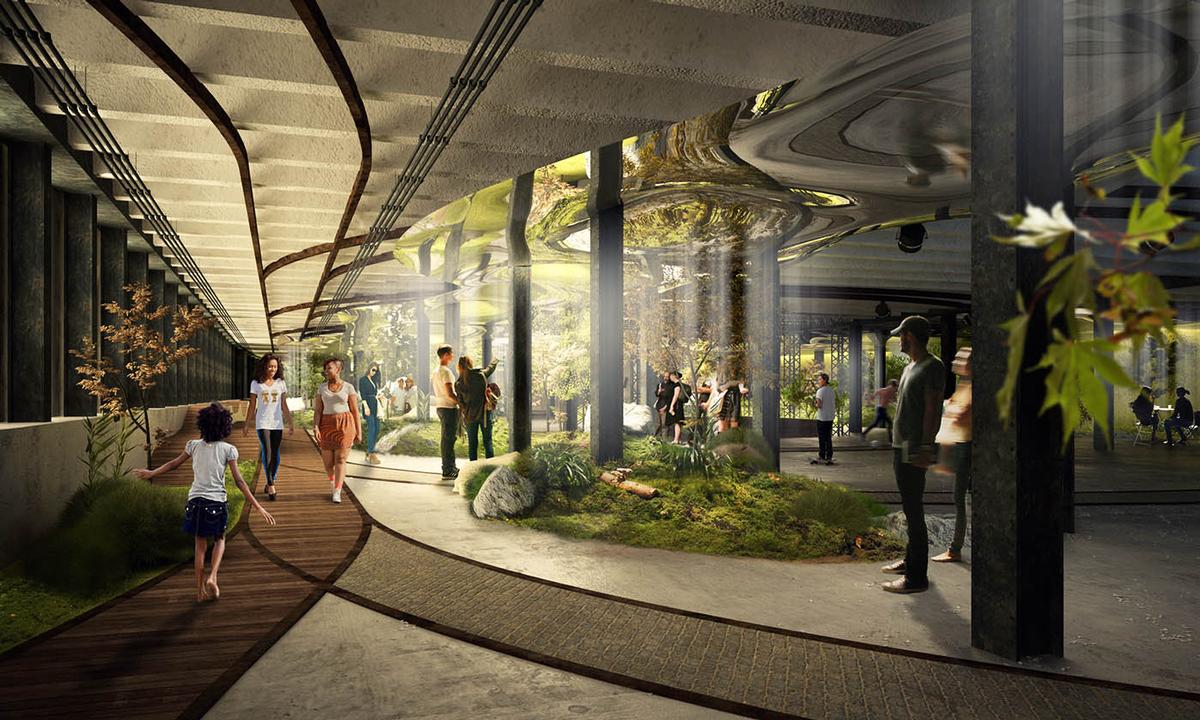
The US$60m (€53.8m, £38.2m) Lowline project, designed by James Ramsey of Raad Studio, would see the transformation of an abandoned, underground trolley terminal in Manhattan's Lower East Side. It would harness solar power to become a fully-lit public park with trees, planting, seating and artwork.
The technically challenging concept would act as a counterpoint to New York's High Line scheme, which has seen an elevated urban park created on a disused railway line. High Line's third and final phase was completed in September and was a collaboration between landscape firm James Corner Field Operations, architects Diller Scofidio + Renfro and Dutch planting designer Piet Oudolf.
Money generated for Lowline through the Kickstarter crowd funding platform would be used to fund a science laboratory, open to the public from the autumn, that would explore and develop the use of solar energy in the subterranean park. It is being spearheaded by the Lowline organisation, a not-for-profit organisation led by Ramsey and former radio producer Daniel Barasch. It has also won support from a number of designers, as well as Girls star Lena Dunham and Craigslist founder Craig Newmark.
Daniel Barasch gave a TED Talk outlining plans for the Lowline
The project would see light reflectors placed on surrounding buildings and rooftops to channel sunlight into the park. They would direct the sun's rays to an above-ground solar collector, which would then funnel the light downward through fibre-optic cables. The cables would be linked to dome-shape panels that would beam the natural light throughout the park.
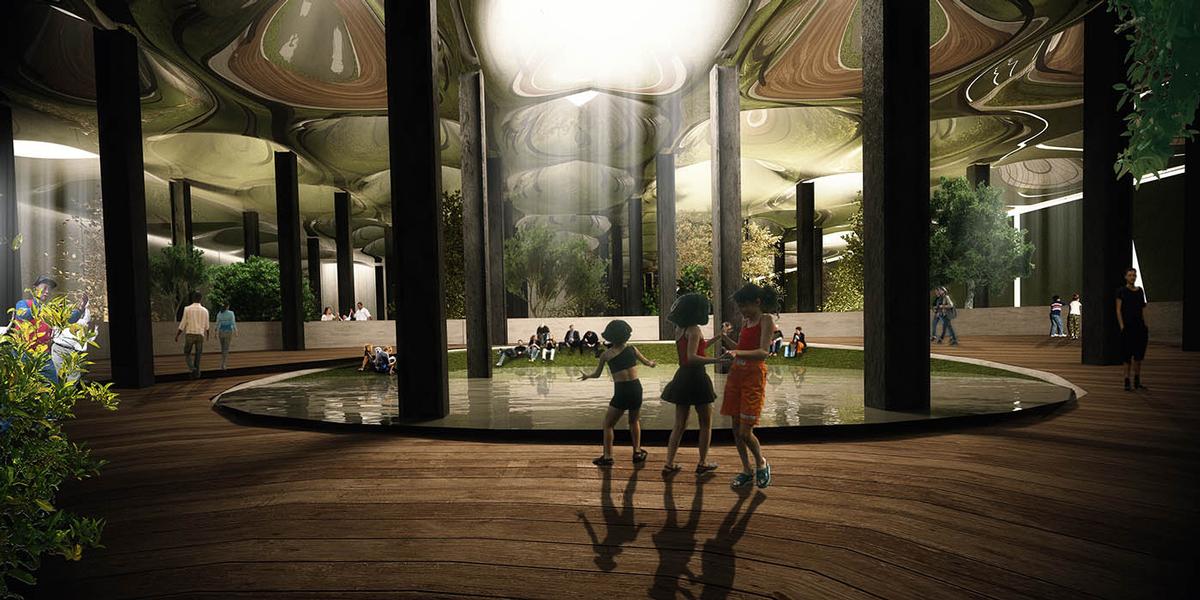
The Lowline team says the technology would support photosynthesis, enabling plants and trees to grow. Artificial light would illuminate the park when sunlight is not available.
The Kickstarter campaign had already raised US$113,926 (€102,000, £72,500) as of June 30 and is due to run until July 8.
By the end of 2017, the Lowline group hopes to complete negotiations and launch a capital campaign to support construction of the park, with a target opening date of 2018.
Artificial light would illuminate the park when sunlight is not available Credit: Raad Studio
The Lowline team says the technology would support photosynthesis, enabling plants and trees to grow Credit: Raad Studio
The Lowline scheme, designed by James Ramsey of Raad Studio, would see the transformation of an abandoned, underground trolley terminal in Manhattan's Lower East Side Credit: Raad Studio
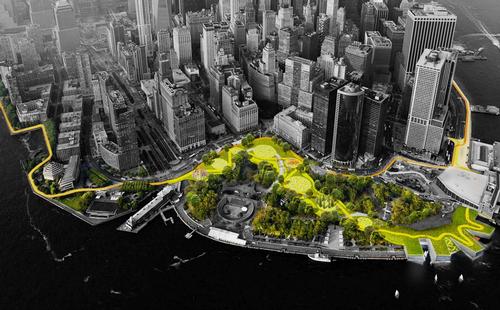
Could BIG's Dryline be New York's next High Line? POSTED 11 Mar 2015. BY Katie Buckley Bjarke Ingels, in conjunction with Rebuild by Design, has laid out plans for ‘The Dryline’ –
a leisure-oriented storm barrier for New York City.
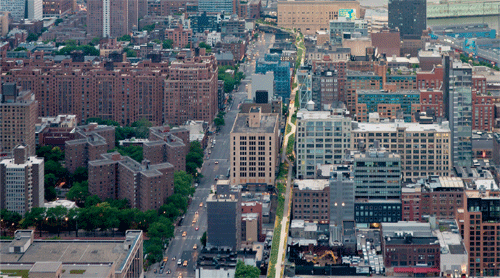
FEATURE: Features: The High Line POSTED 03 Jan 2014. Joshua David and Robert Hammond saved
New York's High Line from demolition,
turned it into a liner urban park and
unleashed a movement on the world
OMA has completed a major transformation of New York's New Museum, creating a larger
cultural campus that combines expanded exhibition spaces with learning, performance,
hospitality and public programming.
A US$50 million (£44.2 million, €51.2 million) transformation of Chicago's historic McCormick
Mansion has created a new destination that combines live magic, immersive theatre, dining and
private membership under one roof.
The Montana Historical Society has officially celebrated the opening of its new Montana
Heritage
Center, a US$107 million (£79 million, €92 million) destination that combines immersive
storytelling with cutting-edge audiovisual technology to bring the sta
Raad Studio-designed Lowline project to create ‘world’s first underground park’ in New York
POSTED 30 Jun 2015 . BY Jak Phillips
The project would see light reflectors placed on surrounding buildings and rooftops to channel sunlight into the park Credit: Raad Studio
The team behind an ambitious New York design project to create the ‘world's first underground park’ have turned to Kickstarter to raise US$200,000 (€179,000, £127,000) for technical development for the complex scheme.
The US$60m (€53.8m, £38.2m) Lowline project, designed by James Ramsey of Raad Studio, would see the transformation of an abandoned, underground trolley terminal in Manhattan's Lower East Side. It would harness solar power to become a fully-lit public park with trees, planting, seating and artwork.
The technically challenging concept would act as a counterpoint to New York's High Line scheme, which has seen an elevated urban park created on a disused railway line. High Line's third and final phase was completed in September and was a collaboration between landscape firm James Corner Field Operations, architects Diller Scofidio + Renfro and Dutch planting designer Piet Oudolf.
Money generated for Lowline through the Kickstarter crowd funding platform would be used to fund a science laboratory, open to the public from the autumn, that would explore and develop the use of solar energy in the subterranean park. It is being spearheaded by the Lowline organisation, a not-for-profit organisation led by Ramsey and former radio producer Daniel Barasch. It has also won support from a number of designers, as well as Girls star Lena Dunham and Craigslist founder Craig Newmark.
Daniel Barasch gave a TED Talk outlining plans for the Lowline
The project would see light reflectors placed on surrounding buildings and rooftops to channel sunlight into the park. They would direct the sun's rays to an above-ground solar collector, which would then funnel the light downward through fibre-optic cables. The cables would be linked to dome-shape panels that would beam the natural light throughout the park.
The Lowline team says the technology would support photosynthesis, enabling plants and trees to grow. Artificial light would illuminate the park when sunlight is not available.
The Kickstarter campaign had already raised US$113,926 (€102,000, £72,500) as of June 30 and is due to run until July 8.
By the end of 2017, the Lowline group hopes to complete negotiations and launch a capital campaign to support construction of the park, with a target opening date of 2018.
Artificial light would illuminate the park when sunlight is not available Credit: Raad Studio
The Lowline team says the technology would support photosynthesis, enabling plants and trees to grow Credit: Raad Studio
The Lowline scheme, designed by James Ramsey of Raad Studio, would see the transformation of an abandoned, underground trolley terminal in Manhattan's Lower East Side Credit: Raad Studio
Could BIG's Dryline be New York's next High Line? POSTED 11 Mar 2015. BY Katie Buckley Bjarke Ingels, in conjunction with Rebuild by Design, has laid out plans for ‘The Dryline’ –
a leisure-oriented storm barrier for New York City.
FEATURE: Features: The High Line POSTED 03 Jan 2014. Joshua David and Robert Hammond saved
New York's High Line from demolition,
turned it into a liner urban park and
unleashed a movement on the world
OMA has completed a major transformation of New York's New Museum, creating a larger
cultural campus that combines expanded exhibition spaces with learning, performance,
hospitality and public programming.
A US$50 million (£44.2 million, €51.2 million) transformation of Chicago's historic McCormick
Mansion has created a new destination that combines live magic, immersive theatre, dining and
private membership under one roof.
The Montana Historical Society has officially celebrated the opening of its new Montana
Heritage
Center, a US$107 million (£79 million, €92 million) destination that combines immersive
storytelling with cutting-edge audiovisual technology to bring the sta
San Antonio Zoo has reported a US$283 million economic impact for 2025, following a decade-
long transformation programme that has seen almost US$200 million invested into the Texas
attraction.
Plans for the AU$180 million redevelopment of Reef HQ Aquarium in Townsville, Australia, are
progressing, with the project set to transform the attraction into a global centre for reef
education and conservation.
+ More news
COMPANY PROFILES
Sally Corporation Our services include: Dark ride design & build; Redevelopment of existing attractions; High-quality [more...]