Originally developed to provide a social and physical outlet for older men, walking football is steadily gaining popularity among people from all walks of life. Professor Terry Stevens, founder of Ymaohyd Walking Football Club, discusses the appeal of this new sport
By Professor Terry Stevens | Published in Sports Management 2018 issue 3
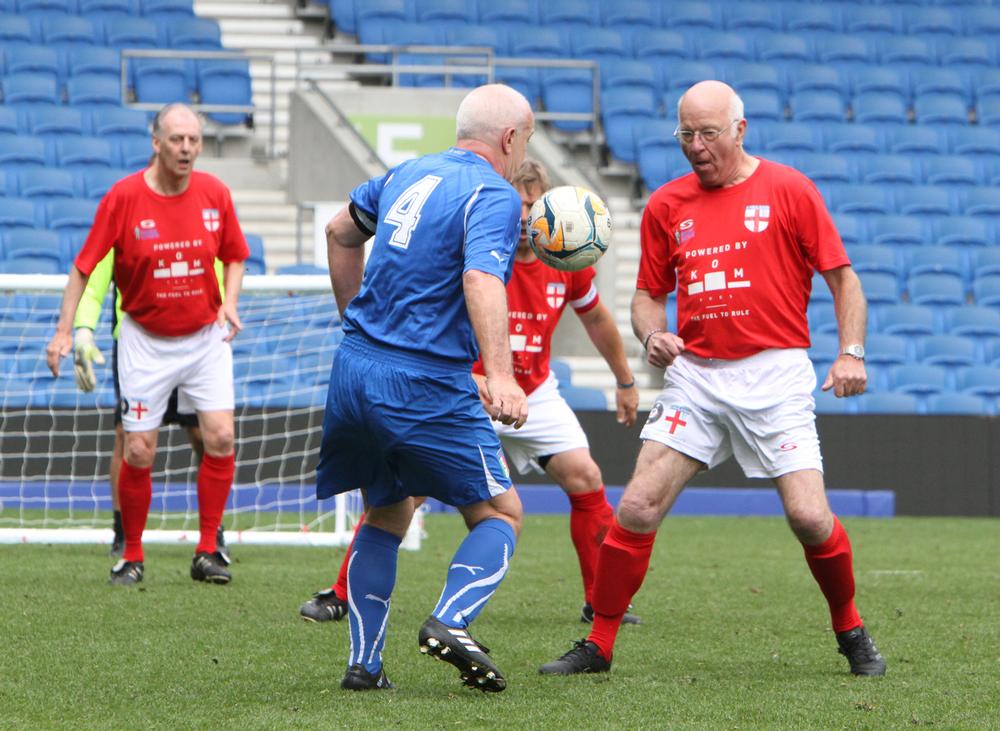
The sport is played with two teams of five or six players a side and does not allow running
Is ‘slow’ the new trend? We have slow food, slow travel, slow money and slow fashion. So, when you hear about ‘walking football’ you might naturally assume it is part of this overall slowing down phenomenon. But it’s far from it!
Walking football is not only one of the fastest growing sporting activities for both men and women, it is also a sport that’s surprisingly fast moving, physically challenging, skilful and technical. Designed and adapted for those who can’t play or aren’t interested in playing mainstream soccer, this more controlled game has many tangible health benefits for people of any age. Indeed, being physically active as we get older is a critical factor associated with personal physical and mental wellness and health.
Led by researchers at the University of Aston in Birmingham and The University of Brighton, there is now a growing body of demonstrable proof that playing walking football can help:
• Build strength in bones, connective tissue and cartilage
• Improve posture by strengthening musculature
• Increase core stability
• Decrease fat stores by burning calories
• Improve balance and coordination
• Normalise blood pressure, improve blood flow and reduce stress
• Lower blood sugars
• Strengthen the immune system
• Improve social life, combat loneliness and support collaborative networks
It is widely accepted that walking football was conceived by Chesterfield Football Club’s Community Trust in 2011 as a participation sport, designed to help older men find a way out of loneliness and isolation. Today there are over 1,000 walking football clubs affiliated to The Walking Football Federation, the national governing body for the sport in Great Britain, with almost 2,000 members.
The sport, which teams play with five or six players a side, has very specific rules that outlaw both running and physical contact. There are also a number of very specific technical regulations now codified by the various national football associations.
Getting popular The meteoric rise of walking football over the past six years is due to a number of factors. In 2014, Barclay’s Bank ran a television advertisement that featured the sport. Then in 2015 walking football was introduced in the FA People’s Cup as part of BBC’s ‘Get Inspired’ initiative. In 2017, the Football Association of Wales and UEFA included a walking football competition in the celebrations held in Cardiff for the Champions League Cup Final, and the same year Sky Sports began televising national and international walking football tournaments.
As a result, walking football is now becoming a spectator sport as well as a participation sport. It is commanding the respect of national football organisations, with professional clubs across Europe establishing walking football activities for their community outreach programmes. And a growing number of walking football clubs are being established around the world.
This is inevitably generating demand for local, region and international tournaments, which have been held in Majorca, Brittany, Italy and the Netherlands. In 2017 Swansea University hosted the International Super Veterans five-a-side tournament and in Autumn 2018 the first official ‘home nations’ competition between Wales, England, Scotland and Northern Ireland will be held.
The first women’s walking football competition took place in Preston in July 2017 to commemorate 100 years of the Dick, Kerr Ladies Football Club – one of the earliest known women’s football clubs in England.
Walking therapy The sport was originally aimed at tackling physical inactivity, loneliness and depression, issues that are often experienced by men of age 50-plus. But it soon became apparent that it appeals to a much broader range of markets, including women, younger people, ex-professional footballers and other ex-athletes, those recovering from sporting injuries and those looking for relief from stress and anxiety.
As Paul Murtagh, a 43 year old former local Shropshire league player who snapped his knee playing football when he was 20, told the Guardian newspaper recently: “Nobody stops playing football because they don’t like it anymore; they stop because they think their time is up, whether through age or injury”.
For Dean Curtis, a forty-something former soldier, life has been transformed through playing walking football every Friday night with the Welsh club Ymaohyd.
“Two years ago I was in a very dark place with declining physical and mental health, few friends and little desire to socialise,” says Curtis. “I can now count on over two dozen good mates.”
Entering the mainstream Inclusive and open to all, walking football is an enjoyable form of exercise with multiple benefits. One of the leading advocates of the sport is Harry Hubball from the University of British Columbia in Vancouver, who highlights the opportunities for “frequent participation, team and community-building and cross-generational involvement.”
While still in its infancy, there are real opportunities for the sport to enter the mainstream. The media is taking notice and, increasingly, sponsors are being attracted to the access to interesting markets. As walking football picks up steam, it’s time for the general public to become more open minded about the range of people who can benefit from playing walking football, and to embrace it as a serious sport.
The story of Ymaohyd Football Club Beginnings “There has to be more to Fridays nights than this!”, was the consensus of 12 fathers (all ex-soccer or rugby players). They started Ymaohyd Football Club in 1982 for exercise, fun and to develop the use of the Welsh language in sport.
Success During the years from 1982 to 2014, the club enjoyed its glory days. Over 300 players had become involved. The club was unbeaten in over 30 friendlies.
Despair In 2014 injuries, old age, and grandkids to look after meant that numbers dwindled. The suggestion to try walking football was initially met with scorn, scepticism and derision, but finally the club decided to give it a go.
Revival Soon ten players grew to twenty, the club received a Heritage Lottery grant to play walking football, the running football was revived alongside the new sport and the club’s strong social environment was restored.
Transformation Ymaohyd’s walking football team quickly climbed the ranks, making it to the final of the FA People’s Cup in 2015 and the semi-final in 2016. They won the FA Wales People’s Cup, which was played in front of 5,000 people before the Champions League Final in Cardiff, and were 2018 winners of the Swansea City FC tournament.
Ymaohyd FC has a proud history of playing football and socialising
The sport was developed to give older men a physical and social outlet
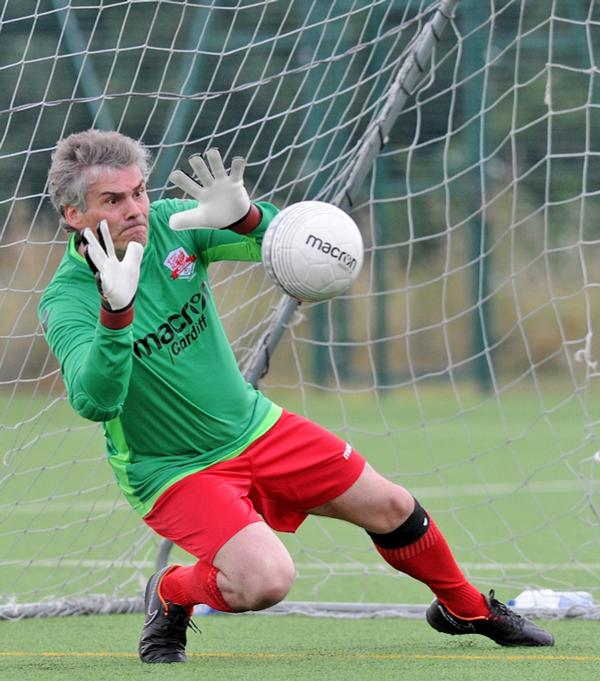
Professor Terry Stevens founded Ymaohyd Walking Football Club
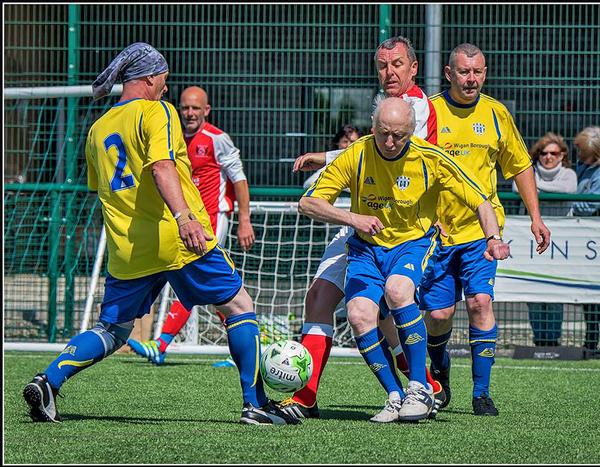
Players can improve strength, posture, immune system and balance
The British national governing body for the sport has 2,000 members
COMPANY PROFILES
RMA Ltd
RMA Ltd is a one-stop global company
that can design, build and produce from a
greenfield site upw [more...]
QubicaAMF UK
QubicaAMF is the largest and most
innovative bowling equipment provider with
600 employees worldwi [more...]
Painting With Light
By combining lighting, video, scenic and architectural elements, sound and special effects we tell s [more...]
TechnoAlpin Indoor
TechnoAlpin is the world leader for snowmaking systems. With the Indoor snow division, TechnoAlpin c [more...]
An opportunity to reimagine one of the UK’s most recognisable towers has been formally
opened by Rivington Hark, as St Johns Beacon invites operators and partners to shape its
next phase. [more...]
Originally developed to provide a social and physical outlet for older men, walking football is steadily gaining popularity among people from all walks of life. Professor Terry Stevens, founder of Ymaohyd Walking Football Club, discusses the appeal of this new sport
By Professor Terry Stevens | Published in Sports Management 2018 issue 3
The sport is played with two teams of five or six players a side and does not allow running
Is ‘slow’ the new trend? We have slow food, slow travel, slow money and slow fashion. So, when you hear about ‘walking football’ you might naturally assume it is part of this overall slowing down phenomenon. But it’s far from it!
Walking football is not only one of the fastest growing sporting activities for both men and women, it is also a sport that’s surprisingly fast moving, physically challenging, skilful and technical. Designed and adapted for those who can’t play or aren’t interested in playing mainstream soccer, this more controlled game has many tangible health benefits for people of any age. Indeed, being physically active as we get older is a critical factor associated with personal physical and mental wellness and health.
Led by researchers at the University of Aston in Birmingham and The University of Brighton, there is now a growing body of demonstrable proof that playing walking football can help:
• Build strength in bones, connective tissue and cartilage
• Improve posture by strengthening musculature
• Increase core stability
• Decrease fat stores by burning calories
• Improve balance and coordination
• Normalise blood pressure, improve blood flow and reduce stress
• Lower blood sugars
• Strengthen the immune system
• Improve social life, combat loneliness and support collaborative networks
It is widely accepted that walking football was conceived by Chesterfield Football Club’s Community Trust in 2011 as a participation sport, designed to help older men find a way out of loneliness and isolation. Today there are over 1,000 walking football clubs affiliated to The Walking Football Federation, the national governing body for the sport in Great Britain, with almost 2,000 members.
The sport, which teams play with five or six players a side, has very specific rules that outlaw both running and physical contact. There are also a number of very specific technical regulations now codified by the various national football associations.
Getting popular The meteoric rise of walking football over the past six years is due to a number of factors. In 2014, Barclay’s Bank ran a television advertisement that featured the sport. Then in 2015 walking football was introduced in the FA People’s Cup as part of BBC’s ‘Get Inspired’ initiative. In 2017, the Football Association of Wales and UEFA included a walking football competition in the celebrations held in Cardiff for the Champions League Cup Final, and the same year Sky Sports began televising national and international walking football tournaments.
As a result, walking football is now becoming a spectator sport as well as a participation sport. It is commanding the respect of national football organisations, with professional clubs across Europe establishing walking football activities for their community outreach programmes. And a growing number of walking football clubs are being established around the world.
This is inevitably generating demand for local, region and international tournaments, which have been held in Majorca, Brittany, Italy and the Netherlands. In 2017 Swansea University hosted the International Super Veterans five-a-side tournament and in Autumn 2018 the first official ‘home nations’ competition between Wales, England, Scotland and Northern Ireland will be held.
The first women’s walking football competition took place in Preston in July 2017 to commemorate 100 years of the Dick, Kerr Ladies Football Club – one of the earliest known women’s football clubs in England.
Walking therapy The sport was originally aimed at tackling physical inactivity, loneliness and depression, issues that are often experienced by men of age 50-plus. But it soon became apparent that it appeals to a much broader range of markets, including women, younger people, ex-professional footballers and other ex-athletes, those recovering from sporting injuries and those looking for relief from stress and anxiety.
As Paul Murtagh, a 43 year old former local Shropshire league player who snapped his knee playing football when he was 20, told the Guardian newspaper recently: “Nobody stops playing football because they don’t like it anymore; they stop because they think their time is up, whether through age or injury”.
For Dean Curtis, a forty-something former soldier, life has been transformed through playing walking football every Friday night with the Welsh club Ymaohyd.
“Two years ago I was in a very dark place with declining physical and mental health, few friends and little desire to socialise,” says Curtis. “I can now count on over two dozen good mates.”
Entering the mainstream Inclusive and open to all, walking football is an enjoyable form of exercise with multiple benefits. One of the leading advocates of the sport is Harry Hubball from the University of British Columbia in Vancouver, who highlights the opportunities for “frequent participation, team and community-building and cross-generational involvement.”
While still in its infancy, there are real opportunities for the sport to enter the mainstream. The media is taking notice and, increasingly, sponsors are being attracted to the access to interesting markets. As walking football picks up steam, it’s time for the general public to become more open minded about the range of people who can benefit from playing walking football, and to embrace it as a serious sport.
The story of Ymaohyd Football Club Beginnings “There has to be more to Fridays nights than this!”, was the consensus of 12 fathers (all ex-soccer or rugby players). They started Ymaohyd Football Club in 1982 for exercise, fun and to develop the use of the Welsh language in sport.
Success During the years from 1982 to 2014, the club enjoyed its glory days. Over 300 players had become involved. The club was unbeaten in over 30 friendlies.
Despair In 2014 injuries, old age, and grandkids to look after meant that numbers dwindled. The suggestion to try walking football was initially met with scorn, scepticism and derision, but finally the club decided to give it a go.
Revival Soon ten players grew to twenty, the club received a Heritage Lottery grant to play walking football, the running football was revived alongside the new sport and the club’s strong social environment was restored.
Transformation Ymaohyd’s walking football team quickly climbed the ranks, making it to the final of the FA People’s Cup in 2015 and the semi-final in 2016. They won the FA Wales People’s Cup, which was played in front of 5,000 people before the Champions League Final in Cardiff, and were 2018 winners of the Swansea City FC tournament.
Ymaohyd FC has a proud history of playing football and socialising
The sport was developed to give older men a physical and social outlet
Professor Terry Stevens founded Ymaohyd Walking Football Club
Players can improve strength, posture, immune system and balance
The British national governing body for the sport has 2,000 members
Hotel de France, located on the British Isle of Jersey, has created a wellness retreat package
that includes a hot yoga session that will take place in Jersey Zoo’s butterfly sanctuary.
A new immersive attraction designed to transport visitors into the final hours of ancient Pompeii
is preparing to open near the world-famous archaeological site in southern Italy.
Experience design company, BRC Imagination Arts, has completed a transition that sees founder
Bob Rogers pass ownership of the business to four long-serving senior executives, while
remaining actively involved with the company.
Movie Park Germany has opened a new Paramount Pictures-themed attraction as part of its 30th
anniversary celebrations, using immersive storytelling and adaptive reuse to reinforce the park’s
longstanding “Hollywood in Germany” positioning.
Therme Manchester’s 28-acre development, which will include interconnected glass pavilions
that measure 65,000sq m, will be the largest bathing and wellbeing attraction in the world once
complete, according to prof David Russell, CEO of Therme UK.
Efteling has opened Hooghmoed, a new family drop tower designed to broaden the appeal of its
recently launched Sirene Island themed area and introduce younger visitors to thrill attractions.
A proposed Puy du Fou development near Bicester and Universal Destinations and Experiences’
planned resort in Bedford are emerging as part of a wider transformation of the Oxford–
Cambridge Growth Corridor into a major centre for UK leisure and tourism inv
Shedd Aquarium has opened the Immersion Theater developed in partnership with SimEx-
Iwerks, as part of a wider strategy to enhance the guest experience and create additional
revenue opportunities.
The UK government has announced a temporary reduction in VAT on visitor attractions and
children’s meals as part of a summer cost-of-living support package designed to stimulate the
visitor economy and encourage family days out.
As designer Yinka Ilori prepares for his first solo gallery show in London, he speaks exclusively
to CLADmag about his mission to spread joy, the power of play, and his bold approach to using
colour (including the colours you won’t see in his work).
The government of Thailand is exploring plans for a THB300bn (£6.3bn, US$8.3bn)
entertainment complex in the country’s Eastern Economic Corridor (EEC), with officials
proposing a large-scale theme park and sports destination as part of a broader tourism and
economic development strategy.
+ More news
COMPANY PROFILES
RMA Ltd RMA Ltd is a one-stop global company
that can design, build and produce from a
greenfield site upw [more...]
QubicaAMF UK QubicaAMF is the largest and most
innovative bowling equipment provider with
600 employees worldwi [more...]
Painting With Light By combining lighting, video, scenic and architectural elements, sound and special effects we tell s [more...]
TechnoAlpin Indoor TechnoAlpin is the world leader for snowmaking systems. With the Indoor snow division, TechnoAlpin c [more...]
An opportunity to reimagine one of the UK’s most recognisable towers has been formally
opened by Rivington Hark, as St Johns Beacon invites operators and partners to shape its
next phase. [more...]